

AI is materially improving hereditary cancer risk detection and medication guidance right now, but the quality of that improvement depends entirely on who built the test and how. Before you order any AI-driven genetic test, confirm three things: CLIA certification, clinician-validated sign-off on every report, and a stated training dataset large enough to be meaningful. As of 2026, 81% of U.S. physicians report using AI in their practice, up from 38% in 2023, and the FDA's authorized AI device list has grown significantly in recent years. That scale is real, but it does not guarantee the test you are considering was validated on data that looks like you; for examples of patient-facing AI tools and considerations on user experience, see the Peace Health AI symptom checker.
- Bottom line: AI-driven genetic testing works best when it combines CLIA-certified lab processes, a training dataset of substantial size, clinician review, and genetic counseling.
- What to ask: Does this provider have CLIA certification? Who reviews the AI output? How large is the training dataset? What is the turnaround time?
- Genematrix is one CLIA-certified provider offering AI-powered hereditary cancer and pharmacogenomic testing with clinician-validated reports delivered within 72 hours.
Table of Contents
- What is the real impact of AI in medicine in 2026?
- How AI is applied today in hereditary cancer screening and pharmacogenomics
- What concrete benefits can patients expect from AI-driven testing?
- What are the real risks and limits of AI in genetic testing?
- How do you evaluate an AI-powered genetic test or provider?
- How does Genematrix's GeneMatrixAI platform work?
- What do AI-driven genetic tests cost, and does insurance cover them?
- What should you watch for in the near-term future of AI in medicine?
- What are the ethical implications of predictive AI in genetic testing?
- How do leading AI genetic testing providers differ in 2026?
- Key Takeaways
- AI in genetic testing demands both optimism and precision
- Genematrix offers CLIA-certified AI genetic testing with clinician-validated results
- Useful sources and further reading
What is the real impact of AI in medicine in 2026?
Three shifts define this year. First, physician adoption has crossed a threshold: the average U.S. physician now uses AI across 2.3 distinct clinical tasks. Second, the model architecture in genomics is getting smarter in a specific way. Smaller, task-specialized models like MSAPairformer and GPN-Star are outperforming much larger general models on genomic benchmarks, according to Stanford HAI's 2026 AI Index. Third, the field is moving from static analytics toward active co-creation, where models adapt alongside clinicians as new data arrives.
Stat to know: 91% of physicians say AI reduces their administrative burden, freeing time for direct patient care — a shift that directly benefits patients who need more face time with their doctor.
- Regulatory picture: the FDA's authorized AI devices are mostly concentrated in radiology and imaging, meaning genomics and PGx remain a smaller but fast-growing slice.
- Many of those devices entered via modification pathways that often did not require new randomized trial data, a gap the ARISE State of Clinical AI Report explicitly flags.
- Prospective, real-world trials are the next evidence frontier. Consumers should watch for peer-reviewed validation, not just FDA authorization, when evaluating a genetic test.
For a broader view of where precision medicine trends are heading, the picture in 2026 is one of accelerating adoption with uneven evidence quality.
How AI is applied today in hereditary cancer screening and pharmacogenomics
AI does several concrete jobs inside a modern genetic test. In sequencing, it filters noise and improves sensitivity when calling variants, catching mutations that older rule-based pipelines miss. In risk scoring, machine learning models combine your raw variant data with family history, polygenic risk scores, and clinical variables to produce a probability estimate rather than a binary positive/negative result.

Pharmacogenomics is where AI adds a layer that pure sequencing cannot. By mapping your genotype against drug-metabolism pathways, an AI model can flag that a standard antidepressant dose is likely to be metabolized too quickly or too slowly for your specific CYP2D6 variant. That kind of prediction requires training on large, diverse datasets, which is why dataset size is a legitimate trust signal, not marketing copy.
Task-specialized model architectures, as Stanford HAI notes, outperform larger general models on specific genomic benchmarks. Smaller, focused models also tend to be more interpretable, which matters when a clinician needs to explain a result to a patient. The types of precision healthcare models in use today range from single-gene classifiers to multi-modal systems that integrate imaging and EHR data.
Pro Tip: Ask any provider whether their AI outputs include reasoning traces or evidence links. A report that says "elevated BRCA2 risk" without showing which variants triggered that score and why is harder for your clinician to act on.
What concrete benefits can patients expect from AI-driven testing?
Speed is the most visible change. Automated variant calling and report drafting compress timelines that once took weeks. A 72-hour turnaround is realistic for a well-resourced AI-assisted lab, though sample shipping time and lab queue add to that clock.
Detection quality is improving with evidence behind it. The MASAI randomized trial, published in The Lancet Oncology, found that AI-supported mammography detected 29% more cancers without increasing false positives and cut radiologist workload by 44%. That is randomized-trial evidence, not a vendor claim, and it signals what well-validated AI can do in screening contexts.
On the administrative side, a large deployment of ambient AI scribes saved significant clinician time across many patient encounters. Clinicians with lighter documentation loads spend more time on the clinical conversation, including explaining genetic results. For patients navigating a BRCA2 finding or a complex PGx profile, that extra time matters.
Trust signals tied to each benefit: CLIA certification backs lab accuracy; clinician sign-off backs report reliability; a dataset of 500,000+ profiles backs risk-score calibration; peer-reviewed validation backs detection claims.
The top benefits of AI-powered genomics in 2026 extend beyond speed to include more nuanced risk stratification and medication guidance that a standard panel test cannot produce.
What are the real risks and limits of AI in genetic testing?
The honest answer is that AI in genetic testing carries several failure modes that consumers rarely hear about.
Training data bias is the most consequential. Many clinical AI systems were validated on curated datasets that lack the diversity of real-world populations. A model trained predominantly on European-ancestry genomes will produce less reliable risk scores for patients of African, Asian, or Latino ancestry. Ask directly: what does the training dataset look like demographically?
False positives and negatives remain a real concern, particularly for variants of uncertain significance. AI can flag a variant as pathogenic when the evidence is ambiguous, or miss a low-frequency mutation in noisy sequencing data. Neither error is benign.
"There are also significant risks and issues with an approach of permissive regulatory oversight that has chiefly relied on low-bar clearance instead of formal approvals for applications of AI algorithms." — American Academy of Arts and Sciences, Daedalus
Regulatory gaps compound the problem. Many FDA-authorized AI devices entered via modification pathways without new randomized clinical trial data. Authorization is not the same as prospective validation. Surveys indicate many U.S. adults remain uncomfortable with providers relying solely on AI for diagnosis and treatment decisions, and that discomfort is not irrational.
Practical safeguards to demand: clinician sign-off on every report, pre- and post-test genetic counseling, clear data ownership terms, and documented validation cohorts.
How do you evaluate an AI-powered genetic test or provider?
Use this checklist before you pay for any test.
- CLIA certification: non-negotiable for any clinical-grade result
- Clinician validation: a licensed clinician must review and sign off on the AI output
- Dataset size and diversity: 500,000+ profiles is a meaningful threshold; ask about demographic representation
- Peer-reviewed validation or FDA clearance: marketing claims are not evidence
- Genetic counseling: available before and after results, not just as an upsell
- Privacy and data use: who owns your raw genetic data after testing?
- Turnaround time: 72 hours from sample receipt is achievable; ask what that clock excludes
- Pricing transparency: no hidden fees for report access or counseling
| Trust signal | Essential | Helpful | Warning sign |
|---|---|---|---|
| CLIA certification | Yes | — | Absent or unverifiable |
| Clinician sign-off | Yes | — | AI-only report |
| Dataset size stated | Yes | 500,000+ profiles | Not disclosed |
| Peer-reviewed validation | Yes | Published trial | Vendor white paper only |
| Genetic counseling | Yes | Included in price | Add-on only, costly |
| Data ownership terms | Yes | Patient retains rights | Vague or third-party sharing |
| Turnaround time stated | Yes | 72 hours or less | "Varies" with no range |
Questions to ask a provider's support team:
- Is your lab CLIA-certified, and can you share the certificate number?
- Does a licensed clinician review every AI-generated report before it reaches me?
- What is the demographic breakdown of your training dataset?
- Is genetic counseling included, and is it available before I receive results?
- Who owns my raw genetic data, and can I request deletion?
- What peer-reviewed studies validate your variant-calling accuracy?
For a deeper look at AI genetic testing platforms and what consumer-facing features to prioritize, the checklist above is a solid starting point.
How does Genematrix's GeneMatrixAI platform work?
Genematrix is a Chicago-based, CLIA-certified biotechnology company. Its GeneMatrixAI platform covers hereditary cancer screening (BRCA1/2, Lynch syndrome), pharmacogenomics, psychiatric genetics (GeneMind), pediatric screening (GeneBaby), and nutrigenomics (GeneDiet).
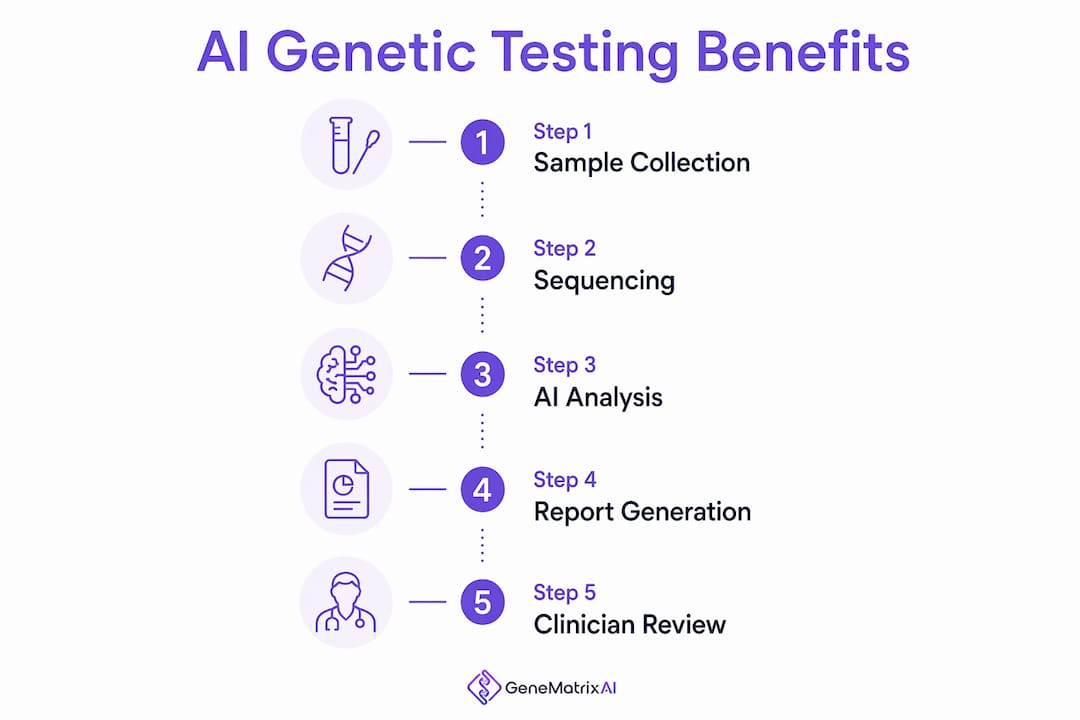
The workflow runs: at-home sample collection, sequencing, AI-assisted variant calling trained on a large genetic dataset, expert clinical review, and a delivered report with genetic counseling available. The 72-hour turnaround claim applies from sample receipt at the lab.
| Service element | Genematrix offering | Consumer expectation |
|---|---|---|
| Lab certification | CLIA-certified | Required for clinical-grade results |
| AI training dataset | 500,000+ profiles | Larger datasets improve risk calibration |
| Clinician review | Yes, on every report | Non-negotiable for clinical use |
| Turnaround | 72 hours from lab receipt | Faster than traditional 1–3 week timelines |
| Genetic counseling | Available | Should be included or clearly priced |
| Test scope | Cancer, PGx, mental health, pediatric, nutrition | Broad panel reduces need for multiple tests |
Pro Tip: Before purchasing, request a sample de-identified report and ask for a summary of the validation cohort used for the specific panel you are ordering. A provider confident in their accuracy will share both without hesitation.
What do AI-driven genetic tests cost, and does insurance cover them?
Pricing for AI-driven genetic tests in the U.S. varies by panel type and delivery model. Single-test hereditary cancer panels typically run in the range of a few hundred dollars out of pocket; comprehensive multi-panel subscriptions covering cancer, PGx, and wellness can run higher. Subscription models that bundle multiple test types often offer better per-test value than ordering individually.
Insurance coverage depends on medical necessity. Hereditary cancer testing (BRCA1/2, Lynch syndrome) is more likely to be covered when a physician orders it based on documented family history or clinical criteria. Pharmacogenomic testing coverage is expanding but remains inconsistent across payers. Direct-to-consumer orders without a physician referral are typically self-pay.
- Coverage is most reliable when: a physician orders the test, family history is documented, and the lab is CLIA-certified
- Out-of-pocket scenarios: consumer-initiated orders, wellness-focused panels, and nutrigenomics are rarely covered
- Turnaround note: "72 hours" typically means 72 hours from lab receipt of your sample, not from the day you mail it; add 2–5 business days for shipping
Pricing callout: Costs vary widely. Ask for an itemized price that includes the test, report access, and genetic counseling before you order. Hidden counseling fees can double the apparent cost of a low-priced panel.
What should you watch for in the near-term future of AI in medicine?
The next meaningful shift is active co-creation: AI models that adapt to your physiological data over time rather than producing a one-time static report. Wearable device data, repeat lab values, and updated family history will feed continuously learning models that refine risk estimates as your health picture changes.
Multi-agent AI systems are moving from sandboxed EHR simulations toward limited real-world pilots. A Nature study on the MIRA autonomous medical AI agent showed strong performance in simulated environments but flagged that safety and governance remain open questions for full deployment. Patients should treat any "autonomous AI diagnosis" claim with skepticism until prospective trial data exists.
What to watch for as a consumer: peer-reviewed validation results from prospective trials (not retrospective benchmarks), clearer FDA pathways for genomic AI, and improved explainability features that let you and your clinician understand exactly why a risk score landed where it did.
What are the ethical implications of predictive AI in genetic testing?
Predictive genetic information carries weight that a cholesterol result does not. Knowing you carry a BRCA2 pathogenic variant affects not just your own medical decisions but potentially your family members' choices, your insurance situation, and your psychological wellbeing. AI amplifies this by producing probabilistic risk scores that are easy to misread as certainties.
Three ethical tensions deserve attention. First, incidental findings: an AI model scanning your genome for cancer risk may flag variants linked to conditions you did not ask about. Providers should have a clear policy on whether and how they disclose these. Second, data ownership and secondary use: your raw genomic data is uniquely identifying and permanent. Understand exactly who can access it and for what purposes before you consent. Third, equity: as noted above, models trained on non-diverse datasets produce less reliable results for underrepresented populations, which risks widening health disparities rather than closing them.
Genetic counseling is not optional in this context. It is the mechanism by which a trained professional helps you interpret probabilistic AI output in the context of your actual life, family, and values.
How do leading AI genetic testing providers differ in 2026?
The market in 2026 divides roughly along three dimensions: test scope, validation rigor, and service model.
Test scope ranges from single-gene panels (BRCA1/2 only) to comprehensive multi-panel platforms covering hereditary cancer, pharmacogenomics, mental health, pediatric genetics, and nutrition. Broader scope is only an advantage if each panel is independently validated.
Validation rigor is where providers diverge most sharply. Some publish peer-reviewed accuracy data; others rely on internal white papers or FDA modification-pathway clearances that did not require new randomized trial data. The presence of a CLIA-certified lab and a stated training dataset size are the two fastest proxies for rigor when peer-reviewed data is not readily available.
Service model splits between one-time test purchases and subscription platforms that bundle multiple panels with ongoing report access, counseling, and app-based health management. Subscription models suit patients who want longitudinal tracking; single-test purchases suit those with a specific clinical question.
Genematrix sits in the comprehensive, subscription-capable tier: CLIA-certified, multi-panel, with clinician-validated reports and genetic counseling. For consumers comparing options, the role of genetic data in healthcare decisions is a useful frame for understanding what you actually need from a provider before choosing one.
Key Takeaways
AI-driven genetic testing delivers real clinical value in 2026, but only when CLIA certification, clinician review, a large validated dataset, and genetic counseling are all present.
| Point | Details |
|---|---|
| CLIA certification is non-negotiable | No CLIA certification means results cannot be used for clinical decisions. |
| Clinician review protects you | AI output without a licensed clinician sign-off is not a clinical-grade result. |
| Dataset size signals reliability | A training dataset of 500,000+ profiles is a meaningful threshold for risk-score calibration. |
| Genetic counseling is part of the test | Pre- and post-test counseling turns a probability score into a decision you can act on. |
| Genematrix covers the full checklist | CLIA-certified, 500,000+ profile training set, 72-hour clinician-validated reports, and counseling available. |
AI in genetic testing demands both optimism and precision
The promise here is genuine. Faster turnaround, more sensitive variant detection, and medication guidance personalized to your genotype are not hypothetical. The MASAI trial's 29% improvement in cancer detection is a randomized result, not a vendor claim. The 81% physician adoption figure reflects a real shift in how medicine is practiced.
What concerns me is the gap between what AI can do in a well-resourced, rigorously validated setting and what gets sold to consumers under the same "AI-powered" label. The FDA's modification-pathway problem means a device can carry regulatory authorization without ever being tested on a population that looks like the person buying it. That is not a reason to avoid AI-driven genetic testing. It is a reason to ask harder questions before you do.
Treat any AI genetic report as a conversation starter with a clinician, not a verdict. The technology is good enough to be genuinely useful. It is not yet good enough to be trusted without a human in the loop.
Genematrix offers CLIA-certified AI genetic testing with clinician-validated results
If you have a family history of cancer, are starting a new medication, or simply want a clearer picture of your genetic health, Genematrix delivers what the checklist above demands: a CLIA-certified lab, GeneMatrixAI trained on 500,000+ genetic profiles, clinician-validated reports within 72 hours, and genetic counseling built into the process.

The platform covers hereditary cancer (BRCA1/2, Lynch syndrome), pharmacogenomics, mental health, pediatric, and nutrition panels, all accessible through a single subscription or as individual tests. You get a report your doctor can actually use, not a wellness PDF with no clinical standing.
Order your hereditary cancer or PGx test and get clinician-validated results within 72 hours.
Useful sources and further reading
Use these sources to verify provider claims and go deeper on the evidence behind AI in medicine.
- Stanford HAI 2026 AI Index — Medicine: The most comprehensive annual snapshot of AI adoption, device authorizations, and evidence quality in healthcare; essential for understanding regulatory context.
- AI in Healthcare: Adoption & Outcomes 2026 (AI Index): Aggregates AMA physician survey data, FDA device counts, and trial results including the MASAI mammography study.
- Doximity State of AI in Medicine 2026: Physician-reported data on administrative burden reduction and clinical use cases; useful for understanding how clinicians actually use AI day to day.
- ARISE State of Clinical AI Report 2026: Calls for prospective, context-specific evaluations; the clearest articulation of what the evidence gap looks like and what good validation requires.
- Nature — Towards Autonomous Medical AI Agents (MIRA): Peer-reviewed study on autonomous AI agents in EHR simulations; important for understanding both the promise and the limits of agentic AI in medicine.
- American Academy of Arts and Sciences — The Future of AI-Facilitated Medicine: Authoritative long-form analysis of AI's potential to improve diagnostics, restore the patient-doctor relationship, and extend health span, alongside a frank accounting of bias, privacy, and regulatory risks.
- BCG — How AI Agents Will Transform Health Care 2026: Expert perspectives on AI agents, precision medicine, and the organizational changes health systems need to make AI work safely.
This article is general health information, not medical or genetic counseling advice. Confirm current testing options, coverage, and clinical relevance with a licensed clinician or certified genetic counselor for your specific situation.