

Most people with a family history of colorectal or endometrial cancer can get a full germline Lynch syndrome panel for $250–$500 out of pocket if they pay cash, or potentially nothing if their insurer covers it. Single-site cascade tests for relatives who already have a confirmed family variant run lower but vary widely in cost. Tumor tests like microsatellite instability (MSI) and immunohistochemistry (IHC) usually fall in the $300–$1,200 range depending on where they're performed.
Here's the insurance reality in plain terms:
- Germline panels ($250–$500 cash): Most U.S. private plans and Medicare cover these when clinical criteria are met, but prior authorization is almost always required.
- Tumor MSI/IHC tests ($300–$1,200): Often ordered by a pathologist at the time of surgery or biopsy; coverage is generally strong when medically indicated.
- Cascade/single-site tests ($100–$400): Usually covered for relatives once a pathogenic variant is confirmed in the family.
- Diagnostic vs. preventive billing matters enormously. If your colonoscopy or test is billed as diagnostic rather than preventive, cost-sharing applies even with good insurance.
Pro Tip: Before ordering any test, call your insurer and ask specifically whether the test will be processed as diagnostic or preventive — that single question can be the difference between a $0 and a $500 bill.
Key Takeaways
Lynch syndrome germline panels now cost $250–$500 at cash prices, most U.S. private insurers cover testing when clinical criteria are met, and single-site cascade tests for relatives cost as little as $100–$400.
| Point | Details |
|---|---|
| Germline panel cash price | Full five-gene Lynch panels typically run $250–$500 at self-pay rates. |
| Tumor testing cost | MSI and IHC tumor tests cost $300–$1,200 depending on facility and setting. |
| Insurance coverage | Most private plans and Medicare cover testing when prior authorization and medical necessity criteria are met. |
| Cascade testing savings | Relatives with a known family variant need only a single-site test at $100–$400, not a full panel. |
| Genematrix option | Genematrix offers a CLIA-certified 108-gene hereditary cancer panel with 72-hour turnaround and insurance submission support for eligible patients. |
Table of Contents
- How much does a Lynch syndrome test cost by test type?
- How does insurance cover Lynch syndrome testing?
- How do you actually get tested for Lynch syndrome?
- Who qualifies for Lynch syndrome testing?
- How can you lower your Lynch syndrome testing costs?
- What Genematrix offers for Lynch syndrome testing
- Why I think most people wait too long to get tested
- Genematrix makes Lynch syndrome testing accessible and fast
- Sources
How much does a Lynch syndrome test cost by test type?
Lynch syndrome diagnosis usually follows a sequence: tumor testing first, then reflex testing, then germline sequencing if needed. Each step has its own price tag and clinical purpose.
Tumor tests: MSI and IHC
Microsatellite instability (MSI) testing and immunohistochemistry (IHC) for mismatch repair (MMR) proteins are typically the first tests ordered, usually on a tumor sample already collected during surgery or biopsy. Tumor testing costs $300–$1,200 depending on whether it's done at an academic medical center, community hospital, or reference lab. IHC is often cheaper than MSI-PCR and gives directional information about which gene may be defective.
BRAF and MLH1-methylation reflex tests
When IHC shows loss of MLH1 protein, a BRAF V600E mutation test or MLH1 promoter methylation assay is often run next. These reflex tests help distinguish sporadic colorectal cancer (which is common and not hereditary) from true Lynch syndrome. Cash prices for BRAF reflex testing typically run $200–$300, and they're usually bundled into the tumor workup rather than billed separately to the patient.
Germline hereditary panels
If tumor testing suggests Lynch syndrome, the next step is a blood or saliva-based germline panel covering the five Lynch genes: MLH1, MSH2, MSH6, PMS2, and EPCAM. Cash prices for these panels now commonly fall in the $250–$500 range, a dramatic drop from the $3,000–$5,000 tests that were standard a decade ago. Broad direct-to-consumer panels that include Lynch genes have helped push prices down across the board.
For relatives of someone with a confirmed pathogenic variant, single-site testing (looking for only the known family mutation) costs $100–$400 — a fraction of a full panel.
Price summary by test type
| Test Type | Sample | Typical Cash Price | Clinical Purpose |
|---|---|---|---|
| MSI / IHC | Tumor tissue | $300–$1,200 | First-line tumor screening for Lynch |
| BRAF / MLH1 methylation | Tumor tissue | $200–$300 | Rules out sporadic MLH1 loss |
| Germline Lynch panel (5 genes) | Blood or saliva | $250–$500 | Confirms hereditary Lynch diagnosis |
| Single-site cascade test | Blood or saliva | $100–$400 | Tests relatives for known family variant |
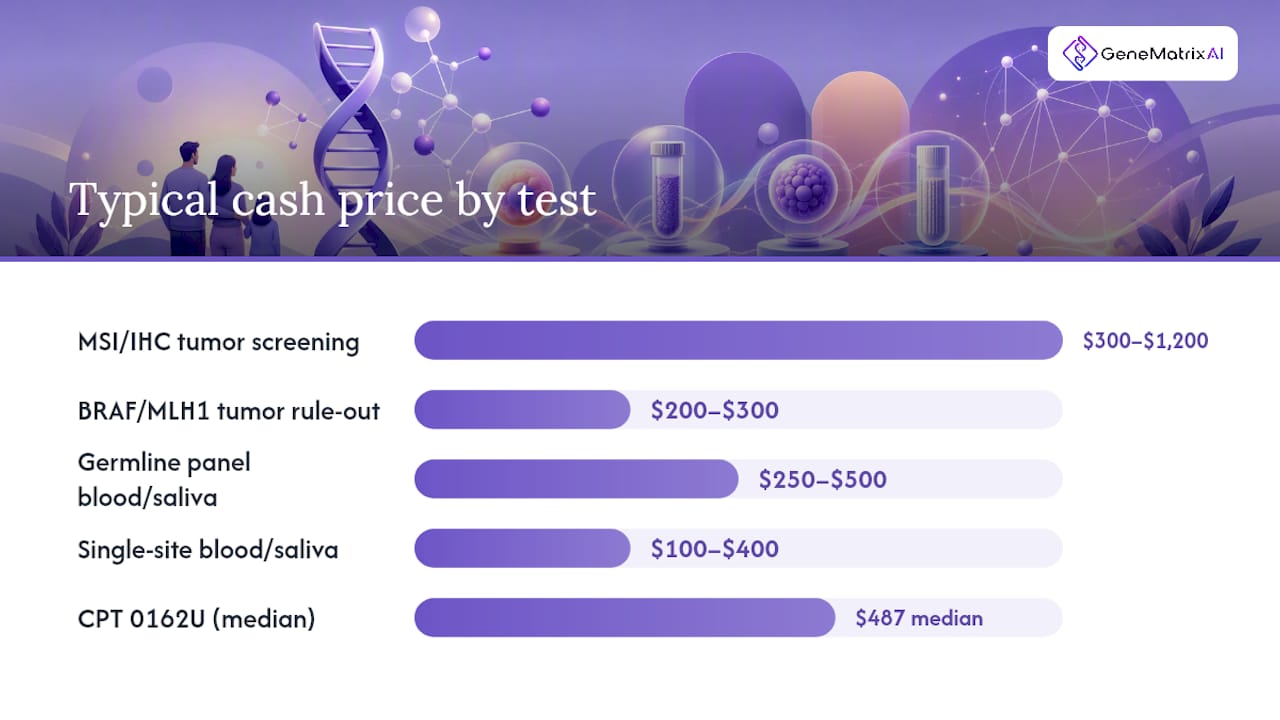
MedRates.fyi data for CPT code 0162U (a targeted Lynch mRNA sequence analysis panel) shows a median cash price around $487, with facility-level variation pushing some outliers above $1,900. That spread is a reminder that where you get tested matters as much as what you're testing for.
How does insurance cover Lynch syndrome testing?
Coverage exists, but it's conditional. Most private U.S. insurers cover Lynch syndrome genetic counseling and testing when a personal or family history meets clinical criteria, though prior authorization and plan-specific rules almost always apply.
What insurers typically require
- A personal history of colorectal, endometrial, or other Lynch-associated cancer, especially diagnosed before age 50
- A first- or second-degree relative with a confirmed Lynch pathogenic variant
- Tumor features (MSI-high or MMR-deficient IHC) that suggest hereditary risk
- A referral or order from a physician or genetic counselor, with documentation of medical necessity
- Prior authorization before the test is performed (skipping this step is the most common reason claims are denied)
ASCO's practice guidelines for gastrointestinal cancer inform how payers define medical necessity, so citing guideline alignment in your prior auth request strengthens the case.
Diagnostic vs. preventive billing
This distinction trips up a lot of patients. The same logic applies to some genetic tests: if you're being tested because of symptoms or a cancer diagnosis, expect diagnostic billing and the associated deductible or copay.
Medicare basics
Medicare Part B generally covers genetic counseling and testing for Lynch syndrome when a beneficiary has a personal or family history that meets criteria. Counseling is billed separately under its own CPT codes and may carry a 20% coinsurance after the Part B deductible.
Checklist for calling your insurer
Before you order any test, have these ready:
- CPT codes for the specific test (e.g., 81292 for MLH1 sequencing, 0162U for the Lynch panel)
- ICD-10 codes your physician plans to use (Z84.81 for family history of malignant neoplasm of digestive organs is commonly relevant)
- Ask: "Does this test require prior authorization?"
- Ask: "Will this be processed as diagnostic or preventive?"
- Ask: "Is this lab in-network for my plan?"
- Ask: "What is my current deductible status?"
Pro Tip: Request the prior authorization number in writing before your sample is collected. Labs can submit claims without it, but your insurer can deny the claim after the fact — leaving you with the full bill.
How do you actually get tested for Lynch syndrome?
The path from suspicion to results involves a few distinct steps, and knowing the sequence prevents delays and billing surprises.
Clinician-ordered vs. direct-to-consumer
Clinician-ordered testing is the standard route for anyone who wants insurance coverage. Your physician or genetic counselor orders the test, handles prior authorization, and receives the results to discuss with you. The lab bills your insurer directly. Direct-to-consumer (DTC) panels that include Lynch genes are available and cheaper upfront, but they don't support insurance billing, and a positive DTC result typically needs confirmatory clinical testing before any medical decisions are made.
For a deeper look at how labs process samples, this primer on genetic testing explains the mechanics without the jargon.
Sample types
- Tumor tissue: Formalin-fixed paraffin-embedded (FFPE) blocks from a prior surgery or biopsy; the pathology department retrieves these.
- Blood: Standard venipuncture; most germline panels accept blood.
- Saliva: Some labs accept a saliva kit mailed to your home, which works for germline testing but not tumor testing.
Step-by-step process
- Collect your family history (2–3 generations, cancer types, ages at diagnosis) — this is the raw material for any genetic counselor or physician assessment.
- Schedule a genetic counseling session — a counselor assesses your risk, helps determine which test is appropriate, and can initiate prior authorization. Genetic counseling is recommended as part of the standard diagnostic pathway.
- Obtain prior authorization from your insurer if required (allow 5–10 business days).
- Sample collection — blood draw at a clinic, saliva kit at home, or tumor tissue retrieval from pathology.
- Lab processing — germline panels typically return results in 2–4 weeks; some expedited panels run 5–10 business days.
- Post-test counseling — review results with your genetic counselor or physician, discuss implications for relatives, and plan next steps.
Who qualifies for Lynch syndrome testing?
Not everyone needs a full germline panel. These are the red flags that commonly meet clinical criteria for testing and support insurance coverage:
- Colorectal or endometrial cancer diagnosed before age 50
- Multiple Lynch-associated cancers (colorectal, endometrial, ovarian, gastric, urinary tract, small bowel) in the same person
- Two or more first-degree relatives with Lynch-associated cancers, regardless of age
- A first-degree relative with a confirmed Lynch pathogenic variant (this alone qualifies a person for single-site cascade testing)
- Tumor pathology showing MSI-high status or loss of MMR protein expression on IHC
Tumor features matter because they create a clinical bridge. An MSI-high result on a colorectal tumor is often what triggers a referral for germline testing, and it's the kind of documented finding that makes prior authorization approvals much smoother. Mayo Clinic's diagnostic pathway follows this sequence: tumor testing first, then reflex testing, then germline sequencing with genetic counseling at each stage.
Criteria vary by insurer, and some plans use proprietary coverage policies rather than published guidelines. A genetic counselor's documentation of your personal and family history is often the difference between an approved and a denied prior auth.
Pro Tip: If your tumor was tested for MSI or IHC as part of routine pathology (now standard practice for all colorectal cancers at many centers), ask your oncologist or pathologist for those results before scheduling a genetic counseling appointment. You may already have the key data that triggers germline testing coverage.
How can you lower your Lynch syndrome testing costs?
There are real, concrete options here, not just vague advice about "shopping around."
Cash prices and lab discounts
Ask the lab directly for a self-pay or cash price before ordering. Many reference labs offer discounted rates for uninsured patients that are significantly lower than their standard list prices. Some labs post these rates online; others require a phone call. The difference between the list price and the cash price can be several hundred dollars on a germline panel.
Financial assistance programs
- FORCE (Facing Our Risk of Cancer Empowered) maintains a resource list of financial assistance programs for hereditary cancer testing, including voucher programs and low-cost clinic referrals.
- University and academic medical center genetics clinics often offer sliding-scale fees or research-funded testing for patients who qualify.
- Lab patient-assistance programs: Several major reference labs have hardship programs for uninsured or underinsured patients. Ask the lab's billing department directly.
- State programs: Some state health departments fund hereditary cancer screening for qualifying residents; eligibility varies widely.
Advocacy organizations report that uninsured patients can often access testing for under $350 through voucher programs and university clinics.
Cascade testing savings for relatives
Once a pathogenic variant is confirmed in your family, relatives need only a single-site test, not a full panel. At $100–$400, that's a fraction of the full germline panel cost. Encourage first-degree relatives to get tested promptly — early knowledge changes surveillance schedules and can prevent cancer, not just detect it.

Surveillance cost management
Long-term surveillance is the largest ongoing expense for people with Lynch syndrome, not the initial test. Colonoscopies every 1–2 years add up fast. Using ambulatory surgery centers (ASCs) instead of hospital outpatient departments for colonoscopies typically reduces facility fees substantially. Ask your gastroenterologist whether an ASC is an option.
Questions to ask labs and insurers upfront
- "What is your cash/self-pay price for this test?"
- "Do you have a financial hardship or patient-assistance program?"
- "Can I get an itemized estimate before the test is performed?"
- "Is there a lower-cost panel that still covers the five Lynch genes?"
What Genematrix offers for Lynch syndrome testing
Genematrix is a Chicago-based, CLIA-certified biotechnology company. CLIA certification means the lab meets federal standards for accuracy, personnel, and quality control — the same standard required of hospital reference labs.
The Hereditary Cancer Screening panel covers 108 genes, including all five Lynch syndrome genes (MLH1, MSH2, MSH6, PMS2, and EPCAM), along with BRCA1, BRCA2, and dozens of other hereditary cancer risk genes. Results are analyzed through the GeneMatrixAI platform, trained on more than 500,000 genetic profiles, and delivered as a clinician-validated report.
Key details for readers evaluating Genematrix:
- Turnaround: Results delivered within 72 hours for eligible tests, faster than the 2–4 week standard for many clinical labs.
- Sample collection: At-home saliva kit for germline testing, with no clinic visit required for the collection step.
- Genetic counseling: Pre- and post-test counseling support is available, consistent with standard diagnostic pathway recommendations.
- Insurance submission: Available when testing is clinically indicated and ordered through a physician.
- Self-pay option: Direct-to-consumer ordering is available for those who prefer not to go through insurance.
- Data privacy: Reports are HIPAA-compliant; raw data is not sold to third parties.
For a full breakdown of what the report includes and how clinician validation works, the hereditary cancer testing overview covers the specifics.
Before ordering, prepare your three-generation family history, note any prior cancer diagnoses and ages, and gather any existing tumor pathology reports. That information shapes which test module fits your situation and supports any insurance submission.
Why I think most people wait too long to get tested
The cost conversation is real, but the bigger problem is that most people with a family history that clearly meets testing criteria never get referred at all. Research on physician barriers to Lynch syndrome testing shows that streamlined ordering pathways and education make a measurable difference in testing rates — which means the gap isn't always about patient reluctance or cost.
Here's what I'd tell anyone sitting on the fence: the one-time cost of a germline panel, even at full cash price, is almost always less than a single colonoscopy. And if you have Lynch syndrome and don't know it, you're likely missing the surveillance schedule that catches cancers at stage I instead of stage III. The math on early detection is not subtle.
Genetic counseling matters here too, not just for interpreting results but for helping you communicate findings to siblings and children who may also qualify for cascade testing. A counselor can also help you frame the conversation with your insurer if prior authorization is denied on the first attempt.
The cost is manageable. The window for acting on a family history is not infinite.
Genematrix makes Lynch syndrome testing accessible and fast
If you've read this far and you're ready to act, Genematrix offers something most clinical labs don't: a 72-hour turnaround on a CLIA-certified, 108-gene hereditary cancer panel that covers every Lynch syndrome gene, delivered through an at-home saliva kit with no clinic visit required for sample collection.

The GeneMatrixAI platform analyzes your results against more than 500,000 genetic profiles and produces a clinician-validated report you can share directly with your physician or genetic counselor. For patients ordering through a clinician, insurance submission is available when medically indicated. For those who prefer a direct path, self-pay ordering is straightforward online.
Visit the Hereditary Cancer Screening page to review the 108-gene panel, see what's included in the report, and start your order. If you want to understand Genematrix's lab standards and AI platform before ordering, the science overview covers CLIA certification, platform methodology, and accuracy benchmarks.
Sources
These are the primary sources used to build this guide, each worth bookmarking for your own research:
- Genetic Testing – Fight Lynch Syndrome
- Lynch Syndrome Screening Cost: Genetic Testing, Surveillance, and What Insurance Pays — Colonoscopy Cost Guide
- Lynch syndrome - Facts, Resources, Support
This article is general information, not a substitute for advice from a qualified doctor. Consult a qualified healthcare professional about your own circumstances before acting on anything here.