

TL;DR:
- Lynch syndrome is a hereditary condition caused by mismatch repair gene mutations, leading to a high lifetime risk of multiple cancers. Early detection through genetic screening and enhanced surveillance significantly improves survival outcomes and allows for preventive care. Broader testing methods now identify more carriers, even without traditional family cancer history, enabling proactive management.
Lynch syndrome is defined as an inherited genetic condition caused by mutations in mismatch repair (MMR) genes that dramatically raise a person's lifetime risk of colorectal, endometrial, and several other cancers. Understanding why screen for Lynch syndrome matters starts with one fact: carriers face up to a 60% lifetime risk of colorectal cancer, compared to roughly 4% in the general population. That gap is not a statistical footnote. It is the difference between catching a cancer early and facing a late-stage diagnosis. Genetic screening identifies carriers before cancer develops, giving them the chance to act on that knowledge through surveillance, preventive care, and informed family planning.
Why screen for Lynch syndrome when general cancer screening exists?

Standard colorectal cancer screening is designed for average-risk adults. Lynch syndrome carriers are not average-risk adults. Men with Lynch syndrome face a 20–74% lifetime colorectal cancer risk depending on which MMR gene is mutated. Women face a 20–52% colorectal risk and up to 60% endometrial cancer risk, compared to a 2.8–3% general population rate. Those numbers make standard screening schedules dangerously inadequate for carriers.
Cancer also behaves differently in Lynch syndrome. Tumors can develop at younger ages, often before 50, and progress faster than sporadic colorectal cancers. A routine colonoscopy every ten years, appropriate for a 55-year-old with no family history, leaves a Lynch carrier exposed for years between screenings.
Specialized protocols change that outcome. Carriers who follow enhanced surveillance schedules see colonoscopies every 1–2 years, starting as early as age 25. That frequency allows clinicians to find and remove pre-cancerous polyps before they become invasive cancers. The survival benefit is direct and measurable.
Key cancer risks for Lynch syndrome carriers include:
- Colorectal cancer: 20–74% lifetime risk (men), 20–52% (women)
- Endometrial cancer: up to 60% lifetime risk in women
- Ovarian cancer: elevated above general population rates
- Gastric and urinary tract cancers: associated with specific MMR gene mutations
- Small bowel cancer: rare in the general population but elevated in carriers
How is Lynch syndrome screening done?
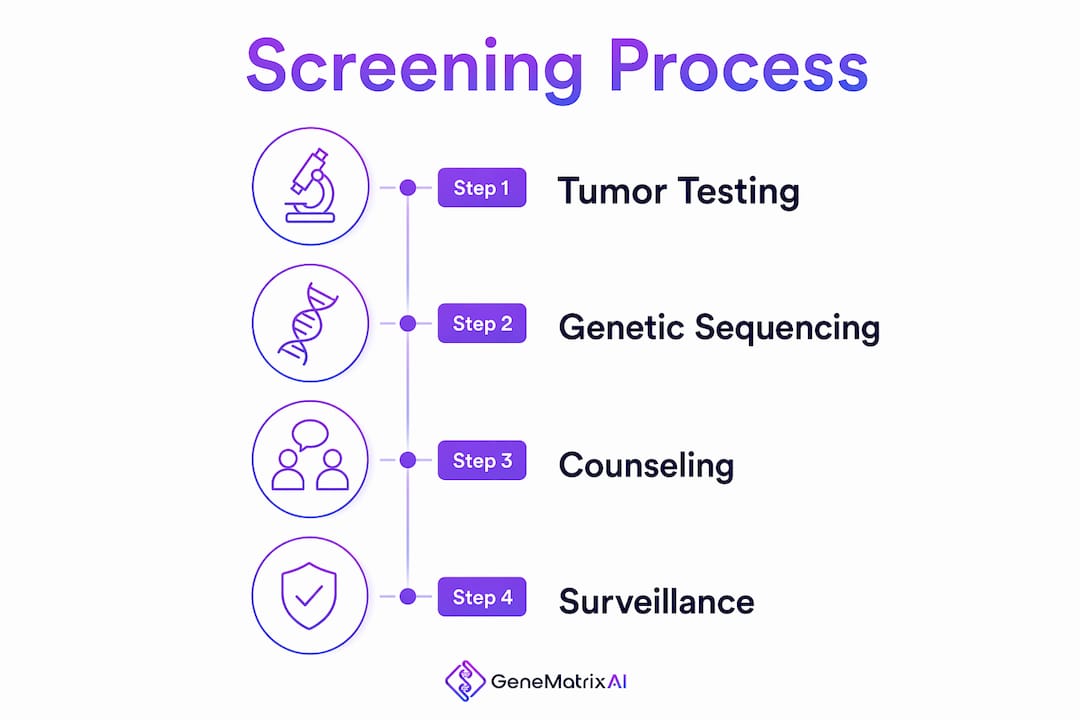
The Lynch syndrome genetic screening process involves two distinct phases: confirming the diagnosis through genetic testing, and then following a structured surveillance protocol based on the mutation identified.
Confirming the diagnosis
Genetic testing for Lynch syndrome typically begins with tumor-based methods. Immunohistochemistry (IHC) and microsatellite instability (MSI) testing examine tumor tissue for signs of MMR gene dysfunction. These tests are often performed on colorectal or endometrial tumor samples as a first step. When clinical suspicion is strong or tumor tissue is unavailable, germline testing confirms the diagnosis directly by analyzing a blood or saliva sample for inherited MMR mutations in genes including MLH1, MSH2, MSH6, and PMS2.
Next-generation sequencing (NGS) has made germline testing faster and more thorough. A single NGS panel can screen all four major MMR genes simultaneously, identifying mutations that older single-gene tests might miss.
The surveillance schedule for carriers
Once a mutation is confirmed, the surveillance protocol is specific to the gene involved. The general framework looks like this:
- Colonoscopy every 1–2 years, beginning at age 25–30 for MLH1 and MSH2 carriers, or age 30–35 for MSH6 and PMS2 carriers.
- Annual endometrial biopsy and transvaginal ultrasound for women, typically starting between ages 30 and 35.
- Annual urinalysis to screen for urinary tract cancers, particularly for MSH2 carriers.
- Upper GI endoscopy every 2–3 years for carriers with elevated gastric cancer risk, especially those with relevant family history.
- Discussion of risk-reducing surgery, including prophylactic hysterectomy and salpingo-oophorectomy for women who have completed childbearing.
Pro Tip: Ask your genetic counselor which specific MMR gene mutation you carry before scheduling surveillance. The protocol for an MLH1 carrier differs meaningfully from that for an MSH6 carrier, and starting at the wrong age or interval can leave gaps in protection.
Who should consider Lynch syndrome genetic screening?
Approximately 1 in 270 people carry a Lynch syndrome mutation. That prevalence makes it one of the most common hereditary cancer syndromes. Yet most carriers remain undiagnosed, often because they do not fit the traditional profile of someone with a strong family cancer history.
Historically, clinicians used criteria like the Amsterdam Criteria or Bethesda Guidelines to identify candidates for testing. These tools relied heavily on documented family cancer patterns across multiple generations. The problem is that family history is an unreliable filter. More than 60% of Lynch syndrome carriers do not show a classic family cancer history. Relying solely on family history to decide who gets tested means the majority of carriers are never identified.
Identifying Lynch syndrome risk now requires a broader lens. Consider genetic testing if any of the following apply:
- A personal diagnosis of colorectal or endometrial cancer before age 50
- A first-degree relative diagnosed with a Lynch-associated cancer at any age
- A personal or family history of multiple Lynch-associated cancers
- A tumor that tested positive for MSI or showed absent MMR protein expression on IHC
- A family member already confirmed to carry an MMR gene mutation
The last point connects to cascade testing, which is the practice of testing relatives after one family member is confirmed positive. Each first-degree relative of a confirmed carrier has a 50% chance of carrying the same mutation. Cascade testing through family genetic testing is one of the highest-yield interventions in hereditary cancer medicine. One confirmed diagnosis can protect an entire family.
What are the real benefits and challenges of Lynch syndrome screening?
Screening for Lynch syndrome delivers a concrete survival advantage. Carriers who follow structured surveillance protocols catch cancers at earlier, more treatable stages. Lifelong surveillance, including high-frequency colonoscopies, dramatically improves outcomes compared to no monitoring. Beyond detection, preventive strategies like daily aspirin use have shown promise in reducing cancer risk for Lynch syndrome individuals, adding another layer of protection alongside surveillance.
Screening is not without complexity. Genetic tests sometimes return a "variant of uncertain significance," or VUS. A VUS result means a gene change was detected but its effect on cancer risk is not yet established. Clinical decisions should not be based on a VUS alone, and cascade family testing is generally not recommended until the variant is reclassified. This is exactly why working with a genetic counselor matters. A counselor interprets results in the context of personal and family history, preventing both under-reaction and unnecessary alarm.
The emotional dimension is real. Learning you carry a Lynch mutation changes how you think about your health and your children's health. That weight is manageable with the right support. Genetic counseling provides both the clinical interpretation and the emotional framework to make informed decisions without panic.
Pro Tip: Request a copy of your full genetic report, not just a summary. Knowing the exact mutation and gene involved gives every future clinician the information they need to tailor your care correctly.
How are screening guidelines evolving in 2026?
The field has moved decisively away from family-history-only criteria. Next-generation sequencing now makes it practical to screen broader populations for Lynch syndrome mutations at lower cost and higher throughput than was possible a decade ago. Research published in 2026 confirms that NGS-based approaches identify carriers who would have been missed entirely under older diagnostic frameworks.
The shift matters because early detection rates improve when the net is cast wider. Universal tumor screening, where every colorectal and endometrial cancer is reflexively tested for MMR deficiency, is now standard practice in many major cancer centers. That policy catches Lynch syndrome cases regardless of age, family history, or clinical suspicion.
| Approach | Who it reaches | Key limitation |
|---|---|---|
| Family history criteria | Families with documented cancer patterns | Misses 60%+ of carriers |
| Universal tumor screening | All colorectal and endometrial cancer patients | Requires a cancer diagnosis first |
| Population-level NGS | Broader at-risk populations | Still expanding in clinical practice |
The direction is clear. Broader, earlier, and more inclusive testing identifies more carriers at the stage when surveillance can prevent cancer rather than just detect it.
Key Takeaways
Lynch syndrome screening saves lives by identifying high-risk carriers early enough to prevent cancer through structured surveillance, cascade family testing, and targeted preventive care.
| Point | Details |
|---|---|
| Elevated cancer risk | Lynch syndrome carriers face up to 60% lifetime colorectal cancer risk versus 4% in the general population. |
| Early and frequent surveillance | Colonoscopies every 1–2 years starting at age 25–35 are the foundation of Lynch syndrome management. |
| Most carriers lack family history | Over 60% of carriers show no classic family cancer pattern, making broader genetic testing critical. |
| Cascade testing protects families | Each first-degree relative has a 50% chance of carrying the mutation and deserves the option to test. |
| Lifelong commitment required | Lynch syndrome screening is ongoing surveillance, not a single test, and consistent follow-through drives survival benefit. |
Screening knowledge changes the outcome
I have spent years working at the intersection of genetics and cancer prevention, and the pattern I keep seeing is the same: people who learn about Lynch syndrome after a diagnosis wish they had known sooner. The ones who learn before a diagnosis have a fundamentally different experience. They are not reacting to cancer. They are staying ahead of it.
What strikes me most is how many people assume that no family history means no risk. That assumption is wrong, and the data backs it up. Most carriers I encounter had no idea they were at elevated risk until a genetic test said otherwise. The absence of a family cancer story is not reassurance. It is often just a gap in information.
The other thing I want people to understand is that a positive result is not a sentence. It is a map. Knowing you carry an MMR mutation tells you exactly where to focus your surveillance, which preventive options to consider, and which family members to alert. That knowledge is protective, not paralyzing. The people who do worst with a Lynch diagnosis are the ones who stop at the test and never build a surveillance plan around it.
If you are on the fence about testing, talk to a genetic counselor first. Not after you get results. Before. Understanding what the test can and cannot tell you makes the entire process less frightening and more useful.
— Tarek
Genematrix and hereditary cancer risk assessment
Genematrix is a CLIA-certified biotechnology company based in Chicago that specializes in AI-powered hereditary cancer screening, including comprehensive Lynch syndrome gene panels covering MLH1, MSH2, MSH6, and PMS2. The GeneMatrixAI platform delivers results within 72 hours, with analysis trained on more than 500,000 genetic profiles.

For families navigating cascade testing, Genematrix supports coordinated testing across relatives with clear, clinician-ready reports. The GeneCancer testing module covers Lynch syndrome alongside BRCA1, BRCA2, and other hereditary cancer genes, giving patients and their physicians a complete picture of inherited risk. If you are ready to move from uncertainty to a clear risk profile, Genematrix provides the science and the support to get there.
FAQ
What is Lynch syndrome and why does it increase cancer risk?
Lynch syndrome is an inherited condition caused by mutations in mismatch repair genes, which normally fix DNA copying errors. When these genes malfunction, DNA errors accumulate and cancer risk rises sharply.
At what age should Lynch syndrome screening begin?
Screening typically begins between ages 25 and 35, depending on which MMR gene mutation is present. MLH1 and MSH2 carriers generally start earlier than MSH6 and PMS2 carriers.
Can I have Lynch syndrome without a family history of cancer?
Yes. More than 60% of Lynch syndrome carriers do not have a classic family cancer history, which is why family history alone is an unreliable screening tool.
What does a variant of uncertain significance mean in Lynch syndrome testing?
A VUS means a gene change was detected but its effect on cancer risk is not yet established. Clinical management decisions should not be based on a VUS result alone, and expert genetic counseling is required to interpret it correctly.
How does cascade testing work for Lynch syndrome families?
When one family member tests positive for a Lynch mutation, first-degree relatives are offered targeted testing for that specific mutation. Each relative has a 50% chance of carrying it, and those who test positive can immediately begin surveillance.