

TL;DR:
- Modern genetic reports analyze thousands of genes with advanced, faster sequencing technologies.
- Variants are classified into five categories; only Pathogenic and Likely Pathogenic require immediate action.
- Reports should be revisited periodically as scientific knowledge and variant classifications evolve.
Getting your genetic report back should feel empowering. Instead, most people stare at pages of variant classifications, gene names, and probability scores with no clear idea what to do next. The confusion is real, and it's not your fault. These reports have grown dramatically in scope and complexity over the past decade, and the gap between raw data and real-world decisions is wide. This guide cuts through that noise. We'll walk you through how modern reports work, what each result category actually means, how pharmacogenomics can change your prescriptions, and where the real limits lie.
Table of Contents
- What makes next-generation genetic reports different?
- How to interpret risk and result categories
- Medication optimization and pharmacogenomics (PGx) in your report
- Nuances, limitations, and common misunderstandings
- Our perspective: The real value and real risks of next-gen genetic reports
- Next steps: Unlocking actionable insights with Gene Matrix
- Frequently asked questions
Key Takeaways
| Point | Details |
|---|---|
| Understand result categories | Your report’s categories—pathogenic, likely benign, VUS—dictate next steps and need careful interpretation. |
| Medication guidance is powerful | Many reports show how you respond to dozens of medications for safer, personalized care. |
| Expert review reduces risk | Consulting a professional and reanalyzing results over time ensures you benefit from new discoveries. |
| Limitations exist | Technical limits and population biases mean no report is perfect—context matters for every result. |
What makes next-generation genetic reports different?
A decade ago, most genetic tests examined one gene at a time. A physician would order a BRCA1 or BRCA2 test, and you'd receive a narrow, focused result. Today's next-generation sequencing (NGS) panels examine hundreds to thousands of genes simultaneously, and some reports now cover your entire exome or genome. That's a fundamental shift in what's possible and what's delivered to you.
The technology powering these reports has also advanced quickly. Short-read NGS platforms like Illumina with DRAGEN processing deliver high accuracy for SNVs and indels at depths above 60x coverage, while long-read platforms like PacBio and Oxford Nanopore are better at detecting structural variants, larger rearrangements that older methods often missed entirely. Accelerated pipelines now process raw sequencing data 17 to 33 times faster than older workflows, which means you can receive clinically actionable results within days rather than weeks.
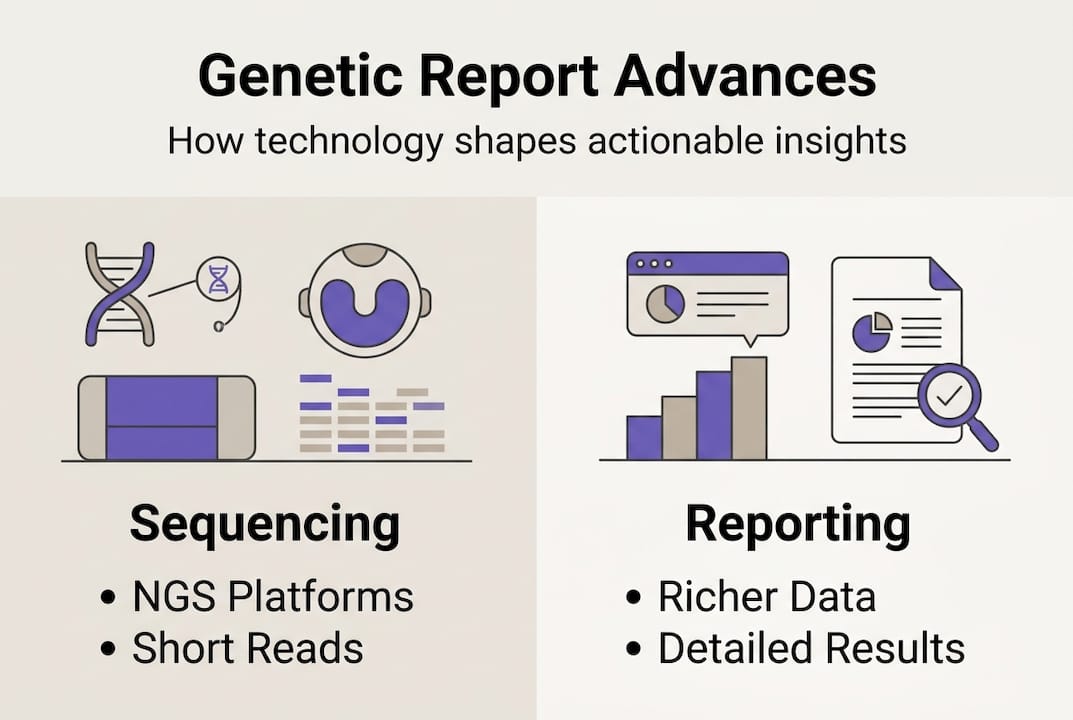
These improvements in genetic testing impact translate directly into richer, more detailed reports. But more data requires more interpretation, which is exactly where most patients get lost.
| Feature | Traditional single-gene tests | Next-gen panel/exome/genome |
|---|---|---|
| Genes analyzed | 1 to 5 | Hundreds to 20,000+ |
| Structural variant detection | Limited | Improved (especially long-read) |
| Medication guidance | Rarely included | Often integrated (PGx) |
| Report turnaround | Weeks | Days (accelerated pipelines) |
| Incidental findings | None | Possible |
Key features you'll find in a modern next-gen report:
- Actionable cancer risk scores tied to specific gene variants and population-level data
- Pharmacogenomic (PGx) guidance showing how your body processes specific medications
- Family implication flags that indicate which relatives might benefit from testing
- Variant classifications using standardized ACMG (American College of Medical Genetics) categories
- AI in genomics analysis that compares your results against large-scale reference populations
Pro Tip: Always confirm surprising or actionable findings with a certified genetic counselor before making any health decisions. A pathogenic result in isolation is not a treatment plan.
For clinicians and patients alike, precision medicine guidance increasingly emphasizes that results should be interpreted within a full clinical and family history context, not read in isolation.
How to interpret risk and result categories
Every next-gen report uses a standardized classification system developed by the ACMG. Once you understand these five categories, the report becomes far less intimidating. Most of the anxiety people experience comes from misreading a result or not knowing what each label actually requires you to do.
Reports classify variants per ACMG guidelines into five categories: Pathogenic and Likely Pathogenic (these indicate actionable risk), Benign and Likely Benign (no clinical action needed), and Variant of Uncertain Significance or VUS (uncertain meaning, roughly 40% of results in hereditary cancer panels fall here).
| Classification | Confidence level | Clinical action |
|---|---|---|
| Pathogenic | Very high | Act: consult specialist, consider surveillance or prevention |
| Likely Pathogenic | High | Act: treat similarly to Pathogenic |
| VUS | Uncertain | Wait: do not change health management |
| Likely Benign | High | No action needed |
| Benign | Very high | No action needed |
Steps to take based on your result type:
- Pathogenic or Likely Pathogenic: Schedule an appointment with a genetic counselor or specialist immediately. Discuss screening protocols, preventive options, and family testing.
- VUS: Document the finding, revisit it annually, and watch for VUS reclassification insights as new evidence emerges.
- Likely Benign or Benign: Note the finding for your records but take no clinical action. It does not indicate elevated risk.
- Multiple results of different types: Prioritize Pathogenic findings. Discuss the full picture with your care team, especially when genetic testing for prevention is part of your family's broader health strategy.
- Any result affecting relatives: Share relevant findings with first-degree family members and discuss whether cascade testing, meaning testing specific relatives, makes sense for your situation. This is a core part of family test tips that many families overlook.
Pro Tip: A VUS is not a risk finding. Do not alter medical management, start new surveillance, or make major health decisions based on a VUS result alone.
"Genetic reports are living documents. A VUS today may be reclassified as Pathogenic or Benign within two to five years as scientific evidence accumulates. Annual reanalysis of uncertain findings is increasingly considered best practice."
Medication optimization and pharmacogenomics (PGx) in your report
Beyond risk scores, your report can illuminate how you respond to medications. This is where pharmacogenomics, commonly abbreviated as PGx, enters the picture. PGx examines how specific gene variants affect the way your body absorbs, processes, and eliminates drugs. It's one of the most immediately actionable sections of a modern genetic report, and it's often the most overlooked.

PGx reports detail response to 100+ drugs, covering gene-drug pairs that affect everything from chemotherapy toxicity to antidepressant effectiveness. Variants in genes like CYP2D6, DPYD, and UGT1A1 directly influence how your body handles specific medications, sometimes with life-altering consequences.
| Gene | Affected drug(s) | Clinical impact |
|---|---|---|
| DPYD | Fluorouracil (5-FU) | Severe toxicity risk in poor metabolizers |
| CYP2D6 | Codeine, tamoxifen | Ineffectiveness or dangerous accumulation |
| UGT1A1 | Irinotecan | Increased toxicity in reduced-function variants |
| CYP2C19 | Clopidogrel, PPIs | Reduced drug activation or altered dosing needs |
| TPMT | Azathioprine | Severe bone marrow suppression risk |
A striking 99% of people carry at least one actionable medication-related variant. Most have no idea. This is not a rare edge case; it's the baseline human condition. Your personalized medication insights are embedded in your DNA, waiting to inform safer prescribing.
How to put your PGx results to work:
- Bring your PGx report to every doctor appointment, especially before starting a new prescription
- Update your pharmacy records so your pharmacist can flag interactions automatically
- Ask your physician specifically about drugs known to interact with your identified variants
- Consider the wellness impact for family members who may share the same variants and face similar medication risks
- Request a PGx-aware formulary review if you're currently on multiple medications
PGx is not theoretical. Patients with DPYD variants who receive standard fluorouracil chemotherapy doses face severe, sometimes fatal toxicity. Knowing your variant in advance changes the prescribing calculus entirely.
Nuances, limitations, and common misunderstandings
While these advancements are powerful, it's vital to recognize their boundaries. The most dangerous moment in genetic testing is not receiving a bad result. It's misunderstanding a good one.
Key limitations to keep in mind when reading your report include reporting nuances around VUS uncertainty, the need for periodic reanalysis, ancestry bias in reference databases, incomplete penetrance (meaning a pathogenic variant doesn't guarantee disease), and technical gaps where short-read sequencing can miss large structural variants.
Common misconceptions that can genuinely mislead:
- "A VUS means I have elevated risk." It does not. VUS means science doesn't yet have enough evidence to classify it either way.
- "A negative result means I'm safe." Negative means no variants were detected in the genes tested, not that no genetic risk exists.
- "My result applies fully to my child." Penetrance and environmental factors mean a variant's effect can vary significantly between family members.
- "The report covers my whole genome." Most panels test specific gene sets. Even exomes miss some intronic and regulatory regions that whole-genome sequencing would detect.
- "I only need one test, ever." Science evolves. Reclassifications happen. Following genetic screening steps includes planning for updates.
"A genetic report is a snapshot of current scientific knowledge applied to your DNA. As knowledge grows, what was uncertain yesterday may become clearly actionable tomorrow. This is why interpretation should never be a one-time event."
Understanding the technical constraints in reports also matters for realistic expectations. Short-read platforms excel at common variant detection but can struggle with repeat regions and large deletions. Long-read platforms are improving, but access and cost remain barriers for many patients.
Pro Tip: Always discuss your results with a genetic counselor, particularly before making decisions about family planning, prophylactic surgery, or major screening changes. The report is the starting point, not the final answer.
Our perspective: The real value and real risks of next-gen genetic reports
Having worked at the intersection of AI and genomics, we've seen what happens when people treat a genetic report as a verdict rather than a tool. The data is extraordinary. But data without context is noise.
The uncomfortable truth about next-gen reports is this: they're not self-interpreting. A pathogenic BRCA2 variant means something very different for a 28-year-old woman with a strong family history versus a 70-year-old man with no family history of cancer. The variant is the same. The clinical meaning is not. Overreliance on a single result, without ongoing care and reanalysis, is one of the most common ways genetic information gets misapplied.
What we believe, based on real-world experience with thousands of reports, is that value comes from iteration. Reports should be treated as living documents. As AI genomics platforms grow more sophisticated and reference databases expand, findings that were once uncertain will be reclassified. The families who benefit most from genetic testing are those who stay engaged with their results over time, not those who file the report away after the first read.
Next-gen genetic reports can genuinely change outcomes. But only when used correctly, with professional guidance and realistic expectations.
Next steps: Unlocking actionable insights with Gene Matrix
Understanding your genetic report is the first step. Acting on it intelligently is the next. At Gene Matrix, we built our platform specifically to close the gap between raw genomic data and real clinical decisions.

Our genetic testing science combines CLIA-certified laboratory precision with AI analysis trained on over 500,000 genetic profiles, delivering structured, clinician-ready reports within 72 hours. Whether you're exploring hereditary cancer risk, PGx-guided medication optimization, or whole-family screening, our team is ready to help. Reach out through our connect with providers portal to discuss testing options tailored to your clinical needs. Proactive genomic insight is not a luxury. It's the foundation of modern preventive care.
Frequently asked questions
What should I do if my report shows a Variant of Uncertain Significance (VUS)?
Do not make medical changes based on a VUS. A VUS means evidence is insufficient to classify the variant, and proactive reanalysis over time often leads to reclassification, so consult a genetics expert and plan to revisit the finding periodically.
How does pharmacogenomic information affect my prescription drugs?
PGx findings can reveal whether you metabolize certain drugs faster, slower, or not at all, which directly guides safer and more effective prescribing. Discuss your response to 100+ drugs report section with your prescribing physician before starting any new medication.
Can a 'negative' result guarantee I'm not at genetic risk?
No. A negative result confirms no variants were detected in the tested genes, but technical limits mean some variants, especially structural ones, may go undetected, and not all risk-related genes may be included in your panel.
How often should genetic reports be reanalyzed?
Periodic reanalysis is recommended as scientific evidence grows. NCCN guidelines support regular review, particularly for VUS findings, since reclassification rates have increased significantly with newer criteria and larger population datasets.