

Integrate PGx reports as discrete phenotype and diplotype data, then wire that data to clinical decision support and pharmacist workflows. That single change turns pharmacogenomics from an archived PDF into a live medication safety signal at the point of prescribing. PGx report integration into pharmacy records only produces clinical value when the result is computable, not when it merely exists somewhere in a chart.
Three moves get you there fastest:
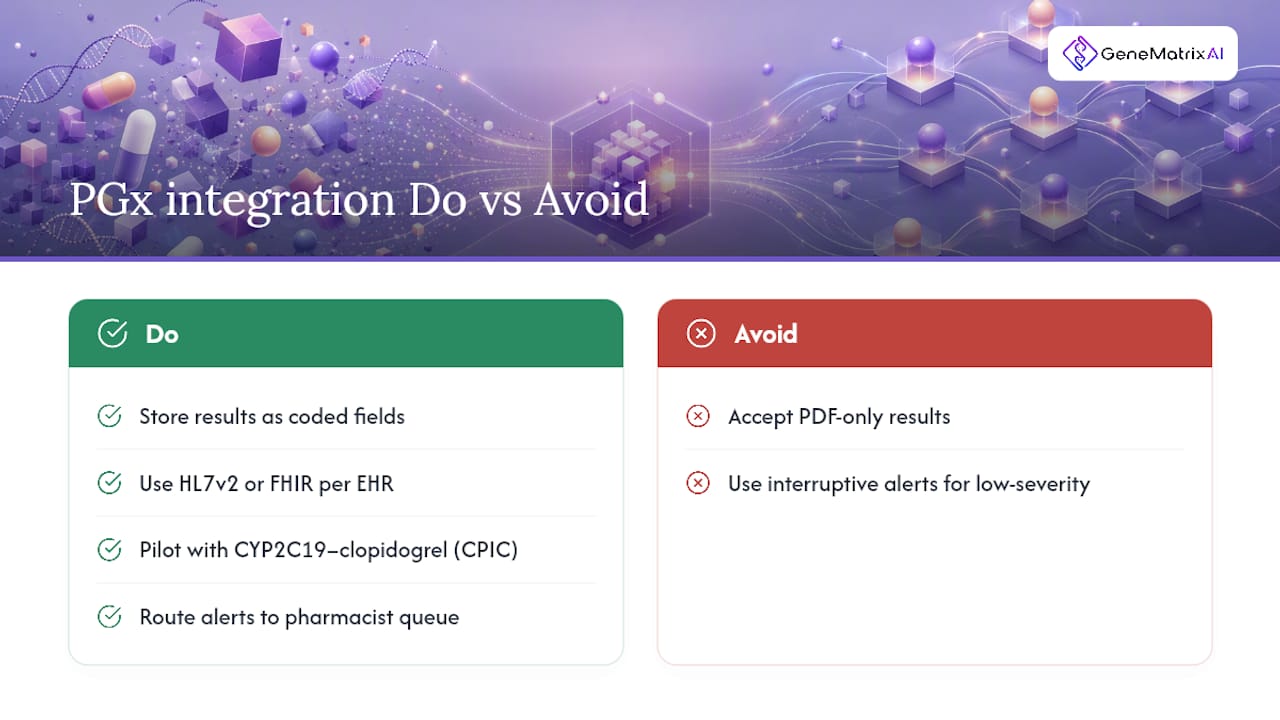
- Confirm the lab sends discrete output. Require LOINC-coded interpretations delivered through HL7v2 or FHIR, not a scanned PDF.
- Define your EHR result components. Build (or activate) genomics module fields that can hold a CPIC phenotype string, not free text.
- Build a pharmacist override workflow. Every interruptive alert needs a human safety net with documented authority to act.
One data point should settle any hesitation about urgency: integrating PGx results into medication therapy management tools and point-of-sale alerts found that 95% of patients on cardiovascular medications had an actionable, PGx-identified medication problem. HL7's genomics reporting guidance and CPIC's phenotype standards already exist to make this discrete; the gap is almost always operational, not scientific.
Key Takeaways
Discrete PGx data, mapped to CPIC phenotype terms and LOINC codes and routed through a pharmacist-owned CDS workflow, is what converts genetic testing into measurable medication safety.
| Point | Details |
|---|---|
| Require discrete lab output | Insist on HL7v2 or FHIR delivery with LOINC codes; reject PDF-only reporting from any lab vendor. |
| Standardize on phenotype terms | Pair every LOINC interpretation code with a CPIC-standard phenotype string for stable CDS rules. |
| Route alerts to pharmacists | Give pharmacists CPA authority and a dedicated queue so alerts translate into medication changes. |
| Pilot one gene-drug pair first | Start narrow (CYP2C19-clopidogrel is common) and track acceptance and modification rates before scaling. |
| Vet lab partners on deliverables | Gene Matrix's CLIA-certified GenePGx module offers sample payloads, LOINC mappings, and 72-hour turnaround for pilot planning. |
Table of Contents
- What Do You Need to Scope a PGx Integration Project?
- Which Standards Should Structure Your PGx Data?
- How Do You Map Lab Results Into the EHR and Trigger CDS?
- Who Should Own Ordering, Consent, and Alert Response?
- How Should You Pilot and Validate a PGx Integration?
- What Actually Blocks PGx Integration, and How Do You Fix It?
- What Should You Ask a PGx Lab Partner to Prove?
- Why the Standards Debate Misses the Real Problem
- Getting Started With Gene Matrix on a PGx Pilot
- Frequently Asked Questions
- Sources
What Do You Need to Scope a PGx Integration Project?
Before any interface gets built, get the right people in a room and get the lab contract right. Skipping this step is the single most common reason PGx integration projects stall after the pilot phase.
Start with governance. You need representation from Pharmacy and Therapeutics (P&T), legal and compliance, clinical informatics, the reference lab, and pharmacy operational leadership. Each group owns a different failure mode: P&T owns clinical appropriateness, legal owns consent and liability, informatics owns the pipe, and the lab owns whether you get usable data in the first place.
- Lock lab deliverables into the contract. Require discrete LOINC and FHIR-formatted outputs, plus sample payloads, before signing. A PDF-only result is a stranded clinical asset no matter how good the underlying science is.
- Confirm infrastructure exists. You need an interface engine, EHR result components or a genomics module, and a dedicated pharmacist inbox for PGx-related tasks.
- Draft the policy layer. Write consent language, documentation templates, and pharmacist consult standard operating procedures before go-live, not after.
Pro Tip: Ask your lab for a sample HL7 or FHIR message during the sales conversation, not after signing. If they can't produce one, they can't deliver discrete data.
Which Standards Should Structure Your PGx Data?
A genotype is the raw sequence read at a gene locus. A diplotype pairs the two alleles a patient carries (like *CYP2C19 *1/17). A phenotype translates that pairing into a clinical category, such as "poor metabolizer" or "rapid metabolizer." For clinical decision support, phenotype is almost always the right layer to build alerts on, because CDS rules that fire off phenotype strings stay stable even as allele nomenclature evolves underneath them.
Four vocabularies do the heavy lifting:
- LOINC codes for the interpretation result itself, so the value is a discrete, searchable data element rather than embedded text.
- CPIC-standard phenotype terms, which give you a controlled vocabulary that CDC and clinical labs increasingly recognize, even though full uptake of CDC's PGx workgroup recommendations remains slow across health systems.
- PharmVar allele references for the underlying diplotype nomenclature, useful for audit trails and research use.
- ClinVar and PharmGKB links as supporting evidence citations embedded in the report, giving prescribers a path back to the primary literature.
The practical mapping rule is simple: every LOINC interpretation code should be paired with a CPIC-standard phenotype string and a source citation. Skip either half and you get a result that's discrete but clinically ambiguous, or clinically clear but unsearchable.
Genematrix's own PGx report interpretation guidance walks through exactly how these fields should read on the clinician-facing side once they're mapped correctly.
How Do You Map Lab Results Into the EHR and Trigger CDS?
The technical path runs from lab message to interface engine to EHR filing to CDS activation, and each hop has a specific failure point worth knowing in advance.
Acceptable message formats. Use HL7v2 OBX segments carrying LOINC codes, or FHIR DiagnosticReport and GenomicReport resources. HL7's pharmacogenomics reporting implementation guide maps a full PGx report into GenomicReport, TherapeuticImplication, and MedicationRecommendation constructs, giving you a working template instead of a blank page.
Interface engine duties. This layer transforms lab-specific codes into your site's LOINC and SNOMED terms, normalizes values, enriches the message with an MRN lookup, and routes the result to the correct EHR component. Require a documented mapping table that translates every lab code your vendor uses, and schedule recurring automated validation so a lab's silent code change doesn't break your CDS rule downstream.
EHR filing. Create dedicated result components, or activate your EHR's genomics module if one exists. Phenotype LOINC values should file into flowsheets, and where the EHR supports it, link the result to MedicationRecommendation or Task objects so the alert has somewhere concrete to point.
| Integration layer | Primary function | Common failure point |
|---|---|---|
| Lab/LIS | Generates discrete result | PDF-only delivery, no LOINC codes |
| Interface engine | Transforms and enriches codes | Missing or stale mapping table |
| EHR filing | Stores structured result | No genomics module or result component |
| CDS layer | Fires medication alert | Alert not linked to correct patient encounter |
Design each Therapeutic Implication so it maps to exactly one medication recommendation. Bundling multiple drugs into one implication object makes the CDS rule nearly impossible to maintain once guidelines change. Patient matching deserves its own check: run a two-identifier match (MRN plus date of birth) before any result files automatically, and route anything ambiguous to a manual queue rather than letting it auto-file into the wrong chart.
Who Should Own Ordering, Consent, and Alert Response?
Workflow decides whether your technical build ever reaches a patient. Two ordering models exist: active CDS that prompts testing on high-risk orders (a new clopidogrel prescription, for instance), and opportunistic testing offered during broader panels or wellness visits. Most health systems run both.
Consent should cover what's tested, who sees results, and how long data is retained, delivered in plain language a patient can act on. Patient-facing education works best when it explains the "why" in terms of the specific medication decision at hand, not genomics in the abstract.
Pharmacist routing needs a clear path: critical alerts go to a dedicated pharmacist queue, ideally under a collaborative practice agreement (CPA) that gives the pharmacist explicit authority to adjust therapy without waiting on a callback. Pharmacists function as the clinical safety net in every well-designed PGx program, and giving them documented authority under a CPA measurably speeds intervention.
- Use hard stops only for high-severity, high-certainty gene-drug pairs (severe HLA-B risk alleles, for example).
- Use passive advisories for moderate-risk phenotypes where clinical judgment still matters.
- Route every fired alert to a named pharmacist queue, never a general inbox.
Pro Tip: Over-triggering hard stops trains prescribers to click through them without reading. Reserve interruptive alerts for the handful of pairings where the evidence is unambiguous.
How Should You Pilot and Validate a PGx Integration?
Pick one high-impact gene-drug pair for your pilot rather than trying to launch every CPIC pairing at once. CYP2C19 and clopidogrel is a common starting point because the clinical action is clear, and the patient population (post-stent, cardiovascular) is easy to identify.
- Validate the pipeline first. Confirm message ingestion, code mapping accuracy, and that the CDS trigger fires on the correct patient and order.
- Test pharmacist handoff. Route a handful of simulated alerts through the queue and confirm documentation reaches the chart correctly.
- Track alert performance from day one. One implementation study logged 74 alerts with a 23% overall acceptance rate, yet pharmacists still drove meaningful clopidogrel order changes. Low acceptance doesn't mean the alert failed. It means the alert needs tuning.
- Watch medication modification rate and safety outcomes, not just alert volume, as your real success metric.
Revisit your mappings whenever CPIC updates a phenotype definition. A stale mapping table is how a correct integration quietly becomes a wrong one.
What Actually Blocks PGx Integration, and How Do You Fix It?
Most failed integrations share the same root causes, and none of them are exotic.
- The PDF trap. A scanned or portal-only report can't feed CDS no matter how good the science is. Require discrete HL7v2 or FHIR feeds and sample payloads before you sign a lab contract.
- Fragmented lab coding. Different labs use different internal codes for the same phenotype. An interface engine with a maintained mapping table resolves this without touching the EHR itself.
- Inconsistent prescriber uptake. A 2025 scoping review found physician adoption of pharmacist PGx recommendations ranged from 27% to 100% across studies, the classic "last mile" problem. Pharmacist-led consults and standardized note templates close much of that gap.
- Reimbursement uncertainty. Start with a narrow pilot to build a documented value case before asking P&T or finance for system-wide funding.
What Should You Ask a PGx Lab Partner to Prove?
Not every reference lab can support discrete integration, and it's worth asking pointed questions before you sign anything. Gene Matrix runs a CLIA-certified lab and its GenePGx module through the GeneMatrixAI platform, trained on more than 500,000 genetic profiles, with a 72-hour turnaround on reports.
Ask any prospective PGx partner for a sample HL7 or FHIR payload, a documented LOINC-to-CPIC mapping table, and a written turnaround SLA before you build a single interface. If they can't produce those three things, the rest of the conversation doesn't matter.
Specifically request:
- A sample HL7v2 or FHIR payload showing the actual message structure.
- LOINC and CPIC phenotype mapping documentation for every gene reported.
- A written SLA covering turnaround time and error handling.
- A clinician-facing report template you can review with your pharmacy team before go-live.
Gene Matrix can support pilot data, interface troubleshooting conversations, and sample clinician-facing reports for teams validating a build against real payload structures.
Why the Standards Debate Misses the Real Problem
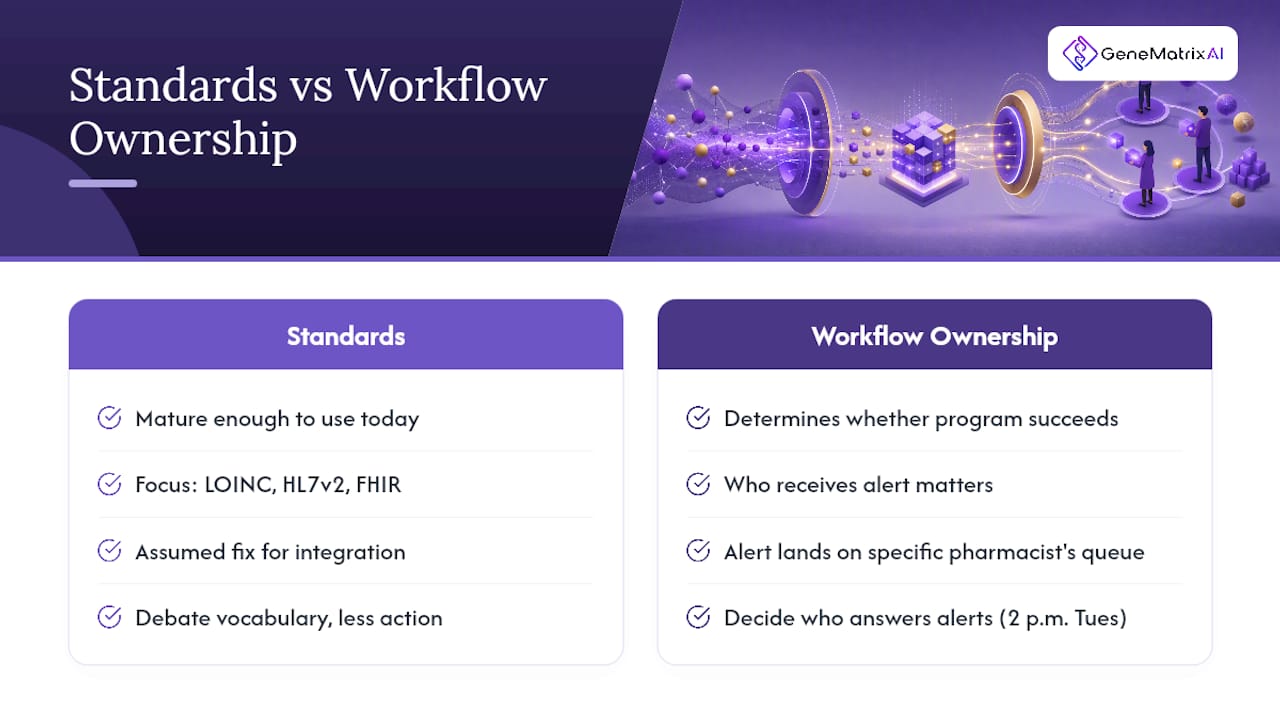
Most conversations about pharmacogenomics reporting fixate on which standard to adopt, LOINC versus a proprietary code set, HL7v2 versus FHIR, as though picking the right acronym solves integration. It doesn't. The standards exist and are mature enough to use today. What actually determines whether a program succeeds is workflow discipline: does a fired alert land on a specific pharmacist's queue with the authority to act on it, or does it disappear into a general inbox nobody owns?
The evidence backs this up. It's a workflow variable. Alert acceptance rates in the low twenties sound like failure until you notice pharmacists still drove real medication changes off those same alerts, because a human was positioned to catch what the system flagged.
If you're building a PGx integration in 2026, spend less time debating vocabulary and more time deciding who answers the alert at 2 p.m. on a Tuesday. Get that governance question wrong and no amount of correct LOINC coding will save the program.
Getting Started With Gene Matrix on a PGx Pilot
If you're evaluating lab partners for a discrete PGx integration, the practical question isn't whether the science works. It's whether the partner can actually hand your team a structured, computable result on day one instead of a PDF you have to re-key by hand. Gene Matrix runs a CLIA-certified lab, and its GenePGx module through the GeneMatrixAI platform delivers reports within 72 hours, built on a model trained across more than 500,000 genetic profiles.

When you set up an initial call, come with a specific ask: request a sample HL7 or FHIR payload, the LOINC-to-CPIC phenotype mapping documentation, a written turnaround SLA, and a clinician-facing report template your pharmacy team can review before committing to a build. Review Gene Matrix's lab credentials and platform details on the Genematrix science page, or start with the hereditary cancer and PGx screening panel to see how results are structured before you scope your own interface work.
Frequently Asked Questions
What does "discrete" PGx data mean in a pharmacy record? It means the phenotype or diplotype result is stored as a structured, coded field the EHR and CDS engine can read and act on, rather than existing only as text inside a PDF or scanned document.
Do I need FHIR, or is HL7v2 enough for PGx integration? Either can work. HL7v2 OBX segments carrying LOINC codes remain common in many health systems, while FHIR GenomicReport and TherapeuticImplication resources offer a more modern, standardized structure. The choice usually depends on what your EHR and interface engine already support.
Which gene-drug pair makes the best starting pilot? CYP2C19 and clopidogrel is a frequent first choice because the clinical action is well established and the patient population is straightforward to identify, but any pairing with clear CPIC guidance and a defined at-risk population works.
How do we prevent alert fatigue once CDS goes live? Reserve interruptive hard stops for high-certainty, high-severity pairings, and use passive advisories for everything else. Route every alert to a named pharmacist queue instead of a general inbox, and revisit trigger sensitivity based on real acceptance data from your pilot.
What's the biggest reason PGx integration projects fail? Accepting PDF-only lab results instead of requiring discrete, structured data upfront. No amount of downstream workflow design fixes a report that was never machine-readable to begin with.
This article is general information, not a substitute for advice from a qualified doctor. Consult a qualified healthcare professional about your own circumstances before acting on anything here.
Sources
- HL7 FHIR pharmacogenomics reporting implementation guide
- Integration and standardization challenges for PGx (PMC6123879)
- Frontiers scoping review: implementing pharmacogenomic testing in community pharmacy (2025)
- NCPDP Foundation XactLabs PGx final results