

TL;DR:
- PGx reports provide genetic insights that guide personalized medication choices and dosages.
- Understanding key terms like genotype, phenotype, and metabolizer status helps interpret results effectively.
- Always consult your healthcare provider before making medication changes based on PGx data.
You open an envelope or log into a portal and stare at a document filled with star alleles, phenotype categories, and color-coded drug tables. Your pharmacogenomics (PGx) report just arrived, and instead of feeling empowered, you feel lost. That reaction is completely normal. PGx testing is one of the most powerful tools in modern medicine, matching your unique genetic makeup to the medications most likely to work safely for you. This guide walks through every section of a PGx report, explains what the terminology actually means, and shows you exactly how to bring those insights into a productive conversation with your doctor.
Table of Contents
- What is a PGx report and why does it matter?
- Understanding key terms: Genotype, phenotype, and metabolizer status
- Step-by-step: How to read each section of your PGx report
- Common pitfalls, nuances, and advanced tips
- What PGx can (and can't) do for your health-do-for-your-health)
- The real-world truth: Why understanding your PGx report empowers you—if you're smart about it
- Get more from your PGx results with Gene Matrix
- Frequently asked questions
Key Takeaways
| Point | Details |
|---|---|
| PGx decodes medication safety | A PGx report translates your genes into recommendations for safer, more effective prescriptions. |
| Understand key terms | Learning the difference between genotype and phenotype empowers you to interpret results. |
| Always involve your provider | Never make medication changes without discussing your PGx report with a healthcare professional. |
| Watch for report limitations | PGx has boundaries—some drugs aren’t covered, and new updates occur regularly. |
| Use PGx as a conversation starter | Your PGx results are a tool for informed discussions with your provider, not a solo decision guide. |
What is a PGx report and why does it matter?
A PGx report is a clinical document that translates your DNA into actionable guidance about how your body is likely to process specific medications. It is not a diagnosis. It is a roadmap. The report tells your healthcare team which drugs may work well for you, which ones carry elevated risk, and which ones may need a dose adjustment based on your genetic profile.
Understanding personalized medicine overview helps you see why PGx is not just a trend. Medications are still largely prescribed using a one-size-fits-all model, yet genetics can dramatically shift how a drug behaves in your body. People with certain variants may experience toxic side effects at a standard dose while others may get no therapeutic benefit at all.
Who benefits most from PGx testing?
- People who have experienced unexpected side effects from medications
- Patients managing multiple prescriptions at once (polypharmacy)
- Individuals starting psychiatric, oncology, or cardiovascular medications
- Anyone with a family history of adverse drug reactions
- Those exploring genetic testing and health prevention as part of a proactive care strategy
A VA PGx overview confirms that PGx reports include demographics, genes analyzed, genotype and phenotype results, and drug-gene interactions for tailored recommendations. Here is a quick overview of what each major section covers:
| Report section | What it contains |
|---|---|
| Demographics | Patient name, date of birth, ordering provider |
| Genes analyzed | Which genes were tested (e.g., CYP2D6, CYP2C19) |
| Genotype results | Your specific genetic variants (star alleles) |
| Phenotype translation | How your body likely processes drugs |
| Drug recommendations | Medications affected and suggested actions |
| Disclaimers | Limitations, coverage gaps, clinical context |
One critical rule: never adjust your medications based on a PGx report alone. The report is a tool for your provider, not a self-treatment guide.
Understanding key terms: Genotype, phenotype, and metabolizer status
The terminology inside a PGx report can feel like a foreign language. Two words you will see everywhere are genotype and phenotype, and understanding the difference between them is the key to reading your report confidently.
Your genotype is your actual DNA result. It describes the specific genetic variants you carry, usually written as star allele combinations like CYP2D6 *1/*4. Think of it as the raw data layer of your report. Your phenotype is what that genotype means in practice. It describes how your body actually processes a drug based on those variants. The CPIC standardizes allele and phenotype mapping so that labs and clinicians use consistent language across reports.
Here are the four main metabolizer categories you will encounter:
| Phenotype | What it means | Clinical implication |
|---|---|---|
| Ultrarapid Metabolizer | Breaks down drugs very fast | May need higher doses or alternative drugs |
| Normal Metabolizer | Processes drugs as expected | Standard dosing typically applies |
| Intermediate Metabolizer | Slower than average processing | May need dose adjustment |
| Poor Metabolizer | Minimal or no drug breakdown | High risk of toxicity at standard doses |
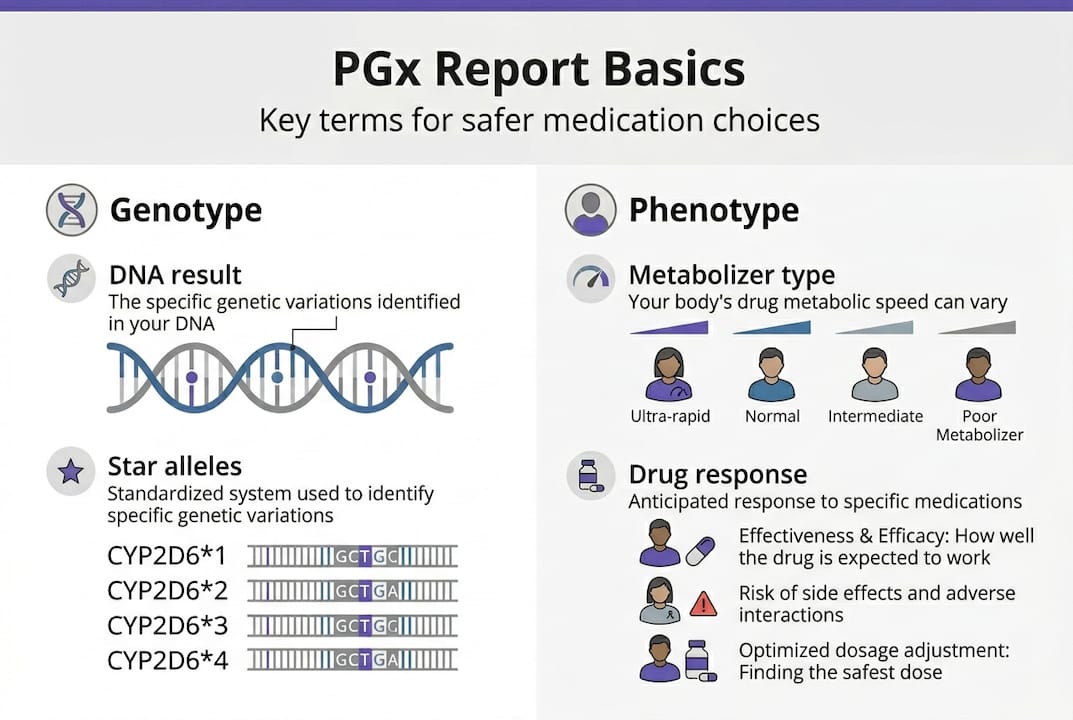
You can also explore gene panel insights to understand how multi-gene panels add depth to these results. A genotype to phenotype translation is not always straightforward, which is why clinical interpretation matters.
Common terms you will see in your report:
- Allele: One version of a gene inherited from each parent
- Diplotype: The combination of two alleles (e.g., *1/*4)
- Star allele: A named variant pattern for a gene (e.g., CYP2C19 *2)
- Wild-type: The most common, reference version of a gene
- Drug-gene interaction: A known relationship between your genotype and a specific medication's behavior
Pro Tip: Always cross-check your report's phenotype labels with the CPIC or FDA tables. Different labs may use slightly different terminology, and the CPIC database is the gold standard for confirming what your metabolizer status means for a specific drug.
Step-by-step: How to read each section of your PGx report
Once you understand the jargon, reading your report becomes a structured process. Follow these steps every time you review a PGx document.
- Confirm patient information. Verify your name, date of birth, and the ordering provider. Errors here can mean you are reading someone else's results.
- Review genes tested and star alleles. Check which genes the lab analyzed. Not all panels cover the same genes. Note your specific star allele diplotypes.
- Decode genotype to phenotype. Find the phenotype assigned to each gene. This is where the clinical meaning starts to emerge.
- Identify impacted drugs. Most reports use color-coding. Red or orange typically signals a significant interaction. Green usually means the drug is expected to work normally for you.
- Read the guideline-based recommendations. These come from CPIC, FDA labeling, or DPWG (Dutch Pharmacogenetics Working Group). Look for specific language like "use as directed," "consider alternative," or "avoid."
- Note limitations and disclaimers. Every report has a section listing what was not tested or where evidence is limited. This section is not fine print. It is essential context.
- Discuss with a healthcare professional. Bring a printed or digital copy to your next appointment. PGx provider guidance consistently recommends that you read genotype and phenotype sections together, confirm drugs of interest, review guideline-based recommendations, and consult your provider before acting.
A step-by-step guide for families can also help you prepare for that conversation if you are navigating this process with a loved one.
Pro Tip: If your medication list changes or you develop a new health condition, revisit your PGx report. Drug-gene interactions can become newly relevant as your treatment plan evolves.
Safety warning: Never adjust, stop, or add a medication based solely on your PGx report. Always consult your prescribing provider first. Acting alone on genetic data without medical guidance can cause serious harm.
Common pitfalls, nuances, and advanced tips
Even careful readers run into trouble. PGx interpretation has real complexity, and knowing where confusion tends to arise will help you avoid costly mistakes.
One of the most common issues is ambiguous genotype data. Some labs cannot definitively phase (separate) your two alleles, which means the phenotype assignment carries more uncertainty. Your report may flag this explicitly. If it does not, ask your provider or the lab directly.

Another issue is coverage gaps. Not every gene or drug combination has strong clinical evidence yet. A drug may be absent from your report not because it is safe for you, but because the evidence base has not matured enough for a recommendation. PGx reports can feature ambiguous genotypes, genes lacking consensus, incidental findings, and evolving guidelines.
Common mistakes to avoid:
- Treating the report as a final answer rather than a clinical input
- Ignoring the disclaimers section because it seems technical
- Using direct-to-consumer (DTC) genetic test results in place of a clinical-grade PGx panel
- Relying on outdated versions of guidelines that the lab may not have updated
- Assuming that a "normal metabolizer" result means all medications are safe
DTC tests like those from ancestry platforms are not equivalent to clinical PGx panels. They typically cover fewer variants, use different assay methods, and are not validated for prescribing decisions. Clinical-grade testing, like what is offered through certified labs, follows stricter standards.
Expert tip: Always verify that your report references the most current CPIC, FDA, or DPWG guidelines. Guidelines are updated regularly, and FDA PGx tables are revised as new evidence emerges. An older report may not reflect today's best recommendations.
Exploring AI-powered genomics benefits can show you how modern platforms keep pace with these rapid updates automatically.
What PGx can (and can't) do for your health
PGx testing is genuinely powerful, but it works best when you understand both its reach and its limits.
On the impact side, the numbers are striking. Adverse drug reactions cause an estimated 100,000 deaths per year in the United States, making them one of the leading causes of preventable harm in healthcare. PGx implementation can meaningfully reduce that burden by flagging high-risk drug-gene combinations before a prescription is written. Research shows that PGx implementation can reduce adverse drug reactions, with actionable results available for the vast majority of patients tested.
What PGx testing can do:
- Identify which medications are likely to cause side effects for you specifically
- Reduce the trial-and-error process for psychiatric, pain, and cardiovascular medications
- Support safer prescribing decisions when starting new treatments
- Contribute to a genetic risk assessment strategy alongside cancer screening and wellness planning
- Give your provider a data-driven starting point for medication selection
What PGx testing cannot do:
- Replace your provider's clinical judgment
- Predict every possible side effect or drug interaction
- Cover all medications (only those with sufficient evidence are included)
- Account for non-genetic factors like age, kidney function, diet, or other drugs
- Serve as a standalone basis for changing prescriptions
Regular medication reviews remain essential. Your PGx report is one input among many, and its value grows when it is integrated into your broader health picture over time.
The real-world truth: Why understanding your PGx report empowers you—if you're smart about it
Here is something most PGx content will not tell you directly: the report itself is not the breakthrough. The conversation it starts is.
We have seen patients receive clear, actionable PGx results and still end up on the wrong medication because no one sat down to connect the dots between the report and the prescription pad. The data alone does not protect you. What protects you is bringing that data into a structured, informed dialogue with your care team.
Self-interpretation is one of the most avoidable risks in precision medicine. Reading that you are a Poor Metabolizer for CYP2D6 and then stopping an antidepressant on your own is not empowerment. It is a shortcut that can cause real harm. The value of AI in personalized medicine is that it can surface patterns and flag interactions at scale, but it still requires a clinician to act on those signals responsibly.
"There is no silver bullet. Genetics is a powerful tool, not a solo act."
Treat your PGx report like a roadmap for a conversation, not a prescription. The patients who get the most from PGx testing are the ones who bring their reports to appointments, ask specific questions, and revisit the data as their health evolves.
Get more from your PGx results with Gene Matrix
Now that you know how to read and act on your PGx report, the next step is making sure your results are backed by clinical-grade science and expert support.

Gene Matrix's GeneMatrix AI App delivers AI-powered PGx analysis trained on over 500,000 genetic profiles, giving you actionable insights within 72 hours. Our platform, built on rigorous our science, helps you and your care team move from raw genetic data to confident, evidence-based medication decisions. Whether you are a patient or a clinician, the providers portal connects your genomic results directly to clinical workflows. Gene Matrix makes precision medicine practical, not just possible.
Frequently asked questions
What are the most important parts of a PGx report?
Focus on your genotype, phenotype, and medication recommendations first, then review the disclaimers section carefully. The key sections include genes tested, genotype, phenotype, drug recommendations, and limitations.
How do I know if a PGx recommendation applies to my medications?
Check whether your specific drugs appear in the report's drug-gene table, then confirm the guidance with your doctor. Drug-gene tables and color-coding help identify which medications are affected and how.
Can I use PGx results to change prescriptions myself?
No. Bring your report to your healthcare provider before making any medication changes. PGx results do not replace provider guidance and should always be interpreted in a clinical context.
Are all medications covered by PGx testing?
No, only drugs with strong evidence-based guidelines are included in most panels. PGx covers over 70 medications but not all drugs, so consult your report's coverage tables and your provider for a complete picture.