

TL;DR:
- Pharmacogenomics uses genetic information to personalize medication choices, reducing adverse reactions and improving efficacy. Despite strong evidence and cost benefits, systemic barriers hinder widespread clinical adoption of PGx testing. Integrating PGx through education, decision support, and pharmacist-led models enhances safe, precision prescribing in healthcare.
Two patients receive the same antidepressant at the same dose. One improves. The other lands in the emergency room with a dangerous drug reaction. Same drug, same dose, completely different outcomes. This is not bad luck. It is genetics. The role of PGx in healthcare is precisely to close that gap between who we prescribe to and what we prescribe. Pharmacogenomics (PGx) uses your genetic makeup to predict how your body will process medications, giving clinicians a sharper tool for choosing the right drug at the right dose, and giving patients a safer path through treatment.
Table of Contents
- Key takeaways
- The role of PGx in healthcare: genetic foundations
- Clinical impact of PGx on patient safety
- Barriers to PGx integration in clinical practice
- Real-world applications across therapeutic areas
- What I've learned about PGx's promise and its real limits
- How Genematrix brings PGx to precision medicine
- FAQ
Key takeaways
| Point | Details |
|---|---|
| Genetics shapes drug response | Gene variants alter how you metabolize medications, directly affecting efficacy and adverse reaction risk. |
| Preemptive testing prevents harm | Panel-based PGx testing reduced ADRs by 30% in the PREPARE trial, especially for patients on multiple medications. |
| PGx results are lifelong assets | Genetic data stored in your medical record can guide every prescribing decision you will ever need. |
| Adoption barriers remain real | Education gaps, EHR integration failures, and reimbursement obstacles slow clinical uptake despite strong evidence. |
| It complements clinical judgment | PGx informs prescribing decisions but must be combined with age, organ function, and other medications for full accuracy. |
The role of PGx in healthcare: genetic foundations
Pharmacogenomics studies how inherited gene variants change the way your body responds to drugs. The genes most relevant to prescribing decisions are called pharmacogenes, and they encode enzymes, transporters, and receptors that directly determine whether a medication works, fails, or causes harm.
The most studied pharmacogenes are the cytochrome P450 enzymes, particularly CYP2C19 and CYP2D6. These enzymes metabolize an enormous percentage of commonly prescribed medications, from antidepressants and antipsychotics to cardiovascular drugs and pain medications. Variants in these genes sort patients into four metabolism phenotypes:
- Poor metabolizers carry loss-of-function variants and cannot break down drugs effectively, leading to drug accumulation and toxicity.
- Intermediate metabolizers have reduced enzyme activity and may require dose adjustments.
- Normal metabolizers process drugs at the expected rate and respond predictably to standard doses.
- Ultrarapid metabolizers have extra gene copies or gain-of-function variants, metabolizing drugs so fast that standard doses produce little to no therapeutic effect.
The clinical stakes are real. A patient with CYP2C19 poor metabolizer status prescribed clopidogrel, a widely used antiplatelet drug, may receive no cardiovascular protection because their body cannot convert the prodrug into its active form. An ultrarapid CYP2D6 metabolizer given codeine can convert it to morphine at a dangerous rate, risking opioid toxicity. These are not theoretical edge cases. They are documented, preventable events.
Complexity increases further with drug-drug-gene interactions, a phenomenon called phenoconversion. A patient who is genetically a normal metabolizer can temporarily function like a poor metabolizer if they are also taking a drug that inhibits the same enzyme. This matters enormously in polypharmacy patients, where multiple prescriptions can combine with genetics in ways that no single prescriber can track mentally. Understanding pharmacogenomic markers is the first step toward building safer protocols.
Pro Tip: When reviewing a patient's medication list, consider both their genotype and any co-prescribed enzyme inhibitors. A genetically normal metabolizer on fluoxetine can behave like a CYP2D6 poor metabolizer, requiring the same caution you would apply to a genotypically poor metabolizer.
Clinical impact of PGx on patient safety
The evidence for PGx improving patient outcomes has moved well beyond theory. The PREPARE trial, a large European multicenter study, used a 12-gene panel to guide prescribing decisions prospectively. The result was a 30% reduction in clinically relevant adverse drug reactions compared to standard care. Critically, this benefit was most pronounced in patients with multimorbidity and polypharmacy, the exact population where medication errors are most common and most dangerous.
Over 90% of people carry at least one high-risk pharmacogenomic variant. That statistic reframes the conversation. PGx testing is not a niche tool for outliers. It is a baseline safeguard for the general patient population.

The economic argument is equally strong. A multinational cost-utility analysis of the PREPARE program found that PGx-guided treatment cost €491 per patient versus €767 for controls receiving standard care. When test costs were excluded, the intervention was cost-saving. This positions preemptive PGx not as an expensive add-on, but as an investment that pays back through fewer hospitalizations, fewer repeat prescriptions, and less trial-and-error medicine.
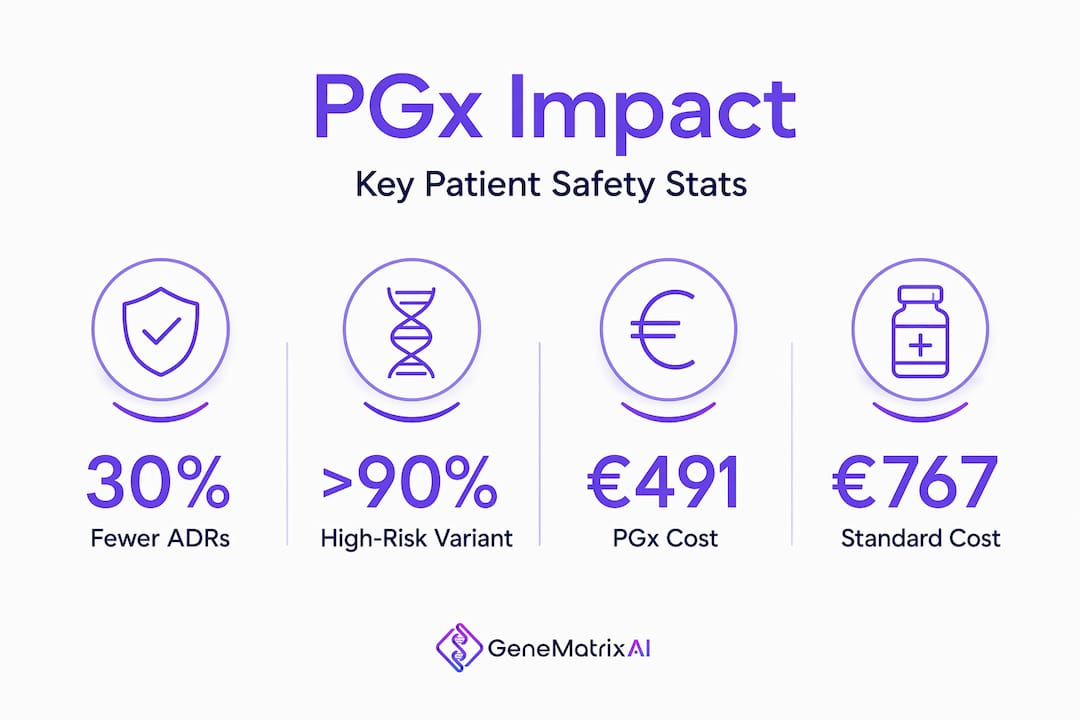
| Metric | Standard care | PGx-guided care |
|---|---|---|
| Clinically relevant ADRs | Baseline | 30% reduction |
| Cost per patient (PREPARE) | €767 | €491 |
| Population carrying a risk variant | N/A | Over 90% |
| Utility of past test results | Single encounter | Lifelong EHR record |
The VA's clinical PGx program offers a practical model for implementation. VA PGx testing stores genetic results permanently in the patient's medical record, meaning a test done today informs prescribing decisions for the rest of that patient's life. That durability is one of PGx's most underappreciated advantages. Unlike a lab value that changes over time, your genome does not.
That said, genetics only partially informs prescribing. Providers at the VA explicitly integrate PGx results with age, organ function, drug interactions, and the full clinical picture. PGx testing is not a replacement for clinical judgment. It sharpens it.
Pro Tip: Preemptive panel-based testing, ordering a multi-gene panel before prescribing rather than after a reaction occurs, maximizes clinical utility. Reactive testing after an adverse event is valuable, but it means a patient has already been harmed.
Barriers to PGx integration in clinical practice
Despite compelling evidence, the role of PGx in medication management has not translated into routine clinical practice at the scale the data warrants. The obstacles are systemic, and understanding them is the first step toward overcoming them.
- Reimbursement gaps. Insurance coverage for PGx testing remains inconsistent. Many payers do not reimburse pharmacist-administered counseling on PGx results, and community pharmacists face reimbursement barriers that limit their ability to lead PGx programs despite being ideally positioned to do so.
- EHR integration failures. Genetic results sitting in a PDF do nothing. Meaningful use requires active decision support built directly into the prescribing workflow, so that when a physician orders a CYP2D6-metabolized drug for a poor metabolizer, the system flags it at the point of care. Most EHR systems are not built for this yet.
- Education gaps across disciplines. A study of physicians and pharmacists found that only 30% of pharmacists had received formal PGx training, despite 88.6% supporting clinical PGx applications. Prescribers know they should pay attention to pharmacogenomics but frequently lack the knowledge to act on results.
- Role ambiguity. There is genuine uncertainty in many health systems about whether interpreting a PGx result is the physician's responsibility or the pharmacist's. This ambiguity leads to results being collected and then ignored.
- Panel design limitations. Not every gene relevant to every medication is covered by every commercial panel. Limited gene panels require clinicians to understand what their test does and does not include before drawing conclusions.
- Diversity gaps in research. PGx databases are predominantly built on data from populations of European descent. Variant frequency and clinical significance can differ substantially across ethnic groups, limiting the generalizability of current guidelines for all patients.
Overcoming these barriers requires investment in clinical decision support tools, mandatory PGx components in pharmacy and medical education, and policy advocacy for consistent insurance coverage.
Real-world applications across therapeutic areas
Knowing how PGx works in theory is one thing. Seeing it applied across the clinical spectrum is where the importance of PGx testing becomes concrete.
-
Cardiovascular medicine. The CYP2C19-clopidogrel interaction is now one of the most documented drug-gene pairs in clinical pharmacology. Cardiology guidelines from major professional societies recommend CYP2C19 testing before prescribing clopidogrel after acute coronary syndrome. Patients identified as poor metabolizers can be switched to prasugrel or ticagrelor, drugs that do not require CYP2C19 activation.
-
Psychiatric medications. Antidepressant selection has historically involved significant trial and error. PGx changes that calculation directly. PGx-personalized antidepressant treatment matches patients to medications based on their CYP2D6 and CYP2C19 status, reducing the weeks or months patients spend on ineffective or poorly tolerated drugs.
-
Pain management. Codeine, tramadol, and other opioids are metabolized by CYP2D6. Ultrarapid metabolizers face toxicity risk while poor metabolizers get inadequate pain relief. PGx-guided pain management allows prescribers to identify which patients need alternative analgesics before the first dose is ever written.
-
Oncology. DPYD variants predict severe toxicity from fluoropyrimidine chemotherapy. Patients with certain DPYD variants who receive standard doses of 5-fluorouracil face life-threatening neutropenia. Preemptive DPYD testing is now recommended by European guidelines and increasingly adopted in U.S. oncology centers.
-
Shared decision-making with patients. When patients understand that their genetic profile explains why three antidepressants failed them, or why a standard dose of a pain medication never touched their pain, it transforms the clinical conversation. Compliance improves. Trust improves. And patients become active participants in their own care rather than frustrated bystanders.
Pharmacists play a defining role in translating these results into clinical action. They interpret genotype-phenotype relationships, flag interactions, and communicate results in terms prescribers and patients can act on. Emerging mobile platforms are also making it possible for patients to carry their PGx results with them and share them at any point of care encounter.
What I've learned about PGx's promise and its real limits
I've spent years watching clinicians genuinely excited about PGx results that then go nowhere. The test gets ordered, the report arrives, and it lands in a folder no one ever opens again because there is no workflow built to use it. That is the honest state of PGx adoption in much of clinical practice right now.
The science is solid. The PREPARE data is compelling. The economics make sense at the system level. But the gap between what PGx can do and what it actually does in routine care is still wide, and it is not a science problem. It is an infrastructure and education problem.
What I find most encouraging is the growing recognition that pharmacists belong at the center of PGx programs, not as an afterthought. The pharmacist who counsels a patient on their CYP2D6 result, flags a phenoconversion risk, and communicates with the prescribing team is doing exactly what this technology was built for. Health systems that have invested in that model are seeing results. Those that treat PGx as a one-time lab order are not.
My view is that genetics should be understood as one signal among many, not the final answer. Age, kidney function, drug interactions, patient preferences, and comorbidities all shape the prescribing decision. PGx sharpens the picture. It does not complete it. The clinicians and patients who get the most from this technology are the ones who hold both truths at once: it is genuinely useful, and it requires judgment to apply well.
— Tarek
How Genematrix brings PGx to precision medicine
If you are ready to move from understanding PGx to acting on it, Genematrix delivers the scientific depth and clinical infrastructure to make that happen. As a CLIA-certified lab built on AI-driven analysis trained on 500,000+ genetic profiles, Genematrix provides advanced pharmacogenomic testing with results in 72 hours. Their GenePGx module covers the key pharmacogenes that drive medication response across cardiovascular, psychiatric, pain, and oncology drug classes.

The GeneMatrixAI platform gives clinicians and patients access to genetic health management tools on iOS and Android, so PGx results travel with the patient and remain accessible at every point of care. For health systems looking to shift from reactive prescribing to proactive precision medicine, Genematrix offers subscription plans starting at $69 per month that make comprehensive PGx accessible without the institutional overhead. Explore what your genetics can do for your prescribing decisions today.
FAQ
What is the role of PGx in healthcare?
PGx uses genetic information to predict how a patient will respond to specific medications, allowing clinicians to choose drugs and doses that are more likely to be effective and less likely to cause adverse reactions.
How does PGx affect drug response?
Gene variants in enzymes like CYP2D6 and CYP2C19 alter the rate at which your body metabolizes drugs, which can result in toxic drug accumulation, inadequate therapeutic effect, or dangerous drug-gene interactions.
Can PGx testing reduce adverse drug reactions?
Yes. The PREPARE trial demonstrated a 30% reduction in clinically relevant ADRs using a preemptive 12-gene panel, with the strongest benefits seen in patients taking multiple medications.
Is PGx testing cost-effective?
A multinational cost-utility analysis found PGx-guided care cost €491 per patient versus €767 for standard care, supporting PGx as a cost-effective or cost-saving intervention when factored across a patient's lifetime.
Does a PGx test replace clinical judgment?
No. PGx results must be interpreted alongside age, organ function, co-prescribed medications, and the full clinical picture. The VA explicitly frames PGx as a decision support tool, not a standalone prescribing guide.