

TL;DR:
- Carrier screening identifies if healthy individuals carry gene variants linked to inherited conditions they could pass to their children. It is recommended for all individuals planning pregnancy and can be done via blood, saliva, or cheek swab with results in 2-4 weeks. Genetic counseling is essential to interpret results and guide reproductive decisions effectively.
Carrier screening is a genetic test that identifies whether you carry gene variants linked to inherited conditions you could pass to your children. Most carriers are completely healthy and have no idea they carry these variants until they test. The American College of Obstetricians and Gynecologists (ACOG) now recommends pan-ethnic carrier screening for all individuals planning pregnancy, regardless of ethnicity or family history. A simple blood draw, saliva sample, or cheek swab is all it takes, and results typically return within 2–4 weeks. Genetic counseling is the critical next step for interpreting what those results actually mean for your family.
What is a carrier screening and how does it work?
Carrier screening is a DNA-based test that detects gene variants associated with autosomal recessive and X-linked conditions that can cause severe childhood-onset diseases. Understanding the biology behind it makes the results far less intimidating.

The science of being a carrier
Every person inherits two copies of most genes, one from each parent. For autosomal recessive conditions, a person needs two faulty copies of a gene to develop the disease. A carrier has one working copy and one variant copy. That single working copy is enough to keep the carrier healthy. This is why carriers are typically asymptomatic and often have no family history of the condition at all.
X-linked conditions work slightly differently. Because males have only one X chromosome, a single variant on that chromosome can cause disease in a son. A female carrier with one affected X chromosome usually stays healthy but has a 50% chance of passing the variant to her children.
The carrier screening process
The carrier screening process starts with sample collection. Your provider takes a blood draw, a saliva sample, or a cheek swab. No special preparation is needed for blood samples. If you use a saliva or cheek swab kit, you should avoid eating, drinking, or smoking for at least 30 minutes before collection.
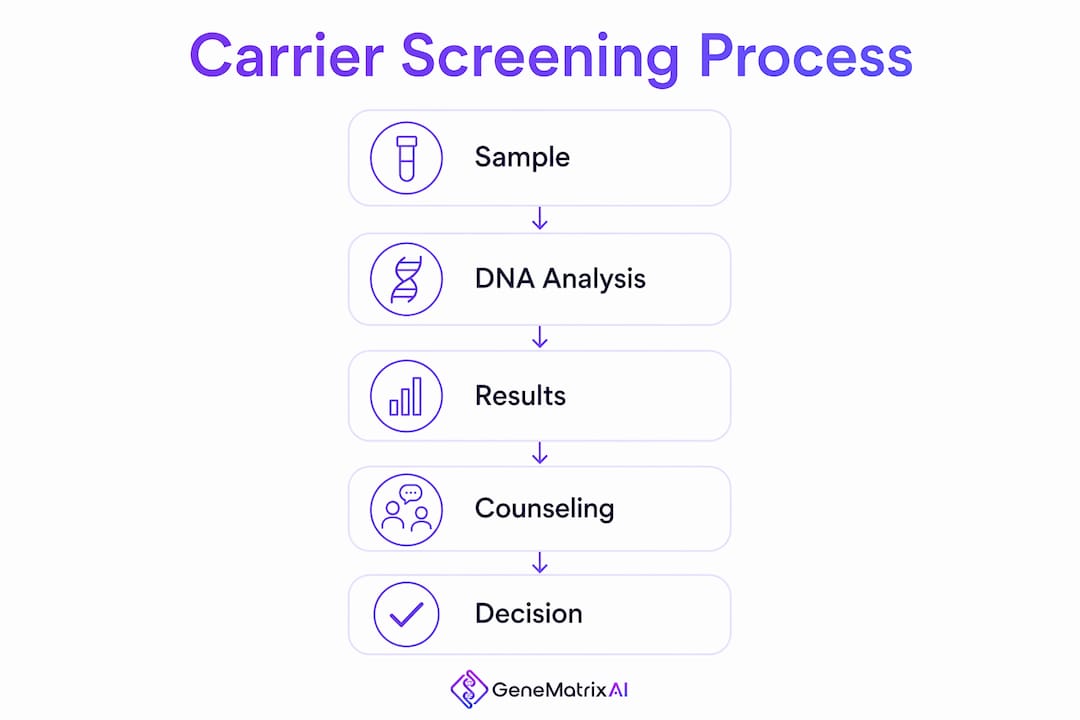
The lab then analyzes your DNA for variants across a panel of genes. Expanded carrier screening panels can test for hundreds of conditions in a single run. Results return in 2–4 weeks, after which a genetic counselor reviews the findings with you.
Pro Tip: Ask your provider specifically whether they use an expanded panel or a targeted panel. Expanded panels cover far more conditions and are now the preferred standard in most clinical settings.
The key conditions screened include:
- Cystic fibrosis: A lung and digestive condition caused by CFTR gene variants
- Spinal muscular atrophy (SMA): A progressive neuromuscular disease
- Fragile X syndrome: The most common inherited cause of intellectual disability
- Sickle cell disease: A blood disorder affecting red blood cell shape
- Tay-Sachs disease: A fatal neurological condition with childhood onset
Who should get carrier screening and when?
ACOG recommends that all individuals planning pregnancy receive carrier screening, regardless of ethnicity, race, or family history. This shift away from ethnicity-based screening reflects growing population diversity and a commitment to equitable reproductive care. The old model, which targeted only Ashkenazi Jewish couples for Tay-Sachs or only African Americans for sickle cell, missed too many at-risk couples.
The best time to test
Preconception testing is the gold standard. Testing before pregnancy gives couples the most time to understand their results, consult a genetic counselor, and consider all reproductive options. Testing during early pregnancy is still valuable, but time pressure can limit decision-making.
The recommended sequence for couples looks like this:
- Both partners test concurrently. Concurrent testing is the fastest approach. Both partners submit samples at the same time, and results come back together. This eliminates the waiting period between partners.
- Review results with a genetic counselor. A counselor explains what the findings mean for your specific situation, including the probability of an affected child.
- Assess shared carrier status. If both partners carry variants in the same gene, each pregnancy carries a 25% chance of the child inheriting both variants and developing the condition.
- Discuss reproductive options. Options include natural conception with prenatal diagnosis, preimplantation genetic testing (PGT) with IVF, use of donor gametes, or adoption.
- Retain your results permanently. Carrier status does not change. You will not need to retest for future pregnancies.
Sequential vs. concurrent testing
Sequential testing tests one partner first and only tests the second partner if the first is positive. This approach saves cost when the first partner tests negative. The drawback is time. During pregnancy, waiting for one result before ordering the next can push critical decisions into later trimesters. Concurrent testing costs more upfront but delivers a complete picture faster. For couples already pregnant, concurrent testing is the better choice.
A practical guide on genetic screening steps can help you map out the full process before your first appointment.
How do you interpret carrier screening results?
Carrier screening results fall into three categories: positive carrier status, negative result, and variant of uncertain significance (VUS). Each carries different implications.
Positive carrier result
A positive result means you carry one variant in a specific gene. Being a carrier does not mean you have the disease. Your health is not affected. The result only becomes clinically significant when your partner is also a carrier of a variant in the same gene. In that scenario, each pregnancy has a 25% chance of the child being affected, a 50% chance of the child being a carrier like you, and a 25% chance of the child inheriting neither variant.
Negative result and residual risk
A negative result significantly lowers your risk but does not eliminate it entirely. No screening panel detects every possible variant in every gene. A small residual risk always remains. Your genetic counselor will explain your specific residual risk based on the panel used and your background.
Variants of uncertain significance
Expanded carrier screening panels increase the chance of finding a VUS. A VUS is a genetic change whose clinical impact is not yet fully understood. Labs reclassify VUS findings over time as more data becomes available. A VUS is not a positive result and should not be treated as one without counselor guidance.
Pro Tip: Keep a copy of your full genetic report, not just the summary. Genetic test results are lifelong documents. Retaining them prevents redundant testing in future pregnancies and avoids potential insurance complications.
Carrier screening results should be stored permanently, since carrier status never changes and the same results apply to all future pregnancies.
Genetic counseling is not optional when results are complex. Counselors translate probabilistic data into plain language and help couples weigh options without panic or false reassurance.
What are the benefits and limitations of carrier screening?
Carrier screening gives couples real information to make real decisions. The benefits are concrete. The limitations are worth knowing before you test.
| Factor | Benefits | Limitations |
|---|---|---|
| Reproductive planning | Informs decisions before or early in pregnancy | Does not guarantee a healthy pregnancy or child |
| Condition coverage | Expanded panels cover hundreds of conditions | No panel detects all variants in all genes |
| Carrier health | Confirms carriers are healthy; reduces anxiety | May cause psychological stress if both partners test positive |
| Timing | Preconception testing maximizes decision time | Sequential testing during pregnancy can delay results |
| Results clarity | Clear positive or negative for most findings | VUS findings require expert interpretation and may be reclassified |
The most common misconception about carrier screening is that a positive result means you are sick. It does not. Carriers live normal, healthy lives. The result is only relevant to reproductive planning, not personal health management.
Cost and access remain real barriers for some couples. Insurance coverage for carrier screening varies by plan and state. Many providers offer self-pay pricing, and some labs provide financial assistance programs. The benefits of preconception genetic screening consistently outweigh the cost for couples who want complete information before starting a family.
Key Takeaways
Carrier screening is a DNA test that identifies gene variants in healthy individuals who could pass inherited conditions to their children, and genetic counseling is required to act on the results responsibly.
| Point | Details |
|---|---|
| Universal screening is the standard | ACOG recommends carrier screening for all individuals planning pregnancy, regardless of ethnicity. |
| Carriers are healthy | Carrying one gene variant does not cause disease; it only affects reproductive risk when both partners carry variants in the same gene. |
| Test before pregnancy when possible | Preconception testing gives couples the most time to understand results and consider all options. |
| Retain results permanently | Carrier status never changes; keep your full report for all future pregnancies. |
| Genetic counseling is required | A counselor translates complex results, including VUS findings, into clear reproductive guidance. |
What I've learned from watching couples navigate carrier screening
The couples who handle carrier screening best are the ones who test before pregnancy, not during it. When results arrive during the first trimester, the emotional weight of a positive finding collides with time pressure. Decisions that deserve weeks of reflection get compressed into days. That compression is avoidable.
The second thing I see consistently is confusion about what a positive carrier result actually means. Patients hear "positive" and assume something is wrong with them. Nothing is wrong. A carrier is simply someone who carries one copy of a recessive gene variant while remaining completely healthy. The disease only becomes possible when two carriers of the same gene variant have a child together. That distinction matters enormously, and it needs to be stated clearly before testing, not after.
I also think the move to pan-ethnic screening is one of the most important changes in reproductive medicine in the past decade. The old ethnicity-based model excluded too many people. Mixed-heritage couples, adoptees, and anyone without a detailed family history were systematically underserved. Universal screening closes that gap. Every couple deserves the same information regardless of background.
My advice: get tested together, get counseling together, and keep your results. The test itself is simple. What you do with the results is where the real work begins.
— Tarek
Genematrix supports your genetic testing needs
Carrier screening is one piece of a larger picture of genetic health. Genematrix is a Chicago-based, CLIA-certified biotechnology company that uses AI-driven analysis trained on 500,000+ genetic profiles to deliver genomic reports within 72 hours.

Genematrix offers specialized testing modules including GeneBaby for pediatric genetic insights and GeneCancer for hereditary cancer risk assessment, including BRCA1/BRCA2 and Lynch syndrome. Their genetic testing science and certifications are publicly available for review. Couples who want a complete genetic health picture before starting a family can begin with a health intake assessment to determine which panels are right for their situation. Genematrix pairs every report with expert guidance so results are never left to interpretation alone.
FAQ
What is the carrier screening definition in simple terms?
Carrier screening is a genetic test that checks whether a healthy person carries a gene variant that could cause an inherited disease in their child. Carriers themselves have no symptoms and are not at personal health risk.
How does carrier screening work at the lab level?
A lab analyzes your DNA sample for known variants across a panel of genes linked to recessive and X-linked conditions. Results are compared against established databases to classify each finding as positive, negative, or a variant of uncertain significance.
Who should get carrier screening?
ACOG recommends carrier screening for all individuals planning pregnancy or currently pregnant, regardless of ethnicity or family history. Both partners should ideally test, since results are only clinically significant when both carry variants in the same gene.
What happens if both partners are carriers of the same gene?
Each pregnancy carries a 25% chance of the child inheriting both variants and developing the condition. A genetic counselor will explain all available reproductive options, including prenatal diagnosis and preimplantation genetic testing.
Does a positive carrier result mean something is wrong with me?
No. A positive carrier result means you carry one variant in a specific gene while remaining completely healthy. Carrier status affects reproductive planning, not your personal health or life expectancy.