

TL;DR:
- Most individuals carrying genetic mutations for serious conditions often have no symptoms or family history, making universal pre-pregnancy screening essential. This testing identifies hidden risks early, enabling options like IVF with genetic testing, donor gametes, or early prenatal diagnosis, thereby reducing emotional distress and improving reproductive planning. Genetic screening should be routine before pregnancy, as it offers valuable knowledge and peace of mind, regardless of perceived risk factors or ethnicity.
Most couples assume genetic screening is something only families with a known history of inherited disease need to worry about. That assumption is wrong, and it leaves a lot of people unprepared. Understanding why consider genetic screening before pregnancy matters to every couple starts with one uncomfortable fact: most people who carry a genetic mutation linked to a serious condition have no idea. No symptoms. No family history. No warning. Pre-pregnancy genetic testing, formally called carrier screening, exists precisely to surface those hidden risks before conception, giving you information and options when they're most useful.
Table of Contents
- Key Takeaways
- Why consider genetic screening before pregnancy
- Who should actually get screened
- Benefits of pre-pregnancy genetic screening
- Preconception health: beyond genes alone
- What to do after you get your results
- My take on why this conversation needs to change
- Start your pre-pregnancy screening with Genematrix
- FAQ
Key Takeaways
| Point | Details |
|---|---|
| Carriers rarely show symptoms | Most people who carry mutations for conditions like cystic fibrosis have no signs and no known family history. |
| Universal screening is recommended | Medical guidelines now support screening for all couples planning pregnancy, not just those with identified risk factors. |
| Early testing expands your options | Screening before conception gives you time to consider IVF with genetic testing, donor gametes, or prenatal monitoring. |
| Thyroid health matters too | Combining genetic and thyroid screening gives a fuller picture of preconception health and pregnancy risk. |
| A negative result is not a guarantee | Carrier screening checks for known mutations only and cannot detect every possible genetic risk. |
Why consider genetic screening before pregnancy
Carrier screening is the clinical term for what most people call pre-pregnancy genetic testing. It is a blood or saliva test that looks at your DNA to determine whether you carry one copy of a gene mutation linked to a specific inherited condition. Carrying one copy typically causes no health problems for you. The concern arises when both you and your partner carry a mutation in the same gene. In that scenario, each pregnancy carries a 25 percent chance of the child inheriting both copies and developing the condition.
Carrier screening panels can test for over 100 conditions simultaneously, covering diseases that range from relatively common to rare but severe. The most frequently included conditions are:
- Cystic fibrosis: A progressive disease affecting the lungs and digestive system
- Spinal muscular atrophy (SMA): A leading genetic cause of infant death, affecting muscle control
- Tay-Sachs disease: A fatal disorder of the nervous system, more common in certain ancestries
- Sickle cell disease: A blood disorder that causes chronic pain and organ damage
- Fragile X syndrome: The most common inherited cause of intellectual disability
Screening identifies your carrier status. It does not diagnose a disease in you or predict with certainty what will happen in a future pregnancy. Think of it this way: a smoke detector doesn't tell you a fire is happening right now, but it gives you the information to act before serious harm occurs. Carrier screening works on the same principle.
Pro Tip: Ask your provider for an expanded carrier screening panel rather than a basic one. Expanded panels test for significantly more conditions and are now widely available at comparable cost.
Who should actually get screened
Here is where the biggest misconception lives. Many couples believe they only need screening if a relative has a genetic condition, or if they belong to a specific ethnic group with known elevated risk. That thinking is outdated.
Asymptomatic carrier status is common. Carrier mutations pass silently through generations without anyone becoming sick, because carriers themselves are healthy. A great-grandparent's condition may never have been diagnosed, or the family may simply have lost that information over time. Relying on family history to decide whether to screen misses a significant portion of at-risk couples.
There are ancestral patterns worth knowing. Ashkenazi Jewish individuals carry higher rates of Tay-Sachs and Canavan disease. African Americans face higher rates of sickle cell trait. People of Mediterranean descent have elevated rates of beta-thalassemia. But these are statistical tendencies, not rules. Conditions cross ethnic lines constantly, and genetic counselors now advocate for universal screening as standard practice for anyone planning a pregnancy.
Current professional guidelines from organizations like the American College of Obstetricians and Gynecologists support offering carrier screening to all individuals who are pregnant or considering pregnancy. The shift is from "screen if there is a reason" to "screen because there are often reasons we cannot see." That is a meaningful change in how reproductive care approaches risk.
A few groups for whom screening carries particular weight:
- Couples pursuing IVF, because results directly inform embryo selection strategies
- Single individuals using donor sperm or eggs, to check compatibility with their donor's carrier status
- Anyone with a history of unexplained pregnancy loss, where genetic factors may play a role
- Same-sex couples using donor gametes, who need carrier information from both genetic contributors
Benefits of pre-pregnancy genetic screening
The most concrete benefit of preconception screening is time. When you learn about a shared carrier risk before you are already pregnant, you have a range of options that simply are not available under the time pressure of an active pregnancy.
Here is what early knowledge actually makes possible:
- IVF with preimplantation genetic testing (PGT-M): Couples who are both carriers can use IVF to test embryos before transfer, selecting those that did not inherit both copies of the mutation. PGT-M is a selection tool, not a cure, but it gives couples a meaningful path to having an unaffected biological child.
- Using donor gametes: Some couples choose to use donor eggs or sperm from a non-carrier, eliminating the genetic risk from one side of the equation.
- Prenatal diagnostic testing: If natural conception is preferred, knowing the risk in advance allows couples to plan for chorionic villus sampling (CVS) or amniocentesis early in pregnancy, with emotional preparedness already in place.
- Informed monitoring during pregnancy: Even without intervention, knowledge allows your obstetric team to put specialized monitoring in place from the start.
- Emotional preparation: Couples who receive a positive carrier result before pregnancy consistently report that having time to process and discuss their options with a genetic counselor made the experience significantly less distressing than learning the same information mid-pregnancy.
Preconception screening removes urgent decision-making stress. When you find out during a pregnancy that both partners are carriers, you face an immediate and emotionally loaded choice. When you find out before, you have months to research, talk to specialists, grieve if needed, and arrive at a decision that genuinely reflects your values.
Pro Tip: If you and your partner are both carriers for the same condition, request a referral to a certified genetic counselor before making any reproductive decisions. A counselor will walk through your specific odds, your options, and your emotional responses in a structured, supportive way.

Preconception health: beyond genes alone
Genetic carrier screening is one piece of a broader preconception health picture. Thyroid function is another piece that gets far less attention than it deserves.
Undiagnosed thyroid imbalances can cause anemia, preeclampsia, and delayed fetal brain development. Thyroid disorders are increasingly common among women of reproductive age, and many go undetected because the symptoms overlap with normal fatigue and hormonal changes. Addressing thyroid issues before conception is far simpler than managing them once a pregnancy is already underway.
Consider how these two screenings complement each other:
| Screening type | What it detects | Why timing matters |
|---|---|---|
| Carrier genetic screening | Inherited mutations that could affect offspring | Best done before conception to maximize reproductive options |
| Thyroid function testing | Hormonal imbalances affecting fertility and fetal development | Treatable before conception; complications are harder to reverse mid-pregnancy |
| Complete blood count (CBC) | Anemia, blood disorders that affect pregnancy | Identifies issues that benefit from pre-pregnancy treatment |
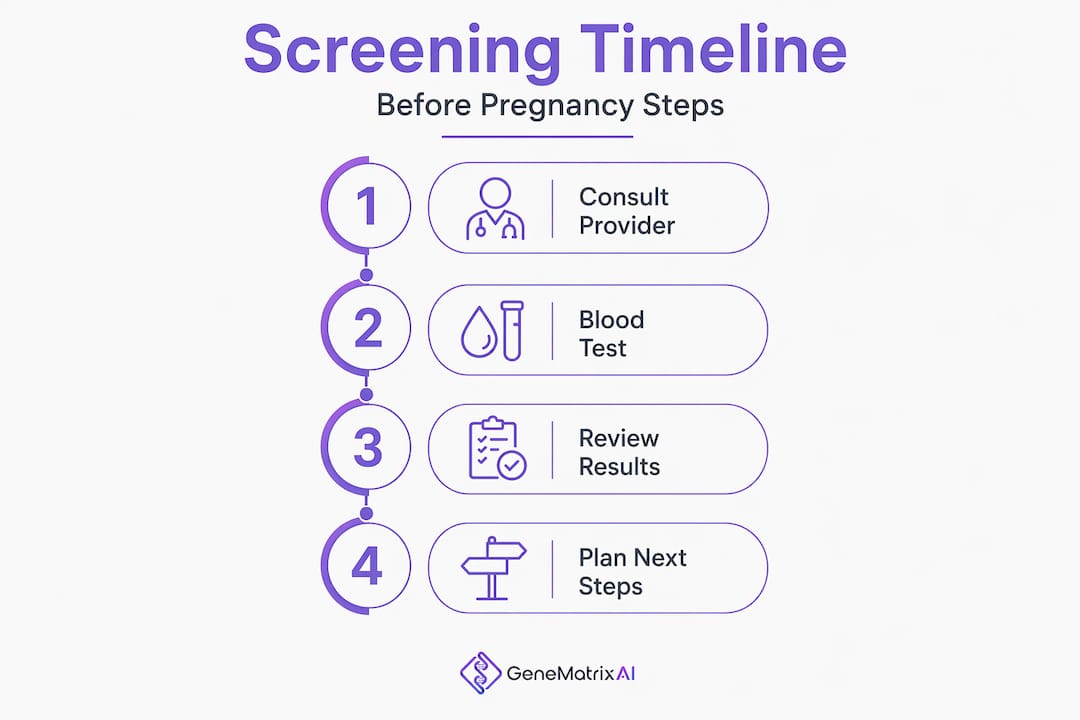
Arriving at your first prenatal appointment with these screenings already completed puts you and your provider in a far better position. You are not reacting to information. You are acting on it.
What to do after you get your results
Most couples who undergo carrier screening receive reassuring results. One or both partners may be carriers for different conditions, which carries no shared risk. A smaller percentage will find that both partners carry mutations in the same gene, which is where next steps become important.
The single most valuable resource at that point is genetic counseling. A certified genetic counselor does several things that a standard physician visit cannot replicate:
- Explains exactly what your specific result means for your unique situation
- Walks through the statistical risk for each pregnancy in plain language
- Presents reproductive options without judgment or pressure
- Connects you with reproductive endocrinologists or maternal-fetal medicine specialists when appropriate
- Provides emotional support and helps you and your partner align on next steps
One thing worth understanding clearly: a negative screening result does not eliminate all genetic risk. Screening looks only for known mutations and cannot detect polygenic conditions, de novo mutations that arise spontaneously, or conditions outside the panel's scope. That is not a flaw in the technology. It is a realistic boundary that your counselor will help you understand so your expectations remain grounded.
For couples pursuing IVF specifically, understanding why genetic screening before IVF matters goes beyond carrier status. IVF introduces additional testing options like PGT-A, which screens embryos for chromosomal abnormalities to improve implantation rates and reduce miscarriage risk. Carrier screening and IVF-specific testing serve different purposes and are often used together.
My take on why this conversation needs to change
I've spent years watching families navigate genetic diagnoses that could have been identified before pregnancy. What strikes me most is not the medical complexity. It is the regret that comes from not knowing a test existed.
There is still a widespread belief that genetic screening is for people who already have a reason to worry. In my experience, that framing does real harm. The couples who benefit most from carrier screening are often the ones who had no idea they needed it. They had healthy families, no visible risk factors, and no reason to ask. That is precisely the population universal screening is designed to reach.
I have seen what happens when couples find out mid-pregnancy that both partners carry the same serious mutation. The decisions they face are the same as before pregnancy, but now they are making them under time pressure, with the emotional weight of an ongoing pregnancy, and often without having processed the information at all. Contrast that with couples who know before conception. They grieve if they need to, they research, they talk to counselors, and they arrive at a decision that feels like theirs. The information is identical. The experience is completely different.
My view is that pre-pregnancy genetic testing should be as routine as a blood pressure check. Not because the results are always concerning, but because the peace of mind that comes from a negative result is real, and the options that open up from a positive result are genuinely life-changing when you have time to use them.
— Tarek
Start your pre-pregnancy screening with Genematrix
If this article has clarified how much pre-pregnancy genetic screening can offer, the next practical step is finding a provider you can trust to deliver accurate, timely results with the support to understand them.

Genematrix is a CLIA-certified biotechnology company based in Chicago that uses AI-driven analysis trained on over 500,000 genetic profiles to deliver clear, clinically grounded genomic reports within 72 hours. Their GeneBaby module is specifically designed for preconception and pediatric genetic concerns, and their platform covers everything from hereditary risk assessment to pharmacogenomics. If you want to understand what your genes may mean for your family's future, Genematrix provides the technology, the accuracy, and the clinical context to make that knowledge genuinely useful. Explore their science and lab credentials to see how their testing process works before you take the first step.
FAQ
What is genetic screening before pregnancy?
Genetic screening before pregnancy, also called carrier screening, is a DNA test that identifies whether you or your partner carry gene mutations linked to inherited conditions like cystic fibrosis or SMA. It does not diagnose disease in you but reveals risk for future children.
Should I get screened even without a family history?
Yes. Many carriers are completely asymptomatic and unaware of their status, which is why universal screening is now recommended for all couples planning pregnancy, regardless of family history or ancestry.
What are the main benefits of pre-pregnancy genetic testing?
The core benefit is time. Knowing your carrier status before conception gives you access to reproductive options like IVF with PGT-M, donor gametes, or planned prenatal testing, without the pressure of making decisions mid-pregnancy.
Does a negative genetic screening result mean there is no risk?
No. Carrier screening detects only known, specific mutations and cannot identify every possible genetic risk. A negative result significantly reduces known risk but does not eliminate the possibility of other genetic conditions.
Why is genetic screening especially important before IVF?
Before IVF, carrier screening results directly inform which embryos to test and transfer. If both partners carry the same mutation, IVF combined with preimplantation genetic testing allows selection of embryos unaffected by that condition, making genetic knowledge an integral part of the IVF process.