

You likely qualify for BRCA testing if you've had breast cancer before age 50, triple-negative breast cancer at any age, ovarian cancer, male breast cancer, or a close relative with a known BRCA mutation. If any of that applies, the next move isn't ordering a kit. It's genetic counseling, and testing the affected relative first if one is available.
TL;DR:
- A family history of early-onset breast, ovarian, or pancreatic cancer significantly increases the likelihood of BRCA eligibility, especially with multiple relatives affected.
- Testing is recommended for individuals diagnosed with triple-negative breast cancer at any age or ovarian, fallopian tube, or primary peritoneal cancers regardless of family history.
- Paternal relatives' cancer diagnoses, such as a grandmother's ovarian cancer, carry the same weight as maternal ones when assessing eligibility.
- Genetic counseling and testing first-order relatives' results are crucial for accurate assessment and avoiding unnecessary testing.
- Insurance coverage usually requires documented family and personal history aligned with clinical criteria, and pre-test counseling is generally mandatory.
Table of Contents
- Quick Clinical Checklist: Do Any of These Apply to You?
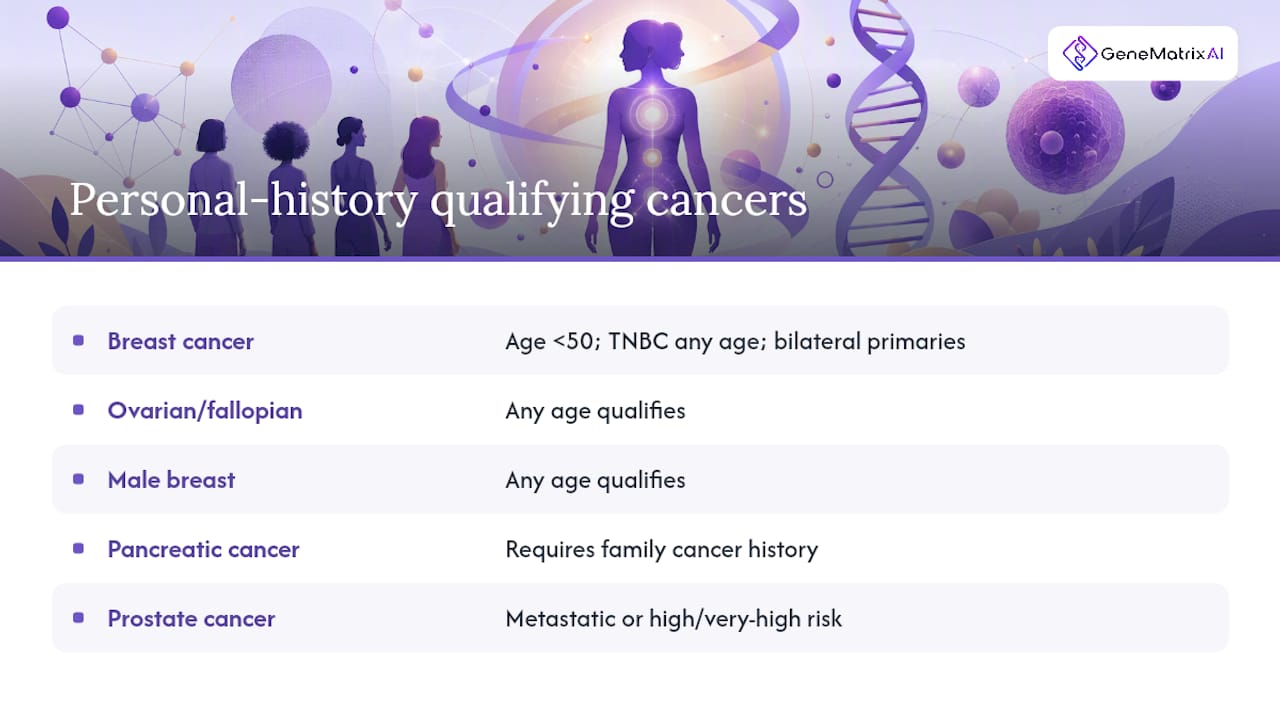
- Personal History Criteria: Which Cancers, Ages, and Tumor Types Qualify You
- Family History Criteria: Who in Your Family and What Patterns Matter
- Special Populations and Ancestry: Ashkenazi Founder Mutations, Men, and Minors
- Testing Workflow and Best Practices: Counseling, Test Order, and Test Type
- Insurance and Medicare Coverage: What Payers Actually Require
- Interpreting Results: Pathogenic Variants, Negatives, and Uncertain Findings
- When Results Change Care: Treatment and Prevention Implications
- Practical Steps to Get Assessed and Tested
- Clinical Evidence Base and Gene Matrix Expertise
- Genematrix's Approach to Eligibility and Testing
- How Genematrix Can Help With Hereditary Cancer Screening
- Sources
Quick Clinical Checklist: Do Any of These Apply to You?
Clinicians and insurers don't guess at BRCA eligibility. They work from a specific set of triggers drawn from NCCN referral criteria, USPSTF screening guidance, and Medicare's coverage rules. If you check any of these boxes, you have a legitimate case for referral.
- Breast cancer diagnosed at age 50 or younger
- Triple-negative breast cancer diagnosed at any age
- Breast cancer in both breasts, or two separate primary breast tumors
- Ovarian, fallopian tube, or primary peritoneal cancer at any age
- Male breast cancer, at any age
- Pancreatic cancer with a family history of breast, ovarian, or prostate cancer
- Metastatic, high-risk, or certain aggressive prostate cancers
- A first or second-degree relative with a known BRCA1 or BRCA2 mutation
- Multiple relatives on the same side of the family with breast or ovarian cancer
- Ashkenazi Jewish ancestry combined with any personal or family cancer history
Most private insurers and Medicare's coverage policy key off this exact list. If you don't see yourself here but a parent or sibling had cancer young, don't rule yourself out. Family history is its own path to eligibility, and it's worth a conversation with a genetic counselor either way. One more thing worth repeating because it changes the whole testing strategy: if a relative already had cancer, get them tested first.
Personal History Criteria: Which Cancers, Ages, and Tumor Types Qualify You
Age is doing a lot of work in these guidelines, and it's not arbitrary. BRCA-related breast cancers tend to cluster at younger ages than breast cancer in the general population, so a diagnosis before 50 raises a flag that a diagnosis at 68 usually doesn't. NCCN referral criteria use 50 as a common cutoff for breast cancer, though the exact threshold shifts depending on what else is happening in your history and your family's.
Triple-negative breast cancer breaks that age rule entirely. Because this subtype has a stronger known association with BRCA1 mutations, guidelines support testing regardless of how old you were at diagnosis, sometimes with cutoffs extending to 60. The tumor biology matters more than the calendar here.
A handful of other personal-history scenarios clear the bar on their own, without needing a supporting family history:
Ovarian, fallopian tube, or primary peritoneal cancer. Any age, any family history status. These cancers have such a tight link to BRCA1/2 that a diagnosis alone is usually enough to justify testing.
Male breast cancer. Rare enough on its own that a diagnosis at any age warrants a genetics referral, since male breast cancer has a disproportionately high association with BRCA2 in particular.
Bilateral breast cancer or multiple primary tumors. Two separate cancers in one person, especially in both breasts, is a pattern guidelines treat as a red flag independent of age.
Pancreatic cancer with a family cancer history. Pancreatic cancer alone doesn't automatically trigger testing, but combined with breast, ovarian, or prostate cancer elsewhere in the family, it often does.
Certain prostate cancers. ASCO and the Society of Surgical Oncology support testing for metastatic prostate cancer or high-risk/very-high-risk disease, partly because the result can open the door to PARP inhibitor therapy.
Timing matters too. If you're newly diagnosed and actively weighing treatment, testing sooner rather than later can change decisions about surgery type and eligibility for specific drug therapies. If you're years past treatment and in surveillance, there's less urgency, but the eligibility criteria remain relevant. A prior cancer diagnosis that meets these criteria can still qualify you for testing.
Family History Criteria: Who in Your Family and What Patterns Matter
Personal history is only half the picture. A lot of people who've never had cancer themselves still meet BRCA testing criteria because of what's happened to relatives, and this is where most people underestimate their own eligibility.
Close relatives, for these purposes, mean first-degree (parents, siblings, children) and second-degree (grandparents, aunts, uncles, half-siblings, nieces, nephews) relatives on both your mother's and father's side. That last part trips people up constantly. BRCA2 mutations pass through fathers just as readily as mothers, so a paternal grandmother's ovarian cancer counts exactly as much as a maternal one's.
The specific patterns that typically meet criteria:
A first or second-degree relative diagnosed with breast cancer at 50 or younger; ovarian, fallopian tube, or peritoneal cancer in a relative at any age; two or more relatives on the same side of the family with breast cancer at any age; male breast cancer anywhere in the family tree; or a cluster of pancreatic and prostate cancers alongside breast or ovarian cancer on one side of the family.
None of this requires a lab-confirmed mutation in the relative. A pattern of diagnoses is enough to justify a counseling referral, even without paperwork proving a specific gene is involved.
Adopted individuals and people from small families face a real gap here, since the whole system leans on family history that may simply not exist for them. Clinicians handle this by leaning more heavily on personal history criteria and, when little is known, treating an unclear picture as reason for a lower threshold for referral rather than automatic disqualification. An unknown family history isn't the same as a clean one, and good clinicians know the difference.
If you're trying to build your case before an appointment, specificity helps enormously. "My aunt had cancer" is much less useful than "my mother's sister was diagnosed with ovarian cancer at 44." Try to gather ages at diagnosis, the specific cancer type, and pathology reports if any family member has them. Genetic counselors can work with rough information, but precise dates and diagnoses turn a vague family story into a testable pattern, and it's the single biggest thing you can do to speed up your own workup.
Special Populations and Ancestry: Ashkenazi Founder Mutations, Men, and Minors
Ashkenazi Jewish ancestry changes the testing math significantly. Three specific founder mutations, two in BRCA1 and one in BRCA2, account for a disproportionate share of hereditary breast and ovarian cancer in this population, which is why CDC guidance supports a targeted approach: test for those three founder mutations first, since they explain most of the inherited risk in this group. If that targeted panel comes back negative but the family history remains suspicious, broader multigene sequencing is the reasonable next step.
Men are frequently overlooked in their own right, not just as a source of family history. If you're a man who's had breast cancer, or you have relatives with breast, ovarian, pancreatic, or aggressive prostate cancer, you meet the same referral logic as anyone else. Cancer genetics has historically been framed as a women's issue, and that framing doesn't hold up against the actual biology.
Testing minors is generally discouraged, and Mayo Clinic is direct about why: BRCA-related cancers are adult-onset conditions, so a positive result in a child doesn't change any medical decision until adulthood, while it does introduce psychological weight and potential insurance complications a child can't meaningfully consent to. That calculus shifts once someone turns 18 and can make an informed choice about what they want to know.
Limited or unknown family history, whether from adoption, estrangement, or simply a small family tree, doesn't disqualify anyone. It shifts the emphasis toward personal history and ancestry, and often toward a slightly lower bar for offering a counseling referral rather than a hard "no."
Testing Workflow and Best Practices: Counseling, Test Order, and Test Type
Genetic counseling isn't a formality you check off before the real work starts. It's where a counselor reviews your actual risk, walks through what different results would mean for your life and your relatives', and figures out which test makes sense for your situation. Cleveland Clinic treats this counseling step as close to mandatory for exactly that reason, and most payers require documentation of it before they'll cover testing.
The single most important workflow principle, and the one people skip most often: test the affected relative first. If your mother had ovarian cancer and is still living, she should be tested before you are. A negative result in her essentially closes that branch of investigation for you without you needing a test at all. A positive result gives you a specific, known mutation to check for, which is a far more useful test than a blind multigene panel. This isn't a nice-to-have process step. The CDC's guidance frames family-first testing as the standard for exactly this reason, and genetic counseling literature backs it up: testing the affected person first sharply increases the odds of finding an informative result while sparing unaffected relatives unnecessary testing.
Once you know who's being tested, there's a choice about test type. Targeted single-site testing checks for one specific mutation already identified in the family, and it's fast and inexpensive. BRCA-only testing sequences both genes in full when no known family mutation exists yet. Multigene panels go further, screening dozens of genes associated with hereditary cancer syndromes beyond BRCA, which makes sense when your family history is complicated or doesn't point cleanly at BRCA alone.
Sample collection is simple either way, a blood draw or saliva sample, and most labs return results within one to three weeks. Genetic counseling before testing also sets realistic expectations for that turnaround and what happens once results come back.
Insurance and Medicare Coverage: What Payers Actually Require
Coverage isn't automatic just because you meet a clinical criterion. Payers want documentation, and the rules differ meaningfully between Medicare and private insurance.
Medicare's Local Coverage Determination L36499 is notably restrictive for beneficiaries who haven't had cancer themselves. Testing unaffected Medicare beneficiaries generally isn't covered unless there's a known family mutation or specific documented signs and symptoms suggestive of hereditary risk. Medicare typically treats BRCA testing as a once-in-a-lifetime benefit, requiring medical necessity to be documented in your chart.
Private insurers tend to follow NCCN and USPSTF criteria more directly, and coverage usually hinges on three things: documented medical necessity, evidence that genetic counseling happened first, and a personal or family history that maps onto recognized guideline criteria. Insurers are less likely to push back if your provider's notes explicitly reference the specific criterion you meet, rather than a vague mention of "family history of cancer."
What actually helps your case when you're building documentation:
Pathology reports confirming cancer type and, when relevant, hormone receptor status. A written family pedigree with ages at diagnosis, not just names of relatives who had cancer. A formal recommendation from your physician or genetic counselor tying your history to a specific guideline criterion.
If a claim gets denied, you're not out of options. Appeals are common and often successful when the original documentation was thin. Some testing labs also offer financial assistance programs for people who don't qualify for coverage, and out-of-pocket costs vary widely depending on whether you're paying for a targeted single-mutation test or a full multigene panel. Understanding how insurance coverage for genetic testing actually works before you start the process saves a lot of frustration later, and knowing realistic BRCA testing costs upfront helps you decide whether to push an appeal or pay out of pocket.
Interpreting Results: Pathogenic Variants, Negatives, and Uncertain Findings
A pathogenic or likely pathogenic result means the lab found a mutation known to meaningfully increase cancer risk. That result triggers real, specific action: intensified screening, a conversation about risk-reducing surgery, and, critically, the opportunity for relatives to get tested for that exact mutation rather than guessing at their own risk.
Negative results split into two categories that get confused constantly, and the difference matters. A true negative happens when a known mutation already exists in the family and you test negative for that specific mutation. That result is genuinely reassuring; it tells you that you didn't inherit the risk variant circulating in your family. An uninformative negative is different: no mutation was found, but no affected relative has ever been tested, so there's no confirmed family mutation to rule out. As USPSTF's supporting evidence makes clear, an uninformative negative doesn't necessarily drop your risk back to the general population baseline, because your family's cancer pattern might be driven by a gene the test didn't check or a mutation type standard sequencing misses.
A variant of uncertain significance, or VUS, is the result that frustrates patients most. The lab found a genetic change, but there isn't enough evidence yet to call it harmful or harmless. VUS results generally shouldn't drive major medical decisions like risk-reducing surgery on their own. Labs periodically reclassify these variants as more data accumulates across the population, so a VUS today might get reclassified as benign or pathogenic years later. Ask your testing lab or genetic counselor whether they'll notify you if a reclassification happens. Not all of them do automatically.

Any of these results is worth walking through with a genetic counselor or medical geneticist, not just a general practitioner. What a result means for your children, your siblings, and your own future screening schedule requires the kind of nuance that a five-minute clinic conversation usually can't cover.
When Results Change Care: Treatment and Prevention Implications
A positive BRCA result isn't just information. It can directly change treatment decisions in the middle of active cancer care. PARP inhibitors, a class of drugs that target cancer cells with defective DNA-repair mechanisms, work specifically well against BRCA-mutated tumors. ASCO and Society of Surgical Oncology guidance points to this as a reason to test many newly diagnosed breast cancer patients promptly, since a mutation finding can open up a treatment option that wouldn't otherwise be on the table.
Beyond active treatment, a positive result reshapes long-term prevention strategy. Options typically discussed include earlier and more frequent screening, often alternating mammography with MRI, risk-reducing surgery such as prophylactic mastectomy or oophorectomy, and in some cases chemoprevention. Enhanced imaging protocols sometimes involve coordinating with specialized remote mammography reading services to keep up with more frequent screening intervals without long wait times for radiologist review.
Maybe the most underappreciated impact: a single positive result cascades through an entire family. Once one relative has a confirmed mutation, every blood relative can get targeted testing for that exact variant instead of a full uncertain workup, turning one diagnosis into clarity for an entire family tree.
Practical Steps to Get Assessed and Tested
Turning eligibility questions into an actual plan comes down to a handful of concrete moves.
- Use a brief risk assessment tool. The USPSTF-recommended approach starts with a short screening questionnaire your primary care provider can administer in minutes to flag whether your history warrants a closer look.
- Build a three-generation family history. List parents, siblings, children, grandparents, aunts, and uncles on both sides, with cancer type and age at diagnosis for anyone affected.
- Ask your provider for a genetic counseling referral. Primary care doctors can refer you directly to a genetic counselor or a clinical genetics service; you don't need a specialist to make the first ask.
- Identify the best relative to test first. If someone in your family has had cancer and is willing to test, that person should generally go first.
- Gather pathology reports and confirmed diagnosis dates. Precise records speed up counseling and strengthen insurance documentation.
- Expect a real counseling conversation before any lab work. Informed consent, a discussion of what results could mean, and cost expectations typically come before a sample is drawn, and turnaround times vary by lab and test type.
Clinical Evidence Base and Gene Matrix Expertise
Every checklist in this guide traces back to the same core sources: USPSTF's recommendation statement on risk assessment and referral, NCCN referral tables used across oncology practices, CDC guidance on testing sequence and ancestry-specific approaches, and Medicare's LCD rules on coverage. These aren't competing frameworks. They largely agree on who qualifies, and where they differ, it's usually a matter of documentation strictness rather than clinical substance.
Genematrix built its hereditary cancer screening around this same evidence base. The company is CLIA certified, runs its analysis through the GeneMatrixAI platform trained on more than 500,000 genetic profiles, and typically returns clinically actionable reports within 72 hours. Every report goes through clinician review before it reaches a patient, and Genematrix offers dedicated modules beyond hereditary cancer, including pharmacogenomics through GenePGx.
Genematrix's Approach to Eligibility and Testing
Eligibility criteria only matter if someone actually applies them consistently, and that's the part a lot of testing pathways get wrong. Genematrix evaluates each request against the same NCCN and USPSTF-aligned criteria walked through in this guide, then routes eligible patients toward genetic counseling before any sample gets processed, not after.
What makes the operational side work is the combination: a CLIA-certified lab, AI-assisted variant analysis that speeds up interpretation without skipping clinician review, and a 72-hour turnaround that's meaningfully faster than many hospital-based genetics programs. None of that replaces judgment. It just removes the weeks of waiting that make people abandon the process halfway through.
Whether you end up testing through a hospital genetics program, a direct-to-consumer option, or Genematrix comes down to how fast you need answers and whether counseling support is built into the process or something you have to arrange separately.
— Tarek
How Genematrix Can Help With Hereditary Cancer Screening
If you've checked several boxes on the eligibility criteria above but don't have an affected relative available to test first, a validated multigene panel is the practical path forward, and it's exactly what Genematrix's Hereditary Cancer Screening was built for.

The panel screens 108 genes tied to hereditary cancer risk, including BRCA1 and BRCA2, and runs through a CLIA-certified lab with GeneMatrixAI analysis behind it. Reports typically come back within a few days, reviewed by clinicians before you see them, not just algorithm output. That speed matters most for people making near-term decisions, whether that's a newly diagnosed patient weighing treatment options or someone with a strong family history who's tired of waiting months for a hospital genetics appointment. Genetic counseling is built into the process, so you're not left interpreting a pathogenic variant or a VUS on your own.
If your family history is thin, your relatives aren't available or willing to test, or you simply want a comprehensive panel rather than a single targeted mutation check, start with the Hereditary Cancer Screening panel and bring your family history notes to your counseling session. That single step turns months of uncertainty into an actionable report in under a week.
Sources
For the original guideline language behind everything covered here: the USPSTF recommendation statement, CDC's hereditary cancer testing guidance, Medicare's LCD L36499, and the ASCO–Society of Surgical Oncology germline testing guideline cover the clinical and coverage rules in full detail. Mayo Clinic's BRCA testing overview and Cleveland Clinic's BRCA testing guide offer patient-friendly explanations of the same criteria. To find a certified genetic counselor near you, the National Society of Genetic Counselors maintains a searchable directory.
This article is general information, not a substitute for advice from a qualified doctor. Consult a qualified healthcare professional about your own circumstances before acting on anything here.
- Genetic Testing for Hereditary Breast and Ovarian Cancer | CDC
- LCD - BRCA1 and BRCA2 Genetic Testing (L36499)
- Germline Testing in Patients With Breast Cancer: ASCO–Society of Surgical Oncology Guideline