
Building a longitudinal genetic health profile means sequencing once and keeping that genomic baseline live and queryable, so new research and clinical decisions can use it immediately instead of triggering another test. It's the "sequence once, query often" model gaining traction among genetics professionals, and it works because raw genomic data doesn't expire. Only the interpretation does.
Your first move: order a CLIA-certified hereditary cancer and pharmacogenomics panel, such as GeneCancer or GenePGx from Gene Matrix's GeneMatrixAI platform, or upload existing raw data to a platform that supports reanalysis under ACMG and CPIC guidelines.
- Get sequenced once, at clinical grade
- Store raw data (VCF/BAM) somewhere portable
- Set a reanalysis schedule instead of retesting
Fast fact: Longitudinal, multi-omics cohort research has identified dozens of clinically actionable findings per participant when genomic baselines are paired with repeated health measures over time.
Key Takeaways
A longitudinal genetic health profile works because it separates sequencing (done once) from interpretation (updated continuously), which cuts long-term cost and catches new risks as science advances.
| Point | Details |
|---|---|
| Sequence once, keep raw data | Choose CLIA-certified testing that hands you downloadable VCF/BAM files, not just a locked report. |
| Set a reanalysis cadence | Plan for reanalysis every 12 to 24 months or after a major life or diagnosis event. |
| Demand structured, EHR-ready results | Discrete data fields let clinical decision support flag drug interactions automatically. |
| Check consent and ownership terms upfront | Confirm you can opt out, export data, or delete your account before you buy. |
| Gene Matrix supports the full model | GeneCancer, GenePGx, and related modules run on a CLIA-certified lab with 72-hour turnaround and genetic counseling included. |
Table of Contents
- How Do You Start Building a Longitudinal Genetic Health Profile?
- Who Handles Reanalysis and Recontact Over Time?
- What Privacy and Consent Terms Should You Check First?
- What Do Sequencing and Reanalysis Typically Cost?
- How Do You Choose the Right Genetic Testing Subscription?
- What Do Genetic Test Reports Actually Mean?
- What Does the Research Say About Lifelong Genomic Profiles?
- Why This Approach Actually Matters
- How Gene Matrix Supports a Sequence-Once Approach
- Frequently Asked Questions
- Sources
How Do You Start Building a Longitudinal Genetic Health Profile?
The workflow has five real steps, not fifty. Skip any one of them and your profile stops being longitudinal. It just becomes another one-off test result sitting in a PDF somewhere.
1. Pick your starting modules. Most people should start with a hereditary cancer panel (looking at genes like BRCA1/BRCA2 and Lynch syndrome markers) plus a pharmacogenomics module like GenePGx, since medication safety applies to almost everyone eventually. Add GeneMind (psychiatric), GeneBaby (pediatric), or GeneDiet (nutrigenomics) if they match your family history or life stage.
2. Choose sequencing that gives you raw data. A CLIA-compliant large panel or whole-genome sequencing that hands you downloadable VCF, FASTQ, or BAM files is worth more over a decade than a cheaper test that only shows you a locked report. Raw data is what makes "query often" possible without paying for a new draw of blood every time medical knowledge shifts.
3. Confirm the data formats before you buy. Ask whether results export as structured data compatible with electronic health records, not just a PDF. This detail sounds bureaucratic. It's the single biggest factor in whether your genome becomes useful to a future doctor.
4. Set a maintenance cadence. Expect an initial report, then plan for reanalysis roughly every 12 to 24 months or whenever your provider flags a guideline update. Layer in event-triggered reanalysis: a new cancer diagnosis in the family, a pregnancy, or a new prescription are all reasons to requery your existing data rather than wait for the calendar.

5. Integrate genomics with the rest of your health picture. A genomic baseline read alongside wearable data and annual labs turns a static risk label into something closer to a forecast, according to longitudinal precision-health research tracking participants over multiple years.
The rhythm looks like this: sequence, store, annotate, integrate, requery, repeat.
Pro Tip: Ask any provider whether reanalysis uses your original sample data or requires a brand-new sample. If it's the latter, you're not building a longitudinal profile. You're just buying repeat tests with better branding.
For a deeper walkthrough of how raw results turn into usable insight, see how genomic profiles get analyzed for personalized health decisions.
Who Handles Reanalysis and Recontact Over Time?
Reanalysis typically falls to the lab or a clinical genetics and precision medicine team working together, not to you refreshing an app. Triggers include updated ACMG variant classifications, new CPIC drug guidelines, or a documented change in your own phenotype, like a new diagnosis.
Practice varies more than most people realize. Some labs only report upgrades to pathogenic status; others report every reclassification, up or down. Stakeholders mapping governance gaps in lifelong genomic medicine point out that recontact isn't scalable yet without automation, which is exactly why you need to ask about it directly rather than assume it happens.
Structured delivery matters just as much as the reanalysis itself. Pharmacogenomic results stored as discrete, EHR-readable fields, not scanned documents, are what let a pharmacy system flag a dangerous drug interaction automatically. Implementation research on pharmacogenomics shows structured, CDS-linked results are what actually change prescribing behavior.
Before signing up with any provider, ask directly:
- How often do you reanalyze stored genomic data?
- What specifically triggers a recontact: any reclassification, or only upgrades to pathogenic?
- Do results integrate with EHR systems or patient portals?
- Is there an audit log showing when and why a result changed?
Pro Tip: A provider who can't answer the recontact question specifically probably doesn't have a real reanalysis process. They're guessing along with you.
What Privacy and Consent Terms Should You Check First?
Before you buy, understand what you're consenting to: a one-time test, or an ongoing relationship where the lab can recontact you for years. Both models exist, and the fine print rarely spells out which one you're getting.
- Can you opt out of future reanalysis or data sharing without losing access to your original report?
- Can you download your raw genomic data (VCF/FASTQ) and delete your account entirely?
- Is the lab CLIA-certified, with a published policy on variant reclassification?
- Who pays for future reanalyses, you, your insurer, or is it bundled into a subscription?
Long-term genomic infrastructure costs money to maintain securely, and analysis of lifelong genomic medicine programs flags maintainable integrations and accountability as ongoing costs, not one-time setup fees. Read the governance terms with that in mind.
What Do Sequencing and Reanalysis Typically Cost?
Clinical hereditary cancer panels generally cost less than whole-genome sequencing, while offering the raw data and reanalysis potential that a basic ancestry-style test doesn't. Subscription models vary: some charge an annual fee covering periodic reanalysis and storage, others charge per reanalysis event.
- Turnaround for an initial clinically validated report can run as fast as 72 hours with providers like Gene Matrix that emphasize rapid, actionable results
- Insurance often covers testing tied to a clinical indication (strong family cancer history, an existing diagnosis) but rarely covers purely elective consumer curiosity testing
- A realistic timeline: order kit, submit sample, lab turnaround, receive report, then reanalysis roughly every 12 to 24 months or after a triggering event
Ask any provider for their reanalysis pricing in writing before you commit. Understanding how a clinical genomics provider validates results helps you compare pricing models that otherwise look identical on the surface.
How Do You Choose the Right Genetic Testing Subscription?
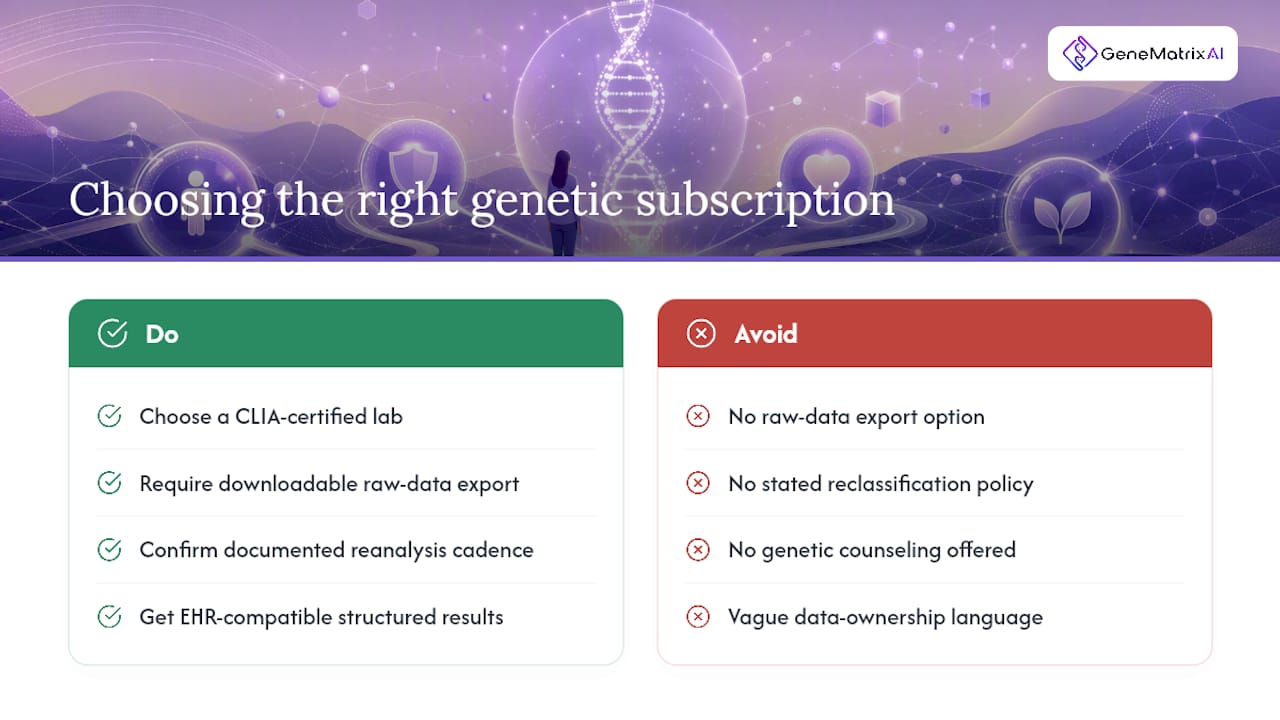
Not every "reanalysis included" subscription actually delivers reanalysis. Look for these must-haves: a CLIA-certified lab, downloadable raw data, a documented reanalysis cadence, genetic counseling access, EHR-compatible structured results, and transparent pricing with no hidden reanalysis fees.
Useful extras worth paying for: multi-module testing across cancer, pharmacogenomics, psychiatric, pediatric, and nutrigenomics panels; AI-driven reinterpretation as guidelines shift; a mobile app for tracking results; and pharmacist consults tied to PGx findings.
Red flags to walk away from: no raw-data export option, no stated reclassification policy, no genetic counseling offered at any point, vague language about who "owns" your stored data, or any provider calling their report "final." Genomic interpretation is never final. That's the whole point of building a longitudinal profile instead of a one-off test.
Pro Tip: Ask a provider to show you a sample structured report, not a marketing PDF. If they can't produce one, their EHR integration claim is probably aspirational.
Gene Matrix's model, spanning GeneCancer, GenePGx, GeneMind, GeneBaby, and GeneDiet under one CLIA-certified lab with AI-assisted reanalysis through GeneMatrixAI, is built around exactly this checklist.
What Do Genetic Test Reports Actually Mean?
Reports typically list a gene-level result, an ACMG interpretation category (pathogenic, likely pathogenic, variant of uncertain significance, benign), a recommended follow-up, and, for pharmacogenomics, a phenotype with CPIC-linked prescribing guidance.
- A pathogenic BRCA1 finding often leads to a genetic counseling referral and increased cancer screening frequency
- A CPIC-flagged PGx variant can change which antidepressant or blood thinner a doctor prescribes
- Either finding may prompt cascade testing offers for close relatives
What Does the Research Say About Lifelong Genomic Profiles?
The evidence base is real but still forming. Cohort research combining a genome baseline with repeated measures has documented dozens of actionable findings per participant, and reviewers generally agree the biggest bottleneck isn't collecting more genomic data. It's building systems that turn that data into usable clinical guidance.
Known limits worth knowing before you start:
- Governance and funding models for repeat reanalysis are still immature industry-wide
- EHR interoperability between labs and hospital systems remains inconsistent
- Recontact practices vary lab to lab, with no universal standard yet
- Some genes, CYP2D6 being the clearest example, have structural complexity that low-resolution genotyping can't fully resolve
Why This Approach Actually Matters
The gap between what genomic testing promises and what most people experience isn't about the science. It's about follow-through. Plenty of consumers get a hereditary cancer panel, read the summary once, and never touch the data again, treating a living dataset like a one-time verdict.
Gene Matrix's approach, a CLIA-certified lab, rapid turnaround, and multidisciplinary review with genetic counseling built in, works precisely because it treats your genome as infrastructure rather than a keepsake. Coordinate any significant finding with your physician before acting on it. The data is a starting point, not a diagnosis.
How Gene Matrix Supports a Sequence-Once Approach
Gene Matrix built its testing model around the exact checklist this article just walked through. The Hereditary Cancer Screening panel covers 108 genes in a single CLIA-certified test, paired with GenePGx for medication safety and optional GeneMind, GeneBaby, or GeneDiet modules depending on your family's needs.

Reports run through the GeneMatrixAI platform and typically return within 72 hours, with genetic counseling built into the process rather than sold as an upsell. Every result is designed for structured delivery, so a future clinician can act on it without decoding a PDF. If you want to see the lab methods and certifications behind that promise, Gene Matrix's science and technology page lays it out in plain terms. Ready to start your own sequence-once profile? Visit the hereditary cancer screening page to see panel details and get your first sample kit moving.
Frequently Asked Questions
What is a longitudinal genetic health profile? It's a personal genomic dataset, sequenced once at clinical grade, that gets reinterpreted over time as guidelines and personal health circumstances change, rather than requiring a new test each time.
How often should I get my genetic data reanalyzed? Roughly every 12 to 24 months, or sooner if you have a new diagnosis, a pregnancy, a new medication, or your provider flags an ACMG or CPIC guideline update.
Do I need to give a new sample every time? No. A true sequence-once model reuses your stored raw data (VCF/BAM) for reanalysis, which is faster and cheaper than resequencing.
Will insurance cover ongoing reanalysis? Insurance more often covers testing tied to a documented clinical indication than elective reanalysis, so check your specific plan and provider's billing policy before assuming coverage.
What should I ask before choosing a testing subscription? Ask about reanalysis cadence, what triggers recontact, whether raw data is downloadable, and whether results integrate with EHR systems or patient portals.
This article is general information, not a substitute for advice from a qualified doctor. Consult a qualified healthcare professional about your own circumstances before acting on anything here.
Sources
- Sequencing for a Lifetime: Value, Feasibility, and the Governance Gap in Lifelong Genomic Medicine | medRxiv
- A longitudinal big data approach for precision health | Nature Medicine
- Advancing pharmacogenomics from single-gene to preemptive testing | Annual Reviews