

If your DNA report flags a serious health risk, contact your ordering clinician or a board-certified genetic counselor today and request clinician-ordered confirmatory testing at a CLIA-certified lab. If your concern is ancestry or genealogy, the path is different: export your raw data file, review the privacy settings of any site you plan to upload it to, and compare results across databases before drawing conclusions.
This DNA report second opinion guide covers both tracks. The clinical path and the genealogy path require different experts, different timelines, and different privacy considerations. Mixing them up wastes time and, in health cases, can delay decisions that matter.
The single most important rule: A consumer DNA test is not a clinical diagnosis. Per CDC guidance on BRCA mutations, a consumer test that suggests a serious risk, such as a BRCA variant, requires clinician-ordered confirmatory testing before any medical decision is made. Act on the report's direction, not the report alone.
Immediate actions by situation:
- Health finding (pathogenic or likely pathogenic result): Call your doctor or request a genetic counselor referral today. Do not schedule surgery, start prophylactic medication, or make major health decisions based on a consumer report alone.
- Variant of uncertain significance (VUS): Ask your clinician whether family testing is appropriate. A VUS rarely justifies immediate clinical action on its own.
- Ancestry discrepancy or genealogy question: Download your raw data file from the original provider. Before uploading it anywhere else, check that site's deletion policy, law enforcement access defaults, and research-sharing settings.
- Paternity or legal/forensic question: Seek a forensic DNA laboratory or a licensed genetic counselor with forensic experience. Consumer reports carry no legal standing.
Key Takeaways
A consumer DNA report is a starting point, not a clinical verdict. Confirmatory testing at a CLIA-certified lab, ordered by a clinician, is the only path to a medically actionable result.
| Point | Details |
|---|---|
| Clinical findings need confirmation | A pathogenic or likely pathogenic consumer result requires clinician-ordered testing at a CLIA-certified lab before any medical decision. |
| VUS means wait and test family | A variant of uncertain significance rarely justifies immediate action; family segregation testing is the appropriate next step. |
| Ancestry second opinions use raw data | Export your raw file, check deletion and law-enforcement policies, then upload to a second database for comparison. |
| GINA does not cover all insurance | Life, disability, and long-term care insurers can legally use genetic results in underwriting; review policies before sharing results. |
| Genematrix for clinical confirmation | Genematrix provides CLIA-certified hereditary cancer and pharmacogenomics testing with clinician-validated reports within 72 hours. |
Table of Contents
- When should you seek a second opinion on your DNA results?
- Who actually provides second opinions on DNA results?
- How to get a clinical second opinion, step by step
- How to get a second opinion on ancestry or genealogy results
- How to read your genetic test report and understand variant classification
- What to bring and what to ask at your second-opinion appointment
- What do second opinions and confirmatory tests cost in the U.S.?
- Privacy and legal protections you need to know in the U.S.
- What actually matters when you get a confusing DNA result
- Genematrix offers clinician-validated testing with a 72-hour turnaround
- Sources
When should you seek a second opinion on your DNA results?
Not every report warrants an urgent call to a specialist. The decision depends on what the report says and what you plan to do with it.
Clinical red flags that require prompt action:
- The report classifies a variant as pathogenic or likely pathogenic in a high-risk gene such as BRCA1, BRCA2, MLH1, MSH2, or other Lynch syndrome genes.
- You have symptoms that align with the reported finding.
- You are considering surgery, chemotherapy, or other major medical interventions based on the result.
- A direct-to-consumer test produced a positive BRCA or cancer-risk result and no clinician has reviewed it.
- The report conflicts with a previous clinical test result.
Valid but non-urgent reasons to seek a review:
- Your report lists a VUS and you want to understand whether family testing could resolve it.
- You are planning a pregnancy and want a counselor to interpret carrier status results.
- You received a "no pathogenic variant detected" result but have a strong family history of a hereditary condition.
- Your ancestry estimate changed significantly between two tests, or a relative match does not align with your known family tree.
- You have a paternity question or a legal matter that requires a forensic-grade result.
The urgency gap between these two categories is real. A pathogenic BRCA2 result warrants a call within days. An ancestry percentage discrepancy between two consumer databases can wait until you have time to research upload privacy settings carefully.
Pro Tip: If you are unsure whether your result is clinically significant, search the variant's name in ClinVar — the public database maintained by NCBI. A variant classified as pathogenic by multiple submitters carries more weight than one with a single submission or conflicting interpretations.
Who actually provides second opinions on DNA results?
The right expert depends entirely on what you need re-evaluated. These roles do not overlap as much as people assume.

Board-certified genetic counselor (MS, CGC): Interprets clinical reports, explains variant classification, coordinates confirmatory testing, and helps you communicate findings to family members. Cannot order lab tests independently in most states, but works alongside an ordering physician. Find one through the National Society of Genetic Counselors directory.
Clinical geneticist (MD or MD/PhD): A physician who can both interpret results and order confirmatory tests. Best for complex multi-system presentations or when a counselor's interpretation needs physician-level clinical integration.
Clinical laboratory (CLIA-certified): Can reanalyze a variant, provide a formal second-read on a submitted report, or run a new confirmatory test. Some labs offer formal variant reclassification requests. They cannot provide clinical management advice.
Forensic DNA laboratory: Handles paternity, legal identity, and chain-of-custody questions. Results from consumer tests have no standing in court; a forensic lab produces legally defensible reports.
Genealogy database or raw-data upload service: Compares your raw genotype file against a different reference population or relative database. Useful for ancestry discrepancies and relative matching. Cannot provide any clinical interpretation.
Key boundaries to keep in mind:
- A genealogy service cannot diagnose a health condition, period.
- A clinical lab reanalysis addresses the variant, not the clinical management plan.
- A genetic counselor interprets findings but typically does not order tests independently.
- A forensic lab result is not interchangeable with a clinical diagnostic result.
Look for these credential signals: "CGC" after a counselor's name (certified by the American Board of Genetic Counseling), "FACMG" for a clinical geneticist (fellow of the American College of Medical Genetics and Genomics), and "CLIA-certified" for any lab performing clinical testing.
How to get a clinical second opinion, step by step
This workflow applies when your report contains a health-related finding and you want a medically valid confirmation.
-
Gather your documents before making any calls. You need: the full lab report as a PDF (not a screenshot), your raw data file if available, a written family health history going back two generations, your current medication list, any relevant symptoms you have noticed, and prior imaging or pathology reports if they relate to the finding.
-
Find and contact the right clinician. Your primary care physician can refer you to a genetic counselor or clinical geneticist. If you want to move faster, search the NSGC "Find a Genetic Counselor" directory directly, or ask your insurer for in-network genetics providers. Telehealth genetics services have expanded access significantly; many board-certified counselors now see patients remotely across state lines.
-
Request clinician-ordered confirmatory testing. This is the step that separates a consumer result from a clinical diagnosis. Your clinician sends a sample to a CLIA-certified laboratory for targeted analysis. For single-variant confirmation, labs typically use Sanger sequencing or targeted next-generation sequencing. These methods are designed to confirm or rule out one specific variant with high accuracy, which is exactly what you need before making a medical decision. The Mass General Brigham guide to reading a genetic test report explains what the methodology section of your original report should tell you about what the assay can and cannot detect.
-
Consider family (segregation) testing if you have a VUS. When a variant's significance is uncertain, testing close relatives who do or do not share the relevant condition can help determine whether the variant tracks with disease in your family. Some labs offer family testing at reduced cost or no cost when they are close to reclassifying a VUS.
-
Follow up on reclassification. Labs periodically update variant classifications as new evidence accumulates. Ask the original lab whether they have a reanalysis or reclassification request process. You or your clinician can also submit evidence to ClinGen, the NIH-funded resource that curates variant evidence and supports reclassification efforts.
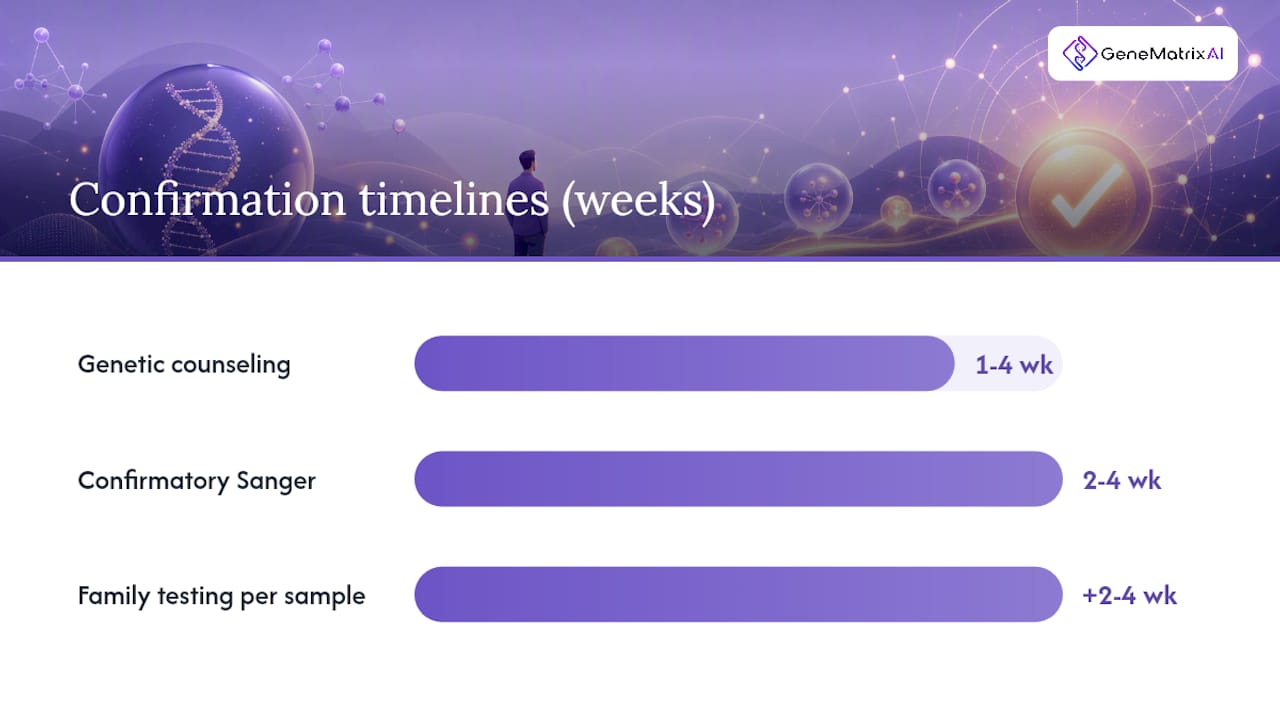
Realistic timelines: A genetic counseling appointment typically takes 1–4 weeks to schedule, though telehealth options can be faster. Confirmatory Sanger sequencing usually returns results in 2–4 weeks. Family testing adds another 2–4 weeks per sample. Formal variant reclassification from a lab can take months.
Pro Tip: When you call to schedule, say specifically: "I have a consumer genetic test result I'd like reviewed by a genetic counselor, and I may need a clinician-ordered confirmatory test." That framing gets you routed to the right person faster than a general genetics referral.
How to get a second opinion on ancestry or genealogy results
Ancestry discrepancies are common and usually not alarming. Different databases use different reference populations, which is why your ethnicity estimate from one service might look meaningfully different from another's.
-
Download your raw data file from the original provider. Look for a "Download Raw Data" or "Export DNA" option in your account settings. The file is usually a compressed text file of your genotype calls. Save it to an encrypted folder on your device, not just your downloads' folder.
-
Check these four things before uploading anywhere else:
- Does the receiving site have a clear deletion policy, and can you actually delete your data on request?
- What are the law-enforcement matching defaults? Some sites share with law enforcement by default; others require an opt-in.
- Is research sharing turned on by default? You may be contributing your data to studies without realizing it.
- Does the site accept uploads from your original provider's format? Some major services block third-party uploads entirely.
-
Upload to a service that accepts your file format and compare ethnicity estimates and relative matches. Differences in centiMorgan (cM) totals for the same relative across platforms are normal because each service uses its own relationship-caller algorithm and reference panel.
-
For adoptees or donor-conceived people: Focus on relative matching rather than ethnicity estimates. A first-cousin match at 1,100–1,500 cM is consistent across most platforms regardless of reference population differences. Upload to multiple databases to maximize the pool of potential relatives who might recognize your connection.
What to expect from ethnicity estimates: They are statistical inferences, not genealogical facts. A 12% "Eastern European" result on one platform and 8% on another does not mean one is wrong. Both reflect different reference panels and different algorithmic choices. Treat ethnicity percentages as approximate regional signals, not precise ancestry fractions.
Pro Tip: Never send your raw DNA file as an email attachment. Use the receiving site's secure upload portal, or transfer via an encrypted file-sharing service. Once a raw file leaves your control, you cannot un-share it.
How to read your genetic test report and understand variant classification
The language in a genetic test report is precise and consequential. Misreading one term can lead to unnecessary panic or, worse, false reassurance.
The five-tier variant classification system
Clinical labs classify variants using a five-tier system developed by the American College of Medical Genetics and Genomics (ACMG) and the Association for Molecular Pathology (AMP):
- Pathogenic: Strong evidence the variant causes disease.
- Likely pathogenic: Evidence strongly suggests disease causation, though not conclusive.
- Variant of uncertain significance (VUS): Insufficient evidence to classify as pathogenic or benign. This is the most common source of confusion.
- Likely benign: Evidence suggests the variant is not disease-causing.
- Benign: Strong evidence the variant does not cause disease.
Labs apply this framework using the same published criteria, but professional judgment still enters the picture when evidence is limited. That is why two labs can classify the same variant differently — not because one is wrong, but because they weighted the available evidence differently. This is the core reason second opinions exist in clinical genetics.
What each section of your report tells you
A standard genetic test report contains four main sections, as described in Mass General Brigham's report-reading guide: patient and test details, a result summary, variant evidence (including population databases, literature, and functional studies), and a methodology and limitations section. The methodology section is the one most readers skip. It tells you which genes were analyzed, what the minimum coverage depth was, and what types of variants the assay cannot detect. That last point matters when you are wondering why a "negative" result does not match your family history.
For whole genome sequencing specifically, best-practice groups recommend that labs follow clear reporting policies and maintain direct clinician communication because WGS produces far more data than a targeted panel and the interpretation complexity is correspondingly higher.
Common test types and their detection limits
| Test type | What it reliably detects | Common limitations |
|---|---|---|
| Single-gene test | Variants in one specified gene | Misses variants in other genes that cause the same phenotype |
| Multi-gene panel | Variants across dozens to hundreds of genes | Higher VUS rate; may not cover all variant types (e.g., large deletions) |
| Exome sequencing | Coding variants across most genes | Misses non-coding variants; structural variants often not reported |
| Whole genome sequencing | Coding and non-coding variants; structural variants | Interpretation complexity; variant of uncertain significance rate is high |
Pro Tip: When a VUS appears on your report, the appropriate response is watchful waiting plus family testing, not immediate medical intervention. Labs and professional guidelines consistently advise against clinical action based on a VUS alone. Ask your clinician to note the VUS in your record so you can be notified if it is reclassified.
For a plain-language breakdown of how variant evidence is weighed, the gene variant analysis guide on the Genematrix blog walks through the evidence categories without the technical jargon.
What to bring and what to ask at your second-opinion appointment
Preparation cuts appointment time in half and gets you better answers.
Documents to bring:
- Full lab report as a PDF, including the methodology and limitations section (describe the types of variants the assay cannot detect)
- Raw data file (for clinical appointments, ask in advance whether the lab or counselor can use it)
- Original test consent form
- Written family health history: conditions, ages of diagnosis, and ages of death for first- and second-degree relatives
- Current medication list (especially relevant if pharmacogenomics results are involved)
- List of symptoms you have noticed, with approximate onset dates
- Prior imaging, pathology, or surgical reports if they relate to the finding
Questions to ask your genetic counselor or clinician:
- Is this result clinically actionable, and if so, what is the recommended next step?
- What confirmatory test do you recommend, and which CLIA-certified lab will perform it?
- Would family testing help resolve this result, and who in my family should be tested?
- What are the risks and benefits of acting on this result now versus waiting for more evidence?
- Does this lab have a reclassification request process, and how do I initiate it?
- What does a negative or inconclusive result on the confirmatory test mean for my clinical management?
What to request from the original lab:
- A variant evidence summary (the specific criteria used to classify the variant)
- The coverage report (which regions of the gene were sequenced and at what depth)
- The lab's reanalysis or reclassification policy in writing
What do second opinions and confirmatory tests cost in the U.S.?
Costs vary widely depending on whether you have insurance, what type of test is ordered, and which lab performs it.
Typical cost ranges:
- Genetic counseling session: $150–$600 per session without insurance. Many insurers cover genetic counseling when ordered by a physician for a medically indicated reason, particularly for hereditary cancer risk assessment.
- Clinician-ordered confirmatory testing (Sanger or targeted sequencing): Often covered by insurance when ordered for a clinical indication. Without coverage, single-variant Sanger confirmation can run $200–$500 depending on the lab.
- Multi-gene panel (clinical-grade): $250–$2,000 without insurance; frequently covered for patients with a documented family history or clinical indication. Prior authorization is often required.
- Exome or genome sequencing: $500–$5,000 without insurance; coverage varies significantly by insurer and indication.
- Raw-data upload to a genealogy database: Free to low-cost ($0–$30 for most services that accept uploads).
Turnaround times:
Typical wait times may vary; genetic counseling appointments and testing results can take from a few weeks to several months depending on the service and provider.
Insurance notes: Call your insurer before scheduling and ask specifically whether "genetic counseling" and "molecular genetic testing" are covered benefits under your plan. Ask whether prior authorization is required and, if so, what clinical documentation the ordering physician needs to submit. Coverage may vary.
Privacy and legal protections you need to know in the U.S.
Genetic information occupies a unique legal space in the United States. Understanding what the law covers and where it stops is not optional if you are sharing your data.
What GINA covers and what it does not
The Genetic Information Nondiscrimination Act (GINA) prohibits health insurers and employers from discriminating based on genetic information. That protection is real and meaningful. What GINA does not cover: life insurance, disability insurance, and long-term care insurance. Insurers in those categories can legally ask about genetic test results and factor them into underwriting decisions in most states. If you are considering purchasing any of these policies, talk to a financial advisor or attorney before sharing genetic test results.
Privacy risks when uploading raw data
Uploading your raw DNA file is a fresh privacy decision with consequences that extend beyond you. Your raw genotype file contains information about your biological relatives, who never consented to share their data. Law-enforcement access policies differ across genealogy platforms, and some sites share with law enforcement by default unless you opt out.
Four questions to ask before uploading your raw file to any site:
- Can I delete my data completely, and how long does deletion take to propagate through the system?
- Does this site share with law enforcement by default, or do I have to opt in?
- Is my data used for research by default, and can I opt out without losing service features?
- What happens to my data if this company is acquired or goes bankrupt?
Practical steps to reduce exposure:
- Store your raw DNA file in an encrypted folder (use VeraCrypt or your operating system's built-in encryption).
- Use a dedicated email address when creating accounts on genealogy platforms, separate from your primary email.
- Never send your raw file as an email attachment over standard email.
- Confirm the deletion policy in writing before uploading, and follow up after deletion to verify.
What actually matters when you get a confusing DNA result
Most people who receive an unexpected genetic result spend the first 48 hours in one of two unproductive states: either catastrophizing a VUS into a diagnosis, or dismissing a genuinely actionable pathogenic finding because the report came from a consumer kit and "those things aren't always accurate."
Both reactions miss the point. The report is a signal, not a verdict. The right response is to treat it as the beginning of a clinical conversation, not the end of one. A clinician who integrates your phenotype, your family history, and the technical limits of the assay will reach a more reliable conclusion than the report alone can provide. Negative results deserve the same scrutiny: a "no pathogenic variant detected" finding does not rule out genetic causes when the panel used did not cover the relevant gene or variant type.
The other thing worth saying plainly: asking for a second opinion does not offend clinicians. Framing your request as "I want to make sure I understand this result fully before we decide on next steps" is a completely reasonable clinical conversation. Most geneticists and counselors welcome it because it means you are engaged and less likely to act on a misunderstanding.
One priority order that works in practice: confirm clinically actionable findings first, through a CLIA-certified lab and a board-certified counselor or geneticist. Then pursue family testing or genealogy re-analysis as a secondary step, once the clinical picture is clearer. Doing it in the other order, chasing ancestry discrepancies while a potentially pathogenic variant sits unconfirmed, is where people lose time they cannot get back.
Genematrix offers clinician-validated testing with a 72-hour turnaround
If your report flagged a hereditary cancer risk, a pharmacogenomics concern, or a finding you want confirmed by a CLIA-certified lab, Genematrix delivers what a consumer test cannot: clinician-validated results, AI-driven analysis trained on 500,000+ genetic profiles, and reports returned within 72 hours.

Genematrix's GeneCancer panel covers BRCA1, BRCA2, Lynch syndrome genes, and other high-risk hereditary cancer markers. The GenePGx module addresses medication-gene interactions for people managing complex drug regimens. Every report is processed in a CLIA-certified facility and reviewed for clinical accuracy before delivery. Genetic counseling is available to walk you through your results and next steps.
People with a family history of hereditary cancer, those managing multiple medications, and families planning for children get the most from Genematrix's testing suite. To get started, visit the Genematrix test finder to select the panel that fits your situation, or review the lab certifications and science behind the platform before ordering.
Sources
These primary resources are worth bookmarking whether you are a patient, a caregiver, or a clinician reviewing a report.
This article is general information, not a substitute for advice from a qualified doctor. Consult a qualified healthcare professional about your own circumstances before acting on anything here.