

Before you walk into that appointment, give your primary care physician one thing: a focused, one-page clinician-ready summary of your at-home DNA findings, limited to two or three decision-relevant results. Ask directly whether clinical confirmation in a CLIA-certified lab is warranted, and request a genetics referral if any finding could change your screening, medications, or surgical decisions. That single, prepared packet is what turns a vague conversation into a documented action plan.
A successful DNA test results primary care discussion ends with clear next steps written in your chart: a referral, a confirmatory test order, a medication review, or documented reassurance. Vague "we'll keep an eye on it" outcomes are avoidable when you arrive prepared.
What to bring:
- Original report PDF from your at-home test
- A printed one-page executive summary (2–3 prioritized findings)
- Your current medication list with doses
- A three-generation family health history
- Two or three specific questions you want answered
Key Takeaways
Treating your at-home DNA results as screening signals, not diagnoses, and arriving with a focused one-page clinician summary is the single most effective way to turn a primary care appointment into a documented action plan.
| Point | Details |
|---|---|
| Bring a one-page summary | Limit to 2–3 prioritized findings; raw files are impractical in a 15-minute visit. |
| Ask about CLIA confirmation | Confirmatory testing in a CLIA-certified lab is recommended before any clinical decision changes. |
| Request a genetics referral | High-impact gene flags, early-onset family history, or reproductive decisions warrant specialist involvement. |
| Know your privacy limits | GINA protects health insurance and employment, not life or long-term care insurance. |
| Genematrix for clinical-grade reports | CLIA-certified, clinician-ready reports with 72-hour turnaround support faster PCP action. |
Table of Contents
- What your DNA results actually mean (and what they don't)
- What your primary care physician can and usually cannot do
- How to prepare a clinician-ready packet for your appointment
- Exact scripts and questions to use during the appointment
- What happens after the visit: realistic timelines and next steps
- Privacy and insurance questions to raise with your doctor
- Red flags that mean you need a genetics referral right away
- What most patients get wrong about this conversation
- Genematrix offers clinician-validated reports built for exactly this conversation
- Vetted resources to share with your doctor
- Sources
What your DNA results actually mean (and what they don't)
DTC genetic tests are screening signals, not clinical diagnoses. They are not held to the same FDA-regulated accuracy standards as tests run in a clinical laboratory, which means a flag in your results is a reason to investigate further, not a reason to panic or make immediate care changes.
Here is a quick breakdown of the result types you are most likely to encounter:
- Pathogenic or likely pathogenic variants: These are the highest-priority flags. A BRCA1/2-like signal or a Lynch syndrome variant from a DTC test still requires confirmatory testing in a CLIA-accredited lab before any clinical decision is made. False positives occur, and DTC panels typically test only a subset of known variants.
- Carrier results: You carry one copy of a recessive gene variant. This rarely affects your own health but matters for reproductive planning. Bring it up if you or your partner are considering pregnancy.
- Pharmacogenomic (PGx) flags: These suggest your metabolism of certain medications may differ from average. Actionable now if you are currently on a flagged drug; less urgent otherwise.
- Polygenic risk scores (PRS): These estimate relative risk across many common variants. PRS has real limitations in clinical use, particularly for patients of non-European ancestry, where the underlying research datasets are thinner. Your PCP cannot act on a PRS alone.
- Raw data or third-party reanalysis: Uploading your raw genotype file to a third-party tool adds another layer of uncertainty. Variants identified this way have not been validated by the original lab and carry a higher false-positive rate.
Pro Tip: BRCA-adjacent flags, rare cardiomyopathy variants, and PRS results for non-European ancestry are the three categories most likely to need clinical follow-up before you draw any conclusions. Lead with those in your appointment.
What your primary care physician can and usually cannot do
Primary care physicians are increasingly the first stop for patients carrying genomic data. PCPs should be prepared to review reports, collect family history, use reliable resources, and refer or order clinical confirmation as indicated — but that does not mean every PCP can interpret individual variants with confidence.
What your PCP can typically do:
- Review your summary and document findings in your chart
- Order a CLIA-confirmatory test when a finding would change care
- Cross-reference your medication list against PGx flags
- Collect or update your family history
- Refer you to a genetic counselor or medical geneticist
What most PCPs cannot do: interpret variant-level genetics with the depth a specialist brings. Primary care physicians often lack the specialized expertise to interpret individual genetic variants and commonly recommend referral for complex hereditary cancer or pharmacogenomic results. That is not a failure; it is appropriate medicine.
Clinical guidance from the AMA is clear: when a DTC result could change medical management, confirmatory testing in an accredited laboratory and specialist involvement are the recommended path, not interpretation of the DTC report alone. Expect your PCP to follow that guidance, and welcome it when they do.
How to prepare a clinician-ready packet for your appointment
Primary-care appointments are generally short, making it impractical to review raw genotype files during the visit; preparing a concise summary beforehand helps your doctor use the time effectively.
Your one-page clinician summary should include:
- A one-line executive summary ("I received a DTC genetic test result flagging a likely pathogenic variant in [gene]. I would like to discuss clinical confirmation and next steps.")
- Two or three prioritized findings with the gene name, result classification, and source lab
- Your current medication list with doses
- Family history highlights (first-degree relatives with cancer, cardiac events, or early-onset disease)
- One specific question per finding
Before the appointment, complete these steps:
- Download the original PDF report from your testing company
- Export your raw data file if you plan to request third-party reanalysis (keep it separate from your summary)
- Generate a one-page clinician summary, or use a Genematrix clinician-ready report if you tested through their platform
- Print two copies: one for your doctor, one for your records
- Upload to your patient portal if your practice supports it
Mayo Clinic advises patients to collect family medical history and bring copies of prior genetic tests to speed evaluation and connect with the right specialists.
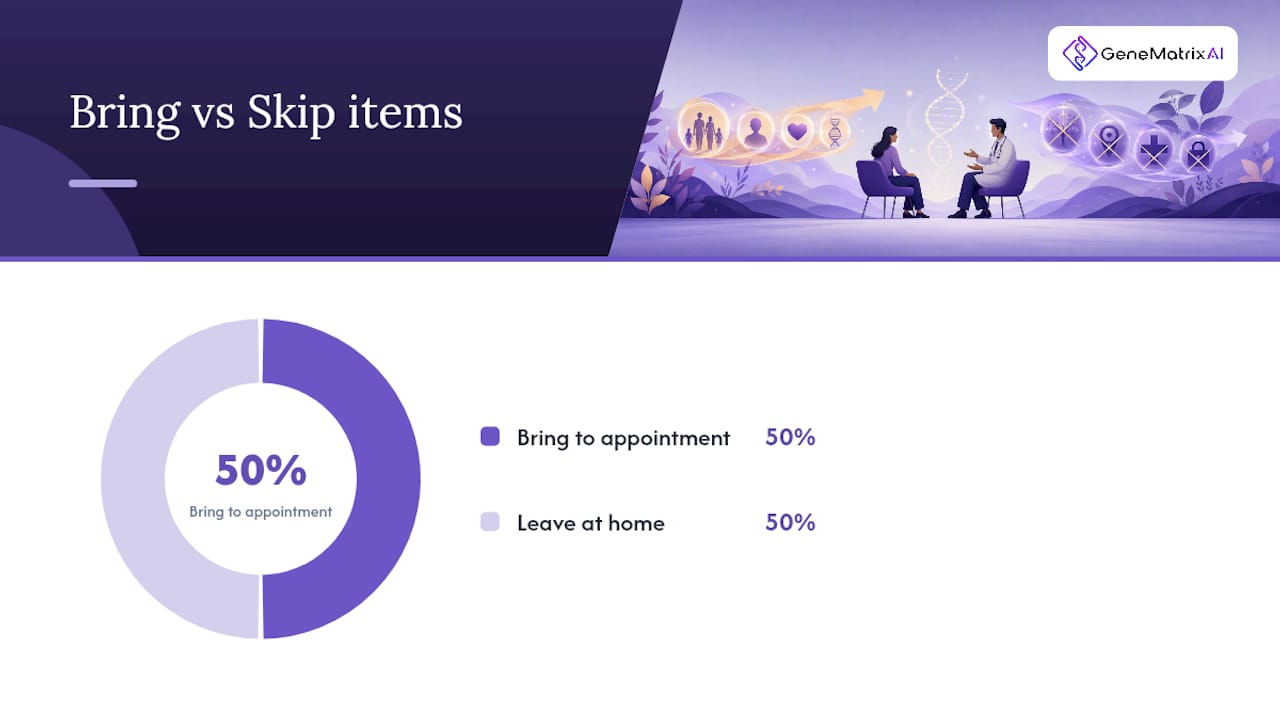
| Bring to the appointment | Leave at home or skip |
|---|---|
| One-page clinician summary | Full raw genotype file |
| Original report PDF | Third-party reanalysis printouts (unless asked) |
| Medication list with doses | Unverified online interpretations |
| Three-generation family history | Duplicate or redundant test reports |
| Printed questions | Lengthy genomic background articles |
Pro Tip: Prioritize findings by decision-relevance: drug interactions affecting a current prescription come first, then high-penetrance cancer gene flags, then reproductive carrier results. PRS and wellness findings can wait for a follow-up visit.
Exact scripts and questions to use during the appointment
The most productive appointments follow a simple pattern: [finding] + [what you are doing or considering] + [the specific decision you need help with]. Vague openings ("I got this DNA test and I'm worried") invite vague responses.
Three script templates:
- Medication: "My test flagged a variant in CYP2C19 that may affect how I metabolize [medication]. I'm currently taking [dose]. Should we confirm this in a clinical lab before adjusting my prescription?"
- Cancer screening: "I have a likely pathogenic flag in a BRCA-adjacent gene. My mother had breast cancer at 48. Does this change my screening schedule, and should I see a genetic counselor?"
- Reproductive planning: "My partner and I are planning a pregnancy. My test shows I'm a carrier for [condition]. Should we both be tested clinically before we proceed?"
Direct questions to ask:
- Should this result be confirmed in a CLIA-certified lab?
- Would this finding change my screening protocol or any current medication?
- Do you recommend a referral to a genetic counselor or medical geneticist?
- How soon should we act on this?
- Can you document the agreed next steps in my chart today?
Do not demand tests your PCP has not recommended. Do ask for a written follow-up plan before you leave.
What happens after the visit: realistic timelines and next steps
Most appointments end in one of four pathways, and knowing which one applies to you sets your expectations for the weeks ahead.
- Watch and document: PCP notes the finding, no immediate action needed. Appropriate for low-penetrance PRS results or carrier status with no near-term reproductive plans.
- CLIA-confirmatory test ordered: Expect 2–8 weeks for results after the lab receives your sample. Confirmatory testing in a CLIA-accredited lab is recommended before using results to guide clinical decisions.
- Genetics referral: Wait times for genetic counseling appointments typically run several weeks. A genetic counseling visit usually runs 60–80 minutes and covers multi-generation family history, prior test review, emotional concerns, and insurance questions.
- Immediate medication or screening change: Rare, but possible for clear, high-confidence PGx findings already supported by clinical evidence.
Sequence to track:
- Immediate: PCP documents findings in your chart
- Week 1–4: Referral scheduled or confirmatory test ordered
- Week 2–8: Confirmatory lab results returned
- Follow-up visit: Finalize the care plan based on confirmed results
Out-of-pocket costs for genetic counseling vary by insurance plan. Ask your PCP's office whether a referral requires prior authorization before the appointment is booked.
Privacy and insurance questions to raise with your doctor
GINA (the Genetic Information Nondiscrimination Act) protects you against health-insurance and employment discrimination based on genetic information. It does not cover life insurance, long-term care insurance, or disability insurance. Those three categories remain unprotected, and insurers in those markets can legally consider genetic test results.
Practical steps to take:
- Ask your PCP to note your consent preferences regarding genetic data in your medical record
- Find out whether your DTC company shares data with third parties and under what conditions
- Before ordering confirmatory testing, ask whether it will be billed to insurance and whether prior authorization is required
- If you have concerns about life or disability insurance, consider the timing of any confirmatory testing carefully
Pro Tip: If you are in the market for life or long-term care insurance, speak with a financial advisor before adding confirmed genetic results to your medical record. GINA does not protect you in those markets.
Red flags that mean you need a genetics referral right away
Some findings should not wait for a routine follow-up. Ask for an immediate referral to a genetic counselor or medical geneticist if any of the following apply.
- A likely pathogenic or pathogenic variant in a high-impact gene (BRCA1/2-like signals, Lynch syndrome genes, or cardiomyopathy/arrhythmia genes)
- A family history of early-onset cancer (before age 50) or sudden cardiac death in a first-degree relative
- A carrier result that affects immediate reproductive decisions
- Any finding that would change a surgical, screening, or reproductive decision now
Ask your PCP directly: "Does this result change any immediate medical or surgical decisions?" and "Can you send a referral to genetics today?" If the answer to the first question is yes, the referral should not wait.
What most patients get wrong about this conversation
The standard advice is to "bring your results and ask questions." That is not wrong, but it misses the real problem: most patients hand their doctor a 40-page PDF and expect interpretation on the spot. A primary-care physician is not a geneticist, and a 15-minute appointment is not a genetics consultation.

The smarter move is to do the triage yourself before you walk in. Identify the one or two findings that connect to something real in your life: a medication you take, a family member's diagnosis, a screening decision you are facing. Anchor the conversation there. Your doctor can act on a specific, decision-linked question. Abstract genomic risk is much harder to translate into a care plan in real time.
The other thing patients underestimate is the value of documented next steps. A verbal "we'll keep an eye on it" disappears. A note in your chart with a referral order or a confirmatory test request does not. Before you leave, confirm that the agreed plan is written down.
Genematrix offers clinician-validated reports built for exactly this conversation
Most at-home tests hand you a PDF and leave the clinical translation to you. Genematrix takes a different approach: as a CLIA-certified biotechnology company, it delivers AI-powered reports structured for clinical handoff, not just personal curiosity.

For patients heading into a primary care appointment, Genematrix's clinician-ready reports cover hereditary cancer risk (BRCA1/2, Lynch syndrome), pharmacogenomics, and additional modules for mental health, pediatric, and nutrition screening. Reports are generated within 72 hours, prioritized by clinical relevance, and formatted so a PCP can act on them in a standard appointment slot. If your current at-home results need clinical-grade confirmation, ask your doctor whether a Genematrix test fits your case, then order your hereditary cancer screening directly.
Vetted resources to share with your doctor
Hand your PCP one printed summary plus one or two of these links to speed evaluation.
- AMA guidance on DTC genetic test follow-up: what physicians should do when patients bring at-home results
- AMA Journal of Ethics on DTC results in primary care: clinical framework for screening vs. diagnosis
- BMJ on direct-to-consumer genetic testing: limitations, false results, and CLIA confirmation guidance
- NCBI Bookshelf: Genetic Counseling: what to expect from a counseling visit, including timelines
- National Society of Genetic Counselors directory: find a board-certified genetic counselor near you
- What is CLIA certification?: patient-friendly explanation of why lab accreditation matters
- Genomic insights for smarter health decisions: turning genetic findings into practical next steps
This article provides general health information and is not a substitute for professional medical or genetic advice. Confirm current clinical guidance with your physician or a board-certified genetic counselor.
Sources
- How Should Primary Care Physicians Respond to Direct-to-Consumer Genetic Test Results? | Journal of Ethics | American Medical Association
- How physicians should follow up on direct-to-consumer genetic tests | American Medical Association
- Preparing primary care providers to integrate genomic medicine into practice | PMC
- Direct-to-consumer genetic testing | BMJ