

At-home hereditary cancer, carrier, and pharmacogenomic (PGx) tests can be a genuinely useful starting point when you're planning children — but any actionable or high-risk finding should trigger confirmatory clinical testing and a conversation with a genetics professional before you make reproductive decisions. ACMG's Tier 3 carrier screening policy recommends offering carrier screening to all patients planning pregnancy or who are already pregnant. ACOG and the FDA both caution that DTC results — including PGx outputs — should be treated as medical tests, not lifestyle data.
If your results flag anything significant, here's what to do first:
- Pause clinical action. Don't change medications or make irreversible reproductive decisions based on a DTC result alone.
- Arrange genetic counseling. Contact a board-certified genetic counselor or clinical geneticist for pretest or posttest guidance.
- Request confirmatory testing. Ask your clinician to order a CLIA-certified clinical lab test to verify any pathogenic, likely pathogenic, or high-risk finding.
Key Takeaways
Preconception genetic testing is most useful when results arrive early enough to preserve every reproductive option, including IVF with PGT-M, donor selection, and cascade testing for family members.
| Point | Details |
|---|---|
| Order tests preconception | ACMG prefers preconception timing to preserve the full range of reproductive options. |
| Confirm actionable findings | Any pathogenic or high-risk DTC result requires CLIA-certified clinical confirmatory testing before reproductive decisions. |
| Carrier screening for donor matching | If you carry a recessive variant, confirm the donor's panel covers the same gene before finalizing selection. |
| PGx needs clinical translation | DTC PGx outputs are discussion starters; CPIC guidelines and a clinician are required before changing medications. |
| Genematrix for end-to-end planning | Genematrix offers CLIA-certified, clinician-validated hereditary cancer, carrier, and PGx testing with 72-hour turnaround and counseling access. |
Table of Contents
- Who should consider genetic testing before pregnancy?
- Donor egg and sperm genetic compatibility testing: which tests to order
- How to interpret your results and what to do next
- Practical logistics: sample type, timing, and cost
- What at-home tests cannot do
- How Genematrix aligns with ACMG and ACOG clinical expectations
- Specific protocols when donor gametes are involved
- Ethical and legal considerations around donor genetic testing
- How donor genetic results shape donor selection and matching
- How IVF and PGT-M integrate with donor gamete genetic results
- The case for testing before you need it
- Genematrix: clinician-validated testing built for preconception planning
- Sources
Who should consider genetic testing before pregnancy?
Anyone planning a pregnancy benefits from thinking about carrier screening early. The clearest candidates: people with a personal or family history of hereditary cancer (BRCA1/2, Lynch syndrome), individuals currently taking medications with known pharmacogenomic interactions, and health-conscious couples who want a complete picture before conception.
ACMG recommends offering Tier 3 carrier screening to all patients planning pregnancy or who are pregnant, with reproductive partners offered testing simultaneously when feasible. Preconception timing is preferred because it preserves the full range of reproductive options — including IVF with preimplantation genetic testing (PGT-M) or the use of donor gametes — and tends to be less stressful than receiving results mid-pregnancy.
ACOG's guidance on ethical considerations ties result timing directly to clinical utility: the latter in pregnancy results arrive, the narrower the window for acting on them. Order early. That single decision keeps every option on the table.
Donor egg and sperm genetic compatibility testing: which tests to order
Three test categories matter for preconception genetics, and they serve distinct clinical purposes:
- Tier 3 carrier screening (ACMG-recommended): identifies whether you carry variants for autosomal recessive or X-linked conditions. Two carriers of the same recessive condition face a 25% chance per pregnancy of an affected child.
- Hereditary cancer panels: assess personal and family cancer risk (BRCA1/2, Lynch syndrome, and related genes). Results affect your own health decisions and trigger cascade testing for relatives.
- Pharmacogenomic (PGx) testing: examines how your genes may influence drug metabolism and response. Useful when medication choice or dosing is a concern, but DTC PGx outputs are discussion starters, not prescriptions.
| Test class | Primary purpose | Key clinical utility | Immediate next step if positive |
|---|---|---|---|
| Tier 3 carrier screening | Reproductive risk | Identify shared carrier status with partner or donor | Genetic counseling; partner/donor testing |
| Hereditary cancer panel | Personal/family cancer risk | Inform surveillance, prevention, cascade testing | NCCN-guided counseling and confirmatory testing |
| Pharmacogenomics (PGx) | Medication response | Flag potential drug-gene interactions | Clinical confirmation before any medication change |
What to look for in any test: CLIA lab certification, a clinician-validated report, access to genetic counseling, and a clear list of genes and variants covered. Saliva-based collection is standard for most at-home panels; some clinical confirmatory tests require a blood draw.
How to interpret your results and what to do next
Treat any actionable or high-risk finding as the start of a supervised clinical pathway, not a final answer. ACOG's hereditary cancer guidance is explicit: risk assessment requires counseling to evaluate risk, review test limitations, obtain informed consent, and plan post-test actions including cascade testing.
Common result categories and what they mean:
- Pathogenic or likely pathogenic variant: a known disease-causing change. Requires confirmatory clinical testing and immediate genetics referral.
- Variant of uncertain significance (VUS): not enough evidence to classify as harmful or benign. Do not make reproductive decisions based on a VUS alone; reclassification happens as databases grow.
- Autosomal recessive carrier: you carry one copy of a disease variant. Risk is reproductive only when a partner or donor carries a variant in the same gene.
- X-linked carrier: female carriers face a 50% chance of passing the variant to sons, who may be affected.
- PGx actionable variant: suggests altered drug metabolism. Needs clinical confirmation before any prescribing change.
The stepwise path: (1) contact a genetic counselor or clinical geneticist, (2) request confirmatory testing at a CLIA-certified clinical lab, (3) discuss reproductive options — prenatal diagnosis, IVF with PGT-M, donor gametes, or adoption — and (4) arrange cascade testing for first-degree relatives. NCCN's three-stage model (pretest counseling → test selection → posttest counseling) is the standard framework clinicians follow.
Pro Tip: Bring any prior family genetic reports, pathology records, or documented familial variants to your first genetics appointment. Clinicians typically ask for the exact variant name (gene, nucleotide change, and classification) to order a targeted confirmatory test rather than a broad panel — this cuts weeks off the confirmation timeline.
Practical logistics: sample type, timing, and cost
Key logistics to plan around:
- Sample type: most at-home tests use a saliva swab; confirmatory clinical tests often require a blood draw at a lab or clinic.
- Turnaround time: at-home panels typically return results within a few days to a few weeks; clinical confirmatory labs may take 2–4 weeks or longer for complex panels.
- CLIA certification: non-negotiable for any test you plan to act on clinically. A CLIA-certified lab meets federal standards for accuracy and quality.
- Counseling availability: check whether your test provider includes pre- or posttest counseling, or whether you need to arrange it separately through a genetics clinic or telehealth service.
- Insurance and cost: carrier screening and hereditary cancer testing are often covered when ordered by a clinician, especially with documented family history. DTC tests are generally out-of-pocket; confirmatory clinical panels vary widely by insurer and indication.
Timing is the variable most people underestimate. ACMG explicitly prefers preconception screening because it allows the full range of reproductive decision-making. Order tests before you're pregnant if at all possible — not because the tests change, but because your options do.
What at-home tests cannot do
DTC tests screen a defined set of variants, not every possible mutation in a gene. A negative result on a carrier screen does not mean you carry no variants — it means none of the tested variants were detected. Residual risk remains, and its size depends on the gene panel's scope and your ancestry.
ACOG cautions that all DTC genetic testing should be treated as medical testing, and that confirmatory clinical testing under clinician supervision is recommended before using results to change care. That applies especially to hereditary cancer findings, where a false positive or a misclassified variant can drive unnecessary surgery.
PGx limits deserve their own note. The FDA frames DTC pharmacokinetic tests as informative about possible drug response, but many DTC PGx outputs require clinical confirmation before guiding prescribing decisions. NHGRI advises that DTC results showing carrier status or high-risk variants should prompt clinical genetic counseling and confirmatory testing in a clinical laboratory. The Clinical Pharmacogenomics Implementation Consortium (CPIC) guidelines are the translation layer clinicians use to convert PGx genotypes into prescribing recommendations — your DTC report alone doesn't do that work.
How Genematrix aligns with ACMG and ACOG clinical expectations
Genematrix is a Chicago-based, CLIA-certified biotechnology company. Its lab certifications and scientific methodology are publicly documented, which matters when you need to hand a report to a clinician for confirmatory testing. Key trust signals:
- CLIA-certified laboratory operations
- Clinician-validated reports across hereditary cancer, PGx, and carrier-relevant modules
- Genetic counseling availability alongside test results
- Reported turnaround of genomic insights within 72 hours — relevant given ACOG's emphasis on timely results in pregnancy
Those features map directly to what ACMG and ACOG require: Tier 3 carrier screening capability, pre- and posttest counseling access, and a clear pathway to confirmatory testing. The NCCN's three-stage counseling model assumes a provider who can support all three stages — Genematrix's clinician-reviewed reports and counseling access cover that ground for at-home users.
Pro Tip: When requesting documents from any testing vendor before a clinical follow-up, ask for: the CLIA certificate number, the complete gene and variant list tested, the lab methodology (NGS, array, or targeted), and whether raw data is available under HIPAA. These four items are what most genetics clinicians need to decide whether to accept the result or re-test.
Specific protocols when donor gametes are involved
Donor egg and sperm genetic compatibility testing follows the same carrier screening logic as partner testing, with one critical difference: you cannot ask a donor to undergo additional testing on demand the way you can ask a partner. Most reputable sperm and egg banks screen donors against expanded carrier panels before listing them, but the scope varies. Confirm which genes were tested, which variant classification system the bank used, and whether the donor's results are available for your clinician to review.
The matching question is straightforward in principle: if you are a carrier for an autosomal recessive condition, you want a donor who is not a carrier for a variant in the same gene. If you are an X-linked carrier (female), a sperm donor's carrier status is less relevant for that condition — the risk flows through your X chromosome to male offspring. A genetic counselor can map this out for your specific situation before you select a donor.
Fertility clinics and reproductive endocrinologists typically require carrier screening results from both the recipient and the donor before proceeding with IVF. If your at-home results are from a CLIA-certified lab with a clinician-validated report, they are generally accepted as a starting point — though the clinic may still order confirmatory testing for any flagged variants.
Ethical and legal considerations around donor genetic testing
Disclosure obligations in donor gamete contexts sit at the intersection of contract law, state statute, and medical ethics — and they vary by state. Most donor agreements specify what genetic information the bank or clinic will share with recipients, and what remains confidential to protect donor identity. Recipients generally receive the donor's carrier screening results and health history; they do not receive the donor's full genome or identifiable information unless the donor has consented to open-identity disclosure.
The ethical tension is real. A donor found to carry a pathogenic BRCA1 variant, for example, may have implications for the donor's own health that were not known at the time of donation. Clinics and banks have differing policies on whether and how to re-contact donors when new clinically significant findings emerge from stored samples. The American Society for Reproductive Medicine (ASRM) has published guidance on this, and recipients should ask their clinic directly what the re-contact policy is before signing a donor agreement.
For recipients, the practical takeaway is to get the donor's genetic report in writing, confirm the lab's CLIA status, and share it with your own genetic counselor before finalizing donor selection.
How donor genetic results shape donor selection and matching
A positive carrier result on your own screening changes how you evaluate a donor profile. If you carry a pathogenic variant in CFTR (cystic fibrosis), you need a donor who has been tested for CFTR variants and is confirmed not to carry one. If the bank's donor panel did not include CFTR, that donor is not a safe match for you regardless of other qualities.
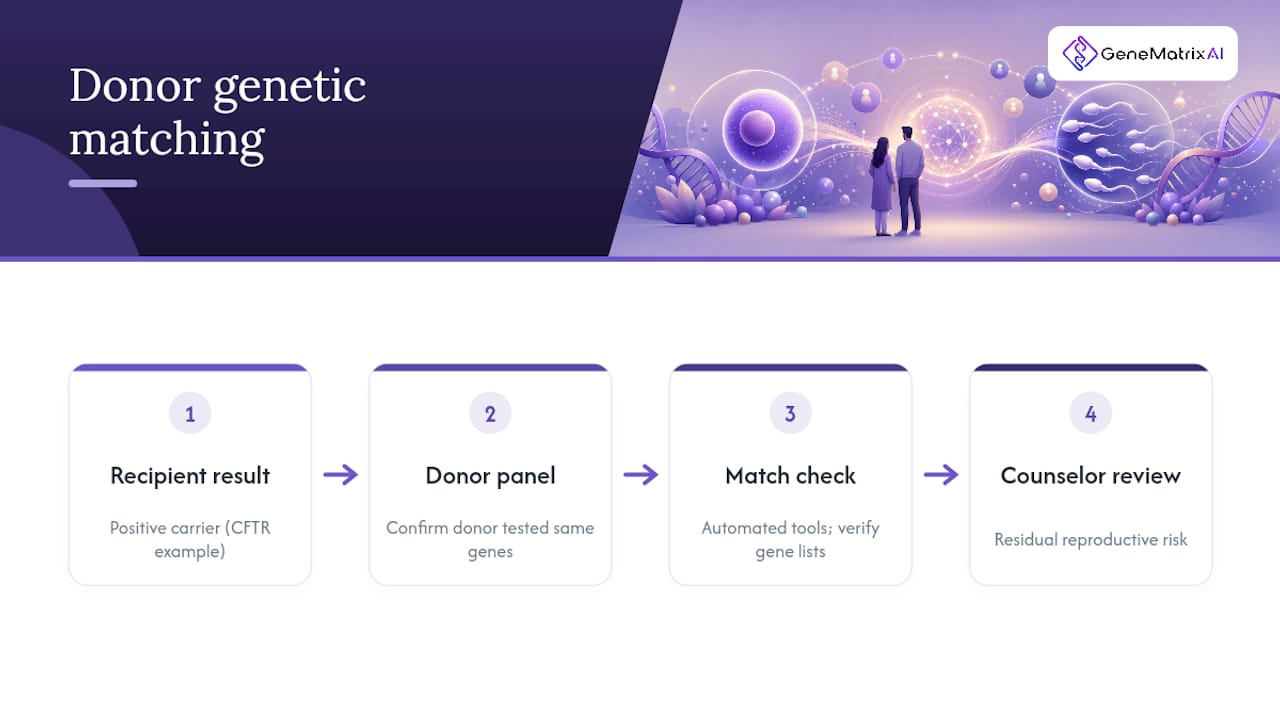
Expanded carrier panels now routinely screen for more than 200 conditions. The broader the panel, the more likely it is that both you and a given donor will each carry something — but usually not the same thing. A genetic counselor can calculate the residual reproductive risk for any donor-recipient pair and help you weigh it against other selection criteria.
Some fertility clinics use algorithmic matching tools that cross-reference recipient and donor carrier results automatically. These tools reduce the chance of a missed match, but they are only as good as the variant lists they compare. Always verify that the donor's panel and your own panel tested the same genes before relying on an automated match result.
How IVF and PGT-M integrate with donor gamete genetic results
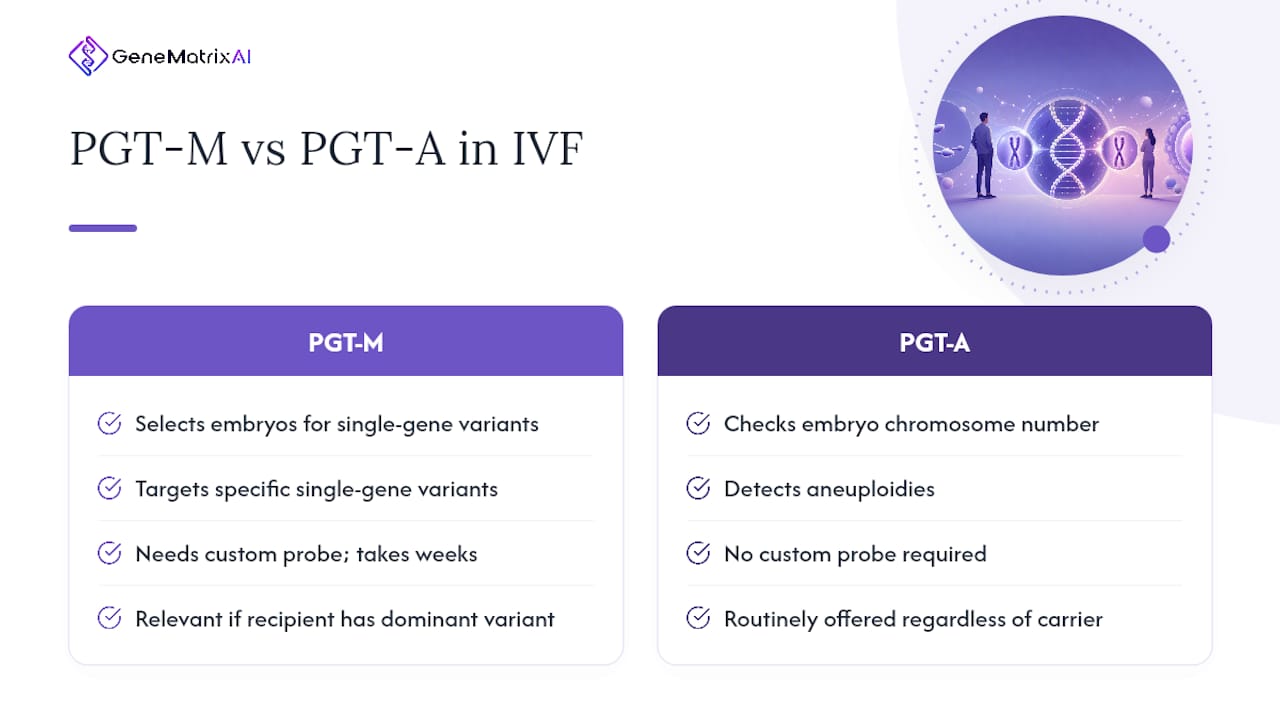
When carrier screening identifies a shared risk — or when a hereditary cancer variant is present — IVF with preimplantation genetic testing for monogenic disorders (PGT-M) is the primary tool for selecting unaffected embryos before transfer. PGT-M requires a custom probe designed around the specific variant in question, which takes several weeks to develop. That lead time is why preconception testing matters: starting the process before a retrieval cycle means the probe is ready when the embryos are.
With donor eggs or sperm, PGT-M is most relevant when the recipient carries a dominant hereditary condition (such as a BRCA1 pathogenic variant) and wants to avoid passing it to offspring. For autosomal recessive risks identified through carrier screening, PGT-M can confirm which embryos are unaffected or carriers only. The distinction matters for family planning and for cascade testing decisions later.
Preimplantation genetic testing for aneuploidies (PGT-A) is a separate test that checks embryo chromosome number and is routinely offered in IVF regardless of carrier status. It does not replace PGT-M for single-gene conditions. Your reproductive endocrinologist and genetic counselor should coordinate on which combination of tests applies to your situation.
The case for testing before you need it
Most people who order a hereditary cancer or carrier screening test are not in crisis. They're planning ahead, which is exactly the right time to do it. The problem I see repeatedly in how this topic gets discussed is the framing of at-home genetic testing as either a complete answer or a gimmick. Neither is accurate.
A CLIA-certified, clinician-validated at-home test gives you real data. What it doesn't give you is the interpretive context that a genetic counselor brings — the family history integration, the residual risk calculation, the reproductive options conversation. Those two things together are what make genetic information useful rather than just anxiety-producing.
The donor gamete context adds a layer most general guides skip: you're not just screening yourself, you're evaluating a genetic profile you can't fully control or retest. That's precisely why the counseling step is non-negotiable here, not optional. Get the data, then get the interpretation.
Genematrix: clinician-validated testing built for preconception planning
If you're planning a pregnancy and want hereditary cancer, carrier, and PGx results you can actually hand to a clinician, Genematrix delivers all three from a single at-home kit, with reports reviewed by clinicians and results back within 72 hours. That turnaround matters when you're working against a conception timeline or a gestational window.

Genematrix's CLIA-certified lab and clinician-validated reports meet the documentation standards most genetics clinicians and fertility clinics require before proceeding with confirmatory testing or IVF planning. Genetic counseling is available alongside your results, so you're not left interpreting a report alone. For anyone navigating donor gamete selection, hereditary cancer risk, or medication optimization before or during pregnancy, start with a Genematrix health intake to see which panels apply to your situation.
Sources
These are the primary clinical and regulatory sources referenced throughout this article. Share them with your clinician when arranging confirmatory testing or counseling.
- Consumer Testing for Disease Risk | ACOG
- Direct-to-Consumer Tests | FDA
- NCCN patient guideline: Genetics - patient guide
- Genome
This article is general information, not a substitute for advice from a qualified doctor. Consult a qualified healthcare professional about your own circumstances before acting on anything here.