

TL;DR:
- Genetics plays a crucial role in pregnancy outcomes, affecting embryo development and maternal support. Recent research shows maternal genetic variants influence miscarriage risk independently of age, shifting clinical approaches. Prenatal testing options like cfDNA screening and carrier analysis help identify risks, while genetic counseling empowers informed pregnancy planning.
Genetics is the single most powerful biological force shaping pregnancy outcomes, from the moment of conception through delivery. About 3% of US babies are born with birth defects, and inherited genetic factors drive a significant share of those cases. Recent 2026 research has confirmed that maternal genetic variants influence miscarriage risk independently of age, a finding that changes how reproductive medicine approaches prenatal planning. Understanding the role of genetics in conception and pregnancy gives you a clearer picture of your risks, your options, and the steps you can take before and during pregnancy.
Why genetics matter for pregnancy outcomes

Genetics shapes pregnancy in two distinct ways. First, the genetic makeup of the embryo determines whether it can develop normally. Second, the genetic profile of the pregnant person affects how the body supports that pregnancy. Both matter, and both are now better understood than ever.
Chromosome errors in embryos are the leading cause of early miscarriage. Aneuploidy, the condition where an embryo has too many or too few chromosomes, accounts for the majority of first-trimester losses. Trisomy 21, which causes Down syndrome, is one well-known example. Trisomies 18 and 13 are also common and are typically incompatible with survival outside the womb.
Maternal age has long been the primary known risk factor for aneuploidy. A landmark study of nearly 140,000 IVF embryos revealed that inherited maternal DNA variations also significantly influence miscarriage risk, beyond what age alone explains. That finding is a major shift in how clinicians think about recurrent pregnancy loss.
Specific genes involved in chromosome cohesion and recombination, including SMC1B, affect how chromosomes separate during egg cell formation. Errors in that process produce aneuploid embryos. Knowing you carry variants in these genes does not guarantee pregnancy loss, but it does explain why some people experience repeated losses even at younger ages.
"Individual common genetic variants typically have a small effect on pregnancy loss risk compared to maternal age and environmental factors, limiting predictive power." — Johns Hopkins Hub, 2026
Family history also carries weight. Inherited single-gene disorders like cystic fibrosis, sickle cell disease, and fragile X syndrome pass from parent to child through predictable patterns. Carrier screening before or during pregnancy identifies whether you or your partner carry one copy of a recessive gene variant that could affect your child.
What prenatal genetic screening and testing options are available?
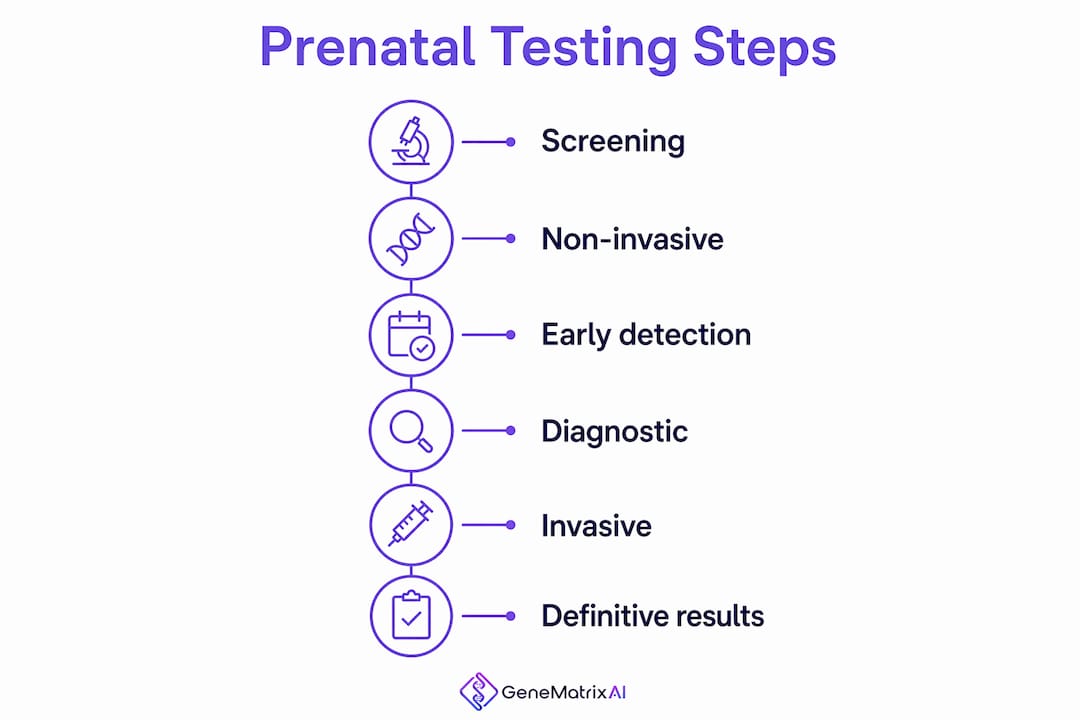
Prenatal genetic testing falls into two categories: screening and diagnostic. Screening tests estimate risk. Diagnostic tests confirm or rule out a condition with near-certainty.
The American College of Obstetricians and Gynecologists (ACOG) recommends cell-free DNA (cfDNA) screening as the most sensitive and specific option for detecting common fetal aneuploidies, including trisomies 21, 18, and 13. cfDNA screening analyzes fragments of fetal DNA circulating in the pregnant person's blood. It outperforms traditional serum marker tests and ultrasound screening for these conditions.
A positive cfDNA result is not a diagnosis. ACOG advises confirmatory diagnostic testing before any clinical decision is made. The two main diagnostic options are:
- Amniocentesis: A sample of amniotic fluid is drawn, usually between weeks 15 and 20. It provides a full chromosomal picture of the fetus.
- Chorionic villus sampling (CVS): Placental tissue is sampled, typically between weeks 10 and 13. It gives results earlier in pregnancy than amniocentesis.
- Preconception carrier screening: Done before pregnancy, this blood or saliva test identifies whether you carry gene variants for inherited conditions. Timing it before conception gives you the widest range of reproductive options.
| Test type | Timing | What it detects | Limitation |
|---|---|---|---|
| cfDNA screening | 10+ weeks | Trisomies 21, 18, 13; sex chromosome conditions | Screening only, not diagnostic |
| Amniocentesis | 15–20 weeks | Full chromosomal analysis | Small procedural risk |
| CVS | 10–13 weeks | Full chromosomal analysis | Small procedural risk |
| Carrier screening | Before or early in pregnancy | Recessive gene variants in parents | Does not test fetal chromosomes |
Pro Tip: If you have a family history of a specific genetic condition, ask your provider about targeted carrier screening for that condition before your first prenatal appointment. Timing matters for your options.
Decisions about prenatal genetic testing are personal. Test accuracy, cost, availability, and your individual risk profile all factor into the choice. A genetic counselor helps you weigh those variables without pressure.
How do genetic variants affect pregnancy health and nutrition?
Genetics does not only influence the embryo. Your own genetic profile affects how your body manages pregnancy, including your risk for complications and your nutritional needs.
Genetic liability to autoimmune conditions has a direct link to pregnancy complications. Risk of preterm birth rises 6% for every doubling in genetic liability for Hashimoto's thyroiditis among pregnant individuals. Genetic predisposition to other autoimmune conditions also correlates with higher rates of hypertensive disorders of pregnancy, including preeclampsia. These are not rare edge cases. They represent a category of pregnancy risk that standard obstetric screening does not always capture.
The MTHFR gene is another example with direct clinical relevance. MTHFR polymorphisms, particularly the 677TT genotype, reduce enzyme activity and impair the body's ability to process folate. Folate is critical for neural tube development in early pregnancy. Disrupted folate metabolism raises the risk of gestational diabetes and preeclampsia.
Folate and vitamin B12 work together to regulate DNA methylation, a process essential for placental development. When MTHFR variants disrupt that balance, the placenta may not develop as it should. Personalized folate supplementation strategies, adjusted for your specific MTHFR genotype, can compensate for these metabolic differences.
Pro Tip: Standard prenatal vitamins contain folic acid, the synthetic form of folate. If you carry an MTHFR variant, your provider may recommend methylfolate instead, which bypasses the conversion step your body struggles with.
Genetics also shapes how your body responds to medications during pregnancy. Pharmacogenomics, the study of how genes affect drug response, is increasingly relevant for managing pregnancy-related conditions safely.
Why is genetic counseling important for pregnancy planning?
Genetic counseling is the clinical bridge between a test result and a decision. It is not just for high-risk pregnancies. It is for anyone who wants to understand what their genetic information actually means.
A certified genetic counselor provides education on your risk factors, explains what testing options exist, and walks through what results would mean for your pregnancy and your family. The process is non-directive by design. Counselors present information without steering you toward a specific choice. That distinction matters, because the decisions involved are deeply personal.
Genetic counseling is recommended in several situations:
- You or your partner have a known genetic condition or family history of one.
- You have had two or more miscarriages.
- A prenatal screening test returned an abnormal result.
- You are 35 or older and pregnant.
- You have been exposed to a teratogen during pregnancy.
Having a genetic diagnosis during pregnancy also enables practical medical planning. Knowing a fetal condition in advance allows your care team to arrange delivery at a facility with the right neonatal resources, plan for specialized interventions, and prepare you emotionally for what comes next. That preparation has real clinical value, regardless of what decisions you make about the pregnancy itself.
Genetic counselors work alongside obstetricians, maternal-fetal medicine specialists, and neonatologists. Their role is coordination as much as education. For couples navigating a complex result, that coordinated care can make a significant difference in outcomes and in the experience of care. You can learn more about how to approach this process through a guide for expectant parents covering genetic planning from preconception through delivery.
Key Takeaways
Genetics influences pregnancy at every stage, from embryo viability to maternal health, and early screening paired with genetic counseling gives couples the clearest path to informed decisions.
| Point | Details |
|---|---|
| Genetics drives miscarriage risk | Maternal gene variants affecting chromosome segregation increase pregnancy loss risk beyond age alone. |
| cfDNA is the top screening tool | ACOG recommends cell-free DNA screening as the most sensitive test for common fetal aneuploidies. |
| MTHFR variants affect nutrition | The 677TT genotype impairs folate processing; personalized supplementation may be needed during pregnancy. |
| Autoimmune genetics raise complication risk | Genetic liability to Hashimoto's thyroiditis increases preterm birth risk by 6% per doubling of liability. |
| Counseling enables informed choices | Genetic counselors provide non-directive education so couples can make decisions aligned with their values. |
What I've learned from watching genetics reshape pregnancy care
Tarek here. I have spent years watching the conversation around genetics and pregnancy shift from a niche clinical concern to something every couple planning a family should understand. The change has been significant, and not just because the science improved.
What strikes me most is how the 2026 research on maternal gene variants and miscarriage reframes recurrent pregnancy loss. For years, couples who experienced multiple losses were told it was likely age-related or unexplained. Now we know that inherited variants in chromosome cohesion genes can be a real contributing factor. That is not a small thing. It means some people have been carrying an explanation they never received.
The part that gets underplayed is the nutrition connection. MTHFR variants are common, and most people have no idea they carry one. The standard advice to take folic acid during pregnancy is correct for most people. But for someone with the 677TT genotype, that advice may not be enough. The gap between generic guidance and personalized guidance is exactly where genetic testing earns its value.
I also think genetic counseling is undersold. People assume it is only for high-risk cases or that it will feel clinical and frightening. In practice, a good counselor creates the opposite experience. They give you a framework for understanding your situation without telling you what to do. That kind of informed autonomy is rare in medicine, and it is worth seeking out early, not after a difficult result.
The science is not perfect. Individual genetic variants still have limited predictive power on their own. But the direction of travel is clear. Personalized genetic insight before and during pregnancy is becoming standard care, not a specialty service. Couples who engage with it early are better prepared, not more anxious.
— Tarek
Genematrix and your pregnancy genetic health
Genematrix is a CLIA-certified biotechnology company based in Chicago. Its genetic testing science is built on AI-driven analysis trained on 500,000+ genetic profiles, with reports delivered within 72 hours. For couples planning a pregnancy, Genematrix offers specialized testing through its GeneBaby module, covering pediatric and reproductive genetic health.

The GeneMatrixAI platform connects your results to clinical insights you can act on, whether that means adjusting supplementation for an MTHFR variant or understanding your carrier status before conception. If you are ready to move from general awareness to specific answers, genetic screening before pregnancy is the clearest first step. Genematrix makes that step accessible, fast, and grounded in certified science.
FAQ
Why does genetics matter for pregnancy?
Genetics determines embryo viability, influences miscarriage risk, and shapes how the pregnant person's body manages the pregnancy. Inherited variants can affect chromosome segregation, folate metabolism, and susceptibility to complications like preeclampsia.
What is cfDNA screening and when is it done?
Cell-free DNA screening is a blood test that analyzes fetal DNA fragments circulating in the pregnant person's bloodstream, typically performed at 10 weeks or later. ACOG recommends it as the most sensitive screening tool for trisomies 21, 18, and 13.
Can genetics cause repeated miscarriages?
Yes. A 2026 study of nearly 140,000 IVF embryos found that maternal gene variants affecting chromosome segregation increase aneuploidy and pregnancy loss risk independently of age. Genetic counseling is recommended after two or more miscarriages.
What does the MTHFR gene have to do with pregnancy?
The MTHFR gene controls how your body processes folate. Certain variants, especially the 677TT genotype, reduce that processing ability and raise the risk of complications including gestational diabetes and preeclampsia. Personalized supplementation can address this.
When should I see a genetic counselor?
Genetic counseling is recommended if you have a family history of a genetic condition, have experienced recurrent pregnancy loss, are 35 or older, or receive an abnormal prenatal screening result. Starting before conception gives you the most options.