

TL;DR:
- Family genetic planning involves using counseling and testing to identify hereditary risks and inform reproductive choices. It emphasizes early preparation, appropriate testing timing, and ongoing management as scientific understanding evolves. Professional interpretation and psychological support are crucial for making informed, personalized decisions for family health.
Family genetic planning is the proactive process of using genetic counseling and testing to identify hereditary risks before or during pregnancy, so you can make informed reproductive choices. The industry term for this practice is reproductive genetic counseling, and it covers everything from carrier screening to interpreting BRCA1/BRCA2 results. This guide to family genetic planning walks you through preparation, testing options, result interpretation, and long-term management. Whether you have a known family history of disease or no red flags at all, understanding your genetic profile before conception gives you options that waiting simply cannot.
Your guide to family genetic planning: where to start
Reproductive genetic counseling combines risk assessment, laboratory testing, and psychological support into one coordinated process. A typical counseling appointment lasts 60–80 minutes, costs approximately $300, and focuses on informed decision-making rather than mandatory testing. That framing matters. No counselor will tell you what to do. The goal is to give you the clearest possible picture of your risks so you decide what to do with that information.
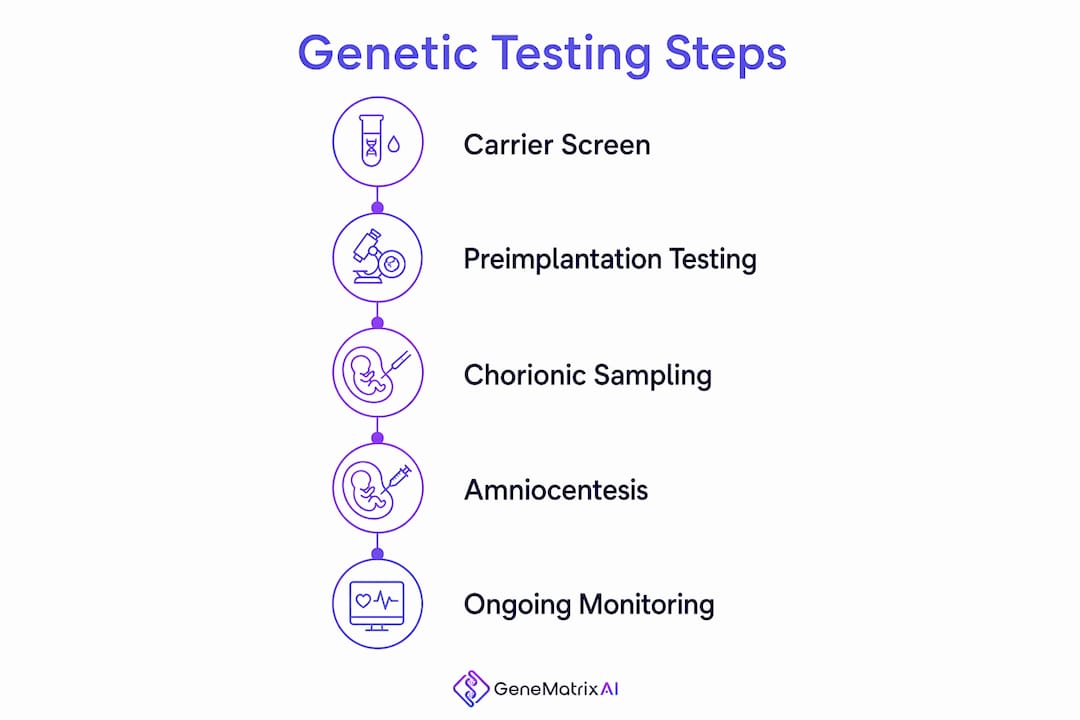
The core tools in this process include carrier screening, preimplantation genetic testing (PGT-M), chorionic villus sampling (CVS), amniocentesis, and pharmacogenomics panels. Each serves a different purpose depending on your stage of family planning. Genematrix, for example, offers specialized modules including GeneCancer, GeneBaby, and GenePGx, covering hereditary cancer risk, pediatric conditions, and medication compatibility in one platform. Knowing which tool fits your situation is the first practical step.
How do you prepare for a genetic counseling appointment?
Preparation is the single biggest factor in getting value from your counseling session. A well-prepared patient leaves with specific, personalized guidance. An unprepared one leaves with general information they could have found online.

The most important thing to gather is your three-generation family history, including grandparents, parents, siblings, and any children. This means documenting diagnoses, ages at diagnosis, and causes of death where known. Counselors use this data to calculate your actual risk profile, not a population average.
Here is what to bring to your first appointment:
- Medical records from any prior genetic tests, biopsies, or relevant diagnoses
- Medication list for both partners, including supplements
- Imaging reports related to any hereditary conditions (mammograms, colonoscopies)
- Family history notes covering at least three generations, even if incomplete
- Written questions you want answered before you leave
Pro Tip: Partial family history is far better than none. If you do not know a grandparent's exact diagnosis, document their approximate age at death and any symptoms you recall. Counselors are trained to work with incomplete data.
Managing your expectations before the appointment also helps. Testing results typically take 2–8 weeks to return. The session itself will not end with a diagnosis. It ends with a plan, and that plan may include follow-up tests, referrals, or simply a clearer understanding of your baseline risk.
What are your family genetic testing options?
Carrier screening is the most common starting point for couples planning to conceive. It identifies whether one or both partners carry a gene variant associated with a recessive condition like cystic fibrosis, spinal muscular atrophy, or sickle cell disease. Most carriers have no symptoms and no family history of the condition. That is exactly why universal preconception screening is now recommended rather than screening only high-risk groups.
There are two main types of carrier screening panels:
| Panel Type | What It Tests | Best For |
|---|---|---|
| Standard panel | 3–5 common conditions (e.g., cystic fibrosis, sickle cell) | Couples with specific ethnic risk factors |
| Expanded panel | 200+ conditions across multiple gene variants | All couples seeking broad preconception coverage |
Timing matters significantly. Preconception screening gives you the widest range of options. If both partners carry the same autosomal recessive condition, each pregnancy carries a 25% chance of an affected child. Knowing this before conception lets you consider IVF with PGT-M, use of donor gametes, or adoption. Prenatal testing through CVS (performed at 10–12 weeks) or amniocentesis (performed at 15–18 weeks) is still available, but it narrows your choices considerably.
For families with a known hereditary cancer risk, panels like Genematrix's GeneCancer screen for BRCA1, BRCA2, Lynch syndrome genes, and dozens of other high-risk variants. This goes beyond standard carrier screening and feeds directly into cancer surveillance and prevention planning for the whole family.
Pro Tip: Review our step-by-step genetic screening guide before your appointment to understand exactly what each test involves and how to ask the right questions.
How are genetic test results interpreted?
Genetic test results fall into three categories: positive (a variant is present), negative (no variant detected), and a variant of uncertain significance (VUS). That third category is where most confusion and anxiety originates.
A VUS means the lab found a gene change, but current science cannot confirm whether it causes disease. Genetic counselors provide expert interpretation that connects raw test data to clinical decisions, which is why professional guidance matters far more than reading a consumer report on your own. A counselor will explain what a VUS means for your specific situation, what follow-up is appropriate, and when to revisit the classification as science advances.
The counseling approach is deliberately non-directive. There is rarely a universally right answer in reproductive genetic decisions. A counselor helps you align your choices with your own values, not a clinical default. This is shared decision-making in practice.
"Genetic counseling acts as a bridge between complex genetic data and the decisions families actually face, combining risk assessment with emotional support at every step." — Genetic Counseling Benefits, 2026
The psychological dimension of this process is real and well-documented. Research shows that genetic counseling produces measurable reductions in both anxiety and depression, with effect sizes of d=0.406 for depression and d=0.353 for anxiety. Those are not trivial numbers. They reflect the difference between feeling paralyzed by uncertainty and feeling equipped to act. If you find the emotional weight of this process significant, ask your counselor about referrals to genetic-specific therapists or support groups. Many hospital-based genetics programs include social workers as part of the team.
For a deeper look at reading your results, Genematrix's resource on interpreting genetic test results breaks down what each outcome means in plain language.
How do you manage genetic information over time?
Genetic information is not static. A VUS classified as uncertain today may be reclassified as pathogenic or benign within five years as more data accumulates. Variants may be reinterpreted as science advances, which means a result you received in 2022 may carry different clinical weight in 2026.
Here is how to stay on top of your genetic health over time:
- Store your records securely. Keep digital and physical copies of all genetic test reports, counseling summaries, and lab results. Cloud storage with access controls works well.
- Schedule follow-up appointments. Check in with your genetics team every two to three years, or sooner if a family member receives a new diagnosis.
- Update your family history. New diagnoses in relatives change your risk profile. Add them to your records and share them with your counselor.
- Coordinate with your primary care physician. Your genetic risk data should inform your cancer screening schedule, medication choices, and preventive care plan.
- Ask about reclassification. When you follow up, specifically ask whether any of your VUS results have been reclassified since your last appointment.
Pro Tip: Ask your genetics lab whether they offer automatic reclassification notifications. Some labs contact patients directly when a VUS changes status. Not all do, so confirm this at your first appointment.
The benefits of genetic counseling extend well beyond a single session. Families who maintain ongoing contact with their genetics team are better positioned to act on new information quickly, whether that means adjusting a cancer screening schedule or reconsidering reproductive options for a second pregnancy.
Key takeaways
Effective family genetic planning requires preparation, the right testing at the right time, professional result interpretation, and ongoing management as genetic science evolves.
| Point | Details |
|---|---|
| Prepare three generations of history | Bring family health records covering grandparents through children, even if incomplete. |
| Screen before conception when possible | Preconception carrier screening gives you the most reproductive options if risks are found. |
| Understand variants of uncertain significance | A VUS is not a diagnosis; follow up with your counselor as science reclassifies variants over time. |
| Counseling reduces anxiety measurably | Research shows genetic counseling lowers depression and anxiety, supporting better decision-making. |
| Treat genetic data as a living record | Update your family history, store records securely, and schedule follow-ups every two to three years. |
Why most families wait too long to start this process
I have seen this pattern repeatedly. Families assume genetic planning is only for people with a clear family history of disease. A grandmother with breast cancer, a sibling with cystic fibrosis. Something obvious. The reality is that the majority of carriers have no family history at all. They are healthy, asymptomatic, and completely unaware. By the time a diagnosis appears in the family, the window for the widest reproductive choices has often closed.
The other misconception I encounter is that genetic counseling is a one-time event. You go, you get results, you move on. That is not how it works. Genetic data ages. A result from five years ago may need to be revisited. A new diagnosis in a sibling changes your risk calculation. Families who treat this as an ongoing conversation with their healthcare team consistently make better decisions than those who treat it as a checkbox.
The psychological benefit is also underestimated. Most people walk into their first counseling appointment bracing for bad news. Many walk out feeling more in control than they expected. That shift from dread to agency is not accidental. It is what well-structured genetic counseling is designed to produce. If you are on the fence about starting this process, that shift alone is worth the appointment.
Open communication within the family matters too. When one person learns they carry a significant variant, siblings and parents may be at risk. Having that conversation early, with support from a counselor if needed, is far better than leaving relatives uninformed.
— Tarek
How Genematrix supports your family's genetic health
Genematrix brings together hereditary cancer screening, pharmacogenomics, and precision medicine in one CLIA-certified platform built for families who want answers, not guesswork.

Genematrix's GeneMatrixAI platform is trained on more than 500,000 genetic profiles and delivers reports within 72 hours. The GeneCancer module screens for BRCA1, BRCA2, Lynch syndrome, and dozens of additional hereditary cancer variants. The GeneBaby module addresses pediatric and preconception concerns directly relevant to family planning. If you are ready to move from uncertainty to a clear, personalized genetic health plan, start with Genematrix's hereditary cancer genetic testing service. For families exploring the full scope of precision medicine options, the research and innovation overview shows exactly what the platform covers.
FAQ
What is family genetic planning?
Family genetic planning is the process of using genetic counseling and testing to identify hereditary risks before or during pregnancy. It helps couples make informed decisions about conception, prenatal testing, and long-term family health management.
Who should get preconception carrier screening?
Universal preconception carrier screening is recommended for all couples planning to conceive, not just those with a known family history. Most carriers are healthy and have no symptoms, making screening the only reliable way to identify risk.
How long does genetic testing take?
Results from carrier screening and other genetic tests typically return within 2–8 weeks. Your genetic counselor will review the results with you and explain what they mean for your specific situation.
What does a variant of uncertain significance mean?
A variant of uncertain significance (VUS) means a gene change was detected, but current science cannot confirm whether it causes disease. VUS results should be monitored over time, as they may be reclassified as more research becomes available.
Does genetic counseling help with the emotional side of this process?
Yes. Clinical research shows genetic counseling produces measurable reductions in both anxiety and depression. It also provides a non-directive framework that helps families make decisions aligned with their own values rather than feeling pressured toward a specific outcome.