

TL;DR:
- Understanding drug metabolism genes helps predict individual responses to medications by identifying how your body processes drugs. Variants in the CYP450 enzyme family significantly influence drug efficacy and safety, with phenoconversion further complicating these effects due to other medications. Sharing pharmacogenomic results with your care team enables personalized dosing and reduces adverse reactions, especially in vulnerable populations.
Two people take the same antidepressant at the same dose. One improves steadily. The other experiences side effects so severe they stop the medication entirely. No error was made. No allergy was involved. The difference comes down to explaining drug metabolism genes and what they reveal about how your body processes medication. Understanding this science puts you and your care team in a far stronger position to choose drugs that work and avoid those that won't.
Table of Contents
- Key takeaways
- Explaining drug metabolism genes and why they matter
- How gene variants change medication outcomes
- Reading and using pharmacogenomic test results
- Practical steps for patients and caregivers
- My take on what clinical practice still gets wrong
- See how Genematrix puts this into practice
- FAQ
Key takeaways
| Point | Details |
|---|---|
| Genes shape drug response | Variants in drug metabolism genes determine whether your body breaks down medications too fast, too slow, or just right. |
| CYP450 enzymes are central | The cytochrome P450 enzyme family, especially CYP2D6 and CYP2C19, handles metabolism for hundreds of commonly prescribed drugs. |
| Four metabolizer types exist | Poor, intermediate, normal, and ultrarapid metabolizers experience significantly different drug effects from identical doses. |
| Phenoconversion complicates results | Current medications can shift your effective metabolizer phenotype, making genotype alone an incomplete picture. |
| Testing informs safer prescribing | Pharmacogenomic test results, shared with your doctor and pharmacist, can guide dose adjustments and drug selection. |
Explaining drug metabolism genes and why they matter
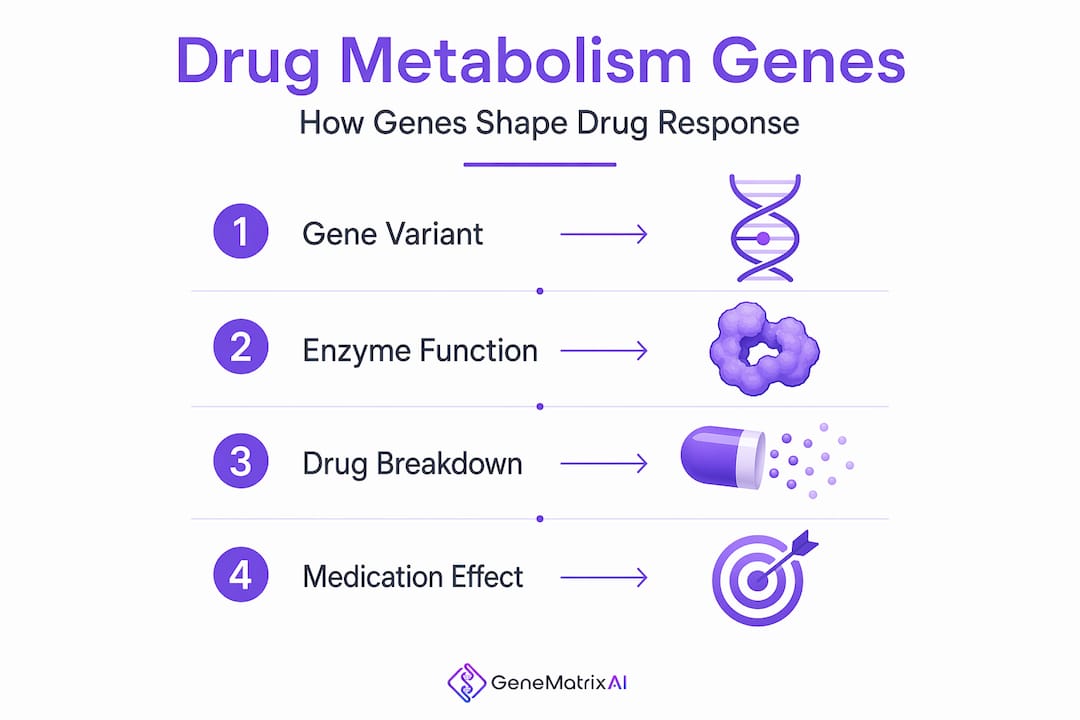
Drug metabolism is the process your body uses to chemically transform a medication so it can be absorbed, used, and eventually eliminated. Genetic variation in drug-metabolizing enzymes can significantly shift whether a drug reaches a therapeutic level, stays too low to help, or builds up to toxic concentrations. This is not rare. It affects a substantial portion of the population in ways that go undetected for years.
The field that studies these relationships is called pharmacogenetics, or more broadly, pharmacogenomics. The goal is straightforward: move away from one-size-fits-all dosing toward prescribing that accounts for your individual genetic blueprint. When a medication fails unexpectedly or causes a puzzling reaction, a gene variant may well be the reason.
The CYP450 enzyme family
The most studied drug metabolism pathways run through the cytochrome P450 enzyme family, commonly abbreviated as CYP450. These enzymes, produced in the liver and intestinal cells, are responsible for breaking down the majority of prescription medications. The genes encoding them, including CYP2D6, CYP2C19, CYP2C9, and CYP3A4, all carry variants that affect enzyme activity.
A gene variant, also called a polymorphism or allele, is a slight difference in DNA sequence that produces an enzyme with altered function. Some alleles reduce enzyme activity. Others eliminate it. A few actually increase it. The combination of alleles you inherit from each parent forms your diplotype, and that diplotype determines your phenotype, meaning the functional outcome of your metabolism for that gene.
Pro Tip: *When reading a pharmacogenomic report, look for both the diplotype notation (e.g., CYP2D6 *1/4) and the phenotype label. The phenotype is the clinically meaningful translation that your prescriber needs most.
Key terms you will encounter in any pharmacogenomics report include:
- Allele: A specific version of a gene; inherited one from each parent
- Star allele: The standardized notation for known pharmacogene variants (e.g., *1 is typically the "normal function" reference allele)
- Diplotype: Your pair of inherited alleles for a given gene
- Phenotype: The functional metabolizer category inferred from your diplotype
- Activity score: A numeric value assigned to each allele that adds up to predict enzyme function overall
How gene variants change medication outcomes
This is where understanding drug metabolism shifts from academic to personal. Metabolizer categories are not arbitrary labels. They predict, with meaningful accuracy, how your body will handle specific drugs.
| Phenotype | What it means | Clinical risk |
|---|---|---|
| Poor metabolizer | Little to no enzyme activity | Drug accumulates; toxicity risk increases |
| Intermediate metabolizer | Reduced enzyme activity | Subtherapeutic or variable response |
| Normal metabolizer | Standard enzyme function | Expected drug response at standard doses |
| Ultrarapid metabolizer | Excessive enzyme activity | Drug cleared too quickly; may see no benefit |
Take CYP2D6 and antidepressants as an example. CYP2D6 carries 72 FDA labeling indications across 13 therapeutic areas, making it one of the most clinically relevant pharmacogenes in existence. A poor metabolizer taking a CYP2D6-dependent antidepressant like nortriptyline will process it far too slowly. The drug accumulates. Sedation, heart rhythm changes, and other side effects become likely before any therapeutic benefit appears.

On the opposite end, an ultrarapid metabolizer breaks the drug down so fast it never reaches an effective concentration. They may try medication after medication without improvement, not knowing their genome is the reason.
Combined CYP2C19 and CYP2D6 variants amplify this effect. Research shows that patients with non-normal genotypes in both genes experienced 2.3 times more adverse drug reactions on antidepressants compared to normal metabolizers. That number is not a statistical curiosity. It represents real people suffering preventable side effects.
The phenoconversion problem
Here is a factor that even experienced clinicians sometimes miss. Your genotype is fixed at birth, but your effective phenotype can shift depending on what other medications you are taking. This phenomenon is called phenoconversion.
Up to 44.9% of patients undergoing psychopharmacotherapy experience phenoconversion, where a concomitant drug inhibits or induces an enzyme, functionally converting a normal metabolizer into a poor one, or an intermediate into an ultrarapid. For example, fluoxetine is a potent CYP2D6 inhibitor. A patient who is genetically a normal CYP2D6 metabolizer may behave like a poor metabolizer while taking fluoxetine alongside another CYP2D6 substrate.
Pro Tip: Always give your pharmacist or physician a complete list of current medications before any pharmacogenomic result is acted upon. The effective phenotype, not just the genotype, drives prescribing decisions.
Reading and using pharmacogenomic test results
A pharmacogenomic report can look technical at first. But the core structure is consistent across providers. Once you understand the framework, you can read the results with your care team far more productively.
Here is what to look for in any report:
- Gene name and diplotype: For example, CYP2D6 *1/*4, which identifies your specific allele pair
- Activity score: Each allele carries a score (typically 0, 0.5, or 1). The combined score predicts function. A score of 0 means poor metabolizer. A score of 2 or higher suggests ultrarapid metabolism.
- Inferred phenotype: The clinical label derived from your activity score
- Drug-specific guidance: Which medications in your current regimen are affected, and how
- Actionability level: Whether the gene-drug pair has strong clinical evidence (actionable) or is still under study (informative)
Curated databases like PharmGKB annotations provide the backbone for these classifications. PharmGKB cross-references FDA labeling language with peer-reviewed evidence to assign clinical relevance levels. Knowing whether a finding is at level 1A (highest evidence) or level 4 (emerging data) helps you and your doctor prioritize what to act on immediately versus what to monitor.
Pharmacogenomic dose adjustment calculators take this a step further by translating your star-allele diplotype and any phenoconversion factors into specific dosing guidance. These tools are increasingly used in hospital systems and specialty pharmacies to operationalize what your report reveals.
It is also worth noting that CYP2D6 allele frequencies differ significantly across ancestral populations. This matters for interpretation. A variant common in East Asian populations may be rare in European populations, which means your ancestry context is relevant to how certain results are weighted. A good genomics provider will account for this when generating your report.
Practical steps for patients and caregivers
Getting a pharmacogenomic test is only the first step. What happens next determines whether those results improve your health outcomes or sit in a folder untouched. Here is a practical sequence that makes genetic information genuinely useful.
-
Share results proactively. Bring your full pharmacogenomic report to every prescriber and pharmacist you work with. Do not assume one provider's system will communicate this to another. You are the consistent thread across your care.
-
Ask about actionable versus informative findings. Actionable gene-drug pairs have clinical guidelines that directly recommend dose changes or alternative drugs. Informative findings are worth noting but may not require immediate changes. Know the difference before expecting your doctor to act on every line of the report.
-
Request a medication review. Use your results as a prompt for a formal review of all current prescriptions. This is especially valuable if you manage multiple medications for chronic conditions. A pharmacist with pharmacogenomics training is often the best person to conduct this review.
-
Track your medication responses. Keep a simple log of how each medication affects you, including any side effects, timing, and dose changes. This creates a practical feedback loop alongside your genetic data and helps your team refine your regimen over time.
-
Revisit results when medications change. If a new drug is added that is a known enzyme inhibitor or inducer, your effective phenotype may shift. Ask your prescriber specifically whether the new medication will interact with your previously identified metabolizer status.
Pro Tip: If you are a caregiver managing medications for a child, elderly parent, or someone with a complex psychiatric regimen, pharmacogenomics testing is especially high-value. These populations are the most vulnerable to adverse drug reactions and the least able to self-report subtle symptoms.
My take on what clinical practice still gets wrong
I have followed the evolution of pharmacogenomics closely, and what strikes me most is not what the science lacks. It is what clinicians and patients consistently miss in practice.
The first blind spot is treating a genotype as a complete answer. I have seen situations where a patient's CYP2D6 *1/*1 normal genotype was used to justify a standard dose without any consideration of the three inhibiting drugs already in that patient's regimen. The genotype said normal. The effective phenotype was poor. The result was predictable and preventable.
The second issue I encounter repeatedly is the disconnect between who orders the test and who interprets it. A physician may order a drug-gene interaction test without the training to parse the report, and the patient ends up with a document they cannot use. Pharmacogenomics results belong in a clinical conversation, not just a patient portal.
What gives me genuine confidence in the direction this field is heading is the standardization of tools like PharmGKB and the growing number of FDA labels that incorporate pharmacogenomic biomarker guidance. The evidence base is no longer niche. The bottleneck now is integration, specifically getting results into the hands of people who know what to do with them. That gap is closing, but patients and caregivers who understand the basics of their own results will always be better advocates for themselves.
— Tarek
See how Genematrix puts this into practice
If you have read this far, you already understand more about drug metabolism gene variants than most people who are actively taking medications affected by them. The logical next step is finding out where you stand personally.

Genematrix's GenePGx module delivers pharmacogenomic analysis through the GeneMatrixAI platform, trained on over 500,000 genetic profiles and returned within 72 hours. The reports are built for clinical use, covering gene-drug interactions across psychiatric, cardiovascular, pain management, and other high-stakes therapeutic areas. Whether you are optimizing a current regimen or preparing for a new prescription, you can start your health intake and get results your care team can act on. Genematrix works with individuals, caregivers, and health systems nationwide to make precision medicine testing a practical reality, not a future promise.
FAQ
What are drug metabolism genes?
Drug metabolism genes encode enzymes that chemically transform medications in your body. Variants in these genes change how quickly or completely a drug is processed, directly affecting its efficacy and safety.
Which genes most affect how medications work?
The CYP450 gene family, especially CYP2D6, CYP2C19, CYP2C9, and CYP3A4, accounts for the metabolism of the majority of prescribed drugs. CYP2D6 alone carries FDA labeling implications across 13 therapeutic areas.
What is phenoconversion and why does it matter?
Phenoconversion occurs when a medication you are taking alters the activity of a metabolizing enzyme, shifting your effective phenotype away from what your genotype predicts. Research shows this affects up to 44.9% of patients in psychopharmacotherapy settings.
How do I use pharmacogenomic test results with my doctor?
Bring your full report to every prescriber and pharmacist. Focus the conversation on actionable gene-drug pairs with established clinical guidelines, and ask specifically whether any current medications interact with your identified metabolizer status.
Is pharmacogenomic testing appropriate for caregivers managing someone else's medications?
Yes. It is particularly valuable for children, elderly patients, and those on complex psychiatric regimens, as these groups face the highest risk of adverse drug reactions and may not reliably report early symptoms.