

TL;DR:
- Most people carry gene variants that affect how their bodies process medications, often leading to ineffective or problematic responses. Pharmacogenomic testing analyzes these genetic differences to help guide personalized medication choices, especially before starting new drugs or following adverse reactions. Using this data alongside medical advice and ongoing monitoring enhances medication safety and efficacy over time.
You've taken a medication your doctor prescribed, only to feel worse than before. Maybe it caused side effects that knocked you off your feet, or it simply didn't work after weeks of waiting. This isn't bad luck. It's often biology. A DNA test for medication compatibility, known clinically as pharmacogenomic testing, reveals how your genes affect the way your body processes drugs. 99.5% of people carry at least one gene variant that affects drug metabolism, and about 10% are prescribed medications that aren't optimized for their genetic profile. This guide walks you through everything you need to know to use this testing effectively.
Table of Contents
- Key Takeaways
- What a DNA test for medication compatibility actually does
- When to consider drug compatibility testing
- How to prepare and take the test
- How to interpret and use your results
- Common challenges and misconceptions
- My take on what these tests actually deliver
- How Genematrix supports your medication optimization
- FAQ
Key Takeaways
| Point | Details |
|---|---|
| Nearly universal relevance | Almost everyone has gene variants affecting drug metabolism, making this testing broadly applicable. |
| Best timing for testing | Test before starting new medications or after experiencing side effects or treatment failures. |
| Results need clinical context | A pharmacogenomic report is a tool, not a standalone answer. Always interpret it with your provider. |
| Insurance coverage varies | Coverage often depends on clinical indication; ask your provider before assuming costs are covered. |
| Benefits build over time | Medication optimization guided by DNA data tends to improve progressively with ongoing monitoring. |
What a DNA test for medication compatibility actually does
Pharmacogenomic testing analyzes specific genes that control how your body absorbs, breaks down, and responds to medications. The most studied genes are enzymes in the cytochrome P450 family, particularly CYP2D6 and CYP2C19. These enzymes are responsible for metabolizing a significant portion of commonly prescribed drugs, from antidepressants to blood thinners. Depending on your genetic makeup, you might break down a drug too quickly (making it ineffective), too slowly (causing toxic buildup), or at a normal rate.
This is different from a standard ancestry or disease risk DNA test. It doesn't tell you whether you'll develop a condition. It tells you how your body is likely to handle a specific drug right now, based on your genetic blueprint.
Sample collection and timeline:
- Cheek swab: The most common method for at-home or clinic-based testing
- Saliva sample: Collected in a tube and mailed to a certified lab
- Blood draw: Used in some clinical settings for broader panels
Results typically return in 7 to 20 days depending on the provider and the scope of the panel. One critical point to understand: this test is not a diagnostic tool. It does not diagnose a disease, and it cannot guarantee a perfect medication match on its own. Age, diet, organ function, and other medications you take all factor into how a drug actually performs in your body.
Pro Tip: Ask specifically for a broad pharmacogenomic panel rather than a single-gene test. A broader panel covers more drug classes and gives your provider more data to work with across your full medication profile.
When to consider drug compatibility testing
Timing matters with genetic medication compatibility testing. Getting tested at the right moment can prevent months of frustrating trial-and-error prescribing and unnecessary side effects.
- Before starting a new medication regimen. If you're about to begin treatment for depression, anxiety, ADHD, or a cardiovascular condition, testing first gives your prescriber a head start on finding the right drug and dose.
- After an adverse drug reaction. If a medication caused an unexpected or severe reaction, your DNA may explain why. Testing can prevent a repeat experience with a similar drug.
- After multiple medication failures. When two or three treatments haven't worked for your condition, genetics could be the missing variable your provider hasn't yet considered.
- When managing multiple prescriptions. Polypharmacy (taking several drugs simultaneously) creates complex interactions that genetic data can help anticipate.
- For psychiatric medication specifically. Pharmacogenomic testing is most utilized in psychiatry, where finding the right antidepressant or antipsychotic can otherwise take years of adjustment.
The benefits go beyond avoiding bad reactions. Personalized medication testing can help your provider choose a starting dose that's actually appropriate for your metabolism. It can identify drugs your body processes so quickly that standard doses have no therapeutic effect. And for conditions like treatment-resistant depression, where patients have already exhausted standard options, genetic insight can open new clinical pathways.
Pro Tip: Bring a list of every medication you've tried, including ones that didn't work or caused problems, when you discuss genetic testing with your provider. This history gives the pharmacogenomic data much stronger clinical context.
How to prepare and take the test
Getting accurate results starts before you ever open the collection kit. Here's what to know.

| Step | What to do | Why it matters |
|---|---|---|
| Choose a certified provider | Look for CLIA-certified labs with pharmacogenomic expertise | Certification ensures accuracy and clinical-grade results |
| Avoid eating or drinking | Wait 30 minutes before a cheek swab or saliva sample | Food particles can degrade or contaminate the DNA sample |
| Skip oral hygiene beforehand | Don't brush, floss, or use mouthwash right before collection | These can disrupt the cellular material needed for analysis |
| Follow kit instructions exactly | Read the provider's guide before starting | Improper collection is the top cause of unusable samples |
| Store and ship promptly | Send the sample the same day it's collected | Delay can affect sample integrity in certain collection methods |
Once you have your results, sharing them with your healthcare provider is the most critical next step. Print the full report or access a digital version through your provider's portal. Many pharmacogenomic-ready platforms allow you to export a summary your doctor or pharmacist can review directly.
A few additional preparation tips worth knowing:
- Confirm your provider is familiar with interpreting pharmacogenomic reports before the appointment
- Ask whether the lab offers a clinical pharmacist consultation as part of the service
- Request that your results be added to your electronic health record for future prescribing decisions
How to interpret and use your results
Your pharmacogenomic report will categorize each analyzed drug or drug class into one of several buckets. The specific labels vary by lab, but most follow a structure like this:
- Use as directed: Your genetics suggest normal metabolism and response for this drug
- Use with caution: A variant exists that may alter response; dose adjustment or monitoring may be needed
- Avoid or select alternative: Strong genetic evidence suggests this drug may be ineffective or risky for you
These categories are a starting point, not a verdict. Clinical Pharmacy Practitioners are specifically trained to translate this data into real prescribing decisions. If your provider isn't yet familiar with pharmacogenomic interpretation, ask for a referral to a pharmacist or specialist who is. This is a growing clinical specialty, and the right expert makes a significant difference in how your results are applied.
One of the most underused features of pharmacogenomic testing is its integration into electronic health records. When your results are stored in your EHR, automated alerts flag drug-gene interactions in real time whenever a prescriber enters a new order. This is exactly how over 19,000 pharmacogenetic alerts were delivered in a single year at one clinical system, directly guiding safer prescribing decisions at the point of care.
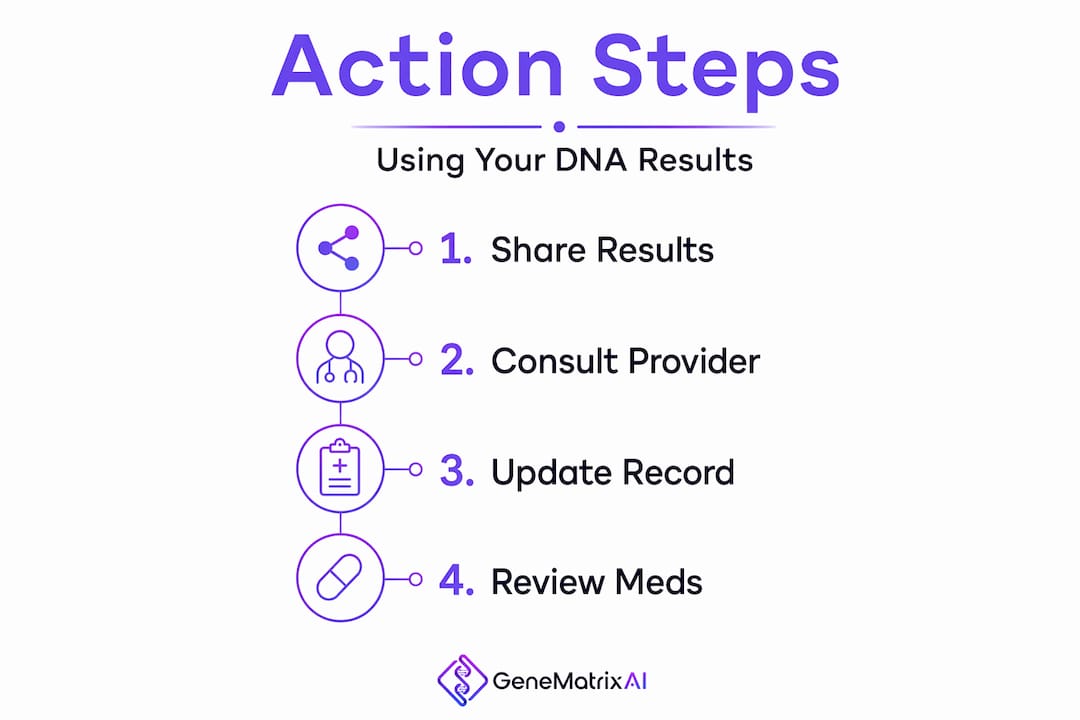
Pro Tip: Don't treat your pharmacogenomic report as a one-time event. As new drugs are prescribed over your lifetime, revisit the report with your provider. Your genetics don't change, but the drugs you take will.
Managing expectations is also part of the process. Benefits of pharmacogenomic guidance tend to build progressively. Patients who follow genotype-guided treatment plans often see better remission rates over time, not overnight. Think of your DNA data as a compass, not a shortcut.
For a deeper breakdown of how to read these reports, the genetic test results guide at Genematrix is worth bookmarking before your appointment.
Common challenges and misconceptions
Even people who understand the basics of DNA analysis for prescription drugs often run into confusion once they have their results in hand. Here are the most common issues and how to navigate them.
Misconception: Testing diagnoses a disease. It does not. Pharmacogenomic testing is a clinical support tool, not a diagnostic. It informs prescribing decisions; it doesn't replace a diagnosis or guarantee an outcome.
Misconception: A "use as directed" result means a drug will work perfectly. Genetics is one variable. Your liver function, other medications, and the condition being treated all shape the final result.
Cost and insurance reality: Testing costs often run several hundred dollars, and insurance coverage is inconsistent. Coverage is more likely when there's a documented clinical indication, such as treatment-resistant depression or cardiology needs. Always check with your insurer before testing.
When your provider doesn't know pharmacogenomics: This is more common than it should be. Ask your provider to refer you to a clinical pharmacist or a genetics-trained specialist. You can also bring printed educational resources from credentialed sources to the appointment.
"Pharmacogenomic data is most powerful when it's part of an ongoing conversation between patient and provider, not a one-time printout filed away and forgotten."
Privacy: Reputable, CLIA-certified labs are bound by federal privacy protections, including HIPAA. Before testing, review the lab's data-sharing policy. Understand whether your genetic data is used for research and whether you can opt out.
My take on what these tests actually deliver
I've followed the pharmacogenomics field closely for years, and I've developed a firm opinion: these tests are genuinely useful, but they are oversold in the wrong ways and undersold in the right ones.
What I mean is this. I've seen providers hand patients a pharmacogenomic report as if it's a prescription for a perfect medication, and I've seen patients walk away confused and disappointed when the "green light" drug still didn't work for them. The test is a roadmap, as experts consistently frame it, but a roadmap only helps if you know how to read it and have a skilled navigator beside you.
What I've found actually moves the needle is when patients bring their full medication history to the conversation, when a pharmacist trained in pharmacogenomics is in the room, and when the results are embedded into the EHR so they aren't lost at the next prescription. The DNA testing benefits I've observed compound over time. The first medication adjustment may be modest. The second and third, guided by the same genetic data, tend to be much more significant.
The biggest mistake I see is treating this as a one-and-done test. Your genes are permanent, and as your medication needs evolve over years and decades, that report stays relevant. The patients who get the most out of pharmacogenomic testing are the ones who keep it in their health record, revisit it with every new prescriber, and treat it as a living clinical asset rather than a novelty result.
— Tarek
How Genematrix supports your medication optimization
If you're ready to stop guessing and start making medication decisions based on your actual biology, Genematrix is built for exactly that.

Genematrix is a CLIA-certified, Chicago-based precision medicine company offering the GenePGx pharmacogenomics panel, a test designed to analyze drug-gene interactions across psychiatry, cardiology, pain management, and more. Their AI platform, trained on over 500,000 genetic profiles, delivers actionable genomic reports within 72 hours, not weeks. For ongoing medication management, the GeneMatrix AI mobile app lets you access your pharmacogenomic data, review drug compatibility alerts, and share results directly with your care team from your phone. Explore subscription plans starting at $69/month to make precision medicine a consistent part of your healthcare.
FAQ
What does a DNA test for medication compatibility test for?
It analyzes specific genes, primarily liver enzymes like CYP2D6 and CYP2C19, that control how your body breaks down and responds to medications. Results indicate whether you are likely to metabolize a given drug normally, too fast, or too slowly.
How long does it take to get pharmacogenomic test results?
Results typically return in 7 to 20 days from sample collection, though platforms like Genematrix's GenePGx deliver reports within 72 hours using AI-assisted analysis.
Does insurance cover genetic medication compatibility testing?
Coverage varies widely. It is more likely when there's a documented clinical need, such as treatment-resistant depression or cardiovascular conditions. Contact your insurer before testing to confirm your specific coverage.
Can this test tell me which medication will work best for me?
Not with certainty. The test identifies genetic factors that influence drug metabolism and response, but genetics alone cannot guarantee a medication outcome. Age, organ function, and other medications all play a role and must be factored in alongside your genetic data.
How do I share my pharmacogenomic results with my doctor?
Ask your testing provider for a shareable digital or printed report, and request that results be added to your electronic health record. EHR integration enables automated alerts for drug-gene interactions whenever a new prescription is entered, keeping your providers informed in real time.