

A positive result from a consumer DNA kit or a prenatal screen is often a flag, not a diagnosis. Genetic testing produces false positives regularly enough that professional guidelines now build in a mandatory confirmation step before anyone changes a treatment plan, has surgery, or makes a pregnancy decision based on a single result.
Here's what to do the moment you see an unexpected positive:
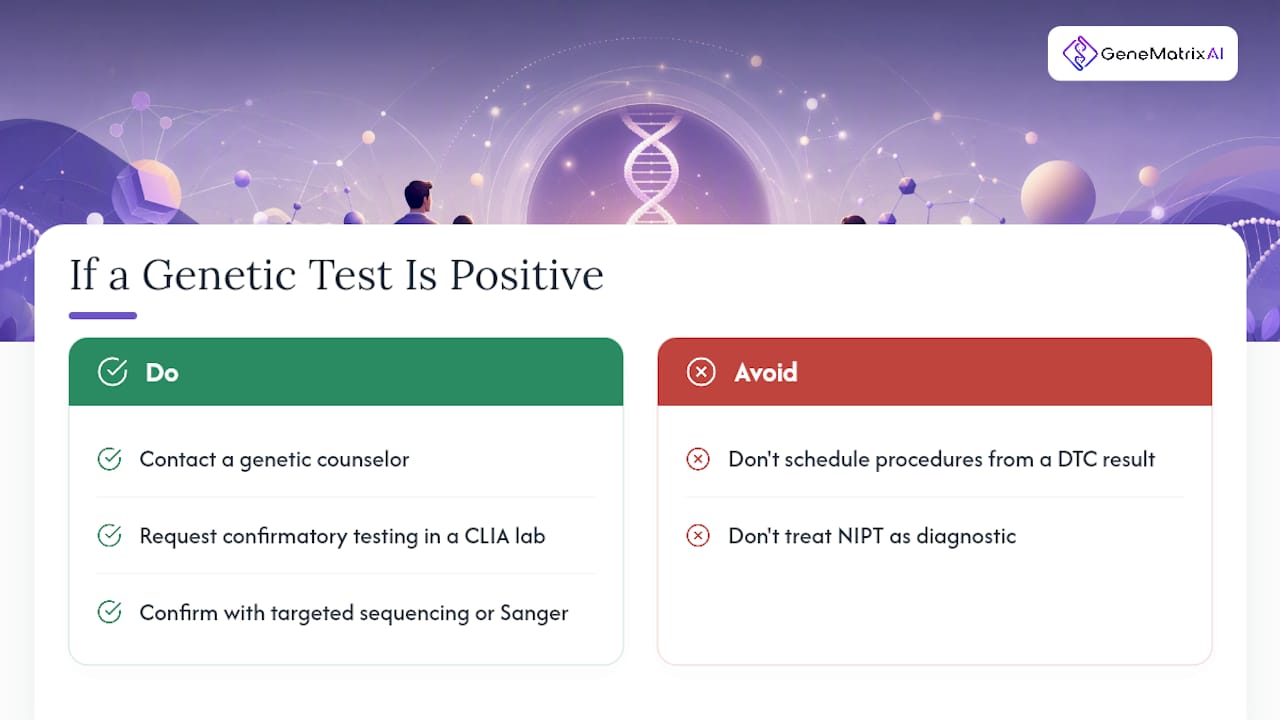
- Pause before scheduling surgery, changing medication, or making any irreversible decision.
- Contact a genetic counselor or your ordering clinician before acting on the result. The CDC recommends genetic counseling as a standard part of interpreting any positive screen.
- Request confirmatory testing in a CLIA-certified lab using a different method than the one that flagged the result.
One study found that 40% of variants reported in direct-to-consumer raw genotyping data were never confirmed by clinical testing, and 94.1% of those false calls sat in cancer-related genes. That single number is why positive predictive value, not raw accuracy, is the number that actually matters when you're staring at a scary result.
Key Takeaways
A positive result on a genetic or prenatal screening test is a probability signal that requires confirmatory testing in a CLIA-certified lab before it should ever drive a medical decision.
| Point | Details |
|---|---|
| False positives are common in DTC data | About 40% of variants in DTC raw-data reports failed clinical confirmation, most in cancer genes. |
| PPV matters more than accuracy | A highly specific test can still have low positive predictive value for rare conditions, so context beats the headline number. |
| Screening and diagnostic tests differ | NIPT and DTC panels flag risk; only orthogonal confirmatory methods like Sanger sequencing or targeted NGS confirm it. |
| Pause before acting | Delay surgery, medication changes, or major decisions until a genetic counselor and confirmatory test weigh in. |
| Confirm before telling family | Wait for confirmation before starting broader family conversations, unless a relative's care is time-sensitive. |
| Genematrix offers clinician-validated confirmation | Its CLIA-certified hereditary cancer panel pairs AI-driven reporting with genetic counseling to reduce false-positive risk. |
Table of Contents
- What Does a Genetic Test False Positive Mean?
- Why Do Genetic Tests Produce False Positives?
- Which Genetic Tests Are Most Prone to False Positives?
- How Common Are False Positives, and What Does PPV Actually Tell You?
- What Harm Can a False Positive Actually Cause?
- What Should You Do After a Positive Genetic Test Result?
- How Do You Know If a Genetic Test or Lab Is Reliable?
- What Does the Research Actually Show About Testing Accuracy?
- Coping With the Emotional Weight of a False Positive
- How Should You Talk to Family About a False Positive?
- Why Careful Interpretation Is the Whole Ballgame
- Get Clinical-Grade Testing That's Built to Confirm, Not Just Flag
- Frequently Asked Questions
- Sources
What Does a Genetic Test False Positive Mean?
A false positive means the test flagged a variant, mutation, or condition that further testing shows was never really there. It's different from a false negative, where a real risk gets missed, and different again from a variant of uncertain significance (VUS), where the lab found a genuine DNA change but nobody yet knows if it causes disease.
These three outcomes get confused constantly, and the confusion carries real consequences. A false positive on a BRCA panel might send someone toward a prophylactic mastectomy they never needed. A VUS misreported as pathogenic does the same damage through a different mechanism: it's not wrong data, it's an overconfident interpretation of ambiguous data. MedlinePlus Genetics frames a positive test result as one of several possible meanings, confirmed diagnosis, carrier status, elevated risk, or a signal for more testing, and says false positives, while uncommon in clinical-grade testing, do happen and always need context.
VUS results deserve special attention because they aren't errors at all. They're the honest admission that science hasn't caught up yet. Research on VUS reporting notes these findings still cause real emotional distress, even though the correct clinical response is usually "wait and monitor," not "treat as positive."
| Result type | What causes it | Typical next step |
|---|---|---|
| False negative | Test missed a real variant (limited panel, low coverage) | Consider broader testing if risk factors persist |
| VUS | Real DNA change with unclear disease link | Periodic reclassification review, genetic counseling |
Knowing which bucket your result falls into changes everything about what you do next. Our guide to interpreting genetic test results walks through how labs classify variants and why the language on your report matters as much as the result itself.
Why Do Genetic Tests Produce False Positives?
False positives come from three distinct sources, and knowing which one applies to your situation tells you how worried to be.
Technical causes live inside the lab equipment and chemistry. SNP-chip arrays, the technology behind most consumer DNA kits, work by testing predetermined genetic markers rather than reading your full DNA sequence. When a rare variant falls near the edge of what the chip can reliably detect, the clustering algorithm can miscall it. Sequencing artifacts and sample contamination add more noise. A large comparison of SNP-chip results against sequencing found false discovery rates of roughly 83% to 99% for very rare pathogenic BRCA variants specifically, meaning the vast majority of "hits" on ultra-rare markers weren't real.
Biological causes are trickier because nothing actually malfunctioned. In prenatal screening, confined placental mosaicism occurs when the placenta carries a chromosomal abnormality the fetus doesn't have, since the placenta and fetus don't always share identical genetics despite growing from the same fertilized egg. A vanishing twin, an early pregnancy loss of a twin that goes undetected, can also leave behind DNA that skews results. Mosaicism in the person being tested, where different cells carry different genetic makeups, produces similar confusion outside of pregnancy testing too.
Reporting and interpretation causes happen after the lab work is done. Someone uploads their raw DTC data file to a third-party interpretation service, and that service cross-references outdated public databases that haven't been updated to reflect a variant's true clinical significance. A benign polymorphism from five years ago can get flagged as pathogenic today simply because the interpreting tool never refreshed its annotations.
- SNP-chip probe clustering errors on rare variants
- Sequencing artifacts and low-coverage regions
- Sample cross-contamination during processing
- Confined placental mosaicism in prenatal screening
- Third-party raw-data reinterpretation using stale databases
Pro Tip: Before you panic over a result, ask the lab or service one direct question: what methodology generated this call, SNP-chip genotyping or next-generation sequencing? The answer alone tells you how much weight the result deserves.
Which Genetic Tests Are Most Prone to False Positives?
Not all genetic tests carry the same risk. Ranking them by relative exposure to false positives helps you calibrate how seriously to take an unexpected result.
- DTC raw-data and SNP-chip rare-variant calls carry the highest risk. These arrays weren't built for the job many consumers now use them for, hunting for ultra-rare pathogenic variants, and they perform poorly at it.
- NIPT and prenatal screening rank second. NIPT analyzes cell-free fetal DNA circulating in maternal blood, and a meta-analysis covering more than 750,000 tests documented false positives tied to confined placental mosaicism, maternal chromosomal variants, and vanishing twin scenarios. NIPT is explicitly a screening test, not a diagnostic one, regardless of how confidently the report reads.
- Research and biobank genotyping arrays sit in the middle. These are built for population-level studies, not individual diagnosis, and using them that way stretches their intended purpose.
- Clinical sequencing panels and diagnostic next-generation sequencing (NGS) carry the lowest risk. These read actual DNA sequence rather than inferring it from markers, and they're the gold standard labs use to confirm anything flagged by the tests above.
- DTC BRCA raw-data reports frequently flag variants that sequencing never confirms.
- NIPT aneuploidy flags often trace back to placental biology, not fetal biology.
A screening test raises a flag. A diagnostic test confirms or clears it. Treating the two as interchangeable is where most unnecessary anxiety, and unnecessary procedures, begin.
How Common Are False Positives, and What Does PPV Actually Tell You?
Positive predictive value, not raw accuracy, is the number that determines whether your positive result is probably real. PPV answers a specific question: of everyone who tested positive, what percentage actually has the condition? That number depends heavily on how rare the condition is in the first place, a detail most people never see explained on their test report.
Here's the math that catches people off guard. Imagine a test with 99% specificity, which sounds nearly perfect. Now apply it to a condition that only affects 1 in 5,000 people, in the range of many rare pathogenic BRCA variants. Because the condition is so rare, the number of true positives stays tiny, while the 1% false-positive rate, applied across a huge population of unaffected people, generates far more false alarms than real ones. The result: a test that sounds 99% accurate can still produce a PPV in the single digits for a rare condition.
That's not a hypothetical. Large-scale comparisons of SNP-chip genotyping against sequencing in population databases found PPV for certain pathogenic BRCA variants dropping as low as roughly 4%, even with high specificity, because the underlying condition is so rare in the general population. Pair that with the earlier finding that 40% of DTC-reported variants failed clinical confirmation, and you get a clear picture: raw-data screening for rare cancer variants is exactly where PPV math turns against the consumer.
- Specificity tells you how often a test correctly clears people without the condition.
- PPV tells you how often a positive result is actually right, and it drops fast for rare conditions.
- Low prevalence is the single biggest reason a "highly accurate" test can still mislead.
What Harm Can a False Positive Actually Cause?
The damage from a false positive rarely stays contained to a bad afternoon of worry. It can cascade into procedures, decisions, and relationships that are hard to walk back.
On the clinical side, a false positive can trigger unnecessary imaging, invasive diagnostic follow-ups, or in the most serious cases, prophylactic surgery based on a result that never should have reached that stage. In pregnancy, a false-positive screen can push someone toward invasive diagnostic procedures like amniocentesis, which carries its own small but real procedural risk, to chase down a flag that biology alone would have explained.
The personal toll is just as real. Anxiety following an unconfirmed positive result can persist for weeks, and family relationships sometimes strain under the weight of a diagnosis that turns out to be wrong. Financial and insurance questions add another layer. The Genetic Information Nondiscrimination Act (GINA) protects against health insurance and employment discrimination based on genetic information, but its protections don't extend to life, disability, or long-term care insurance, a gap worth confirming with your own state and provider before testing.
The safest sequence is always the same: screening result, confirmatory diagnostic test, genetic counseling, then action. Skipping straight from flag to decision is where most preventable harm happens.
Genetic screening carries real tradeoffs even when it works exactly as designed, and our breakdown of screening's advantages and disadvantages covers that balance in more depth.
What Should You Do After a Positive Genetic Test Result?
Treat a positive result as the start of a process, not the end of one. Here's the sequence that protects you from acting on incomplete information.
- Pause on anything irreversible. No surgery, no medication changes, no major life decisions until confirmation is in hand.
- Contact your clinician or a genetic counselor immediately. They can assess whether the result fits your personal and family history before you do anything else.
- Request confirmatory testing in a CLIA-certified lab. Clinical confirmation should use an orthogonal method, meaning a different technology than the one that produced the original flag, such as Sanger sequencing to confirm a single site or targeted NGS to re-verify a broader panel result.
- Ask about family testing if the confirmed result has hereditary implications, since a real pathogenic variant often carries relevance for siblings, parents, and children.
Before you agree to any confirmatory test, ask the lab or provider a short list of pointed questions:
- What specific methodology will you use, and how does it differ from the original test?
- Is your lab CLIA-certified, and do you also carry CAP accreditation?
- What's the realistic turnaround time for results?
- Who interprets the final report, a board-certified geneticist, a genetic counselor, or an automated system?
Confirmatory testing typically takes anywhere from a few days to several weeks depending on the method and the lab's backlog. Costs vary widely, and insurance coverage for confirmatory testing often depends on whether your clinician documents medical necessity, so ask your provider to code the order accordingly before submitting it to your insurer.
Pro Tip: Keep a copy of your original raw report and any lab methodology notes. If you need a second opinion or a different confirmatory lab down the line, having that paperwork ready saves weeks.
For a full walkthrough of what a proper screening-to-confirmation workflow looks like in practice, our step-by-step genetic screening guide breaks down each stage.
How Do You Know If a Genetic Test or Lab Is Reliable?
Reliability comes down to a handful of concrete, checkable things, not marketing language on a website.
Look for CLIA certification at minimum, and CAP accreditation as a stronger signal, published validation data showing how the test performed against a known standard, a clearly stated methodology (SNP-chip versus NGS matters enormously here), a defined confirmatory workflow for positive results, and access to genetic counseling as part of the service, not an upsell bolted on afterward.
Red flags are just as identifiable. Watch for raw-data-only reports with no clinical interpretation included, third-party interpretation services that reclassify variants using databases nobody can name or date, and any test marketing diagnostic-level claims without a clinician anywhere in the process. Mayo Clinic's guidance on genetic testing is blunt about this: consumer tests can provide information that isn't accurate enough for medical decisions, and clinical-grade testing ordered through a provider remains the more reliable path.
Before you buy or act on a test, ask directly:
- Is this test CLIA-certified, and can you show me the certification?
- What methodology generates the results, and what's its published false-positive rate?
- Is genetic counseling included, and who do I talk to if my result comes back positive?
Our guide on what to know before DNA testing covers additional questions worth asking before you send off a sample.
What Does the Research Actually Show About Testing Accuracy?
The strongest evidence on this topic comes from a small set of studies worth knowing by name, because their limitations matter as much as their findings.
- The PMC study on DTC raw-data confirmation found 40% of reported variants failed clinical confirmation, with 94.1% of false calls in cancer genes. Its main limitation: the sample came from people who specifically sought confirmatory testing after a DTC result, so it likely overrepresents concerning findings rather than routine ones.
- The SNP-chip versus sequencing comparison documented 83% to 99% false discovery rates for rare BRCA variants. It draws on large population databases, which strengthens its statistical power but means it reflects population-level patterns rather than any single lab's performance.
- The NIPT meta-analysis pooled results across more than 750,000 tests, giving it strong statistical weight, though NIPT technology and lab protocols have continued to evolve since some of the underlying studies were conducted.
Genetic counselors have consistently pointed out that consumers confuse screening and diagnostic tests, and that unvalidated third-party interpretation services are a recurring source of misclassified variants.
Genematrix operates as a CLIA-certified laboratory, and the practical guidance throughout this article, confirm before you act, understand PPV, involve a genetic counselor, reflects the same standards clinical laboratories are held to industry-wide.
Coping With the Emotional Weight of a False Positive
The psychological toll of a false positive doesn't wait for confirmation to arrive. Studies on VUS and inconclusive results consistently show that distress often sets in the moment a positive flashes on screen, regardless of whether the result later proves accurate. Your body doesn't know the difference between a confirmed diagnosis and a screening artifact, it reacts to the word "positive" either way.

A few things help during the waiting period. Naming the uncertainty out loud, to a partner, a friend, or a counselor, tends to reduce its grip more than trying to reason your way out of worry alone. Genetic counselors are trained specifically for this moment; part of their job is walking you through probability in plain language so the number on your report stops feeling like a verdict. Limiting how much time you spend searching your specific variant online also helps, since forums and outdated databases are exactly the kind of unvetted sources that fuel unnecessary panic.
It's worth remembering that a positive screening result is a data point, not a diagnosis, and that confirmatory testing exists precisely because screening technology produces noise. Treating the waiting period as a normal part of the process, rather than a personal failure to stay calm, makes it easier to get through. A genetic counseling conversation early in that window often does more for your mental state than any amount of independent research.
How Should You Talk to Family About a False Positive?
Timing matters more than most people expect. Sharing an unconfirmed result with relatives before confirmatory testing is complete can trigger a chain reaction, siblings requesting their own tests, parents second-guessing family history, that's hard to undo if the original flag turns out to be false.
The better approach: wait for confirmation before initiating a broader family conversation, unless the situation is time-sensitive for someone else's care. Once a result is confirmed, hereditary variants like BRCA1/BRCA2 or Lynch syndrome mutations carry direct relevance for first-degree relatives, and a genetic counselor can help you figure out exactly who needs to know and how urgently.
When you do have the conversation, separate what's confirmed from what's still pending. Saying "my screening test flagged something, and I'm getting it confirmed" is a very different message than "I have a BRCA mutation," and conflating the two can cause relatives to make decisions, additional testing, anxiety, even preventive procedures, based on information that isn't settled yet.
If a result is confirmed, cascade testing for family members becomes a genuinely useful tool, since a real pathogenic variant found in one relative often changes risk assessment for the whole family tree. Our guide to genetic cancer testing and health decisions walks through how confirmed hereditary findings should inform decisions for relatives, not just the person originally tested.
Why Careful Interpretation Is the Whole Ballgame
The gap between a screening flag and a confirmed diagnosis is where most of the damage in this field happens, and it's almost entirely preventable. Every study cited in this piece points to the same underlying problem: technology built for one purpose (broad population screening) gets used for a much higher-stakes purpose (individual clinical decisions) without the confirmation step that would catch the difference.
What gets underestimated constantly is how much the type of test matters more than the headline accuracy number on the box. A test can be 99% accurate and still mislead you badly if the condition it's checking for is rare enough. That's not a flaw in the test, it's math, and understanding that math is the difference between panic and a clear next step.
Confirmatory testing isn't bureaucratic caution. It's the mechanism that turns a probability into an answer. Anyone skipping that step, on either side, over-trusting a scary result or dismissing one without checking, is making a decision with worse information than they need to.
Get Clinical-Grade Testing That's Built to Confirm, Not Just Flag
If this article left you wondering whether your last DNA kit result deserves more scrutiny, that instinct is correct, and it's exactly the gap Genematrix was built to close. Where raw-data SNP-chip kits report variants without clinical validation, Genematrix runs hereditary cancer screening through a CLIA-certified lab with clinician-validated reporting and genetic counseling built into the process, not offered as an afterthought once you're already anxious.

Genematrix's 108-gene hereditary cancer screening covers BRCA1/BRCA2, Lynch syndrome, and dozens of other actionable genes, with results delivered through the GeneMatrixAI platform and reviewed against the same confirmatory standards this article recommends before anyone acts on a finding. If you've gotten an ambiguous result elsewhere, or you'd rather start with a test designed for clinical decisions from the outset, ordering a panel through Genematrix is the direct next step.
Frequently Asked Questions
Can genetic tests be wrong? Yes. Genetic tests can produce false positives and false negatives, and results can also come back as variants of uncertain significance, which are neither clearly benign nor clearly harmful. Technical errors, biological factors like mosaicism, and outdated database annotations all contribute.
How reliable are genetic tests? Reliability depends heavily on the technology and the specific variant being tested. Clinical-grade sequencing performed in a CLIA-certified lab is far more reliable for rare pathogenic variants than SNP-chip arrays used in most consumer kits, which show false discovery rates as high as 83% to 99% for very rare BRCA variants.
What should I do if a direct-to-consumer test comes back positive for a cancer gene? Don't schedule any procedure based on that result alone. Contact a genetic counselor and request confirmatory testing through a CLIA-certified lab using a different method than the original test, ideally targeted sequencing or Sanger confirmation.
Why do prenatal screening tests like NIPT sometimes give false positives? NIPT analyzes fetal DNA fragments circulating in the mother's blood, and biological quirks like confined placental mosaicism, maternal chromosomal variants, or an undetected vanishing twin can all produce a positive flag that doesn't reflect the fetus's actual genetics. That's why NIPT is a screening test, not a diagnostic one.
Does a positive result always mean I'll develop the condition? No. A positive result indicates increased risk or the need for further testing, not a certainty of developing the condition. Genetic testing can't predict exact severity or timing of onset, and even confirmed pathogenic variants carry variable penetrance depending on the gene involved.
This article is general information, not a substitute for advice from a qualified doctor. Consult a qualified healthcare professional about your own circumstances before acting on anything here.