

TL;DR:
- For most genetic tests, saliva provides a comparable sample to blood, especially for panels and screening. Blood remains preferred for diagnostic-grade WGS, CNV detection, and RNA analysis due to higher quality and reliability. Success depends more on the lab's protocols and pipelines than on the sample type itself.
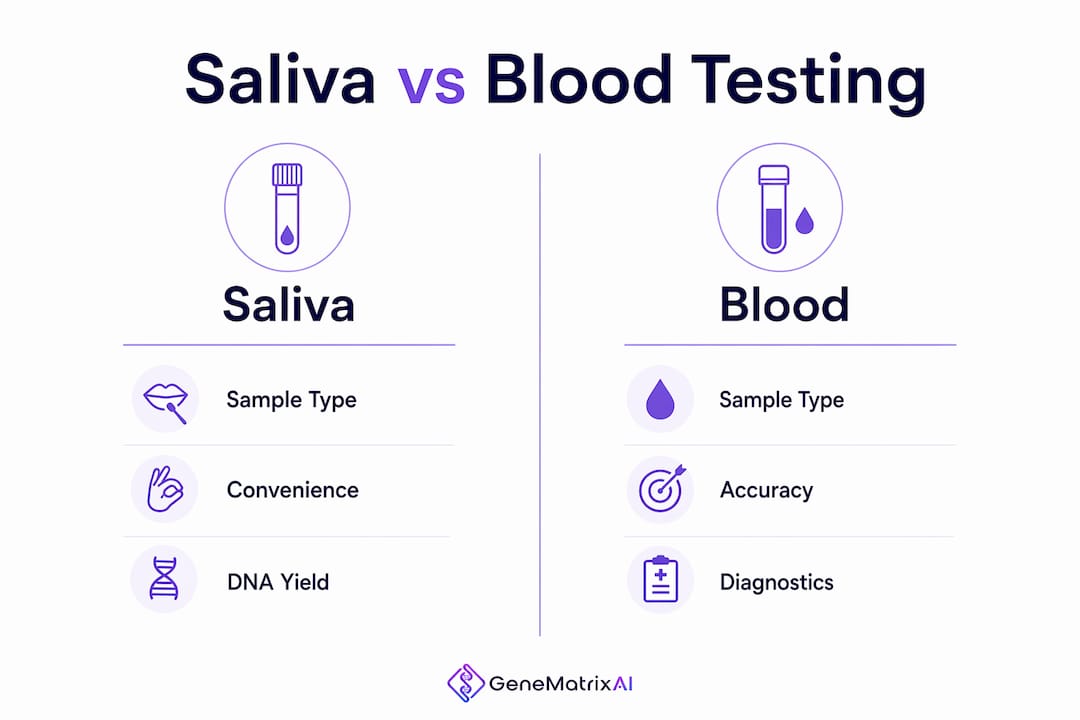
For most routine genetic tests, saliva works just as well as blood. That includes pharmacogenomics panels, carrier screening, and many hereditary cancer risk assessments. Blood remains the preferred sample for clinical-grade whole-genome sequencing (WGS), RNA-based analyses, and tests where copy number variant (CNV) detection is central to the diagnosis. The core saliva vs blood genetic testing differences come down to test purpose, not sample prestige.
A few things to know upfront:
- DNA yield from saliva is typically about 2-fold lower than blood, but lower yield does not automatically mean lower accuracy for array-based or panel tests.
- CLIA-certified labs like Genematrix apply QC thresholds that compensate for yield variability, so the pipeline matters as much as the sample.
- If your clinician ordered a diagnostic-grade test or specifically requested blood, follow that guidance. For everything else, saliva is usually the more convenient and equally appropriate choice.
Table of Contents
- How are saliva and blood samples actually collected?
- DNA yield and quality: what labs actually measure
- Are saliva tests as accurate as blood tests? What the studies say
- Which genetic tests accept saliva and which need blood?
- Practical logistics: cost, shipping, stability, and turnaround
- When does a saliva sample fail, and what happens next?
- How to tell whether a test is clinical-grade
- How Genematrix decides sample acceptance and ensures clinical quality
- Key Takeaways
- The case for letting the test decide, not the sample
- Genematrix at-home testing: clinical quality without the clinic visit
- Useful sources
How are saliva and blood samples actually collected?
Blood collection follows a standard venipuncture protocol: a phlebotomist draws 5–10 mL from a peripheral vein, typically into EDTA-anticoagulant tubes to preserve DNA integrity. The sample needs to reach the lab refrigerated, usually within 72 hours, which means a clinic visit is non-negotiable. WHO phlebotomy guidelines require trained personnel, proper labeling, and cold-chain handling from draw to processing.
Saliva collection is a different experience entirely. Most at-home kits include a collection tube with a stabilizing buffer (Oragene-style kits are the most widely validated), a funnel, and a prepaid return mailer. You spit into the tube until you hit the fill line, snap the cap to release the buffer, shake, and ship at room temperature. No needle, no appointment, no cold pack.
Buccal swabs are a third option, often used for children or people with limited saliva production. You rub a foam-tipped swab along the inside of the cheek for 30–60 seconds. Swabs yield less DNA than liquid saliva but are gentler and faster, making them practical for pediatric testing.
Proper collection technique is the single biggest variable in saliva sample quality. Following manufacturer instructions, including timing and mouth rinsing, yields sufficient DNA for genotyping in the vast majority of saliva samples.
Pro Tip: Avoid eating, drinking (anything other than water), smoking, or brushing your teeth for at least 30 minutes before collecting a saliva sample. Rinse your mouth with water, wait 10 minutes, then collect. This simple step reduces bacterial contamination and improves DNA concentration.
Practical checklist for first-time saliva collectors:
- No food or drink (except water) for 30 minutes before collection
- Rinse mouth with plain water, wait 10 minutes
- Collect in the morning before coffee or breakfast if possible
- Fill to the indicated line, not beyond
- Shake the tube firmly after capping to mix the buffer
- Ship within the window specified by the kit (usually 2–4 weeks at room temperature)
DNA yield and quality: what labs actually measure
Labs do not just look at whether DNA is present. They measure several metrics before a sample ever reaches the sequencing instrument.

Concentration (ng/µL) tells the lab how much DNA is in the extract. Blood typically yields 50–200 ng/µL; saliva usually comes in lower, often 10–100 ng/µL depending on collection quality and the individual. That typical 2-fold gap matters more for WGS than for targeted panels, which need far less input material.
A260/A280 purity ratio measures protein contamination. A ratio of 1.8–2.0 is considered clean. Saliva samples can run slightly lower due to residual proteins from oral mucosa, though validated extraction kits largely correct for this.
Call rate is the percentage of targeted genomic positions that return a usable genotype. For chip-based genotyping arrays, call rates exceed 99% for blood and typically exceed 97% for saliva when collection is done correctly. That difference is small enough that most saliva samples pass QC for array platforms.
Percent human-mappable reads is where saliva diverges most sharply from blood in sequencing workflows. Saliva contains oral microbiome DNA. In some WGS studies, saliva samples showed roughly 10% non-human reads compared with approximately 0.09% in blood. Sequencing pipelines must filter those reads before variant calling, which effectively reduces the usable coverage depth.
| Metric | Blood (typical range) | Saliva (typical range) | Impact on test |
|---|---|---|---|
| DNA concentration | 50–200 ng/µL | 10–100 ng/µL | Matters most for WGS/WES input |
| A260/A280 ratio | 1.8–2.0 | 1.8–2.0 | Affects extraction purity |
| Array call rate | >99% | >97% | Minimal for panel/array tests |
| Non-human reads (WGS) | ~0.09% | ~10% | Requires microbiome filtering |
| CNV concordance | High | Lower | Critical for structural variant tests |
Why does CNV concordance drop for saliva? Saliva contains a mix of cell types: epithelial cells, leukocytes, and microorganisms in proportions that vary from sample to sample. That cellular heterogeneity can distort copy number signals, making CNV calls less reliable unless the bioinformatics pipeline explicitly accounts for it.
Key implications by test type:
- Targeted panels and arrays: yield and call-rate differences are small enough to be clinically negligible with proper collection.
- Low-pass WGS: non-human reads reduce effective coverage; labs may require higher sequencing depth for saliva.
- Rare-variant detection: lower input quality increases the chance of ambiguous calls; blood reduces that risk.
- CNV-heavy tests (e.g., chromosomal microarray): blood is strongly preferred due to cellular heterogeneity in saliva.
Are saliva tests as accurate as blood tests? What the studies say
The short answer: for most genetic tests, yes. Under validated protocols, saliva-derived DNA can be considered equivalent to blood-derived DNA for both WGS and WES. The accuracy of sequencing metrics and variant-detection performance is driven more by genomic context, variant type, and sequencing technology than by whether the sample came from a vein or a spit tube.
A paired-sample study comparing blood and saliva for WGS and WES found high concordance for single nucleotide variants (SNVs) and small insertions and deletions (indels) when both samples were processed through the same validated bioinformatics pipeline. Accuracy declined in difficult-to-sequence genomic regions, but that decline was tied to the properties of those regions, not to the saliva source itself.
The picture changes for WGS at scale. One cardiac-patient study found a WGS QC-failure rate of approximately 46% for saliva versus approximately 6% for blood. SNV concordance for high-quality saliva samples can exceed 95%, but CNV concordance is notably lower. That failure-rate gap is the main reason clinical diagnostic labs still default to blood for WGS.
Evidence summary:
- Array-based genotyping: saliva is validated and widely accepted; call rates are comparable to blood.
- WES under strict protocols: saliva performs equivalently to blood for SNVs and indels.
- WGS (clinical diagnostic): saliva has a substantially higher QC-failure rate; blood is preferred to avoid re-draws.
- CNV analysis: blood is recommended; saliva's cellular heterogeneity introduces noise.
- Pharmacogenomics panels: saliva is well-validated and routinely accepted by clinical labs.
Accuracy, in other words, is a system property. Sample type, lab protocols, sequencing depth, and variant interpretation pipelines together determine whether a result is clinically reliable. A high-quality saliva sample processed through a rigorous pipeline will outperform a poorly handled blood sample every time. Understanding how genetic testing works at the lab level helps clarify why the pipeline matters as much as the tube.
Which genetic tests accept saliva and which need blood?
The decision tree is cleaner than most people expect. Match your test type to the column below, then check the exceptions.
| Test type | Recommended sample | Notes |
|---|---|---|
| Pharmacogenomics (PGx) panels | Saliva | Well-validated; saliva is standard for most PGx labs |
| Hereditary cancer panels (BRCA1/2, Lynch) | Saliva usually acceptable | Blood is preferred for complex multi-gene diagnostic workups |
| Carrier screening (autosomal recessive) | Saliva | Array-based; call rates comparable to blood |
| Whole-exome sequencing (WES) | Either, under validated protocol | Saliva equivalent under strict QC |
| Whole-genome sequencing (WGS, diagnostic) | Blood preferred | Higher QC-failure rate for saliva; CNV sensitivity |
| RNA-based expression tests | Blood (EDTA or PAXgene) | Saliva does not preserve RNA reliably |
| Chromosomal microarray (CNV-focused) | Blood | Cellular heterogeneity in saliva distorts CNV signals |
| Prenatal/urgent diagnostic testing | Blood | Yield consistency reduces re-draw risk in time-sensitive cases |
| Hormone/steroid assays (timed sampling) | Saliva (assay-specific) | Free steroid levels are better reflected in saliva for some timed tests |
A few borderline cases worth knowing:
- Prenatal testing: when timing matters (e.g., first-trimester screening windows), clinical labs prefer blood to avoid the delay of a failed saliva sample and re-collection.
- Suspected rare disease: rare-variant detection and CNV calling are more sensitive to input quality. If a clinical decision hinges on finding a structural variant or a rare pathogenic allele, blood reduces the probability of an ambiguous result.
- Medication decision-making (PGx): saliva is the standard here. DNA testing for medication outcomes relies on SNV-level genotyping where saliva performs on par with blood.
- Hormone testing: certain assays measure free steroid levels that are better captured in saliva for timed sampling, making saliva the preferred matrix for those specific analytes.
Practical logistics: cost, shipping, stability, and turnaround
Convenience gap. At-home saliva kits ship to your door, require no appointment, and return by standard mail at room temperature. Blood draws require a clinic visit, a phlebotomist, cold-chain shipping, and coordination between the draw site and the lab. For most people, that difference alone drives the choice toward saliva when the test supports it.
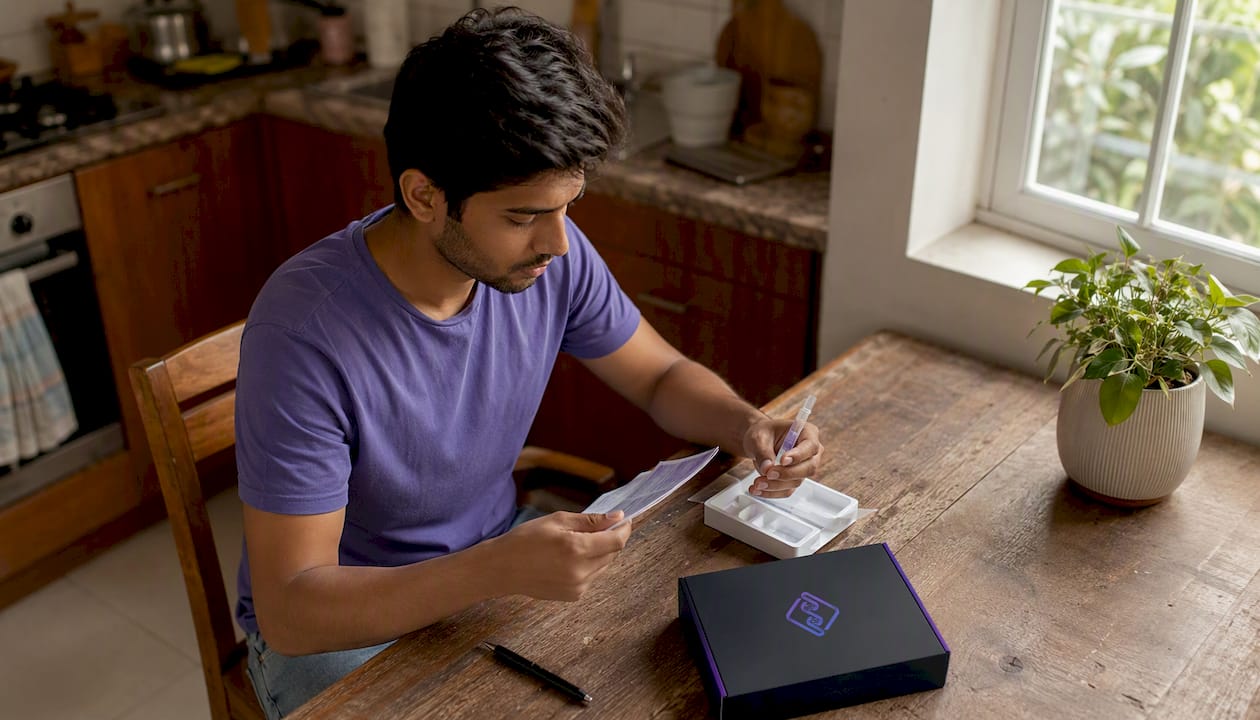
Sample stability. Saliva stabilized with a validated buffer (Oragene-style) is stable at room temperature for weeks to months, which makes international and rural shipping feasible. Blood in EDTA tubes needs to reach the lab within 72 hours under refrigeration. A delay or temperature excursion can degrade blood DNA significantly, while stabilized saliva is far more forgiving.
Turnaround time. At-home saliva kits typically return results in 7–21 days from sample receipt, depending on the test type and lab volume. Clinical blood draws processed in a hospital or reference lab can be faster for urgent diagnostics (3–7 days for targeted panels) but slower for complex WGS (4–8 weeks). Genematrix delivers clinician-validated reports within 72 hours of sample processing for its standard panels, which is faster than most clinical reference labs for comparable tests.
Cost differences. Consumer at-home saliva tests generally run $99–$499 out of pocket depending on panel breadth. Clinical blood-draw tests billed through insurance can be lower cost for patients with coverage, but out-of-pocket costs for uninsured patients can be substantially higher. Re-collection fees apply if a saliva sample fails QC, which is worth factoring in for WGS orders.
Banking and storage. Many labs store extracted DNA for future testing. Saliva-derived DNA stored properly can be used for additional tests years later, which is a meaningful advantage for people who want to expand their panel without another collection.
Key logistics trade-offs at a glance:
- Saliva: no appointment, room-temperature shipping, lower upfront cost, small re-draw risk for WGS
- Blood: clinic visit required, cold-chain shipping, higher logistical burden, lower QC-failure risk for complex tests
- Turnaround: comparable for panels; blood has an edge for urgent diagnostic workflows
- Storage: both can be banked; saliva is more stable for long-term room-temperature storage
When does a saliva sample fail, and what happens next?
Saliva failures are not random. They cluster around a few predictable causes, and most are preventable.
Common failure causes:
- Low human DNA yield: insufficient saliva volume, dilute sample, or poor cell lysis
- Oral contamination: food, drink, or tobacco residue in the sample raises bacterial DNA and lowers the human fraction
- Improper collection timing: collecting immediately after eating or drinking before the buffer has time to work
- Shipping extremes: prolonged heat exposure (above 50°C) or freezing can degrade even buffered saliva
- Inadequate mixing: not shaking the tube after capping means the buffer does not fully contact the sample
For WGS specifically, labs apply strict QC gates: minimum percent human-mappable reads, minimum coverage depth after microbiome filtering, and minimum call-rate thresholds. Samples that fall below these thresholds trigger a re-collection request rather than a reported result. That is the right call clinically, even if it is frustrating for the patient.
Best practices to avoid a re-draw:
- Follow the 30-minute no-food/drink rule without exception
- Collect in the morning before breakfast
- Fill to the line, not under it
- Mix thoroughly after capping
- Ship within 48 hours of collection if possible
- Store the kit at room temperature, away from direct sunlight, until shipping
If the lab requests a re-collection, most providers send a replacement kit at no additional charge for a first failure. A second failure on saliva is a strong signal to switch to a blood draw for that specific test.
How to tell whether a test is clinical-grade
Not all genetic tests are created equal, and the label "genetic test" covers everything from a $29 ancestry kit to a diagnostic-grade WGS ordered by a neurologist. The signals that separate clinical-grade from consumer-grade are specific and checkable.
Trust signals to look for:
- CLIA certification: the Clinical Laboratory Improvement Amendments program certifies labs that perform testing on human specimens for health assessment. A CLIA-certified lab meets federal standards for personnel, QC, and proficiency testing.
- CAP accreditation: the College of American Pathologists accreditation goes further, requiring on-site inspections and peer review. CAP-accredited labs meet a higher bar than CLIA alone.
- Published validation data: clinical-grade labs publish or provide on request their analytical validation data, including sensitivity, specificity, and concordance metrics for each test.
- Clinician sign-off: a licensed clinician (physician or genetic counselor) reviews and signs the report before it is released. This is not standard for consumer tests.
- Genetic counseling availability: access to a board-certified genetic counselor to interpret results is a strong signal of clinical intent.
- Clear QC metrics in the report: the report should state sequencing depth, call rate, and any regions of reduced coverage.
Questions to ask before ordering:
- What is your sample acceptance policy for saliva versus blood for this specific test?
- What is your expected re-draw rate for saliva samples on this panel?
- Is a clinician or genetic counselor available to review my results?
- What sequencing depth do you use, and how do you handle low-coverage regions?
- Is your lab CLIA-certified and CAP-accredited?
Understanding the main types of genetic tests and what each requires helps you ask the right questions before you order, not after you get a re-collection notice.
How Genematrix decides sample acceptance and ensures clinical quality
Genematrix operates as a CLIA-certified lab with AI-driven analysis trained on more than 500,000 genetic profiles. That scale matters for variant interpretation: the platform has seen enough rare variants and edge cases to flag signals that smaller reference databases miss.
For sample acceptance, Genematrix applies test-specific QC thresholds rather than a single blanket policy. Saliva is accepted for its pharmacogenomics panels (GenePGx), hereditary cancer screening (GeneCancer, including BRCA1/2 and Lynch syndrome), psychiatric panels (GeneMind), pediatric screening (GeneBaby), and nutrigenomics (GeneDiet). Blood collection is recommended when a test's clinical question involves CNV analysis, RNA expression, or diagnostic-grade WGS where the higher QC-failure rate of saliva would increase the risk of a re-draw.
The QC workflow applies minimum thresholds for human-read mapping percentage, coverage depth, and call rate before any sample proceeds to variant interpretation. Samples that fall below threshold trigger a re-collection request rather than a low-confidence report. Every report that clears QC receives clinician validation before release, and genetic counseling is available for patients who need help interpreting results.
Robust lab pipelines and clinician review are critical in delivering medically actionable results regardless of sample type. The choice between saliva and blood is one input into a larger system of quality controls that together determine whether a result is clinically reliable.
The GeneMatrixAI platform's AI-powered DNA analysis applies variant interpretation across multiple gene panels simultaneously, which is why the 72-hour turnaround is achievable even for multi-gene hereditary cancer panels. The speed comes from the pipeline, not from cutting corners on QC.
Key Genematrix quality controls:
- CLIA-certified workflows for all clinical panels
- AI variant interpretation trained on 500,000+ genetic profiles
- Test-specific QC thresholds for human-read mapping, coverage, and call rate
- Clinician validation on every released report
- Genetic counseling available for result interpretation
- Re-collection protocol triggered before a low-confidence result is reported
Key Takeaways
Saliva is sufficient for most routine and consumer genetic tests; blood remains the right choice when diagnostic precision, CNV analysis, or RNA-based workflows are involved.
| Point | Details |
|---|---|
| Saliva accuracy for panels | Call rates exceed 97% for array-based tests; saliva is validated for PGx, carrier screening, and many hereditary cancer panels. |
| Blood for complex sequencing | WGS QC-failure rate is approximately 46% for saliva versus approximately 6% for blood; blood is preferred for diagnostic-grade WGS and CNV tests. |
| Non-human DNA in saliva | Saliva WGS samples can contain a notable proportion of non-human reads compared with blood, requiring microbiome filtering. |
| Pipeline quality determines accuracy | Lab protocols, sequencing depth, and clinician review matter as much as sample type for clinical reliability. |
| Genematrix sample guidance | Genematrix accepts saliva for its GenePGx, GeneCancer, GeneMind, GeneBaby, and GeneDiet panels, and recommends blood for diagnostic-grade WGS and CNV-focused tests. |
The case for letting the test decide, not the sample
There is a persistent assumption in consumer health that blood tests are inherently more serious and saliva tests are inherently less reliable. That framing is outdated. The peer-reviewed evidence is clear: under validated protocols, saliva-derived DNA performs equivalently to blood for the tests most people actually need, including pharmacogenomics, hereditary cancer panels, and carrier screening.
What actually determines clinical reliability is the system around the sample: the extraction protocol, the sequencing depth, the bioinformatics pipeline, and whether a clinician reviewed the result before it reached you. A saliva sample processed through a CLIA-certified lab with rigorous QC gates and clinician sign-off is more clinically meaningful than a blood draw processed through a pipeline with no validation data and no clinician oversight.
The place where blood genuinely wins is narrow but real: diagnostic-grade WGS, CNV-heavy structural analyses, RNA expression tests, and urgent prenatal workflows where a re-draw would cause a clinically significant delay. Outside those contexts, insisting on blood adds inconvenience without adding accuracy.
The broader point is about access. Removing the needle removes a real barrier. People who would otherwise skip testing because of needle anxiety, lack of clinic access, or cost do get tested when a saliva kit arrives in the mail. That is a public-health win, not a compromise. The goal is getting the right information to the right person at the right time, and for most genetic questions, saliva gets you there.
Genematrix at-home testing: clinical quality without the clinic visit
Most people ordering a hereditary cancer screen, a pharmacogenomics panel, or a pediatric wellness test do not need a blood draw. They need a clinician-validated result they can act on, delivered without a clinic visit, a cold-chain shipment, or a two-week wait.
Genematrix's at-home saliva kits cover exactly that range: GeneCancer (BRCA1/2, Lynch syndrome, and more), GenePGx for medication optimization, GeneMind for psychiatric medication guidance, GeneBaby for pediatric screening, and GeneDiet for nutrition-based insights. Every result is processed through a CLIA-certified workflow, reviewed by a clinician, and delivered within 72 hours of sample processing. Genetic counseling is available for anyone who wants to talk through what their results mean.

If your clinician has specifically requested a blood draw for a diagnostic-grade test, Genematrix can guide you through that process as well. For everyone else, the path forward is straightforward: start your health intake at Genematrix, select the panel that fits your clinical question, and get a clinician-validated report without leaving home.
Useful sources
- Saliva samples are a viable alternative to blood samples as a source of DNA for high throughput genotyping — PMC, paired-sample genotyping study
- Validated WGS and WES protocols proved saliva-derived gDNA as an equivalent to blood-derived gDNA for clinical and population genomic analyses — BMC Genomics, validated protocol comparison
- Quality of whole genome sequencing from blood versus saliva derived DNA in cardiac patients — BMC Medical Genomics, WGS QC-failure rate data
- The Pros, Cons, and Differences Between Blood and Saliva for Genetic Testing — Norton & Elaine Sarnoff Center for Jewish Genetics
- Genotyping Performance between Saliva and Blood-Derived Genomic DNAs — PMC, genotyping concordance study
- How Does Genetic Testing Work: a Clear Explanation — Hope at Rare Labs, educational primer
- Why Genetic Diagnosis Is Critical for Personalized Care — Hope at Rare Labs, clinical genetics context