

If your genetic test came back with a pathogenic or likely pathogenic finding, tell your closest blood relatives soon, and give them more than just the news. Hand them the test summary and your clinic's contact information so their own doctor can act on it. That single step, backed by a document instead of a secondhand retelling, is what turns a hard conversation into a useful one.
Before anything else, work through this short list:
- Request a family letter or written clinic summary from your genetic counselor. It's a neutral document that does the explaining for you.
- Decide who needs to know first. Parents, siblings, and adult children come before extended family.
- Get a copy of your actual test report, including the gene name and variant classification, ready to share.
- Write down your genetic counselor's phone number or email so relatives can reach a real clinician, not just you.
Pro Tip: Ask your genetic counselor for the exact test name or ordering code relatives should give their own doctor. "Familial variant testing for [gene name]" gets a faster, cheaper result than a full panel ordered from scratch.
Key Takeaways
Sharing a clinically actionable genetic result works best when it's paired with a documented clinic summary and genetic counseling support, not conversation alone.
| Point | Details |
|---|---|
| Tell close relatives first | First-degree relatives carry the highest shared risk and should hear the news before extended family. |
| Share the report, not a summary | Include the gene, variant classification, condition name, and inheritance pattern so a clinician can act. |
| Request a family letter | Ask your genetic counselor for a written summary and the recommended test name for relatives. |
| Never use PGx results to self-dose | Relatives need their own pharmacogenomic testing before adjusting any medication. |
| Genematrix supports the process | Genematrix's clinician-validated hereditary cancer and PGx reports come with counseling support for family notification. |
Table of Contents
- Which Family Members Should You Tell First?
- What Exactly Should You Share With Relatives?
- How Should You Communicate the News?
- Templates You Can Use Right Now
- How Can Your Genetic Counselor Help?
- What's Different About Sharing Pharmacogenomic Results?
- What Should Relatives Do Next?
- What About Privacy and Who Decides Who Gets Told?
- How Do You Handle Difficult Reactions?
- Why Clinical Backing Changes the Outcome
- How Genematrix Supports Family Notification
- Where to Learn More
- Sources
Which Family Members Should You Tell First?
Start with first-degree relatives: parents, full siblings, and children. They each carry roughly a 50% chance of sharing a pathogenic variant found in an autosomal dominant condition like most hereditary breast and ovarian cancer syndromes or Lynch syndrome. That math alone makes them the priority.
Second-degree relatives, meaning aunts, uncles, nieces, and nephews, come next. More distant cousins matter too, just less urgently, and they're often easier to reach once closer relatives already understand the situation.
Two groups deserve special attention regardless of degree of relation. Relatives of reproductive age need to know before they make decisions about pregnancy or family planning, since some hereditary conditions carry reproductive implications. And any relative who could act on the information right now, through earlier cancer screening or a preventive procedure, should hear from you before someone who's simply curious about family history.
Genetics clinics generally recommend a tiered approach: tell one or two close relatives first, then let them help spread the word to more distant family. This isn't just easier on you emotionally. Clinicians at cancer centers point out that relatives who already trust each other tend to relay medical information more accurately than a letter mailed cold to someone you haven't spoken to in a decade.
- First-degree relatives (parents, siblings, children) have the highest priority as they share a significant proportion of genetic material in dominant conditions.
- Second-degree relatives (aunts, uncles, nieces, nephews, grandparents) have a moderate priority due to their lower but relevant genetic risk.
- Relatives of reproductive age: prioritize regardless of degree, given family-planning implications.
- Relatives who could act immediately on surveillance or prevention: move them up the list.
Pro Tip: If a distant relative overseas or across the country is hard to reach directly, ask a close relative who already knows to make the first contact. A familiar voice lands better than a message from someone they barely remember.
What Exactly Should You Share With Relatives?
Relatives don't need your entire lab report. They need the pieces their own doctor can act on, and those pieces are specific.
Include these items every time:
- Gene name (for example, BRCA1, BRCA2, or MLH1).
- Variant classification: pathogenic, likely pathogenic, or another result if that's what you received.
- Condition or syndrome name tied to that variant, such as hereditary breast and ovarian cancer syndrome or Lynch syndrome.
- Mode of inheritance, usually autosomal dominant for these conditions, so relatives understand their own odds.
- A copy of the report or clinic summary, not just your description of it.
Each of these matters because a relative's doctor needs the exact language to order the right test. Family letter templates from major genetics programs consistently instruct patients to attach the report and specify the variant, since a vague description like "I have a breast cancer gene" gives a clinician nothing to search for.
Give relatives a phrase they can literally hand to their own doctor. Something like:
That single sentence does more work than a long explanation, because it gives the relative's clinician the gene, the risk, and the recommended next step in one breath.
How Should You Communicate the News?
The right channel depends on the relationship and how the news is likely to land. The American Cancer Society notes there's no single correct method. Some families do this over coffee. Others rely on a formal letter, especially for relatives they don't see often.
For close relatives you talk to regularly, a phone call or in-person conversation usually works best. It lets you answer questions in real time and gauge how they're taking it. For distant relatives, or ones you have a strained relationship with, email or a written letter often works better; it gives them room to process privately before responding.
Open with the bottom line, then the next step, then where to get more help. Say what you found, tell them what to do about it, and give them your clinic's contact information. If they ask something you can't answer, say so directly and point them to your genetic counselor rather than guessing.
| Method | Pros | Cons |
|---|---|---|
| In person | Immediate emotional support, room for questions | Harder to schedule, more pressure in the moment |
| Phone call | Personal, faster than writing, good for close relatives | No visual document to share right away |
| Lets you attach the report, gives them time to absorb it | Can feel impersonal for close family | |
| Formal letter | Neutral, clinic-backed tone works well for distant relatives | Slower, less room for immediate dialogue |
Pro Tip: Whatever method you choose, write down the date and what you told them. If a relative later needs to explain "familial risk" to their own doctor, a documented timeline of who knew what and when actually helps.
Templates You Can Use Right Now
You don't need to write these from scratch. Genetics clinics have refined this language for years, and borrowing it saves you the anxiety of finding the right words on your own.
A short phone opener:
"Hey, I got my genetic test results back, and there's something I need to tell you. I have a variant in [gene] linked to [condition]. It means you might want to get tested too. Can I send you the details tonight?"
A concise email:
"Subject: Important health information from my genetic test. I recently tested positive for a variant in [gene name], associated with [condition name]. I'm attaching my test summary and my genetic counselor's contact information. You may want to discuss familial testing with your doctor."
A more detailed family letter, the kind a clinic will often draft for you, should include the gene and variant, the associated condition, the recommended next test (a targeted familial variant test rather than a full panel, in most cases), and your genetic counselor's direct contact.
That's not a small detail. It's often the difference between a relative getting tested within weeks and one who gives up after their doctor says "I'm not sure what test you mean."
How Can Your Genetic Counselor Help?
This is where a lot of people stop too early, thinking the burden of notifying an entire family falls on them alone. It doesn't have to.
Genetic counselors and clinics routinely provide:
- A pre-written family letter you can forward or print, summarizing the finding in clinical language.
- Clinician-to-clinician contact details, so a relative's doctor can call your clinic directly with questions.
- Referral letters that specify which cascade test a relative should request.
- In some cases, direct outreach to relatives, but only with your consent.
Structured communication support, including coaching and written aids, has been shown in intervention studies to meaningfully increase how often people share results and how often relatives follow through on testing. That's not a minor detail. It's the clearest evidence that clinic involvement changes outcomes, not just conversations.
When you meet with your counselor, ask specifically for the family letter, the recommended test code or name for relatives, and contact information for regional genetic services if any of your relatives live elsewhere. Genetic counseling itself is also linked to better medical and psychological outcomes for people receiving pathogenic or likely pathogenic results, which is part of why professional frameworks recommend it for many actionable findings.
Pro Tip: If a relative lives in a different state, ask your clinic whether they can refer that relative directly to a genetics program near them rather than making that relative fly to your city for a single appointment.

What's Different About Sharing Pharmacogenomic Results?
Pharmacogenomic findings work differently from hereditary cancer results, and this distinction matters enough that it's worth stating plainly: a relative should never adjust their own medication based on your PGx result.
PGx testing shows how your body tends to metabolize specific drugs, based on genes like CYP2D6 or CYP2C19. Mayo Clinic's guidance is direct on this point: your medication response is shaped by more than one gene, plus factors like age, other medications, and liver function. A relative can inherit a related genetic pattern without inheriting an identical response.
What's worth sharing: your metabolizer status (poor, intermediate, normal, rapid, or ultrarapid), the specific drugs implicated, and the name of the test assay used. What's not worth sharing: any suggestion that a relative should raise, lower, or stop a dose because of your result.
A useful line to give a pharmacist or prescriber: "My family member's pharmacogenomic test showed reduced metabolism of [drug class] due to a variant in [gene]. I'd like to ask about getting my own PGx testing before starting or adjusting any related medication." That framing invites the right clinical response instead of an informal guess.
What Should Relatives Do Next?
Once a relative knows about a familial variant, the path forward usually comes down to one choice: a targeted test or a broad panel.
A familial variant test looks only for the specific variant already identified in your family. It's faster, generally cheaper, and the right choice when the family's variant is already known and well documented. A broader panel makes sense when a relative wants comprehensive screening regardless of family history, or when the family history includes multiple cancer types that a single-variant test wouldn't explain.
- Contact a primary care provider or genetics clinic and mention the exact gene and variant from your report.
- Request the familial variant test specifically. Bring or send a copy of your report.
- Ask about genetic counseling before testing, so results come with context rather than a number on a page.
- Confirm insurance coverage or ask about self-pay pricing before scheduling, since coverage varies by plan and by whether a genetic counselor's referral is documented.
Timelines vary, but most relatives can expect a counseling consultation within a few weeks and results within one to three weeks after the sample is collected. Costs depend heavily on insurance and whether the lab has documentation of the known familial variant.
- Ask specifically for the familial variant test, not a general panel, if the variant is already known.
- Request genetic counseling before and after testing.
- Check with your insurer about coverage for testing tied to a documented family history.
What About Privacy and Who Decides Who Gets Told?
You control this process. In almost every situation, you decide who to tell, what to share, and when. Clinicians respect that boundary and won't contact your relatives without your say.
That said, clinicians can sometimes assist directly. Analysis of privacy frameworks in clinical genetics describes situations where a clinician may collect a relative's contact information from the patient and use it, with consent, to notify that relative when there's a meaningful health risk involved. This isn't a clinician overriding your wishes; it's a clinician helping you reach someone you've already agreed should know.
- You typically decide who is told and when.
- Clinicians can support notification with your consent, including preparing letters or, in some cases, reaching out directly.
- Rules and clinic practices vary, so ask your own clinic what they can and can't do before assuming either extreme.
Pro Tip: If you're unsure how much a distant relative needs to know, ask your genetic counselor for guidance on what's medically relevant versus what's simply personal history. That distinction usually clarifies the decision fast.
How Do You Handle Difficult Reactions?
Expect a range of responses, and don't take any of them personally. Guilt, anxiety, denial, and relief all show up in these conversations, sometimes within the same phone call.
A few short responses that help without overpromising:
- "I understand this is a lot. You don't have to decide anything today."
- "This isn't about blame. It's information that can help you and your doctor plan ahead."
- "I felt overwhelmed too when I first heard this. It gets easier once you talk to someone who specializes in it."
Experts on the emotional side of genetic disclosure generally advise giving relatives time rather than pushing for an immediate decision. The goal is informed choice, not a rushed appointment booked out of panic.
Pace the conversation. Offer the family letter as something they can review privately, and give them your genetic counselor's contact for questions you genuinely can't answer. If a relative seems to be spiraling into distress rather than working through it, that's the moment to gently suggest they talk to a genetic counselor or their primary care provider rather than continuing to lean on you.
And if the conversation surfaces something unrelated but sensitive, like an unexpected non-paternity finding, pause. That's a separate conversation requiring its own care, often best handled with a genetic counselor present rather than worked through on the fly during a call about cancer risk.
Why Clinical Backing Changes the Outcome
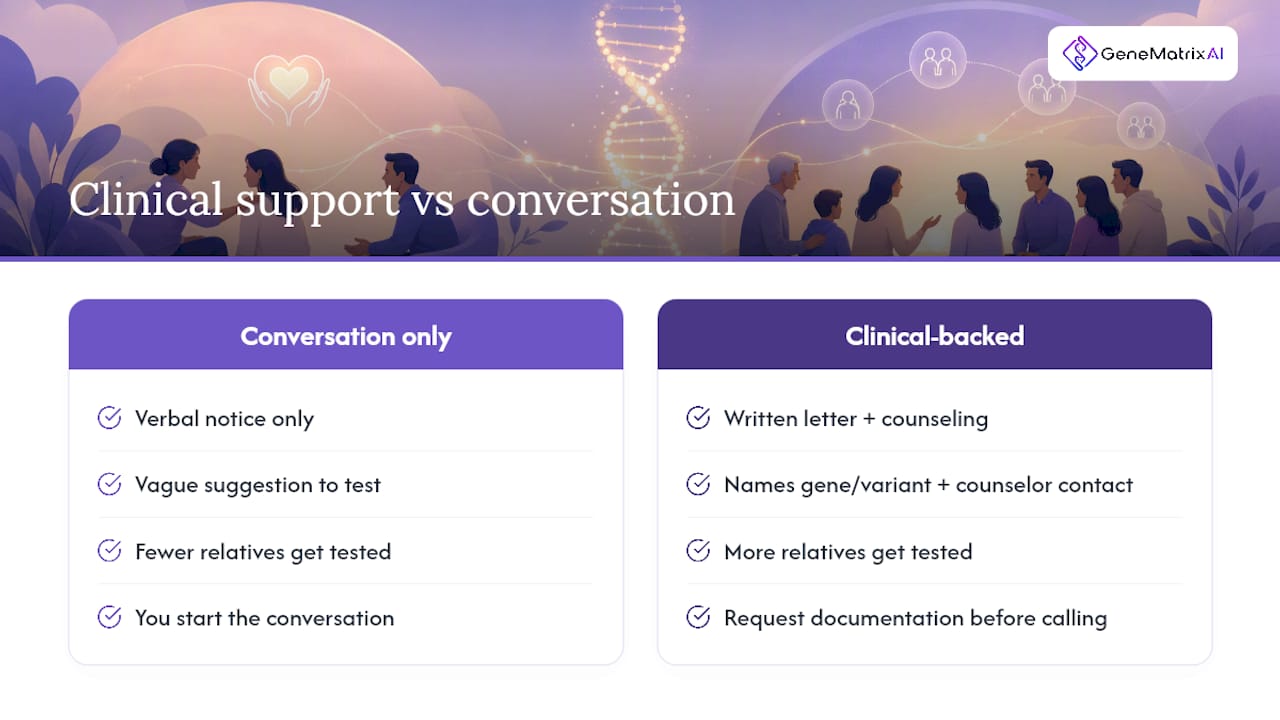
Most people assume sharing a genetic result is purely a communication problem: find the right words, and the rest follows. That's only half true. The research on family communication interventions is clear that structure matters as much as sincerity. Families given a written family letter and access to counseling support shared results more often and saw more relatives actually get tested than families who relied on conversation alone.
That's the piece I'd push back on if I heard someone say "I'll just tell them myself and let them figure out the rest." You can, and you should, be the one who starts the conversation. But treating the clinic and the genetic counselor as optional extras, rather than as the mechanism that makes the information usable, is where good intentions quietly stall out. A relative who hears "you might want to get tested" from you is far less likely to act than one who receives a letter naming the exact gene, the exact variant, and a phone number for a genetic counselor who already knows the family's history.
Genematrix's position on this is straightforward: clinical follow-up isn't a bureaucratic add-on to family notification, it's the part that actually moves relatives from "I should probably look into that" to booking an appointment. If you've received an actionable result, ask for the documentation before you make the first call.
How Genematrix Supports Family Notification
Genematrix's hereditary cancer panels and pharmacogenomics testing come with clinician-validated reports built for exactly this moment, when you need language a relative's doctor can act on immediately, not a printout full of jargon.

If you've tested positive for a variant in a gene like BRCA1, BRCA2, or one linked to Lynch syndrome, Genematrix's genetic counseling team can prepare a family letter summarizing your specific finding and the recommended next test for relatives. You can also work with a counselor to figure out exactly which family members are highest priority based on your family's specific history. Explore the hereditary cancer screening panel to see what's included in a full report, or start directly through the health intake page to request counseling support and a family letter tied to your results. If you want to understand the lab standards behind your report, Genematrix's testing and certification details lay out exactly how results are validated before they ever reach you.
Where to Learn More
For deeper reading on the medical side of disclosure, the CDC's conversation tips for hereditary cancer results and the American Cancer Society's guidance on talking with family both offer practical starting scripts. Mayo Clinic's pharmacogenomics patient resources walk through what a PGx result actually means for you and your relatives.
For general screening context beyond genetics, the Hippocratic Cancer Research Foundation's guide to why cancer screening matters is a useful companion resource for relatives weighing whether to pursue testing at all.
On Genematrix's own blog, Family Genetic Testing Tips for Informed Health Choices and Hereditary Cancer Testing: Personalized Risk Insights go deeper into how families coordinate testing once the first conversation is behind them.
This article is general information, not a substitute for advice from a qualified doctor. Consult a qualified healthcare professional about your own circumstances before acting on anything here.
Sources
- Talking to family members about genetic test results | CDC
- Pharmacogenomics for patients - Center for Individualized Medicine - Mayo Clinic Research
- Interventions to improve family communication about genetic risk (systematic review) | PMC
- Sharing genetic testing results with family | Huntsman Cancer Institute