

If a single-gene disorder runs in your family, you have five realistic reproductive paths: preconception carrier screening with genetic counseling, IVF with preimplantation genetic testing for monogenic disorders (PGT-M), prenatal diagnostic testing (CVS or amniocentesis), donor gametes or embryos, and adoption or natural conception with accepted risk. Which path fits your situation depends on the inheritance pattern of the disorder, your personal values, your timeline, and your budget.

Your single most important immediate action: contact a certified genetic counselor before you do anything else. Look for the NSGC (National Society of Genetic Counselors) credential at nsgc.org. Bring your family health history going back at least three generations, any prior genetic test reports, and a list of affected relatives with confirmed diagnoses.
Here is when each option is most commonly chosen:
- Carrier screening + counseling: Both partners want to know their carrier status before conceiving, especially when there is no confirmed family diagnosis yet.
- IVF + PGT-M: Both partners are confirmed carriers (or one has a dominant condition) and want to select unaffected embryos before implantation.
- Prenatal diagnostic testing (CVS/amniocentesis): You conceive naturally and want a definitive fetal diagnosis in the first or second trimester.
- Donor gametes or embryos: You want to eliminate transmission risk entirely and are open to using a donor egg, sperm, or embryo.
- Adoption: You prefer not to pursue pregnancy but still want to build a family.
- Natural conception with monitoring: You accept the recurrence risk and want to proceed without assisted reproduction.
Approximately 80% of children born with a genetic disorder have no prior family history, which is exactly why preconception carrier screening matters even when no one in your immediate family has been diagnosed.
Table of Contents
- How does inheritance pattern affect your recurrence risk?
- What are your reproductive options, and which fits your situation?
- Which genetic tests are used in family planning, and what are their limits?
- What questions should you bring to your genetic counselor or fertility clinic?
- What do testing and IVF + PGT-M actually cost in the U.S.?
- How do you handle the emotional and ethical weight of these decisions?
- How does CLIA-certified, AI-enabled genetic testing fit into family planning?
- Key Takeaways
- The part of this conversation most clinics skip
- Genematrix supports your family planning decisions with fast, certified testing
How does inheritance pattern affect your recurrence risk?
The inheritance pattern of a disorder is the single biggest factor shaping which reproductive options make clinical sense. Get this wrong and you may over- or under-estimate the actual risk to a future child.
Autosomal recessive disorders require two copies of a pathogenic variant, one from each parent. If both partners are carriers, each pregnancy carries a 25% chance of an affected child, a 50% chance of a carrier, and a 25% chance of neither. Cystic fibrosis is the textbook example: two carrier parents, one in four odds per pregnancy.
Autosomal dominant disorders need only one copy of the variant to cause disease. An affected parent has a 50% chance of passing the variant to each child. Huntington disease follows this pattern, and the stakes are high because the disorder is late-onset and currently untreatable, which makes PGT-M or prenatal testing a frequent conversation.
X-linked disorders sit on the X chromosome. Hemophilia A is the classic case: carrier mothers have a 50% chance of passing the variant to sons (who will be affected) and a 50% chance of passing it to daughters (who will be carriers). Affected fathers pass the variant to all daughters but no sons.
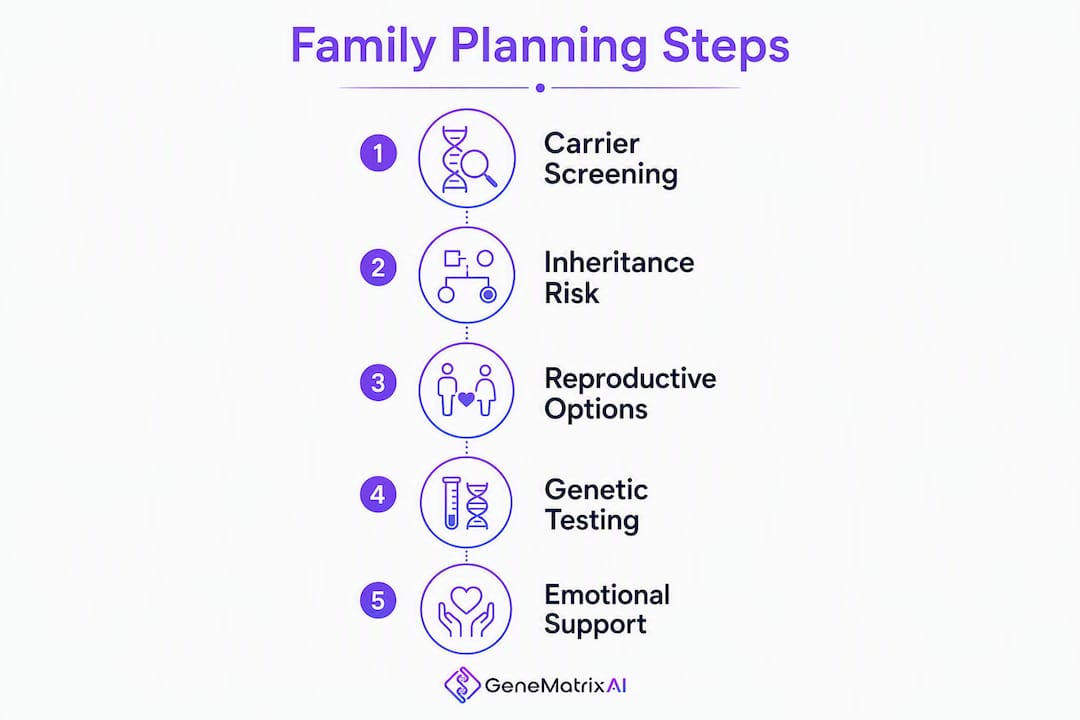
A few practical points worth knowing. Some disorders require targeted variant testing rather than full gene sequencing, particularly when the family's specific pathogenic variant is already confirmed. For those families, testing the closest affected relative first is the most efficient starting point, because it confirms the exact variant before you test anyone else. Partner testing matters most in autosomal recessive conditions, where both parents must carry a variant for the child to be at risk. And because roughly 80% of affected children have no prior family history, waiting for a family diagnosis before screening is a strategy that misses most carriers.
What are your reproductive options, and which fits your situation?
The options range from low-intervention (natural conception with prenatal monitoring) to high-intervention (IVF with PGT-M), and the right choice depends on how much risk you want to reduce before pregnancy versus how much you are willing to manage during one.
Preconception carrier screening with genetic counseling
Carrier screening tests one or both partners for pathogenic variants in genes associated with specific disorders before conception. Expanded panels now cover hundreds of conditions simultaneously. Genetic counselors review your family history, select the appropriate panel, and help you interpret results in the context of your specific situation.
Best for: Couples with no confirmed diagnosis who want to establish baseline risk before deciding on a reproductive path. Pros: Non-invasive, relatively affordable, informs all downstream decisions. Cons: A negative result does not eliminate all risk; some variants are not covered by standard panels. When to prefer: Always the first step, regardless of which other option you ultimately choose.
Natural conception with prenatal diagnostic testing
You conceive naturally and then use CVS (chorionic villus sampling, typically weeks 10–13) or amniocentesis (typically weeks 15–20) to test the fetus directly. CVS and amniocentesis both provide diagnostic-level certainty for most single-gene disorders and require pre- and post-test counseling to discuss what you will do with the results.
Best for: Couples who accept the recurrence risk and want a definitive fetal diagnosis rather than embryo selection. Pros: No IVF required; faster path to pregnancy. Cons: Procedure-related miscarriage risk (small but real); results arrive mid-pregnancy, which makes decisions emotionally harder. When to prefer: When IVF is not medically indicated or financially feasible, or when the couple's values favor natural conception.
IVF with PGT-M
PGT-M (preimplantation genetic testing for monogenic disorders) tests embryos created through IVF for a specific pathogenic variant before transfer. Only embryos without the variant are transferred. Per-cycle pregnancy rates after PGT-M can be substantially lower than standard IVF, often cited near 20% per cycle for some disorders., so couples should go in with realistic expectations about the number of cycles needed.
Best for: Confirmed carrier couples (autosomal recessive), affected individuals with dominant conditions, or X-linked carrier mothers who want to avoid transmitting the variant. Pros: Highest pre-pregnancy risk reduction; avoids the need for prenatal testing or termination decisions. Cons: Expensive, physically demanding, and not always successful; confirmatory prenatal testing is still often recommended after a positive PGT-M result. When to prefer: When both partners are confirmed carriers and reducing transmission risk before implantation is the priority.
Donor gametes or embryos
Using donor eggs, donor sperm, or a donated embryo eliminates the genetic contribution from the carrier or affected parent. This is a straightforward path to a very low transmission risk, though the child will not be genetically related to one or both parents.
Best for: Couples where one or both partners carry a dominant or recessive variant and are open to donor conception. Pros: Eliminates or dramatically reduces transmission risk without IVF complexity for the carrier parent. Cons: Emotional and identity considerations around genetic relatedness; donor selection and legal agreements add time and cost. When to prefer: When PGT-M is not technically feasible for the specific disorder, or when the couple prefers this path for personal reasons.
Adoption
Adoption builds a family without any genetic transmission risk. It is not a medical decision but a life decision, and it deserves the same serious consideration as any other option.
Best for: Couples who prefer not to pursue pregnancy, or for whom all other options are medically or financially out of reach. Pros: No medical procedures; addresses the family-building goal directly. Cons: Lengthy process, variable costs, and its own emotional complexity.
Comparison of reproductive options
| Option | Risk reduction | Time to pregnancy | Estimated cost range (U.S.) | Invasiveness | Emotional burden |
|---|---|---|---|---|---|
| Carrier screening + counseling | Informs risk; does not reduce it | Fastest | — | None | Low |
| Natural conception + prenatal testing | Moderate (diagnosis mid-pregnancy) | Fast | — | Moderate (procedure) | High (mid-pregnancy decisions) |
| IVF + PGT-M | High (pre-implantation) | Slow (months per cycle) | — | High | High |
| Donor gametes/embryos | High to very high | Moderate | — | Moderate | Moderate to high |
| Adoption | Complete (no transmission) | Slow (months to years) | — | None | Moderate |
Which genetic tests are used in family planning, and what are their limits?
Three test categories drive most reproductive decisions for single-gene disorders: carrier screening, prenatal diagnostic testing, and PGT-M. Each answers a different clinical question, and confusing them leads to misapplied results.
Carrier screening identifies whether an asymptomatic person carries one copy of a pathogenic variant. Two formats exist:
- Expanded carrier screening panels test for hundreds of conditions simultaneously and are now recommended by ACOG on a pan-ethnic basis rather than by ancestry alone. ACOG's committee opinion supports moving toward universal carrier screening because ancestry-based approaches miss a significant proportion of carriers.
- Targeted variant testing looks for a specific, already-identified pathogenic variant in a family. It is faster and cheaper when the family's variant is confirmed.
Prenatal diagnostic testing (CVS or amniocentesis) tests fetal DNA directly and provides a definitive diagnosis. It is not screening. A positive result means the fetus is affected; a negative result means the fetus does not carry the tested variant. Both tests require pre- and post-test genetic counseling to discuss the implications of each possible outcome before the procedure.
PGT-M during IVF tests embryos at the blastocyst stage for a specific pathogenic variant. For complex conditions involving large repeat expansions, specialized laboratory methods or linkage-based testing may be required, and PGT-M can be less accurate than prenatal diagnostic testing in those cases. Confirmatory prenatal testing after a successful PGT-M transfer is often still recommended.
Limitations every couple should know
Carrier screening can return variants of uncertain significance (VUS), meaning the lab found a variant but cannot yet determine whether it causes disease. Some laboratories offer the option to suppress VUS reporting on carrier panels to reduce unnecessary anxiety and follow-up testing. Ask your lab about this before ordering.
False negatives exist. No panel covers every possible pathogenic variant in a gene, so a negative carrier screen reduces risk but does not eliminate it. Pretest counseling helps set realistic expectations about what a negative result actually means for your specific disorder.
CLIA certification matters for every test used in reproductive decision-making. A CLIA-certified laboratory meets federal quality and accuracy standards, and results from CLIA-certified labs carry legal and insurance weight that results from non-certified labs do not. Always confirm CLIA status before ordering any test whose results will inform a clinical decision.
Pro Tip: Before ordering any panel, ask the lab whether they report VUS on carrier screens and whether you can opt for pathogenic/likely pathogenic variants only. This one question can prevent months of unnecessary follow-up.
What questions should you bring to your genetic counselor or fertility clinic?
Start with your inheritance pattern and your answer to one core question: do you want to reduce the chance of an affected child before pregnancy, or are you willing to test during pregnancy and decide then? That single distinction narrows the field from five options to two or three.
Step-by-step checklist before your first appointment
- Collect medical records for all affected relatives, including confirmed diagnoses and any prior genetic test reports.
- Build a three-generation family history (parents, siblings, grandparents, aunts, uncles, first cousins) and note which relatives have been tested and what their results were.
- Identify the specific disorder and its inheritance pattern. If you do not know the pattern, your genetic counselor will determine it.
- Test the closest affected relative first if no variant has been confirmed in your family. This is the most efficient path to identifying the exact variant before testing partners or other relatives.
- Assess partner risk. For autosomal recessive conditions, both partners need carrier testing. For dominant or X-linked conditions, only the carrier or affected parent typically needs testing first.
- Determine your timeline. If you plan to conceive within 6–12 months, start preconception testing now. IVF + PGT-M requires several months of preparation before a transfer cycle.
- Consult a fertility specialist if PGT-M is under consideration. Not all fertility clinics have in-house PGT-M capability; some partner with specialized reference labs.
For family genetic testing tips on assembling records and deciding which relatives to test first, Genematrix's resource library covers the practical logistics in detail.
Questions to ask your genetic counselor
- What is the exact recurrence risk for our specific variant and inheritance pattern?
- Which carrier screening panel do you recommend, and does it cover our specific disorder?
- Is the lab CLIA-certified, and will results be accepted by my OB or fertility clinic?
- What does a VUS result mean for our situation, and what follow-up would be required?
- If PGT-M is an option for our disorder, how accurate is it for our specific variant?
Questions to ask your fertility clinic
- How many PGT-M cycles have you performed for this specific disorder?
- What is your per-cycle pregnancy rate for patients in our age and diagnosis category?
- Do you perform PGT-M in-house or through a reference lab, and what is the turnaround time?
- What is the all-in cost per cycle, including embryo biopsy, genetic analysis, and transfer?
- What emotional support or counseling services do you offer during treatment?
Red flags to watch for
Avoid any clinic or genetic testing service that guarantees a specific outcome, quotes success rates without specifying the patient population, or offers testing without pre- and post-test counseling. PGT-M does not guarantee a live birth, and no test eliminates all genetic risk.
What do testing and IVF + PGT-M actually cost in the U.S.?
The honest answer: costs vary widely by geography, clinic, and insurance coverage, but the ranges below reflect typical U.S. out-of-pocket figures when insurance does not cover the service.
| Service | Typical U.S. cost range | Typical timeline |
|---|---|---|
| Carrier screening (expanded panel) | — | 2–4 weeks to results |
| Targeted variant testing (known familial variant) | — | 1–3 weeks to results |
| Prenatal diagnostic testing (CVS or amniocentesis) | — | 1–3 weeks to results |
| IVF + PGT-M (per cycle, all-in) | — | 3–6 months clinic-to-transfer |
| Donor egg cycle | — | 3–6 months |
| Donor sperm (per vial plus IUI/IVF) | — | Varies |
| Domestic adoption | — | 1–5 years |
Insurance and financial assistance
Insurance coverage for genetic testing and assisted reproduction is inconsistent across states and plans. Carrier screening is increasingly covered under preventive care provisions, particularly for couples with a documented family history. Prenatal diagnostic testing (CVS/amniocentesis) is generally covered when medically indicated. IVF and PGT-M coverage varies sharply: as of 2026, roughly 20 states have fertility insurance mandates, but the scope of those mandates differs significantly.
When insurance does not cover IVF or PGT-M, several financial assistance programs exist. RESOLVE: The National Infertility Association maintains a resource list of grants and financing options. Some fertility clinics offer multi-cycle discount packages or financing through third-party lenders. Pharmaceutical manufacturers sometimes offer medication discount programs for IVF stimulation drugs.
Planning tip: If you want to conceive within 6–12 months and PGT-M is a possibility, start preconception carrier screening and your genetic counseling appointment now. The PGT-M preparation process, including probe design for your specific variant, can take 6–12 weeks before a retrieval cycle even begins.
How do you handle the emotional and ethical weight of these decisions?
These decisions are not purely medical. The choice between PGT-M and prenatal testing, or between using donor gametes and accepting recurrence risk, involves values that no test result can resolve for you. Acknowledging that upfront, and building emotional support into your planning from the start, is not optional.
Genetic counselors do more than order tests. They translate family history into targeted test strategies and help couples weigh medical facts against their values. That second part, the values conversation, is where many couples find the most support.
Reliable resources for emotional and practical support:
- NSGC (National Society of Genetic Counselors): Find a certified counselor at nsgc.org; search by specialty to find counselors experienced with your specific disorder.
- RESOLVE: The National Infertility Association: Support groups, financial resources, and advocacy for couples navigating assisted reproduction.
- Condition-specific patient advocacy groups: Organizations like the Cystic Fibrosis Foundation, the Huntington's Disease Society of America, and the National Hemophilia Foundation offer peer support, clinical referrals, and disorder-specific family planning guidance.
- Mental health professionals: A therapist experienced in reproductive medicine or genetic conditions can be a critical partner, particularly during IVF cycles or when facing a difficult prenatal diagnosis.
Pro Tip: When you first contact a genetic counselor or fertility clinic, ask specifically how many families they have counseled for your disorder. A counselor who has worked with dozens of cystic fibrosis families will give you a very different conversation than one encountering the disorder for the first time.
Involving your partner, extended family, or spiritual advisors in these decisions is entirely appropriate. Some couples find it helpful to write down their values before the first counseling appointment, specifically around questions like: How do we feel about termination? How do we feel about donor conception? What does "family" mean to us? Arriving with those conversations already started saves time and reduces the chance of making a decision under pressure.
How does CLIA-certified, AI-enabled genetic testing fit into family planning?
Rapid, clinician-validated genetic testing has a concrete role in the family planning workflow, particularly at two points: preconception carrier screening and confirmatory testing for known familial variants. Genematrix operates a CLIA-certified laboratory and uses AI-driven analysis trained on over 500,000 genetic profiles to deliver clinician-validated genomic reports within 72 hours, which is meaningfully faster than the 2–4 week turnaround typical of many reference labs.
For families with a known pathogenic variant, that speed matters. A couple trying to decide whether to pursue IVF + PGT-M or proceed with natural conception and prenatal testing does not benefit from waiting three weeks for a carrier result that could arrive in three days. Faster results compress the decision timeline and give couples more time to consult with fertility specialists before a conception window closes.
The use cases where this kind of workflow adds the most value:
- Preconception carrier screening for couples who want results quickly to inform a time-sensitive reproductive decision.
- Targeted confirmatory testing for a known familial variant, where the specific pathogenic change is already documented and the question is simply whether a partner carries it.
- Rapid reporting to support prenatal or IVF planning, where a clinician needs results before scheduling a procedure or referral.
The limits are equally important to state clearly. AI-assisted interpretation accelerates analysis and flags clinically significant findings, but it does not replace genetic counseling or confirmatory diagnostic testing. A report from any lab, including a CLIA-certified one, is a clinical input, not a clinical decision. Every result that will drive a reproductive choice should be reviewed with a certified genetic counselor before action is taken. For complex disorders requiring specialized assays (large repeat expansions, for example), confirmatory testing at a reference lab with specific expertise in that disorder may still be required.
For more on how preconception genetic testing integrates into reproductive planning timelines, Genematrix's resource library covers the clinical workflow in detail.
Key Takeaways
When a single-gene disorder is present, the most effective approach combines early carrier screening, inheritance-pattern-driven option selection, and certified genetic counseling before any reproductive decision is made.
| Point | Details |
|---|---|
| Start with genetic counseling | Book an NSGC-certified counselor first; bring family history and prior test reports to the appointment. |
| Inheritance pattern drives the choice | Autosomal recessive, dominant, and X-linked patterns each carry different recurrence risks and point to different reproductive options. |
| PGT-M has realistic limits | Per-cycle pregnancy rates after PGT-M can be near 20% for some disorders; plan for multiple cycles and confirmatory prenatal testing. |
| Carrier screening catches most cases | Roughly 80% of affected children have no prior family history, making preconception screening valuable even without a known family diagnosis. |
| Genematrix supports rapid preconception workflows | Genematrix's CLIA-certified lab delivers clinician-validated carrier and confirmatory test results within 72 hours to support time-sensitive planning decisions. |
The part of this conversation most clinics skip
There is a tendency in reproductive genetics to treat the decision-making process as primarily technical: run the carrier screen, calculate the recurrence risk, present the options, let the couple decide. That framing is incomplete, and it often leaves couples feeling more lost after the appointment than before it.
The real difficulty is not understanding the options. Most couples, given a clear explanation, can grasp the difference between PGT-M and prenatal diagnosis within a single conversation. The difficulty is that the options force a values conversation that many couples have never had explicitly, and that conversation is harder than any genetic test.
What I find consistently underestimated is how much the framing of risk shapes the decision. A 25% recurrence risk sounds very different depending on whether you think of it as "one in four chance of an affected child" or "three in four chance of an unaffected child." Neither framing is wrong, but they pull couples toward different choices. A skilled genetic counselor presents both, and then asks which framing feels more true to how you actually think about risk. That question alone can clarify a decision that seemed impossible.
The other thing worth saying plainly: there is no objectively correct choice among these options. IVF with PGT-M is not inherently better than natural conception with prenatal testing. Donor conception is not inherently better than accepting recurrence risk. These are value-laden decisions, and the medical system's job is to make sure you have accurate information, not to make the choice for you. The couples who navigate this best are the ones who arrive at the counseling appointment having already talked honestly with each other about what matters most.
Genematrix supports your family planning decisions with fast, certified testing
Waiting weeks for carrier results when you are trying to make a time-sensitive reproductive decision is a real obstacle. Genematrix offers CLIA-certified, AI-assisted genetic testing with clinician-validated reports delivered within 72 hours, designed specifically to support preconception and confirmatory testing workflows for families navigating inherited disorder family planning.

The GeneBaby module covers pediatric and preconception genetic screening, while targeted variant testing can confirm a known familial pathogenic variant quickly so you and your genetic counselor can move forward with a clear picture. Tests are available as a subscription or a one-time order, and results are reviewed by clinicians before delivery. Turnaround is 72 hours from sample receipt.
One important note: Genematrix testing supports your decision-making process and is designed to complement, not replace, certified genetic counseling and clinical confirmatory testing when indicated. Every result that will drive a reproductive choice should be reviewed with an NSGC-certified counselor.
Ready to start? Review Genematrix's CLIA-certified testing science or explore subscription plans starting at $69/month to find the right test for your family planning needs.