

TL;DR:
- Genetic variants are permanent DNA changes that can be harmless or significantly impact health. Interpreting variants requires professional assessment, classification, and context for actionable decisions. Viewing genetic information as a tool helps individuals make informed, proactive health choices.
A genetic variant is a permanent change in the DNA sequence of a gene. That single fact is the foundation of all genetic testing, ancestry analysis, and precision medicine. Understanding genetic variants means knowing not just what changed in your DNA, but what that change actually means for your health, your family, and your future medical decisions. Most people receive genetic test results without a clear framework for interpreting them. This guide gives you that framework, in plain language.
What is a genetic variant and how do variants occur?

A genetic variant is any difference in a DNA sequence compared to a reference genome. The word "variant" has largely replaced "mutation" in clinical and research settings. Modern genetic reports prefer "variant" over "mutation" because the older term implies disease, while most DNA changes are neutral or even beneficial.
Variants arise in two main ways. Some are inherited directly from a parent and present in every cell of your body from birth. Others arise spontaneously from environmental exposure, aging, or errors during DNA replication. Neither source automatically makes a variant dangerous.
The major types of genetic variation include:
- Single nucleotide variants (SNVs): A single DNA "letter" changes. This is the most common type and the basis of most consumer ancestry tests.
- Insertions and deletions (indels): One or more DNA letters are added or removed, which can shift how the gene is read entirely.
- Structural variants: Large sections of chromosomes are duplicated, deleted, inverted, or rearranged. These affect many genes at once.
- Copy number variants (CNVs): A segment of DNA is repeated more or fewer times than normal, altering gene dosage.
Variants also relate to alleles and haplotypes. An allele is simply one version of a gene at a specific location. A haplotype is a set of alleles inherited together as a block. Both concepts matter when labs assess whether a variant you carry came from one parent or both.
Pro Tip: The vast majority of variants in any person's genome are benign. A genetic test finding a variant does not automatically mean a health problem exists.
How are genetic variants classified in health reports?
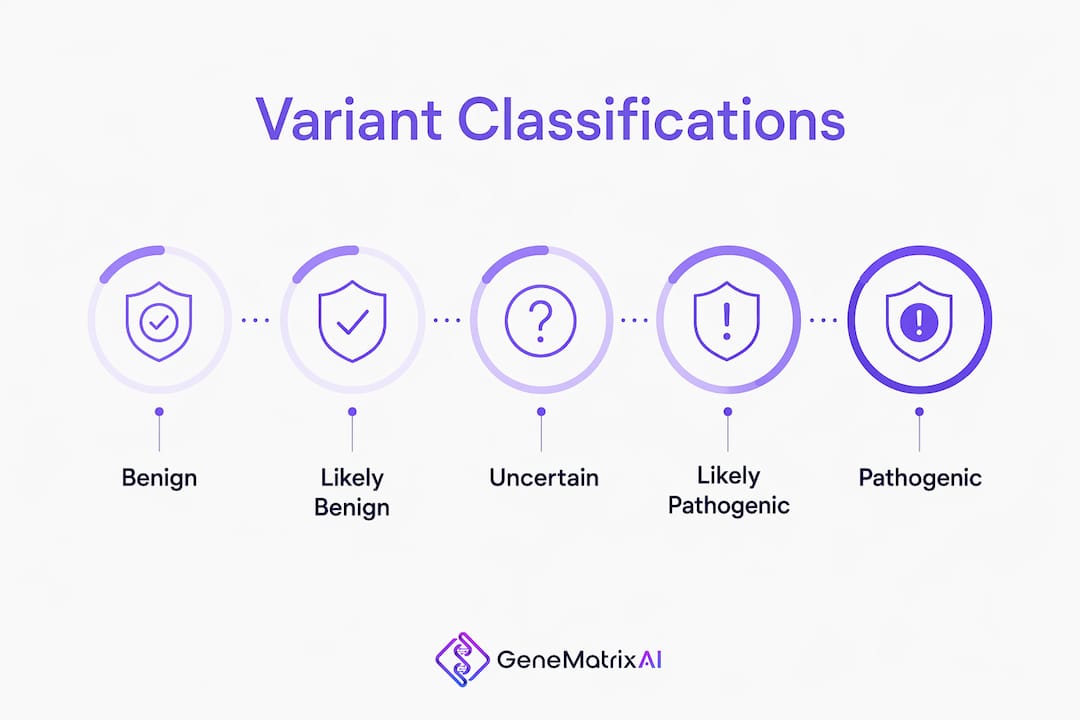
Variant classification is the process labs use to assign clinical meaning to a DNA change. The standard five-tier system, widely adopted across clinical genetics, ranks variants from least to most concerning:
| Classification | What it means | Clinical action |
|---|---|---|
| Benign | No known disease association | No follow-up needed |
| Likely benign | Very probably harmless based on current evidence | Routine monitoring only |
| Variant of uncertain significance (VUS) | Insufficient evidence to classify | Retest as evidence grows |
| Likely pathogenic | Probably disease-causing based on current evidence | Discuss with a specialist |
| Pathogenic | Confirmed disease-causing variant | Active clinical management |
A pathogenic variant increases disease risk but does not guarantee that disease will develop. Environmental factors, lifestyle, and aging all interact with the variant to determine actual outcomes. This is the concept of penetrance: even a high-penetrance variant like BRCA1 does not cause cancer in every carrier.
Zygosity adds another layer of complexity. Zygosity describes whether one or two copies of a variant are present. For recessive conditions, carrying one copy typically means you are a carrier with little personal risk. Carrying two copies means the condition is likely to manifest. Clinicians use zygosity to determine inheritance patterns and counsel families on risk to children.
Pro Tip: A VUS result is not a diagnosis. It means science does not yet have enough data to classify the variant. Many VUS findings are reclassified as benign within a few years as more population data accumulates.
How do you interpret genetic variant results in a personal report?
Genetic test reports typically present one of three outcomes: positive, negative, or VUS. Each carries a different implication, and none of them is as simple as a pass or fail grade.
A positive result means a clinically significant variant was found. For example, a positive BRCA1 or BRCA2 result signals a substantially elevated cancer risk, but it is not a cancer diagnosis. The result tells you about probability, not certainty. Genetic counseling is the required next step to translate that probability into a personal action plan.
A negative result requires careful interpretation. Standard panels may miss rare variants not included in the tested gene set. A negative result reduces risk but does not eliminate it. The test's scope determines how much reassurance a negative result actually provides.
A VUS result is the most misunderstood outcome. It means the lab found a change, but current evidence cannot confirm whether it causes disease. Treating a VUS as a diagnosis leads to unnecessary anxiety and sometimes unnecessary procedures.
Practical steps after receiving results:
- Request a full written report. Verbal summaries omit critical details about which genes were tested and which were not.
- Consult a certified genetic counselor. Counselors translate classification language into personal risk estimates and family planning guidance. Genetic counseling benefits extend to medication choices and cancer surveillance planning.
- Share results with your primary care physician. Variants in genes like BRCA1, BRCA2, and Lynch syndrome genes require coordinated care across specialties.
- Ask about retesting timelines. VUS classifications change as databases grow. Retesting or reclassification requests are standard practice.
- Consider family implications. A pathogenic variant in your report means first-degree relatives carry a 50% chance of sharing it.
Diagnostic testing accuracy for clinical genetic tests reaches 99.0%–99.9% in 2026. That precision applies to detecting the variant itself. Interpreting what the variant means for your specific health situation still requires professional expertise.
The type of test also matters. Diagnostic tests confirm a suspected condition. Predictive tests assess future risk in currently healthy people. Carrier tests identify whether you carry a recessive variant that could affect your children. Each type produces results with a different clinical weight. Understanding which test you took is the first step to reading your report correctly. You can learn more about types of genetic tests and their clinical applications before your appointment.
How do genetic variants affect ancestry and personalized medicine?
Genetic variants do more than flag disease risk. They carry the record of human migration, population history, and individual drug response.
Variants underpin ancestry analysis by tracking allele frequency differences across populations. When a specific SNV appears at high frequency in one geographic group and rarely in another, it marks a shared ancestor or a population bottleneck. Haplotype blocks, inherited as units across generations, let researchers trace migration routes going back tens of thousands of years.
In medicine, variants in genes that regulate drug metabolism determine how your body processes medications. Variants in CYP2C19, for example, affect how people metabolize clopidogrel, a common blood thinner. A person with a loss-of-function variant in that gene may receive no benefit from standard dosing. Pharmacogenomics, the field that maps drug-gene interactions, depends entirely on precise variant knowledge.
Variants also determine eligibility for gene and cell therapies. Specific variant knowledge guides clinical trial eligibility and the design of precision medicine protocols. A therapy targeting a BRCA2 frameshift variant, for instance, will not work for a patient with a BRCA2 missense variant. The distinction matters at the molecular level.
The practical implications for people considering genetic testing include:
- Ancestry reports and health reports use the same raw variant data but interpret it through completely different lenses.
- Pharmacogenomic testing, such as Genematrix's GenePGx module, can prevent adverse drug reactions before they happen.
- Knowing your variant profile positions you for eligibility in emerging targeted therapies as they reach clinical availability.
- Families with known hereditary cancer variants can use variant data to guide surveillance schedules and preventive interventions.
Key Takeaways
Genetic variants are permanent DNA changes that range from completely harmless to clinically significant, and their meaning depends on classification, zygosity, and professional interpretation.
| Point | Details |
|---|---|
| Variants are not mutations | "Variant" is the preferred clinical term because most DNA changes do not cause disease. |
| Five-tier classification system | Reports rank variants from benign to pathogenic; a VUS requires monitoring, not alarm. |
| Pathogenic does not mean certain | A pathogenic variant raises disease risk but does not guarantee the condition will develop. |
| Negative results have limits | Standard panels miss rare variants, so a negative result reduces but does not eliminate risk. |
| Professional interpretation is required | Genetic counselors translate classification language into personal risk estimates and next steps. |
Genetic information is a tool, not a verdict
I have spent years watching people receive genetic test results and immediately assume the worst. A pathogenic variant label reads like a diagnosis. A VUS feels like a threat with no name. Neither reaction is accurate, and the gap between what a report says and what people hear is one of the most consequential communication failures in modern healthcare.
The terminology problem is real. Words like "pathogenic" and "variant of uncertain significance" carry weight that the average person was never trained to calibrate. I have seen people cancel surgeries they needed because a VUS result scared them, and I have seen others ignore genuinely elevated risks because a counselor explained the result too quickly. Neither outcome serves the patient.
What I have found actually works is treating genetic information the way you treat a weather forecast. A 70% chance of rain does not mean it will rain. It means you bring an umbrella and stay informed. A pathogenic BRCA1 variant does not mean cancer is coming. It means you build a surveillance plan, talk to your family, and work with specialists who understand the full picture.
The other thing worth saying plainly: genetic data is one input, not the whole story. Lifestyle, environment, and chance all interact with your variants in ways no report can fully predict. The people who use genetic information well are the ones who treat it as a starting point for proactive decisions, not a sentence. Family genetic testing done with that mindset changes outcomes. Done in isolation, without counseling or context, it mostly generates anxiety.
— Tarek
Genematrix: genetic testing backed by certified science
Genematrix is a CLIA-certified, Chicago-based biotechnology company that delivers AI-powered genetic analysis within 72 hours. Its GeneMatrixAI platform is trained on 500,000+ genetic profiles, covering hereditary cancer screening (including BRCA1/BRCA2 and Lynch syndrome), pharmacogenomics, psychiatric genetics, pediatric testing, and nutrigenomics.

Every report Genematrix produces is built on laboratory standards designed to meet clinical-grade accuracy requirements. If you are ready to move from questions to answers, the science behind Genematrix explains exactly how the technology, certifications, and research methodology work together to deliver results you can act on with confidence.
FAQ
What is a genetic variant in simple terms?
A genetic variant is a permanent change in a DNA sequence compared to a standard reference genome. Most variants are harmless; only a small fraction are linked to disease risk.
What does a VUS result mean in a genetic report?
A variant of uncertain significance (VUS) means current evidence cannot confirm whether the variant causes disease. VUS findings are often reclassified as benign as more population data becomes available.
Can a negative genetic test result rule out disease?
No. Standard panels test only common variants, so rare disease-causing variants may be missed. A negative result reduces risk but does not eliminate it.
How do I interpret a positive BRCA1 or BRCA2 result?
A positive BRCA result indicates significantly elevated cancer risk, not a cancer diagnosis. Genetic counseling is the required next step to build a personal surveillance and prevention plan.
How does knowing my genetic variants help with medications?
Variants in drug-metabolizing genes determine how your body processes specific medications. Pharmacogenomic testing identifies these variants so physicians can prescribe the right drug at the right dose from the start.