

TL;DR:
- Genematrix is the best alternative to 2020biolabs.com for healthcare institutions seeking comprehensive, CLIA-certified hereditary cancer and pharmacogenomics testing.
- It offers rapid 72-hour results with AI-powered variant classification, integrated into clinical workflows for accurate decision-making.
What are the top alternatives to 2020biolabs.com for AI-driven hereditary cancer and pharmacogenomic testing?
Genematrix stands out as the strongest alternative for US healthcare institutions that need AI-powered hereditary cancer screening and pharmacogenomics in a single, CLIA-certified platform. Beyond Genematrix, four other providers serve distinct clinical needs: Guardant Health, Perthera, CirculoGene Diagnostics, and Liquid Genomics.
Before comparing them, one distinction matters more than any feature list. 2020biolabs.com (formerly 20/20 GeneSystems) uses patented proteomic biomarker panels combined with AI for multi-cancer early detection, with capillary blood collection that avoids venipuncture. That approach differs fundamentally from the ctDNA sequencing and hereditary gene panel testing that most clinical institutions actually need. Knowing which technology type fits your patient population is the first decision, not the last.
| Provider | Technology platform | Test scope | AI integration | Turnaround time | Workflow integration | Phlebotomy required |
|---|---|---|---|---|---|---|
| Genematrix | GeneMatrixAI, trained on 500,000+ profiles | Hereditary cancer, PGx, GeneMind, GeneBaby, GeneDiet | Deep AI across all panels | 72 hours | EHR-compatible reporting | Standard venipuncture |
| Guardant Health | ctDNA liquid biopsy sequencing | Solid tumor profiling, precision oncology | AI-assisted variant interpretation | Varies by panel | Clinical portal integration | Standard venipuncture |
| Perthera | Multi-omic AI ranking platform | Multi-omic cancer therapy selection | AI ranks therapy options from historical data | Not publicly listed | Oncology center integration | Varies by test |
| CirculoGene Diagnostics | NGS, PCR on circulating free DNA/RNA | Solid tumor genomic profiling | Algorithmic variant calling | Not publicly listed | Oncology workflow tools | Standard venipuncture |
| Liquid Genomics | Digital PCR, allele-specific blocker PCR | Cancer gene mutation quantification | Mutation quantification algorithms | Not publicly listed | Research and clinical labs | Standard venipuncture or tissue |
CLIA certification and AI training on large genomic datasets are the two credentials that most reliably predict diagnostic accuracy across all these platforms.
Table of Contents
- How do these providers compare on testing capabilities and clinical fit?
- How do you choose the right hereditary cancer and pharmacogenomic testing provider?
- What makes Genematrix stand out among these alternatives?
- Key Takeaways
- The real gap most institutions miss when evaluating these providers
- Genematrix offers hereditary cancer and pharmacogenomic testing built for clinical institutions
How do these providers compare on testing capabilities and clinical fit?
Technology platforms: proteomic vs. genomic approaches
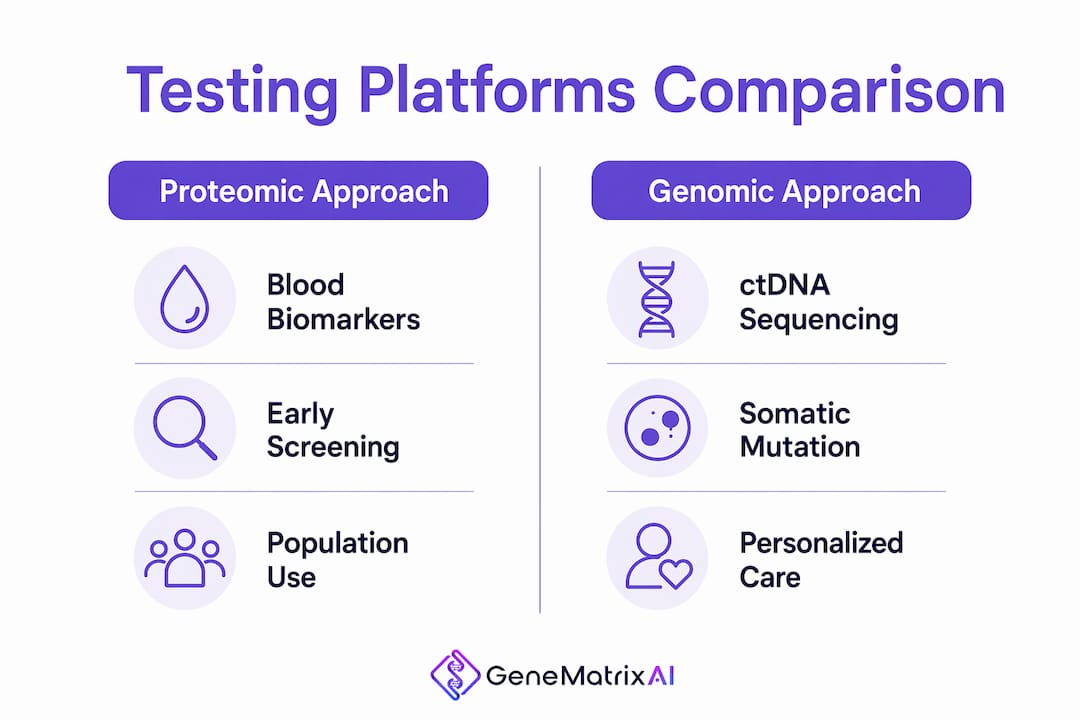
2020biolabs.com's proteomic approach measures tumor-associated proteins in blood, which can flag certain cancers before enough circulating tumor DNA accumulates to be detectable. That sensitivity advantage for early-stage lung, pancreatic, and ovarian cancers is real, and the capillary blood collection model lowers access barriers significantly. The trade-off is test scope: proteomic panels do not cover hereditary gene variants like BRCA1/BRCA2 or Lynch syndrome, which is exactly what most hospital genetics programs need.

Guardant Health operates on ctDNA-based sequencing, making it a fit for oncologists tracking somatic mutations in active cancer patients rather than hereditary risk screening. Perthera takes a different angle entirely: its AI ingests multi-omic results from multiple testing sources and ranks therapeutic options for oncologists, functioning more as a decision-support layer than a standalone diagnostic lab. Institutions that already have genomic data but need ranked treatment guidance will find Perthera useful.
Turnaround times and reporting
Speed matters when a clinician is deciding on a treatment plan. Genematrix delivers results within 72 hours, which is fast enough to fit into most outpatient oncology workflows. AI-driven platforms that support electronic health record integration reduce the manual reporting burden further, keeping results inside the systems clinicians already use. Turnaround times for Perthera, CirculoGene, and Liquid Genomics are not publicly listed, so institutions should request service-level commitments directly before contracting.
Sample requirements and patient accessibility
Phlebotomy requirements split these providers into two practical categories. 2020biolabs.com's capillary collection model works well for community screening programs and pharmacy-based testing. Every other provider on this list requires standard venipuncture, which limits deployment outside clinical settings but is entirely standard for hospital-based genetics programs. Liquid Genomics also accepts tissue samples, which matters for solid tumor profiling in post-surgical cases.
Pricing and insurance coverage
2020biolabs.com prices its OneTest under $200, paid out of pocket by employers or individuals. That model works for wellness screening but does not align with how hospital genetics departments bill. Genematrix pricing is not publicly listed; institutions should contact the team directly. Insurance reimbursement for hereditary cancer panels and pharmacogenomics varies by payer and indication. BRCA1/BRCA2 testing typically qualifies for coverage under high-risk criteria, while pharmacogenomic panels face more variable reimbursement. Verifying payer policies before ordering is standard practice for any of these providers.
Data privacy and regulatory compliance
CLIA certification is the baseline for any clinical diagnostic lab operating in the US. Genematrix holds CLIA certification. 2020biolabs.com operates a CLIA-licensed, CAP-accredited laboratory in Maryland. For the others, institutions should confirm current accreditation status directly, as certifications can change. Data privacy practices for hereditary genomic data fall under HIPAA, and providers handling germline variants should have explicit policies on data retention, secondary use, and patient consent frameworks.
How do you choose the right hereditary cancer and pharmacogenomic testing provider?
The single most common procurement mistake in this space is conflating diagnostic testing services with lab infrastructure or co-working providers. A lab co-working platform gives startups bench space and equipment access. A diagnostic testing service processes patient samples and returns clinical reports. These are entirely different purchases, and mixing them up wastes budget and delays patient care.
Once you have confirmed you need a diagnostic service, evaluate providers on these criteria:
- Technology type match: Proteomic panels suit population-level cancer screening; ctDNA sequencing suits active oncology monitoring; hereditary gene panels suit germline risk assessment and family history programs.
- Test scope alignment: Confirm the provider covers the specific genes or biomarkers your patient population requires, including BRCA1/BRCA2, Lynch syndrome genes, and relevant pharmacogenomic variants.
- AI training data scale: Larger, more diverse genomic datasets produce more reliable variant classifications. Genematrix trains its AI on 500,000+ genetic profiles.
- Regulatory accreditation: CLIA certification is mandatory. CAP accreditation adds a layer of quality assurance that many payers and health systems require.
- Workflow integration: Ask whether the provider's reporting system connects to your EHR. Manual result entry creates errors and slows clinical decisions.
- Customer support and consultation: Genetics programs benefit from access to genetic counselors or clinical support staff who can help interpret complex results.
Pro Tip: Before issuing an RFP, map your institution's biomarker needs to the provider's specific panel. A provider strong in somatic tumor profiling may have no hereditary cancer panel at all. Confirm the exact gene list, not just the category name.
Accessibility also shapes the decision. Genomic profiling solutions that require standard venipuncture work fine in hospital settings but create friction for community outreach programs. If your institution runs satellite clinics or employer wellness programs, capillary-based collection options are worth evaluating separately.
What makes Genematrix stand out among these alternatives?
Genematrix is the only provider on this list that combines hereditary cancer screening, pharmacogenomics, and specialty panels like GeneMind (psychiatric), GeneBaby (pediatric), and GeneDiet (nutrigenomics) in one CLIA-certified platform. That breadth matters for health systems that want a single vendor relationship rather than separate contracts for each testing category.
The GeneMatrixAI platform is trained on more than 500,000 genetic profiles, which gives its variant classifications a statistical foundation that smaller panels cannot match. Results arrive within 72 hours, and the reporting is designed to integrate with clinical workflows rather than requiring manual data entry. For AI genetic testing programs that need to scale across a hospital system, that combination of speed and integration reduces operational friction.
Genematrix was founded by technology and healthcare experts, and the platform targets hospitals, physicians, and health systems specifically. That institutional focus shows in the product design: reports are structured for clinical decision-making, not consumer wellness summaries. The genomic medicine breakthroughs driving precision oncology forward depend on exactly this kind of infrastructure, and Genematrix is built to sit inside it.
Key Takeaways
Genematrix is the strongest AI-driven alternative to 2020biolabs.com for US healthcare institutions that need hereditary cancer screening and pharmacogenomics in a single CLIA-certified platform with 72-hour turnaround.
| Point | Details |
|---|---|
| Technology type determines fit | Proteomic panels suit population screening; hereditary gene panels suit clinical genetics programs. |
| Turnaround speed matters clinically | Genematrix delivers results within 72 hours, supporting timely treatment decisions. |
| CLIA certification is the baseline | Confirm current accreditation status for every provider before contracting. |
| Workflow integration reduces errors | EHR-compatible reporting eliminates manual data entry and speeds clinical decisions. |
| Genematrix covers the full spectrum | GeneCancer, GenePGx, GeneMind, GeneBaby, and GeneDiet serve diverse institutional testing needs in one platform. |
The real gap most institutions miss when evaluating these providers
The conversation around 2020biolabs.com alternatives tends to focus on technology type, and that framing is mostly right. But the more consequential gap is organizational: most institutions evaluate diagnostic providers the same way they evaluate lab equipment vendors, asking about specs and price, but skipping the question of clinical support infrastructure.
A genomic report that arrives in 72 hours is only useful if someone in the clinical workflow knows how to act on it. Pharmacogenomic results, in particular, require interpretation that connects drug-gene interactions to the patient's actual medication list. Providers that offer consultation access alongside the test itself are not just adding a service tier. They are solving the last-mile problem that makes genomic testing clinically actionable rather than just scientifically interesting.
The proteomic approach that 2020biolabs.com uses is genuinely useful for population-level cancer screening, and the capillary collection model is a real accessibility advantage. But for a hospital genetics program evaluating hereditary cancer risk or building a pharmacogenomics service line, that technology does not map to the clinical need. The alternatives in this article do. Choosing among them comes down to which one fits your workflow, your patient population, and your support requirements, not which one has the most impressive technology description.
Genematrix offers hereditary cancer and pharmacogenomic testing built for clinical institutions

Healthcare institutions that need AI-driven hereditary cancer screening and pharmacogenomics in one place, with results in 72 hours, have a direct path with Genematrix. The GeneMatrixAI platform covers BRCA1/BRCA2, Lynch syndrome, drug-gene interactions, and specialty panels, all under CLIA certification, with reporting designed to fit clinical workflows rather than consumer apps. That is a different proposition from the population-screening model that 2020biolabs.com built, and it is the right fit for genetics programs, oncology departments, and health systems that need institutional-grade diagnostics.
Start with Genematrix's hereditary cancer testing intake to connect with the clinical team and confirm which panels fit your institution's needs.