

TL;DR:
- Precision health uses genetic, environmental, and lifestyle data to predict and prevent disease proactively. Key trends include AI-powered analytics, pharmacogenomics, multi-omic data integration, and continuous health monitoring. Families can start with hereditary cancer screening, medication reviews, and AI-based health tracking today.
Precision health is defined as a proactive, predictive approach to care that uses an individual's genetic makeup, environment, and lifestyle data to prevent disease before it starts. Unlike traditional medicine, which responds to illness after it appears, precision health aims to identify risk years earlier. Explaining precision health trends matters now because AI-powered analytics, pharmacogenomics, and multi-omic data integration are reshaping what families can expect from healthcare. Genematrix, a CLIA-certified biotechnology company based in Chicago, builds tools that put these advances directly into the hands of patients and physicians.
What are the main trends driving precision health today?
Precision health is shifting from reactive treatment to predictive wellness by combining AI-powered analytics with real-time biometric telemetry. That shift means a physician can flag cardiovascular risk in a 38-year-old years before a symptom appears, not after a hospital visit. The trends driving this change are specific, measurable, and accelerating.
The four most significant trends right now are:
- AI-powered predictive analytics. Machine learning models trained on large genomic and clinical datasets now identify precursors to chronic conditions with a lead time that was impossible a decade ago. Genematrix's GeneMatrixAI platform, for example, is trained on 500,000+ genetic profiles to generate reports within 72 hours.
- Pharmacogenomics adoption. Pharmacogenomics and model-informed precision dosing are becoming standard in clinical practice to reduce adverse drug reactions. A patient's genetic profile determines how they metabolize a medication, making one-size-fits-all prescribing genuinely obsolete.
- Multi-omic data integration. Genomics alone is not enough. Combining genomic, proteomic, metabolomic, and environmental data gives clinicians a far richer picture of disease risk and treatment response.
- Continuous health monitoring. Wearable devices and digital biomarker tools feed real-time data into precision health platforms, enabling ongoing risk assessment rather than annual checkup snapshots.
Pro Tip: Ask your physician whether your current medications have been reviewed against your genetic profile. A pharmacogenomics test, such as Genematrix's GenePGx panel, can reveal drug-gene interactions your standard bloodwork will never show.
These trends do not operate in isolation. The latest precision health developments show that the greatest clinical value comes when AI, genomics, and continuous monitoring work together as a single system.
How does precision health use data integration to personalize care?
The core of personalized medicine is data fusion. Combining genetic, proteomic, environmental, and lifestyle data produces a picture of health that no single test can replicate. National biobanks are evolving into automated, interoperable research ecosystems that fuel population-scale precision medicine breakthroughs. That infrastructure is what makes individual-level predictions possible.

Proteomics plays a particularly underappreciated role. Proteins are the functional output of genes, and proteomics reveals biological signatures years before symptoms appear, reshaping how clinicians approach disease diagnosis and prevention. A genomic test tells you what your DNA says. A proteomic analysis tells you what your body is actually doing with that information right now.
The table below shows how different data types contribute to a complete precision health profile:
| Data type | What it measures | Clinical value |
|---|---|---|
| Genomics | DNA variants and hereditary risk | Cancer screening, drug metabolism |
| Proteomics | Protein expression levels | Early disease detection |
| Metabolomics | Metabolic byproducts | Nutrition and chronic disease risk |
| Environmental data | Exposures, toxins, lifestyle | Modifiable risk factors |
| Biometric telemetry | Heart rate, glucose, sleep | Real-time health monitoring |
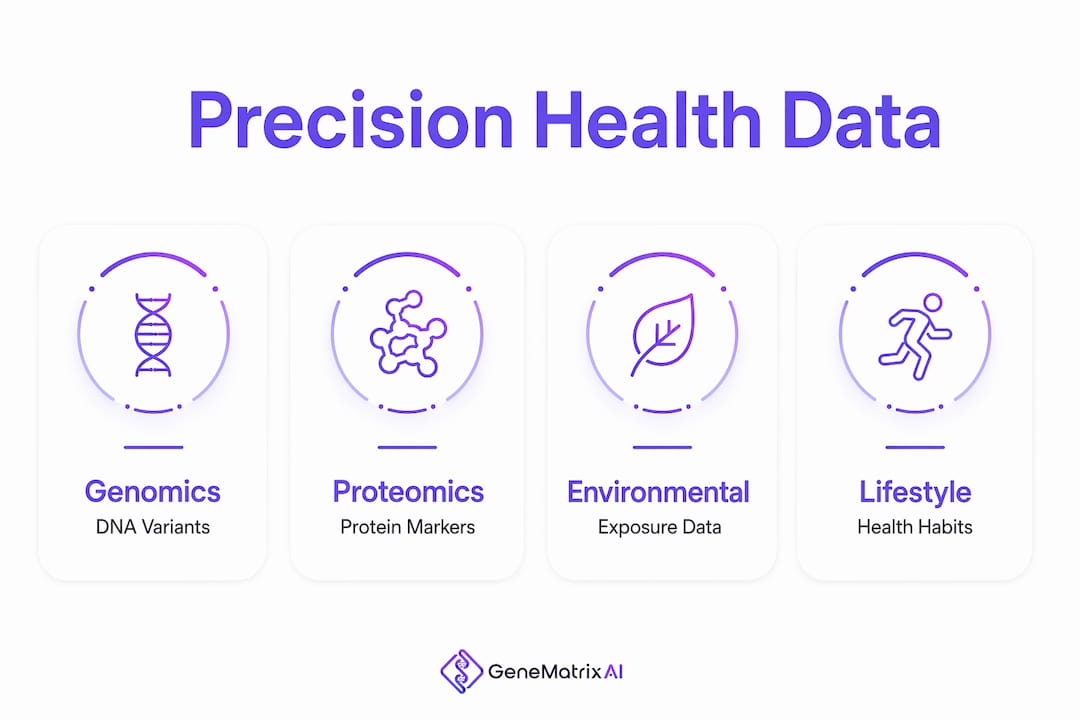
The main barrier to realizing this value is not scientific knowledge. The real challenge is integrating vast, complex datasets reliably enough to optimize patient outcomes at scale. Data quality, interoperability between health systems, and standardized collection methods all determine whether a precision health insight is trustworthy or misleading.
Certified data collection tools with diverse input channels produce more accurate results for personalized care. That is why CLIA certification matters when choosing a genetic testing provider. Longitudinal data collection, meaning data gathered repeatedly over time rather than once, is what separates a meaningful health trend from a single data point.
Pro Tip: When reviewing any genetic or health report, ask whether the analysis used longitudinal data or a one-time sample. Single-point tests are useful, but repeated measurements over months or years produce far more reliable risk predictions.
What challenges and nuances exist in applying precision health insights?
Precision health data is only as useful as the clinical context around it. Personalized medicine translation into routine care is inconsistent, and continuous clinical reassessment is the key safeguard against depersonalization. A genetic risk score without a physician's interpretation can cause unnecessary anxiety or, worse, false reassurance.
The most common challenges families and clinicians face include:
- Depersonalization risk. When data is processed at scale without clinical context, individual nuance gets lost. A high polygenic risk score for heart disease means something very different for a 45-year-old with controlled blood pressure than for a 45-year-old who smokes.
- Data privacy and governance. Families reasonably worry about who accesses their genetic data and how it is stored. Precision health requires continuous data enrichment, interoperability, and governance frameworks to enable secure, responsible AI-driven insights.
- Infrastructure lag. Clinicians face real delays integrating genomic data into standard workflows due to resource constraints. Systematic infrastructure improvements are required before precision health becomes routine primary care.
- Equitable access. Advanced genetic testing and AI-powered monitoring tools are not yet equally available across income levels, geographies, or insurance types. This gap limits who benefits from precision health advances.
Longitudinal patient data and dynamic disease knowledge are prerequisites for future breakthroughs in individualized care. Without them, precision health risks becoming a sophisticated but incomplete tool. The field is advancing, but families should approach any single test result as one input in a larger conversation with their healthcare provider, not a final verdict.
How can families apply the latest precision health developments?
Families can engage with precision health right now through four concrete steps. These are not theoretical. Each one maps to a technology or service that exists today.
-
Start with hereditary cancer screening. Tests for BRCA1, BRCA2, and Lynch syndrome genes identify elevated cancer risk before any tumor forms. Genematrix's GeneCancer panel covers these and other hereditary markers, delivering results within 72 hours. Targeted interventions supported by precision insights improve wellness and reduce risks across a lifetime.
-
Review medications with a pharmacogenomics test. A GenePGx panel reveals how your body processes specific drugs, from antidepressants to blood thinners. Optimizing medication based on genetics reduces the trial-and-error cycle that leads to adverse reactions and ineffective treatment.
-
Use AI-powered monitoring to track health trends over time. Wearable devices paired with AI analytics platforms give families a real-time window into biometric changes. AI supports personalized medicine by flagging deviations from your personal baseline, not a population average.
-
Integrate precision data into your care plan with your physician. A genetic report is most valuable when your doctor can contextualize it against your full medical history. Bring test results to appointments and ask specifically how findings change your screening schedule or medication plan.
Lifestyle changes supported by precision insights add another layer of value. Genematrix's GeneDiet module, for example, uses nutrigenomic data to guide dietary choices based on how your genes affect nutrient metabolism. That is a fundamentally different approach than a generic nutrition plan built on population averages.
Key Takeaways
Precision health delivers its greatest value when genetic, proteomic, and lifestyle data are integrated over time and interpreted within a clear clinical context, not treated as isolated test results.
| Point | Details |
|---|---|
| Precision health is predictive | AI and multi-omic data identify disease risk years before symptoms appear. |
| Pharmacogenomics reduces drug risk | Genetic testing reveals how you metabolize medications, preventing adverse reactions. |
| Data integration is the core challenge | Combining genomic, proteomic, and biometric data reliably is harder than collecting it. |
| Clinical context is non-negotiable | Genetic risk scores require physician interpretation to be safe and useful. |
| Families can act now | Hereditary cancer screening, PGx testing, and AI monitoring are available today. |
What I've learned watching precision health move from lab to living room
The part that surprises most families I talk with is how much precision health has already moved out of research centers and into practical use. People expect it to be further away than it is. The gap between "this exists" and "this is available to me" has closed faster than almost anyone predicted.
What I've also seen is a consistent misunderstanding about what a genetic test actually tells you. A result is not a diagnosis. A BRCA2 variant does not mean you will develop cancer. It means your risk profile is different from the general population, and that difference should shape your screening schedule and your conversations with your doctor. Families who understand that distinction get far more value from precision health than those who treat a report as a verdict.
The integration challenge is real, and I think the field undersells it. Combining genomic, proteomic, and environmental data into a single, reliable picture is genuinely hard. The science is there. The infrastructure is catching up. But the families who benefit most right now are the ones who engage actively, ask questions, and treat precision health as an ongoing process rather than a one-time test.
The promise is real. So is the work required to fulfill it. Approach precision health with curiosity, not anxiety, and you will find it gives you more agency over your health than any previous generation has had.
— Tarek
Genematrix brings precision health within reach for your family
Genematrix is a CLIA-certified biotechnology company that translates the science of precision health into reports families and physicians can actually use. Their GeneMatrixAI platform covers hereditary cancer risk, pharmacogenomics, psychiatric genetics, pediatric screening, and nutrigenomics, all delivered within 72 hours.

The platform is trained on 500,000+ genetic profiles, which means the AI behind each report has seen enough variation to produce results that hold up clinically. For families ready to move from general wellness advice to personalized genetic insights, Genematrix's science and technology page details the lab certifications, testing methods, and AI infrastructure behind every panel. That transparency is what makes the results worth acting on.
FAQ
What is precision health in simple terms?
Precision health is a proactive approach to care that uses your genetic data, lifestyle habits, and environment to predict and prevent disease before symptoms appear. It differs from traditional medicine, which typically responds to illness after the fact.
How does pharmacogenomics fit into precision health trends?
Pharmacogenomics analyzes how your genes affect your response to medications. It is becoming a standard part of precision health because it reduces adverse drug reactions and makes prescribing far more targeted than population-based dosing.
What data does a precision health platform actually use?
A full precision health profile combines genomic data, proteomic markers, metabolic measurements, environmental exposures, and real-time biometric data from wearables. Integrative approaches that combine these sources consistently outperform single-test analysis in clinical value.
Is genetic data safe with precision health providers?
Reputable CLIA-certified providers operate under strict data governance frameworks. Families should confirm that any provider they use holds recognized lab certifications and has a clear, published data privacy policy before submitting a sample.
How can a family get started with precision health today?
The most practical first step is hereditary cancer screening, followed by a pharmacogenomics panel if you or a family member takes regular medications. A step-by-step guide for families can help you understand what each test covers and how to discuss results with your physician.