

When you search "genetic testing for antibiotic sensitivity," you are almost certainly asking about one of two very different tests. Understanding which one you actually need changes everything about where you go and what you do next.
Here is the short version:
- Active infection? The test you need examines the bacteria, not your DNA. A clinician orders a culture and antimicrobial susceptibility test (AST) from a blood draw, urine sample, or wound swab. For highly resistant organisms, the CDC's Antimicrobial Resistance Laboratory Network (AR Lab Network) provides whole-genome sequencing (WGS) and specialized resistance testing through public-health channels.
- Worried about a bad reaction to an antibiotic, or planning long-term therapy? A human pharmacogenomics (PGx) panel tests your DNA for variants that affect how your body processes certain drugs. Bring those results to your clinician or pharmacist.
- Consumer DNA kit from a retail store? It cannot test bacteria. It will not tell you which antibiotic will work against your infection.
Table of Contents
- What does "genetic testing for antibiotic sensitivity" actually mean?
- How is antibiotic sensitivity testing performed in U.S. labs?
- When do your own genes affect antibiotic choice?
- Who should get which test, and how do you get it in the U.S.?
- How do you read the results and what should you ask your clinician?
- What are the real limits, and how does privacy law protect you?
- Key Takeaways
- The test that actually matters depends on what you are treating
- Genematrix GenePGx: clinician-validated pharmacogenomics testing
- Useful sources
What does "genetic testing for antibiotic sensitivity" actually mean?
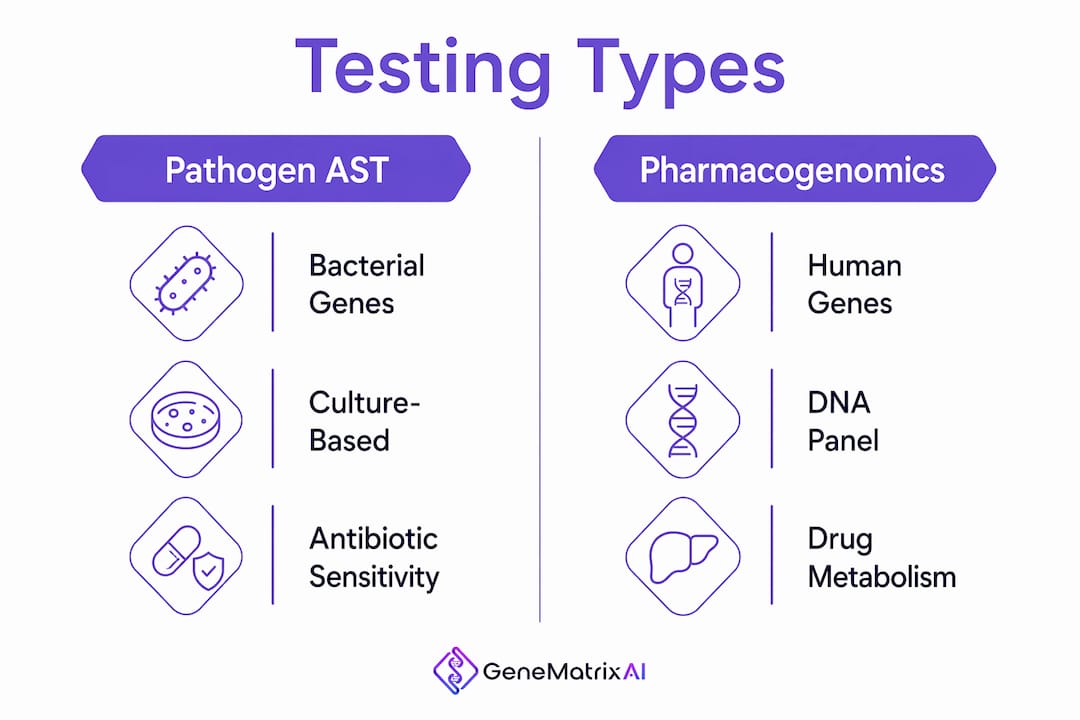
The phrase covers two distinct tests that share almost no overlap in purpose, specimen type, or clinical workflow.
| Feature | Pathogen (bacterial) AST | Human pharmacogenomics (PGx) |
|---|---|---|
| What is tested | The bacteria causing your infection | Your own DNA |
| Specimen | Blood, urine, wound swab, sputum | Saliva or blood |
| Question answered | Which antibiotic kills this specific bug? | How will your body metabolize or react to a drug? |
| When ordered | Active infection | Pre-prescription planning, adverse reaction history |
| Who orders it | Clinician (required) | Clinician or CLIA-certified consumer lab |
| Example scenario | Bloodstream infection → culture + AST | Planned aminoglycoside therapy → check MT-RNR1 variant |
The confusion is understandable. "Antibiotic resistance" sounds like something in your genes, but resistance lives in the bacteria, not in you. A PGx test can flag that you carry a variant raising your risk of hearing loss from aminoglycosides (MT-RNR1), or that G6PD deficiency makes certain agents risky. What it cannot do is tell your clinician whether the Klebsiella in your urine is susceptible to ciprofloxacin.
How is antibiotic sensitivity testing performed in U.S. labs?
Phenotypic testing: still the gold standard
Culture-based AST remains the clinical baseline. A lab grows the bacteria from your specimen, then exposes it to antibiotics using broth microdilution or disk diffusion. The result is a minimum inhibitory concentration (MIC) value, interpreted against breakpoints published by CLSI (Clinical and Laboratory Standards Institute) and EUCAST. Typical blood-culture workflows report organism identification at roughly 43 hours and final AST results at around 65 hours from collection.
That roughly 65-hour window forces clinicians to start empiric (best-guess) therapy before results arrive. It is the single biggest driver of antibiotic overuse.
Rapid molecular and genomic methods
Rapid genotypic tests detect resistance genes directly from specimens, often within hours. Research-stage assays like GoPhAST-R combine transcriptional phenotyping with genotypic detection, returning results in under 4 hours from positive blood cultures. Assembly-based Nanopore WGS can annotate resistance genes within 8–14 hours from cultured isolates in research settings, potentially shortening time to effective therapy by 20–26 hours.
Key caveat: WGS-AST categorical agreement ranges from roughly 77% to 96% depending on the drug class and organism, with carbapenems showing the most variability. CLSI and EUCAST still endorse phenotypic testing as the clinical baseline precisely because genotype-phenotype mismatches do occur.
- AR Lab Network: For carbapenem-resistant organisms and other high-priority pathogens, the CDC's AR Lab Network performs WGS, carbapenemase PCR, and expanded broth microdilution panels. These are accessed through clinicians or state public-health labs, not purchased directly.
- Hospital reference labs: WGS workflows require bioinformatics pipelines and expert interpretation; most community hospitals send complex cases to reference labs or public-health networks.
When do your own genes affect antibiotic choice?
For most routine infections, your DNA has little bearing on which antibiotic your clinician prescribes. The bacteria's resistance profile is what drives that decision. PGx becomes relevant in a narrower set of situations.

MT-RNR1 variants raise the risk of permanent hearing loss from aminoglycosides (gentamicin, tobramycin). Knowing this before a prolonged course matters, especially in neonatal or cystic fibrosis care. G6PD deficiency creates hemolytic risk with dapsone and primaquine; these agents are rarely first-line for common bacterial infections, but the variant is worth knowing if you are being treated for certain parasitic or mycobacterial conditions. CYP enzyme variants can alter levels of a handful of adjunct drugs used alongside antibiotics, though this is more relevant in HIV or tuberculosis regimens than in standard outpatient care.
Pro Tip: If you have a history of an unexpected reaction to a medication, ask your clinician whether a PGx panel could identify a variant that explains it. A single test can inform multiple future prescribing decisions.
PGx does not replace pathogen susceptibility testing. Think of it as a layer of safety information about you, not a substitute for knowing what the bacteria can survive.
Who should get which test, and how do you get it in the U.S.?
| Situation | Test type | How to get it | Typical turnaround | Insurance coverage |
|---|---|---|---|---|
| Active bacterial infection | Culture + AST (clinician-ordered) | Emergency room, urgent care, or primary care | ~65 hours | Usually covered |
| Suspected drug-resistant infection | Molecular/WGS via AR Lab Network | Clinician or public-health referral | Hours to days | Covered via public health |
| Pre-prescription safety planning | CLIA-certified PGx panel | Clinician order or consumer lab | 48–72 hours | Varies by plan |
| History of adverse drug reaction | CLIA-certified PGx panel | Clinician order or consumer lab | 48–72 hours | Varies by plan |
Cost for a CLIA-certified PGx panel varies widely. Insurance coverage depends on your plan and whether the test is ordered by a clinician with documented clinical indication. Consumer-initiated PGx tests are often out-of-pocket. For specialized pathogen testing through the AR Lab Network, costs are absorbed by the public-health system. Ask your clinician to document the clinical reason for any PGx order; that single step significantly improves the odds of coverage.
How do you read the results and what should you ask your clinician?
Pathogen AST reports list each antibiotic as Susceptible (S), Intermediate (I), or Resistant (R), alongside MIC values. Susceptible means the drug should work at standard doses; resistant means it likely will not. Intermediate is a gray zone where higher doses or alternative agents may be considered.
PGx reports use diplotype notation (e.g., CYP2D6 *1/*4) and translate that into a phenotype category: normal metabolizer, intermediate metabolizer, poor metabolizer, or ultrarapid metabolizer. The clinical implication depends on the specific drug.
- Ask your clinician: "Does this AST result change the antibiotic I am currently on, or confirm it is the right choice?"
- Ask your pharmacist: "Based on my PGx report, are there any dosing adjustments or drug interactions I should know about?"
- Request that your PGx report be added to your electronic health record so future prescribers can see it.
- If your infection involves a multidrug-resistant organism, ask whether an infectious-disease specialist should review your case.
Pro Tip: Saving your PGx results to your patient portal and sharing them proactively at every new prescription visit is one of the most practical ways to optimize medication outcomes over time.
Rapid genotypic results, while faster, frequently require clinical correlation before a clinician will de-escalate therapy. Do not expect a genotypic result alone to change your treatment without a clinician's review.
What are the real limits, and how does privacy law protect you?
Accuracy limits
WGS-AST categorical agreement reaches 95% for penicillins and aminoglycosides but drops to 77% for carbapenems. False positives (overcalling resistance) are the more common error, which can lead to unnecessarily broad antibiotic use. CLSI and EUCAST maintain phenotypic testing as the clinical baseline for exactly this reason, and EUCAST's WGS subcommittee continues to evaluate where genomic prediction is reliable enough to stand on its own.
"Rapid genotypic tests are valuable when paired with antimicrobial stewardship interpretation; without that context, clinicians may hesitate to de-escalate therapy on genotype alone." — Society of Infectious Diseases Pharmacists, updated AST primer
Privacy protections
The Genetic Information Nondiscrimination Act (GINA) prohibits health insurers and employers from discriminating based on genetic information. It does not cover life insurance, disability insurance, or long-term care insurance. A PGx test may reveal information beyond drug metabolism, including carrier status for certain conditions. Always use a CLIA-certified lab and confirm the lab's data-sharing and consent policies before ordering. CLIA certification is the minimum federal standard for clinical accuracy; it is a meaningful trust signal, not just a checkbox.
This article is general health information, not medical advice. Confirm current testing options and coverage with your clinician or a qualified pharmacist for your specific situation.
Key Takeaways
Genetic testing for antibiotic sensitivity means two different things, and knowing which test applies to your situation determines whether you call your doctor today or order a PGx panel online.
| Point | Details |
|---|---|
| Pathogen testing vs. PGx | AST tests the bacteria; PGx tests your DNA — they answer different questions and cannot substitute for each other. |
| Standard AST turnaround | Culture-based results typically take about 65 hours; WGS can reach resistance gene annotation within 8–14 hours in research settings. |
| PGx gene examples | MT-RNR1 and G6PD variants are the most clinically relevant for antibiotic safety; CYP variants matter mainly in complex regimens. |
| Privacy under GINA | GINA protects against health insurance and employment discrimination but does not cover life or disability insurance. |
| Genematrix GenePGx | Genematrix offers a CLIA-certified PGx panel with clinician-validated reports delivered within 72 hours, designed to complement clinician-ordered pathogen testing. |
The test that actually matters depends on what you are treating
Most articles on this topic either oversimplify or conflate the two tests entirely. The honest picture is more useful: pathogen AST is irreplaceable for active infections, and no consumer kit changes that. WGS is genuinely exciting for resistant organisms, but it still lives mostly in hospital reference labs and public-health networks. PGx, on the other hand, is where a patient can take real initiative.
The underappreciated move is getting a PGx panel before you need an antibiotic, not after a reaction. Clinicians are increasingly receptive to patients who arrive with a PGx report already in hand. It shortens the conversation, reduces trial-and-error prescribing, and gives your pharmacist something concrete to work with. The precision medicine shift happening in hospitals is filtering down to outpatient care faster than most patients realize. A CLIA-certified PGx panel ordered today can inform prescribing decisions for years.
What I would push back on is the framing that genetic testing for antibiotics is either "the future" or "not ready." For pathogen sequencing, that debate is live and the answer is nuanced. For human PGx applied to antibiotic safety, the evidence for specific variants like MT-RNR1 is solid enough that waiting serves no one.
Genematrix GenePGx: clinician-validated pharmacogenomics testing
If you are considering a PGx panel, Genematrix offers a concrete option worth knowing about. The GenePGx module is processed in a CLIA-certified lab, analyzed on the GeneMatrixAI platform trained on 500,000+ genetic profiles, and delivers a clinician-ready report within 72 hours.

The report is structured for your clinician or pharmacist to act on directly, covering drug-gene interactions across multiple medication classes. Genematrix also offers genetic counseling support so results do not land without context. This is not a replacement for the culture-based AST your clinician orders during an active infection. It is the layer of personal safety data that makes every future antibiotic prescription more informed. Review our science and lab certifications, then order or learn more through the Genematrix app on iOS or Android.
Useful sources
- CDC AR Lab Network — The U.S. public-health reference network for WGS, carbapenemase detection, and expanded susceptibility testing on resistant organisms. The authoritative source for what specialized pathogen testing is available and how to access it.
- CLSI M100 standards — The U.S. clinical laboratory standard for AST breakpoints and workflow interpretation. Every U.S. clinical lab uses these to classify susceptible, intermediate, and resistant results.
- EUCAST WGS subcommittee update — The most current international review of where WGS can and cannot reliably predict susceptibility; essential reading for understanding the limits of genomic AST.
- StatPearls: Antimicrobial Susceptibility Testing — Free, peer-reviewed clinical primer on how AST works and why it tests the pathogen, not the patient.
- Society of Infectious Diseases Pharmacists AST primer — Clinician-facing update on phenotypic vs. genotypic methods, turnaround data, and stewardship context for rapid tests.
- ONT WGS-AST validation study, PMC — Multi-lab validation of long-read sequencing for resistance prediction; the source for categorical agreement figures by drug class.
- GoPhAST-R rapid AST study, PMC — Research demonstrating combined genotypic and phenotypic AST in under 4 hours from positive blood cultures.
- When Doctors Don't Listen: precision vs. negligence in diagnosis — Patient-advocacy perspective on the real-world consequences of delayed or inaccurate diagnostic testing.