

TL;DR:
- Genetic testing for autoimmune risk analyzes inherited DNA variants to assess susceptibility without providing a definitive diagnosis.
- Targeted panels, whole exome sequencing, and whole genome sequencing are chosen based on clinical suspicion and complexity.
Genetic testing for autoimmune risk analyzes inherited DNA variants to assess your predisposition to autoimmune and autoinflammatory conditions. It is not a standalone diagnosis. Instead, it identifies which genetic variants you carry, how those variants affect immune regulation, and where your risk sits relative to the broader population. The results feed into a clinical picture that also includes biomarkers, family history, and symptoms.
Here is what this type of testing typically delivers:
- Identification of high-risk HLA alleles (e.g., HLA-B27 for ankylosing spondylitis, HLA-DQ2/DQ8 for celiac disease)
- Detection of non-HLA immune regulatory variants in genes like PTPN22, CTLA4, and STAT4
- Risk stratification to guide screening frequency and preventive care
- Family risk identification, since many autoimmune variants cluster in families
- Pharmacogenomic data relevant to drug safety (certain HLA alleles predict drug hypersensitivity)
The test complements, never replaces, clinical evaluation. A positive genetic finding raises your prior probability of disease; it does not confirm it.
What disorders and genes do autoimmune genetic panels cover?
HLA genes are the strongest genetic risk factors across most autoimmune diseases, and every serious autoimmune panel includes them. HLA class I and class II genes shape how your immune system recognizes self versus non-self, and variants in this region drive risk for conditions ranging from ankylosing spondylitis to type 1 diabetes.
Beyond HLA, panels typically interrogate non-HLA immune regulatory genes. PTPN22 variants increase risk for rheumatoid arthritis, type 1 diabetes, and lupus. CTLA4 affects T-cell regulation and appears in thyroid autoimmunity. IL2RA and STAT4 variants are associated with multiple sclerosis and lupus, respectively. IRF5 is implicated in systemic lupus erythematosus. The key point: autoimmune risk is polygenic, meaning no single gene tells the whole story.
| Disorder | Key genes tested |
|---|---|
| Ankylosing spondylitis | HLA-B27 |
| Celiac disease | HLA-DQ2, HLA-DQ8 |
| Rheumatoid arthritis | HLA-DR4, PTPN22 |
| Multiple sclerosis | HLA-DRB1, IL2RA, STAT4 |
| Type 1 diabetes | HLA-DR3, HLA-DR4, PTPN22, CTLA4 |
| Autoimmune thyroid disease | CTLA4, HLA-DR3 |
| Systemic lupus erythematosus | IRF5, STAT4, HLA-DR2/DR3 |
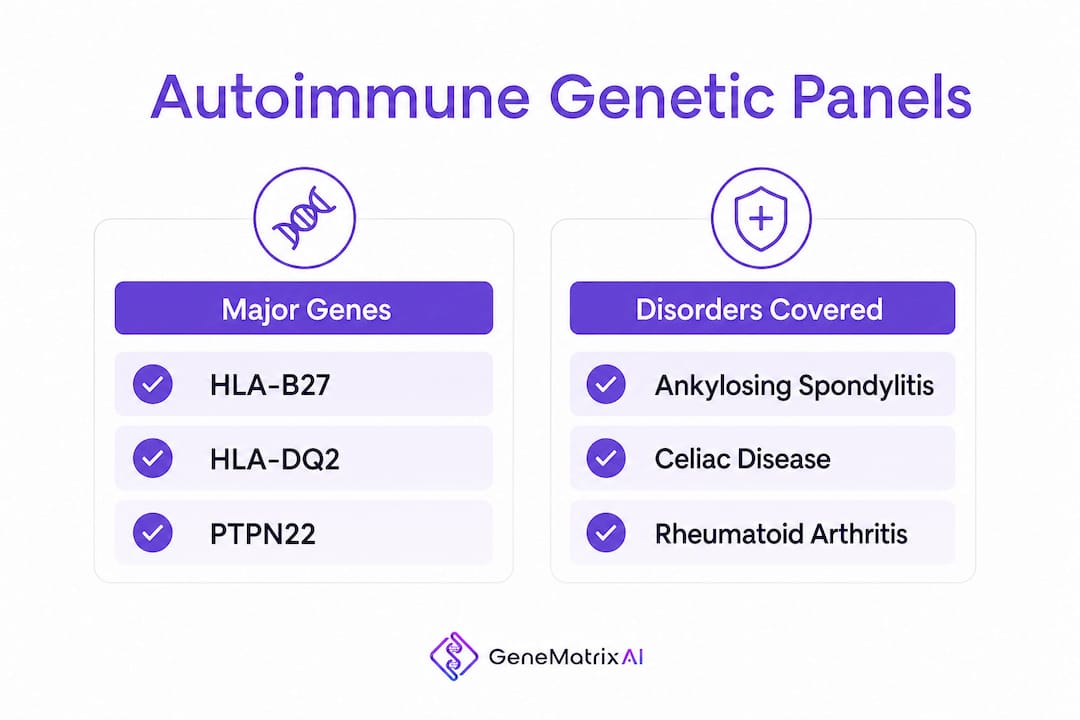
Panels vary considerably in scope. The Invitae Autoinflammatory and Autoimmunity Syndromes Panel covers a broad set of genes associated with monogenic autoinflammatory conditions, including NLRP3, MEFV, and NOD2. Mayo Clinic Laboratory Immunology Panels offer clinically validated HLA typing and immune gene testing ordered through a physician. Dante Labs autoimmune genetic testing includes whole genome sequencing with HLA typing, providing broader coverage than targeted panels alone. Panel size and gene focus shift based on clinical suspicion, so the right panel depends on your presenting symptoms and family history.
Which testing method is right for your clinical situation?
Targeted gene panels are the most common first-line approach. They cover a defined set of known disease-associated genes, return results faster, and cost less than broader sequencing methods. For a patient with a strong family history of rheumatoid arthritis, a focused panel interrogating HLA-DR4 and PTPN22 is often sufficient.
Whole exome sequencing (WES) covers the coding regions of roughly 22,000 genes, making it useful when the clinical picture is ambiguous or when a panel comes back negative but suspicion remains high. WGS is the most comprehensive option, covering both coding and noncoding regions of the entire genome, including regions that WES misses entirely. WGS also provides the most thorough HLA typing available, which matters for autoimmune risk profiling.

| Method | Coverage | Relative cost | Turnaround | Best use case |
|---|---|---|---|---|
| Targeted gene panel | Known disease genes only | Lowest | 2–4 weeks | Focused clinical suspicion |
| WES | ~22,000 coding genes | Moderate | 4–8 weeks | Ambiguous or complex presentations |
| WGS | Entire genome | Highest | 6–12 weeks | Comprehensive profiling, HLA typing |
Factors that influence which test your clinician orders:
- Severity and specificity of symptoms
- Family history of confirmed autoimmune or autoinflammatory disease
- Prior negative panel results
- Insurance coverage and out-of-pocket cost tolerance
- Lab availability and turnaround requirements
Polygenic risk scores (PRS) represent an emerging layer on top of these methods. PRS aggregate the small effects of many common variants into a single risk estimate, but their predictive power remains limited compared to high-penetrance monogenic factors. They are actively researched and will likely play a larger role in precision medicine over the next decade.
How genetic results are interpreted and used clinically
A genetic result lands in one of three categories: pathogenic, likely pathogenic, or variant of uncertain significance (VUS). Pathogenic and likely pathogenic findings carry enough evidence to inform clinical decisions. VUS results are common and frustrating. They mean the lab found a variant but cannot yet confirm whether it causes disease. Additional family testing or functional studies are usually required to resolve them.
Genetic results gain real clinical utility when combined with inflammatory biomarkers, symptom history, and family data. Autoimmune diseases arise from complex polygenic contributions, so a positive HLA finding without supporting clinical evidence rarely justifies treatment changes on its own. Where results do change management immediately is in drug safety: HLA-B*57:01 testing before prescribing abacavir is now standard practice because the allele predicts severe hypersensitivity reactions.
Pro Tip: If your report returns a VUS, do not treat it as a positive or a negative. Ask your genetic counselor whether family member testing could reclassify it, and request that the lab flag your file for reanalysis as new evidence emerges.
Genetic counseling before and after testing is not optional for complex panels. A counselor helps you set realistic expectations, understand what a negative result does and does not rule out, and plan next steps. For interpreting genetic test results that involve multiple variants or uncertain findings, professional guidance prevents both over-reaction and under-reaction. Privacy considerations matter too: the Genetic Information Nondiscrimination Act (GINA) protects against discrimination in health insurance and employment, but it does not cover life, disability, or long-term care insurance.
What lab standards and specimen requirements should you verify?
CLIA and CAP certifications are the baseline quality indicators for any genetic testing laboratory in the United States. CLIA certification means the lab meets federal standards for clinical testing accuracy. CAP accreditation adds a peer-inspection layer that most hospital systems and insurers recognize as the higher bar. Never order a clinical genetic test from a lab that cannot confirm both.
Blood remains the gold standard specimen for immune-related genetic testing because it yields high-quality, high-quantity DNA. Saliva and buccal swabs are accepted by some labs, particularly for consumer-facing tests, but DNA quality can be lower and may affect sequencing depth for complex panels.
Practical checklist before you submit a sample:
- Confirm the lab holds current CLIA and CAP credentials
- Verify the specific panel or sequencing method is clinically validated, not just research-grade
- Ask whether the test requires a physician order (most clinical-grade panels do)
- Check specimen shipping requirements, including temperature and timing constraints
- Clarify turnaround time and whether the report includes a clinical interpretation or raw data only
Next-generation sequencing (NGS) platforms power virtually all modern autoimmune genetic panels. Turnaround times typically run a few weeks for targeted panels and longer for WES or WGS. Reports from reputable labs include variant classification, supporting evidence, and recommended next steps, not just a list of detected variants.
Current advances and what they mean for your care
Whole genome sequencing is reshaping autoimmune risk profiling by capturing variants in noncoding regulatory regions that targeted panels and WES miss entirely. For patients who have cycled through multiple negative panels without a diagnosis, WGS is increasingly the logical next step.
The VUS problem is improving, slowly. Reanalysis of previously nondiagnostic genetic data raised diagnostic yield from 11.8% to 15.2% in patients with inborn errors of immunity, as new gene-disease associations are established and variant databases grow. Requesting periodic reanalysis of a stored exome or genome is a concrete step patients can take years after initial testing.
Pro Tip: Pair your genetic results with inflammatory biomarker panels, including C-reactive protein, erythrocyte sedimentation rate, and antinuclear antibody titers. Genetics identifies molecular risk; inflammation markers signal active immune dysregulation. Together, they give your clinician a far sharper picture than either alone.
Genematrix applies AI-driven analysis, trained on more than 500,000 genetic profiles, to deliver genomic reports within 72 hours. That speed matters when a clinician is trying to rule in or out an autoinflammatory syndrome before initiating immunosuppressive therapy. The platform's clinical genetics workflow integrates genetic findings with pharmacogenomic data, which is particularly relevant for autoimmune patients who face complex, long-term medication regimens.
Ethical and privacy considerations are not peripheral to this conversation. Genetic data is permanent. Before testing, understand how your lab stores data, whether it shares data with third parties, and what your rights are under applicable law. The more comprehensive the test, the more incidental findings become possible, including variants unrelated to your original clinical question.
Genetic testing for autoimmune risk delivers its highest value when ordered by a knowledgeable clinician, interpreted by a genetic counselor, and integrated with the full clinical picture rather than read in isolation.
| Point | Details |
|---|---|
| HLA genes drive most risk | HLA class I and II variants are the strongest genetic risk factors across the major autoimmune diseases. |
| Test choice depends on clinical context | Targeted panels suit focused suspicion; WES and WGS are reserved for complex or previously undiagnosed cases. |
| VUS results require follow-up | Variants of uncertain significance need family testing or functional studies and periodic reanalysis to resolve. |
| Reanalysis improves yield | Diagnostic yield rose from 11.8% to 15.2% when previously nondiagnostic genetic data was reanalyzed. |
| Lab credentials are non-negotiable | CLIA and CAP certification are the minimum quality standards for any clinical autoimmune genetic test in the United States. |

Genematrix is a CLIA-certified, Chicago-based precision medicine company whose GeneMatrixAI platform delivers AI-powered genomic reports within 72 hours. Whether you are exploring autoimmune genetic predisposition or need pharmacogenomic data to guide medication decisions, Genematrix combines laboratory rigor with the speed that clinical decisions actually require.