

TL;DR:
- Effective clinical genetics workflows integrate multidisciplinary teams, digital infrastructure, and standardized processes to improve patient care. Building governance and collaboration first ensures successful technology implementation and program scalability. Prioritizing structured data, participatory design, and ongoing reclassification management enhances clinical decision-making and program sustainability.
A clinical genetics implementation workflow is a structured, multidisciplinary process that integrates genetic testing into routine clinical care to improve diagnosis, risk stratification, and patient management. Done correctly, it connects patient identification, laboratory analysis, electronic health record (EHR) systems, and clinical decision support (CDS) tools into a single, coordinated process. When these components work together, genetic counselors and clinicians can act on results faster, reduce diagnostic delays, and deliver genuinely personalized care. This guide covers every stage of that process, from infrastructure requirements through execution and technology integration, with the practical depth that clinical teams need in 2026.
What are the prerequisites for a clinical genetics implementation workflow?
Before a single sample is collected, your institution needs the right infrastructure in place. Successful implementation depends on local validation, clinical organization, and healthcare system integration far more than on technology alone. Getting the foundation right is the difference between a program that scales and one that stalls after the pilot phase.
Multidisciplinary team structure
A functional clinical genetics process requires clearly defined roles across at least four disciplines. Your core team should include:
- Clinical geneticists and genetic counselors who manage patient-facing assessment, consent, and post-result communication
- Molecular laboratory scientists responsible for sample processing, quality control, and variant interpretation
- Bioinformaticians and IT specialists who maintain the data pipelines, EHR integrations, and reporting interfaces
- Referring clinicians (oncologists, cardiologists, neurologists) who identify appropriate patients and act on results
Each role must have documented responsibilities and escalation pathways. Ambiguity in role definition is one of the most common reasons programs underperform after launch.
Digital infrastructure and EHR readiness
Digital maturity is a fundamental prerequisite for genomic medicine integration, not an optional upgrade. Your EHR must support structured genomic data fields, not just PDF attachments. Genomic data stored as inaccessible PDF reports in the EHR cannot be queried, flagged, or acted on at the point of care. Interoperability with laboratory information management systems (LIMS) and bioinformatics pipelines is non-negotiable for any program aiming at scale.

Laboratory accreditation and quality standards
Laboratories participating in your genetic testing workflow must meet CLIA certification requirements and maintain analytical sensitivity above 99% for the variant classes they report. Standardized, template-based reporting with bolded key findings and explicit clinical recommendations is the baseline expectation. Any lab that cannot produce structured, actionable reports creates downstream bottlenecks for counselors and clinicians.
Pro Tip: Before selecting a laboratory partner, request a sample de-identified report and evaluate it against your clinical team's interpretation needs. A report that requires a geneticist to decode is not ready for routine clinical use.
How do you design and execute the step-by-step genetics workflow?
The clinical genetics process follows a defined sequence. Deviating from this sequence, particularly by skipping pre-test counseling or using non-standardized referral criteria, is the leading cause of inappropriate test utilization and patient harm.
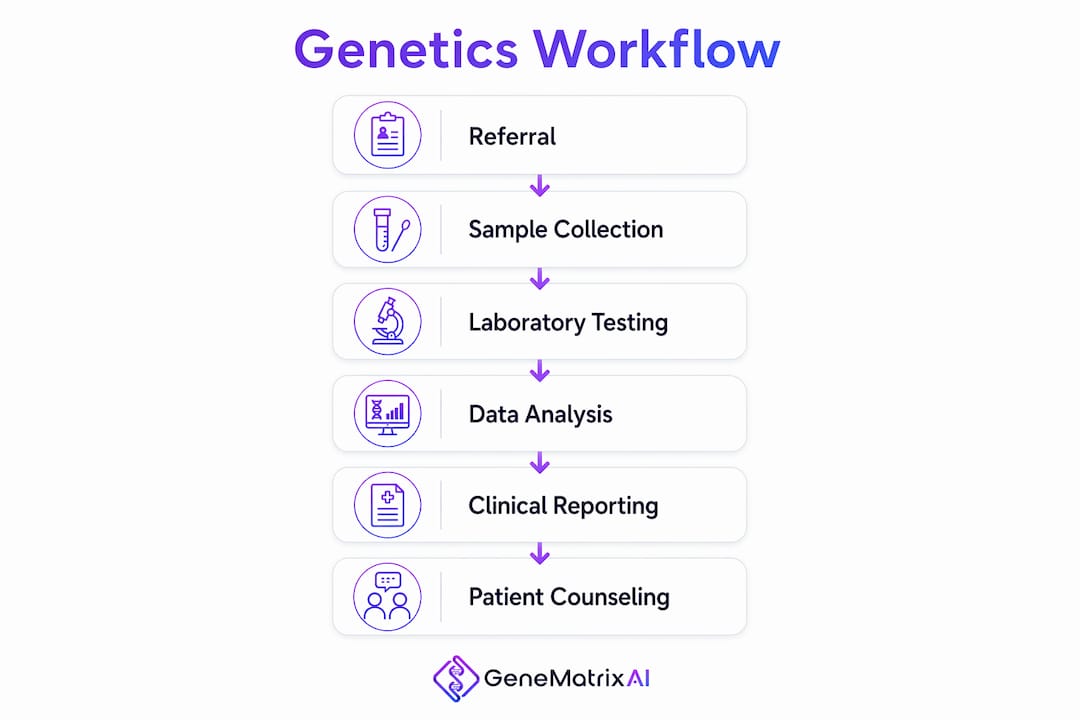
Step-by-step workflow
-
Patient identification and referral. Define explicit clinical criteria for referral, such as personal or family history of hereditary cancer, early-onset disease, or pharmacogenomic indications. Use structured referral forms embedded in the EHR to capture relevant phenotypic data at the point of referral.
-
Pre-test genetic counseling and informed consent. A genetic counselor conducts a 30–60 minute session covering the scope of testing, possible result categories (positive, negative, variant of uncertain significance), and implications for the patient and family. Testing should only be ordered when results will directly impact clinical management. Ordering without this filter wastes resources and risks patient harm.
-
Sample collection and transport. Follow laboratory-specific protocols for sample type, volume, and cold-chain requirements. Document collection time and conditions in the LIMS. Any deviation from protocol at this stage can invalidate results and require recollection.
-
Laboratory analysis and quality benchmarking. The laboratory performs sequencing or targeted panel analysis against validated reference standards. Turnaround time for whole-genome sequencing (WGS) non-priority samples averages 55 days as of 2026, with urgent cases processed significantly faster. Build these timelines into patient communication templates so expectations are set correctly from the start.
-
Standardized result reporting. Reports must use a consistent template that highlights pathogenic variants, clinical significance, and recommended next steps. Review actionable genomic reports to understand what a well-structured clinical output looks like in practice.
-
Post-test counseling and clinical management integration. The genetic counselor reviews results with the patient, coordinates with the referring clinician, and documents the management plan in the EHR. Cascade testing recommendations for at-risk family members should be generated at this stage.
| Workflow Stage | Key Quality Benchmark |
|---|---|
| Patient identification | Structured referral criteria applied consistently |
| Pre-test counseling | Informed consent documented before test order |
| Sample collection | Protocol adherence logged in LIMS |
| Laboratory analysis | Analytical sensitivity above 99% |
| Result reporting | Standardized template with bolded key findings |
| Post-test follow-up | Management plan documented in EHR within 5 business days |
Pro Tip: Build a referral-to-result tracking dashboard from day one. Knowing where every case sits in the pipeline prevents counselors from spending clinical time chasing status updates.
What are the best practices for technology integration in genetics workflows?
Technology integration determines whether your program operates at the speed of clinical care or lags behind it. Effective workflows integrate four key components: patient identification tools, centralized EHR integration, CDS tools, and multidisciplinary review boards. Getting any one of these wrong creates friction that compounds across every case.
Designing clinical decision support tools that clinicians actually use
Poorly designed CDS tools disrupt workflow and generate alert fatigue. Participatory design, which incorporates clinician feedback during development rather than after deployment, is the most reliable method for producing tools that are trusted and used. Higher adoption rates are observed when CDS interfaces incorporate user feedback, integrate into existing EHR workflows, and provide live status updates rather than batch notifications.
The practical implication: involve genetic counselors, ordering physicians, and lab scientists in the design process before any tool goes live. A CDS alert that fires at the wrong point in the clinical encounter will be dismissed every time.
EHR integration and genomic data accessibility
Genomic data must be structured and queryable within the EHR, not buried in attached PDFs. Structured data fields allow the system to flag patients with actionable variants when they present for unrelated care, a capability that is central to the value proposition of implementing genetics programs at scale. Interoperability between the EHR, LIMS, and bioinformatics platforms requires a unified data model and, in most institutions, a dedicated integration engine such as HL7 FHIR-compliant middleware.
| Integration Model | Strengths | Limitations |
|---|---|---|
| PDF report in EHR | Easy to implement | Not queryable; no point-of-care alerts |
| Structured genomic data fields | Queryable; supports CDS triggers | Requires EHR configuration and validation |
| Platform-based interoperable model | Full pipeline integration; live updates | Higher upfront IT investment |
Multidisciplinary review boards
Standardized multidisciplinary review boards enable clinicians to interpret complex genomic data with confidence and support precision care decisions. These boards should meet on a defined schedule, use structured case presentation formats, and produce documented management recommendations that feed directly back into the EHR. Without a formal review structure, variant interpretation becomes inconsistent and clinician confidence erodes.
How do you troubleshoot common challenges in clinical genetics implementation?
Even well-designed programs encounter predictable obstacles. Knowing what they are before you hit them is the most practical form of preparation.
Data silos and inaccessible genomic records. Genomic data stored as PDFs or in disconnected systems cannot support point-of-care decision-making. The fix is a phased migration to structured data fields, starting with the highest-volume test types. Prioritize BRCA1/BRCA2 and Lynch syndrome results first, since these carry the most immediate management implications.
Inappropriate test utilization. Ordering genetic tests without a clear clinical indication wastes resources and exposes patients to unnecessary anxiety. Pre-test review by genetic counselors and formal utilization management protocols, including multidisciplinary tumor boards for oncology cases, are the most effective controls. Treat test ordering as a clinical decision requiring justification, not a reflex.
Low clinician adoption of CDS tools. Alert fatigue is real. If your CDS tools fire too frequently or at irrelevant points in the workflow, clinicians will override them by default. Audit override rates monthly and use that data to refine alert logic.
Result reclassification and long-term record management. Variants of uncertain significance (VUS) are reclassified regularly as evidence accumulates. Your program needs a defined process for notifying patients and updating records when a VUS is upgraded to pathogenic. This is not a one-time task. It requires ongoing database monitoring and a patient re-contact protocol.
"Genomic innovation requires governance models that prioritize structure and teamwork. Technology is the enabler, not the solution." — Karolinska Genomic Medicine Center, 10-year implementation report
For a detailed look at how healthcare organizations structure and govern these programs, the genomics lab partnerships framework used by leading hospital systems offers a practical reference point.
Key takeaways
A clinical genetics implementation workflow succeeds when governance, multidisciplinary collaboration, and digital infrastructure are built before technology is deployed.
| Point | Details |
|---|---|
| Build the team first | Define roles for geneticists, counselors, IT, and clinicians before any tool goes live. |
| Digital infrastructure is non-negotiable | EHR must support structured genomic data fields, not just PDF attachments, for point-of-care utility. |
| Standardize every workflow stage | Use documented referral criteria, consent templates, and reporting standards to reduce variability. |
| Design CDS tools with clinicians | Participatory design prevents alert fatigue and drives adoption across the clinical team. |
| Plan for reclassification | Build a VUS re-contact protocol into the program from day one, not as an afterthought. |
What i've learned after watching programs succeed and fail
The programs that struggle most are not the ones with the worst technology. They are the ones that treated governance as an afterthought. I have seen institutions deploy sophisticated genome sequencing platforms only to find that no one agreed on who owns the result after it lands in the EHR. The variant sits there. No one acts. The patient waits.
The Karolinska Genomic Medicine Center's 10-year implementation is the clearest evidence I know of that structure and collaboration outperform technology investment every time. They built governance first, then layered technology on top of it. Most programs do the opposite.
The other thing I would tell any genetic counselor or clinical lead starting this process: do not underestimate the pre-analytic burden. Getting the right sample from the right patient at the right time, with the right consent documentation, is harder than it sounds. Pre-test counselor reviews are not bureaucratic overhead. They are the quality gate that keeps the entire downstream process valid.
Finally, treat your CDS tools as living products, not deployments. The first version will be wrong in ways you cannot predict until clinicians use it in real encounters. Build in a feedback loop from the start, review override rates, and iterate. A tool that clinicians trust is worth ten that they ignore.
— Tarek
How Genematrix supports your genetics workflow
Genematrix is built for clinical teams that need genetic insights fast, with the structure to act on them. The GeneMatrixAI platform delivers hereditary cancer testing and pharmacogenomics results within 72 hours, using AI-driven analysis trained on 500,000+ genetic profiles. Modules including GeneCancer, GenePGx, GeneMind, and GeneBaby map directly onto the workflow stages covered in this guide, from pre-test identification through post-test management. Genematrix is CLIA-certified and designed for integration with hospital systems and physician practices.

If you are implementing a genetics program and need a lab partner with structured reporting and clinical workflow support, explore what Genematrix precision medicine offers for hospitals and health systems.
FAQ
What is a clinical genetics implementation workflow?
A clinical genetics implementation workflow is a structured, multidisciplinary process that integrates genetic testing into routine clinical care. It covers patient identification, pre-test counseling, laboratory analysis, standardized reporting, and post-test clinical management.
How long does genetic test reporting take?
Turnaround time ranges from 2 to 8 weeks depending on test type and priority. Whole-genome sequencing for non-priority samples averages 55 days as of 2026, while urgent cases are processed significantly faster.
Why is pre-test genetic counseling required?
Pre-test counseling confirms that testing is clinically indicated and that the patient understands possible result categories. Ordering without this step risks inappropriate test utilization and patient harm, according to established clinical precautions for molecular genetic testing.
How do you integrate genomic data into an EHR?
Genomic data must be stored as structured, queryable fields rather than PDF attachments. A platform-based interoperable model using HL7 FHIR-compliant middleware provides the most complete integration, enabling point-of-care alerts and CDS triggers. For a practical overview, the genetic screening guide covers integration considerations in detail.
What is the biggest risk in clinical genetics workflow implementation?
The biggest risk is treating governance as secondary to technology. Programs that lack defined roles, multidisciplinary review boards, and documented escalation pathways consistently underperform, regardless of the quality of their sequencing platform.