

TL;DR:
- An actionable genomic report translates DNA data into specific, evidence-based medical recommendations for diagnosis, treatment, or prevention. These reports identify DNA alterations with direct clinical implications, guiding next steps such as medication changes or preventive measures, while non-actionable findings like VUS require monitoring. Proper interpretation and integration into healthcare infrastructure, including genetic counseling, are essential to maximize their clinical utility.
An actionable genomic report is a medically structured document that translates your DNA data into specific, evidence-based recommendations for diagnosis, treatment, or prevention. Unlike raw sequencing output, these reports identify genetic alterations with direct clinical implications, telling you and your physician not just what your genome contains, but what to do about it. Approximately 13% of healthy adults carry a serious, previously unrecognized genomic risk that symptom-based care would never catch. That number alone explains why understanding actionable genomic data has moved from niche specialty to mainstream medicine.
What are actionable genomic reports and how are they defined?
An actionable genomic report, the clinical term used interchangeably with "clinically actionable genomic findings," identifies DNA alterations linked to approved medicines, clinical trials, or preventive monitoring steps. The word "actionable" is the critical distinction. It means the finding connects to a concrete next step: a medication change, a surveillance protocol, a preventive surgery, or eligibility for a targeted therapy. Reports that lack this connection, regardless of how much genetic data they contain, do not meet the clinical definition of actionable.
The concept of actionable genomics sits at the center of precision medicine. Institutions like Mayo Clinic and major cancer centers use these reports to guide therapy selection, risk stratification, and family counseling. Genematrix, a CLIA-certified biotechnology company based in Chicago, delivers these reports through its GeneMatrixAI platform, trained on more than 500,000 genetic profiles, with results returned within 72 hours. That speed matters because treatment windows in oncology and pharmacogenomics are often narrow.
What makes genomic testing for health genuinely useful is not the volume of data generated. It is the clinical interpretation layer that converts variants into decisions. A report without that layer is a spreadsheet, not a medical tool.
What types of genomic alterations are considered actionable?
Not every genetic variant found in your genome qualifies as actionable. Clinical laboratories classify findings into three broad tiers, and only the first tier drives immediate medical decisions.
- Pathogenic mutations with approved therapies or trial eligibility. These include BRCA1 and BRCA2 variants linked to hereditary breast and ovarian cancer, Lynch syndrome mutations affecting colorectal and endometrial cancer risk, and oncogenic drivers like EGFR, ALK, and KRAS in solid tumors. Each has at least one FDA-approved treatment or a defined surveillance protocol attached to it.
- Pharmacogenomic (PGx) variants. These affect how your body metabolizes specific drugs. CYP2D6 variants, for example, determine whether you are a poor, normal, or ultra-rapid metabolizer of antidepressants, opioids, and cardiovascular medications. Pharmacogenomics offers direct clinical utility and is considered the clearest example of actionable results integration in routine care.
- Immune biomarkers. Tumor mutational burden (TMB) and microsatellite instability (MSI) status guide immunotherapy eligibility. High TMB or MSI-high status predicts response to checkpoint inhibitors like pembrolizumab.
- Variants of Uncertain Significance (VUS). These are not actionable. A VUS means the lab has detected a variant but lacks sufficient population data to classify it as harmful or benign. VUS findings require monitoring and periodic reinterpretation, not immediate clinical action.
Pro Tip: If your report lists a VUS, ask your genetic counselor to flag it for re-review in 12 to 24 months. Classification of VUS changes frequently as population databases like ClinVar and gnomAD expand.
The distinction between pathogenic, benign, and VUS classifications is not semantic. It determines whether your physician adjusts your treatment, orders additional screening, or simply files the result for future reference.
How to read and interpret an actionable genomic report
Most clinical genomic reports follow a standardized structure. Template-based reports with bolded key findings improve interpretation by non-specialist physicians, which matters because most patients receive results through their primary care provider, not a geneticist.
Here is how to work through a report systematically:
- Patient and specimen information. Confirm the sample type (blood, saliva, tumor tissue), the genes tested, and the test methodology. Whole exome sequencing covers more ground than a targeted panel. Knowing the scope tells you what the report can and cannot rule out.
- Result summary. This section lists the most clinically significant findings first. Pathogenic or likely pathogenic variants appear here with their associated conditions. If this section is empty or lists only benign variants, the report is effectively negative for actionable findings.
- Detailed variant interpretations. Each variant gets its own entry with the gene name, the specific alteration (e.g., BRCA2 c.5946delT), the classification, and the clinical significance. This is where you find the evidence base for the classification.
- Clinical recommendations. This section translates findings into next steps: referral to a specialist, specific surveillance intervals, medication adjustments, or family member testing. It is the most practically useful part of the report.
- Laboratory contact and follow-up information. Reputable labs include a direct contact for clinician queries. Use it. Ambiguous findings warrant a conversation, not a Google search.
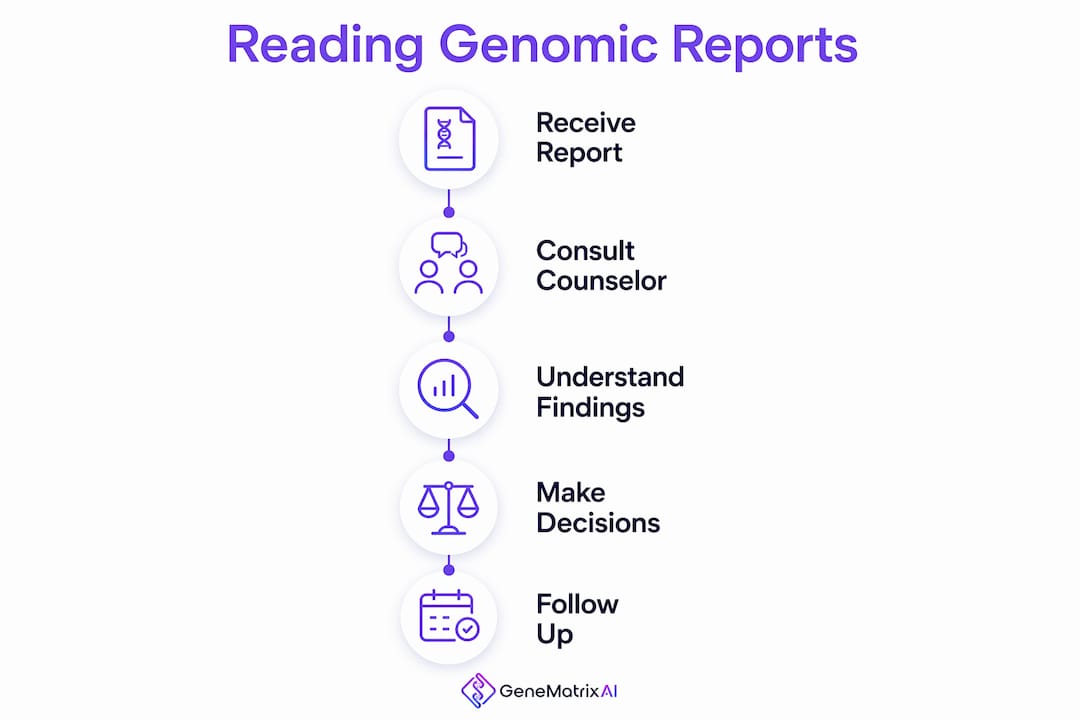
Pro Tip: Never interpret a genomic report in isolation. Genetic counseling after testing is the standard of care. A board-certified genetic counselor translates clinical language into personal health decisions and helps you understand what a finding means for your family members.
A professional genetic counseling session is needed to translate genomic findings into personalized medical decisions. This is not optional for complex findings. It is the mechanism by which a document becomes a health plan.
Clinical utility and real-world applications
The genomic report benefits that matter most are the ones that change what happens in the clinic. Here is where the science meets the patient.

In oncology, actionable reports guide therapy selection with precision that standard pathology cannot match. A patient with non-small cell lung cancer carrying an EGFR exon 19 deletion receives osimertinib rather than generic chemotherapy, because the report identifies the mutation and the matched therapy. This is not theoretical. It is standard of care at major cancer centers.
For hereditary conditions, reports drive preventive monitoring. A BRCA1 carrier who has not yet developed cancer receives annual MRI screening, risk-reducing salpingo-oophorectomy counseling, and cascade testing recommendations for first-degree relatives. The report does not just describe risk. It triggers a surveillance protocol that can prevent cancer from developing at all.
Pharmacogenomic reports reduce adverse drug events. A patient identified as a CYP2C19 poor metabolizer should not receive standard-dose clopidogrel after a cardiac stent. The drug will not work effectively, and the risk of stent thrombosis rises. A PGx report catches this before the prescription is written.
| Application | Clinical impact | Example |
|---|---|---|
| Cancer therapy selection | Matches targeted drugs to specific mutations | EGFR mutation guides osimertinib use |
| Hereditary cancer prevention | Triggers surveillance and risk-reduction protocols | BRCA1/2 findings prompt annual MRI |
| Pharmacogenomics | Prevents adverse drug reactions and treatment failures | CYP2D6 status guides antidepressant dosing |
| Cardiac risk | Identifies inherited arrhythmia and cardiomyopathy genes | LMNA variants prompt cardiology referral |
The challenge is integration. Embedding genomic data into electronic health records with clinical decision support tools is what makes these insights usable during a 15-minute appointment. Without that infrastructure, even a perfect report sits unread in a patient's file. Genematrix addresses this by delivering structured, AI-interpreted reports designed for direct clinical use, not just patient curiosity.
99% of individuals undergoing broad genome sequencing receive at least one genetic finding requiring structured follow-up. That statistic means the question is not whether your genome contains findings. It is whether your healthcare system is equipped to act on them.
Actionable reports vs. other genetic testing results
Understanding what makes a report actionable requires knowing what it is not.
| Result type | Clinically actionable? | What it means |
|---|---|---|
| Pathogenic variant | Yes | Direct link to disease risk or drug response with defined next steps |
| Likely pathogenic variant | Usually yes | Strong evidence of harm; most clinicians treat as actionable |
| Variant of Uncertain Significance | No | Insufficient evidence; monitor and reinterpret over time |
| Benign variant | No | Normal population variation with no clinical consequence |
| Raw sequencing data | No | Uninterpreted output requiring bioinformatic and clinical analysis |
Raw sequencing data from direct-to-consumer tests like 23andMe is not an actionable genomic report. It is a starting point. The interpretation layer, applied by a CLIA-certified laboratory using validated clinical databases, is what converts data into a document a physician can act on. This distinction matters enormously when patients bring consumer test results to their doctors expecting clinical guidance.
Most people tested receive some form of genetic finding, which makes clear communication and clinical interpretation critical. A finding without interpretation is not empowering. It is anxiety-generating. The value of a properly structured actionable report is that it removes ambiguity and replaces it with a plan.
Future trends and challenges in genomic report delivery
The next phase of actionable genomics is not about generating more data. It is about making existing data usable at the point of care.
- AI-assisted interpretation. Machine learning models trained on large genomic databases are accelerating variant classification and reducing the time from sequencing to clinical recommendation. Genematrix's GeneMatrixAI platform exemplifies this approach, applying AI analysis to deliver structured reports within 72 hours.
- Clinical decision support integration. Genomics will transform healthcare not through discovery alone, but by delivering insights integrated into clinicians' existing digital workflows. EHR-embedded alerts that flag drug-gene interactions at the moment of prescribing represent the practical endpoint of this integration.
- Report longevity and reinterpretation. Retaining genomic reports for 10 to 25 years is the current recommendation because variant classifications change as science advances. A VUS classified today may become pathogenic within five years as population databases grow.
- Genetic counseling capacity. Counseling resources are often overwhelmed, with manual report reviews required even for patients without actionable findings. Scaling genomic medicine requires either training more genetic counselors or building AI tools that handle routine interpretation, freeing counselors for complex cases.
- Equity and access. Genomic testing remains unevenly distributed across income levels and geographic regions. Telehealth-based genetic counseling and direct-to-physician reporting platforms are beginning to close this gap.
"Template-based reporting with clear action recommendations reduces cognitive burden on non-genetics-trained providers and enables timely decisions." Ordering molecular genetic tests
The ethical dimension is real. Patients have the right to know their genomic risks, but they also have the right to receive that information within a support structure that helps them process and act on it responsibly.
Key takeaways
Actionable genomic reports are only as powerful as the clinical infrastructure and expert interpretation that surrounds them.
| Point | Details |
|---|---|
| Definition of actionable | Reports link specific DNA variants to approved therapies, prevention protocols, or clinical trials. |
| VUS are not actionable | Variants of Uncertain Significance require monitoring and reinterpretation, not immediate clinical action. |
| Counseling is mandatory | A genetic counselor translates report findings into a personalized, medically sound health plan. |
| Reports have a long shelf life | Retain genomic reports for 10 to 25 years as variant classifications and treatment options evolve. |
| Integration drives impact | Embedding reports into EHR systems with decision support tools is what makes findings clinically usable. |
Why I think most people misunderstand what these reports actually do
People expect a genomic report to deliver certainty. What it actually delivers is structured probability with a plan attached. That is a fundamentally different thing, and the gap between those two expectations is where most of the anxiety around genetic testing lives.
I have seen patients receive a BRCA2 pathogenic variant result and interpret it as a cancer diagnosis. It is not. It is a risk elevation that triggers a surveillance and prevention protocol. The report is the beginning of a clinical conversation, not the end of one. The patients who benefit most are those who treat it that way.
What concerns me more than the science is the infrastructure gap. A perfect report delivered to a physician with no genomics training, no genetic counselor on staff, and no EHR integration is a missed opportunity. The technology is ahead of the system designed to use it. Platforms like Genematrix's GeneMatrixAI are building toward that integration, but the healthcare system as a whole still has significant ground to cover.
The most important thing you can do after receiving a genomic report is not to research your variants online. It is to sit with a genetic counselor who can contextualize your specific findings within your personal and family history. That conversation is where personalized medicine actually begins.
— Tarek
Get your genomic report from a lab built for clinical action

Genematrix is a CLIA-certified biotechnology company in Chicago that delivers AI-powered genomic reports designed for real clinical decisions. Its GeneMatrixAI platform covers hereditary cancer screening including BRCA1/BRCA2 and Lynch syndrome, pharmacogenomics for medication optimization, and specialized modules for psychiatric, pediatric, and nutrigenomic testing. Reports are generated within 72 hours using AI analysis trained on more than 500,000 genetic profiles. Every report is built to be clinically usable, not just data-rich. If you are ready to move from genetic curiosity to a concrete health plan, explore the science behind the platform and see what CLIA-certified, AI-driven genomic testing looks like in practice.
FAQ
What is an actionable genomic report?
An actionable genomic report is a clinically structured document that identifies DNA variants linked to approved therapies, preventive protocols, or clinical trial eligibility. It differs from raw genetic data by providing specific medical recommendations tied to each finding.
Are all genetic test results actionable?
No. Most people receive a mix of pathogenic variants, benign variants, and Variants of Uncertain Significance. Only pathogenic and likely pathogenic findings with defined clinical responses qualify as truly actionable.
What should I do after receiving a genomic report?
Schedule a session with a board-certified genetic counselor before making any medical decisions. Genetic counseling translates clinical findings into a personalized health plan and identifies which family members may need testing.
How long should I keep my genomic report?
Current clinical guidance recommends retaining genomic reports for 10 to 25 years. Variant classifications change as scientific databases expand, meaning a VUS today may become a pathogenic finding within a decade.
What is the difference between a VUS and a pathogenic variant?
A pathogenic variant has strong evidence linking it to disease risk and triggers a defined clinical response. A VUS lacks sufficient evidence for classification and is not actionable. It requires monitoring and periodic reinterpretation as new population data becomes available.