

TL;DR:
- Inherited cancer syndromes are genetic conditions caused by germline mutations that increase lifetime cancer risk. Only 5 to 10 percent of all cancers are hereditary, but testing can help identify at-risk individuals and guide preventive actions.
Inherited cancer syndromes are genetic conditions caused by germline mutations that significantly raise a person's lifetime risk of developing cancer. The American Cancer Society reports that 5–10% of all cancers are hereditary, meaning they trace back to mutations passed down through families rather than acquired through lifestyle or environment. That figure is smaller than most people expect, but it represents millions of individuals who carry measurable, testable genetic risk. Understanding what these syndromes are, how they work, and what you can do about them is the most direct path from worry to informed action.
What are inherited cancer syndromes?
Inherited cancer syndromes, also called hereditary cancer syndromes or cancer predisposition syndromes, are conditions in which a mutation in a specific gene is passed from parent to child and raises the risk of one or more cancer types. The formal clinical term used by oncologists and genetic counselors is "hereditary cancer syndrome," but the two phrases describe the same thing.
The key distinction is between germline mutations and somatic mutations. A germline mutation is present in every cell of the body from birth and can be passed to children. A somatic mutation develops in a single cell during a person's lifetime and stays confined to that cell's descendants. Only germline mutations cause inherited syndromes and create familial risk. This distinction matters because it determines whether your relatives need to be concerned.
The genes most often involved are tumor suppressor genes and DNA repair genes. When these genes work correctly, they prevent cells from dividing out of control. When a pathogenic variant disables one of them, the body loses a critical layer of protection. Common genes involved include BRCA1 and BRCA2 in Hereditary Breast and Ovarian Cancer syndrome, MLH1 and MSH2 in Lynch syndrome, TP53 in Li-Fraumeni syndrome, PTEN in Cowden syndrome, and APC in Familial Adenomatous Polyposis.
Carrying one of these mutations is not a cancer diagnosis. Penetrance varies widely among individuals with the same mutation, meaning environment, lifestyle, and other genetic factors all influence whether cancer actually develops. This nuance is one of the most misunderstood aspects of hereditary cancer genetics.
How do inherited cancer syndromes increase cancer risk?
The mechanism is straightforward. Tumor suppressor genes act as brakes on cell growth. DNA repair genes fix errors that occur during normal cell division. A germline mutation in either type means every cell in your body starts with one copy of that gene already broken.
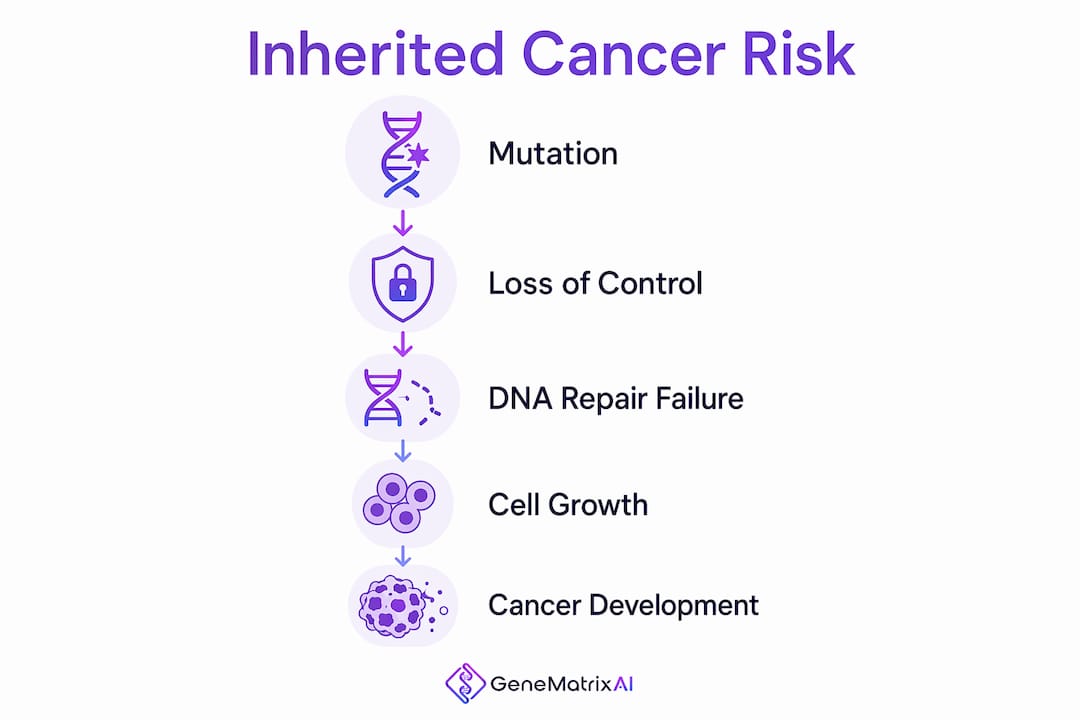
Most hereditary cancer syndromes follow an autosomal dominant inheritance pattern. That means inheriting just one defective copy from one parent is enough to raise cancer risk significantly. It also means each child of a carrier has a 50% chance of inheriting the mutation. A smaller number of syndromes follow autosomal recessive or X-linked patterns, which require different inheritance conditions.
Key biological facts about inherited cancer risk:
- Germline mutations are present in every cell and heritable; somatic mutations are not.
- Tumor suppressor genes like BRCA1, BRCA2, and TP53 normally prevent uncontrolled cell growth.
- DNA mismatch repair genes like MLH1 and MSH2 correct replication errors; mutations in these cause Lynch syndrome.
- Penetrance describes the probability that a mutation carrier will develop cancer. High-penetrance mutations, such as BRCA1, carry lifetime breast cancer risks that can exceed 70% without intervention.
- Variable expressivity means two people with the same mutation can have very different cancer histories.
Pro Tip: If you are a mutation carrier, do not assume your cancer outcome will mirror a relative's. The same mutation can behave differently across family members due to other genetic and lifestyle factors.
The practical takeaway is that a mutation raises your probability of cancer. It does not guarantee it. That distinction is what makes genetic testing useful rather than simply alarming.
What are the most common hereditary cancer types?
Several syndromes account for the majority of hereditary cancer cases. Each has a distinct genetic cause, a characteristic set of associated cancers, and a known prevalence in the general population.

| Syndrome | Key genes | Associated cancers | Estimated prevalence |
|---|---|---|---|
| Hereditary Breast and Ovarian Cancer (HBOC) | BRCA1, BRCA2 | Breast, ovarian, prostate, pancreatic | ~1 in 400–500 |
| Lynch syndrome | MLH1, MSH2, MSH6, PMS2 | Colorectal, endometrial, ovarian, gastric | ~1 in 300 |
| Li-Fraumeni syndrome | TP53 | Sarcomas, breast, brain, adrenal | ~1 in 5,000–20,000 |
| Cowden syndrome | PTEN | Breast, thyroid, endometrial | Rare |
| Familial Adenomatous Polyposis (FAP) | APC | Colorectal, duodenal | Rare |
HBOC and Lynch syndrome are by far the most prevalent hereditary cancer syndromes. Lynch syndrome alone is estimated to affect 1 in 300 people, making it one of the most common inherited cancer conditions in the world. Many carriers never receive a diagnosis because family history is incomplete or testing was never offered.
Li-Fraumeni syndrome is rarer but striking in its breadth. Carriers face elevated risk across a wide range of cancer types, often at very young ages. Children with Li-Fraumeni syndrome can develop sarcomas, brain tumors, and adrenal cancers before age 18. This pattern of early-onset and diverse cancer types is a red flag that genetic counselors watch for closely.
Cowden syndrome and FAP are less common but carry very high cancer risks in specific organs. FAP, caused by APC mutations, can produce hundreds of colorectal polyps by early adulthood. Without intervention, colorectal cancer is nearly inevitable. Recognizing these syndromes early changes outcomes dramatically.
How is inherited cancer risk evaluated and diagnosed?
The evaluation process follows a defined clinical path. Genetic counselors and oncologists use a combination of family history review, risk modeling, and laboratory testing to determine whether a hereditary syndrome is likely.
- Family history collection. A three-generation pedigree is the starting point. Counselors document cancer types, ages at diagnosis, and whether cancers occurred on the maternal or paternal side. Incomplete family histories are common and can obscure hereditary patterns.
- Red-flag pattern recognition. Warning signs include cancer diagnosed before age 50, multiple relatives with the same cancer type, rare cancers such as male breast cancer or ovarian cancer, and multiple primary cancers in one person.
- Risk assessment modeling. Counselors use validated models to estimate the probability of a pathogenic variant before ordering a test.
- Germline genetic testing. Testing uses a blood or saliva sample. Results typically return within weeks, though platforms like Genematrix deliver results within 72 hours. Panels can test dozens of genes simultaneously.
- Result interpretation. Results fall into three categories: pathogenic (a known harmful variant), variant of uncertain significance (a change whose impact is unknown), or negative (no known pathogenic variant found).
ASCO's 2026 updated guidelines now encourage universal tumor screening for certain cancers, particularly colorectal and endometrial, regardless of family history. This approach catches hereditary risk in people who would never have been referred under older criteria.
Pro Tip: Bring a written list of every cancer diagnosis in your family to your first genetic counseling appointment, including the relative's age at diagnosis and cancer type. Incomplete information is the single biggest barrier to accurate risk assessment.
A negative test result does not always clear you of hereditary risk. Ongoing surveillance may still be warranted based on family history, especially when a causative mutation has not been identified in the family. Learning more about hereditary cancer testing can help you understand what results actually mean for your care.
What are the implications of a hereditary cancer syndrome for you and your family?
A confirmed pathogenic variant changes the clinical picture for both you and your relatives. The goal of testing is actionability. Results guide specific decisions rather than simply generating anxiety.
Practical implications for mutation carriers include:
- Increased surveillance. Earlier and more frequent screening, such as annual MRI for BRCA1/2 carriers instead of standard mammography, catches cancers at earlier stages.
- Risk-reducing surgery. Prophylactic mastectomy or salpingo-oophorectomy significantly reduces cancer risk for BRCA1/2 carriers. These are major decisions that require careful counseling.
- Targeted therapies. BRCA mutations make certain cancers eligible for PARP inhibitor therapy, a class of drugs that works specifically against tumors with DNA repair defects.
- Family cascade testing. Once a mutation is identified in one family member, first-degree relatives (parents, siblings, children) each have a 50% chance of carrying it. Sharing results with relatives is one of the most impactful steps a carrier can take.
- Psychological support. Living with elevated cancer risk affects mental health. Genetic counselors routinely connect patients with psychological support resources alongside medical management.
The inheritance probability for autosomal dominant syndromes is 50% per child. That number is concrete and plannable. Families who know their mutation status can make informed decisions about screening timelines, family planning, and preventive care. A genetic risk assessment clarifies which steps apply to your specific situation.
Key Takeaways
Inherited cancer syndromes are caused by germline mutations in tumor suppressor or DNA repair genes, and identifying them through genetic testing is the most direct route to prevention-focused, personalized care.
| Point | Details |
|---|---|
| Hereditary cancers are a minority | Only 5–10% of cancers are inherited, but carriers face significantly elevated lifetime risk. |
| Germline mutations are the cause | Only germline mutations are heritable; somatic mutations stay within a tumor and do not pass to children. |
| Common syndromes are testable | HBOC (BRCA1/2) and Lynch syndrome are the most prevalent and have well-established clinical management protocols. |
| Testing requires family history first | A three-generation pedigree is the foundation of accurate risk assessment before any genetic test is ordered. |
| Results guide action, not just awareness | Positive results inform screening schedules, surgical options, and eligibility for targeted therapies. |
What I've learned from watching genetic testing change cancer care
The conversation around hereditary cancer has shifted more in the past five years than in the previous two decades. When I started following this field closely, genetic testing was reserved for people with textbook family histories. A woman needed multiple relatives with breast cancer before anyone would order a BRCA test. That threshold has dropped significantly, and ASCO's 2026 push toward universal tumor screening reflects how much the field has matured.
The misunderstanding I encounter most often is the conflation of "mutation carrier" with "cancer patient." People hear they carry a BRCA2 variant and assume a diagnosis is inevitable. It is not. Penetrance is real, but so is the variability around it. I have seen carriers in their 70s with no cancer history and carriers in their 30s who caught early-stage disease through surveillance that would not have happened without testing. The difference is almost always early knowledge and consistent follow-through.
The other gap I see is family silence. People receive a positive result and do not tell their siblings or adult children because they do not want to cause worry. That silence is the most preventable harm in this entire space. A mutation identified in one person is information that belongs to the whole family. Sharing it is not a burden. It is one of the most protective things you can do for the people you love.
The goal of testing has always been actionability. A result that changes nothing about your care is a missed opportunity. A result that moves you into earlier screening, connects you to a targeted therapy, or prompts a sibling to get tested is exactly what this science was built for.
— Tarek
Genematrix and hereditary cancer testing
Genematrix is a CLIA-certified biotechnology company based in Chicago that offers AI-powered hereditary cancer genetic testing available nationwide and worldwide. Its GeneCancer panel covers BRCA1/2, Lynch syndrome genes, TP53, PTEN, APC, and dozens of additional clinically relevant variants. The GeneMatrixAI platform, trained on 500,000+ genetic profiles, delivers reports within 72 hours, which is significantly faster than standard laboratory timelines.

Genematrix pairs test results with personalized risk reports and connects patients with genetic counseling resources, so results translate directly into a care plan. If you or a family member has a history that raises concern, learn about the science behind Genematrix's testing process before your next clinical conversation.
FAQ
What are inherited cancer syndromes?
Inherited cancer syndromes are genetic conditions caused by germline mutations in tumor suppressor or DNA repair genes that significantly raise a person's lifetime cancer risk. They account for 5–10% of all cancer cases, according to the American Cancer Society.
How do I know if my family has a hereditary cancer syndrome?
Red flags include cancer diagnosed before age 50, multiple relatives with the same cancer type, rare cancers such as male breast cancer, and multiple primary cancers in one person. A genetic counselor can assess your family history and determine whether testing is appropriate.
Does a positive genetic test mean I will get cancer?
No. A pathogenic variant raises your cancer risk but does not guarantee cancer will develop. Penetrance varies widely, and many carriers never develop cancer, especially with proactive surveillance and risk-reduction strategies.
What genes are most commonly involved in hereditary cancer syndromes?
The most clinically significant genes include BRCA1 and BRCA2 for Hereditary Breast and Ovarian Cancer syndrome, MLH1 and MSH2 for Lynch syndrome, TP53 for Li-Fraumeni syndrome, and APC for Familial Adenomatous Polyposis.
Can a negative genetic test result rule out hereditary cancer risk?
Not always. A negative result means no known pathogenic variant was found, but it does not eliminate hereditary risk entirely. Ongoing surveillance based on family history may still be recommended by your care team.