

Next-generation sequencing (NGS) is a clinical high-throughput DNA testing method that reads millions of genetic fragments simultaneously, making it possible to screen for hereditary cancer risk, guide oncology treatment, optimize medications, and diagnose rare diseases in a single test. If you're considering an NGS health test, the most important first step is talking to a clinician or certified genetic counselor before ordering anything.
Here's what to do right now:
- Talk to your clinician or a genetic counselor about your personal and family history before choosing a test type.
- Decide on test scope (targeted panel, whole-exome, or whole-genome) based on your clinical question.
- Verify lab accreditation — look for CLIA certification and CAP accreditation before submitting a sample.
- Ask about variant classification — results are reported using ACMG/AMP categories and cross-referenced against databases like ClinVar, ClinGen, HGMD, and OMIM.
- Understand turnaround and cost — clinical NGS typically takes several weeks and may or may not be covered by insurance depending on medical necessity documentation.
Key Takeaways
Clinical NGS is the most powerful tool available for hereditary disease diagnosis, oncology profiling, pharmacogenomics, and rare disease — but its value depends entirely on accredited labs, proper variant classification, and genetic counseling before and after testing.
| Point | Details |
|---|---|
| Choose the right test type | Targeted panels offer depth and speed; WES/WGS offer breadth — match the test to your clinical question. |
| Verify lab accreditation | CLIA certification and CAP accreditation are the minimum quality signals to confirm before submitting a sample. |
| Understand variant categories | ACMG/AMP classification (pathogenic, VUS, benign) determines what action, if any, follows your result. |
| Genetic counseling is required | Pre- and post-test counseling is not optional — it's how genomic data becomes a medical decision. |
| Genematrix for rapid results | Genematrix delivers CLIA-certified, AI-assisted NGS reports with clinician review within 72 hours. |
Table of Contents
- What is next-generation sequencing and how does it differ from older methods?
- How the NGS testing workflow goes from sample to report
- What types of clinical NGS tests are available and when should you use each?
- Where NGS is used in medicine today
- How clinical labs classify variants and what your results actually mean
- What NGS tests cannot reliably detect
- How to decide which NGS test to order and what to ask before you consent
- How labs prove their NGS tests are reliable
- What clinical NGS tests cost and how long results take
- What to do before, during, and after your NGS test
- Why your genomic data is a lifelong resource, not a one-time snapshot
- How Genematrix validates, analyzes, and reports clinical NGS results
- The part of NGS testing most people underestimate
- Genematrix offers clinician-validated NGS testing with rapid turnaround
- Sources
What is next-generation sequencing and how does it differ from older methods?
Traditional Sanger sequencing reads one short DNA segment at a time. It's accurate and still used for confirmatory testing, but it's slow and expensive when you need to examine dozens or hundreds of genes. NGS, by contrast, fragments the entire target region into millions of small pieces, sequences all of them in parallel, and then reassembles the results computationally. That parallel architecture is why a single NGS run can cover thousands of genes in the time it would take Sanger to read a handful.
The practical difference for patients is breadth and cost per data point. Sanger costs roughly the same whether you're reading one gene or ten, so clinicians historically had to guess which gene to test first. NGS removes that constraint. You can sequence a 50-gene hereditary cancer panel, a 500-gene oncology panel, or the entire protein-coding genome for a cost that has dropped dramatically since the Human Genome Project. According to NHGRI's DNA sequencing fact sheet, sequencing throughput and costs have fallen substantially over the past two decades, enabling routine diagnostic use that was unimaginable in the early 2000s.
Three terms you'll encounter when comparing NGS approaches:
- Targeted gene panels: Sequence a predefined list of clinically relevant genes at very high depth.
- Whole-exome sequencing (WES): Sequences all protein-coding regions of the genome (roughly 1–2% of total DNA), capturing most disease-causing variants.
- Whole-genome sequencing (WGS): Sequences the entire genome, including non-coding regions, at lower per-base cost but higher total cost and data complexity.
Coverage refers to how many times each base is read. Higher coverage means fewer missed variants. A targeted panel might achieve 500× or more; WGS typically runs at 30×–100× for clinical use. That tradeoff between depth and breadth is the central tension in choosing an NGS test.
How the NGS testing workflow goes from sample to report
Understanding what happens in the lab helps you interpret your report and ask better questions. The core workflow follows these steps:
- Sample collection. Blood is the most common source for germline (inherited) testing; saliva is an alternative. Tumor tissue (FFPE blocks or fresh biopsies) is used for somatic cancer profiling. Liquid biopsy uses a blood draw to capture circulating tumor DNA (ctDNA).
- DNA/RNA extraction. The lab isolates nucleic acids from your sample. Quality and quantity at this stage affect everything downstream — degraded DNA from old FFPE tissue is a common source of downstream noise.
- Library preparation. DNA is fragmented, and short adapter sequences are attached to each fragment. For targeted panels, a capture step pulls down only the genes of interest. This is where the test's scope is physically defined.
- Sequencing run. The prepared library is loaded onto a sequencer. Illumina platforms (NovaSeq, NextSeq) dominate clinical labs because of their accuracy and throughput; Ion Torrent instruments offer a different chemistry that some labs use for specific applications.
- Base calling and quality scoring. The instrument converts optical or electrical signals into nucleotide calls and assigns a Q-score to each base. A Q30 score means a 1-in-1,000 error rate — most clinical labs set Q30 as a minimum threshold.
- Alignment and variant calling. Software aligns your reads to a reference genome and flags positions where your sequence differs. The fraction of reads carrying a variant at a given position is the variant allele fraction (VAF) — critical for distinguishing germline variants (VAF ~50% or ~100%) from somatic or mosaic ones (VAF often below 20%).
- Annotation and filtering. Each flagged variant is annotated with population frequency data, predicted functional impact, and existing database entries from ClinVar, ClinGen, HGMD, and OMIM. Filters remove common benign variants, leaving a manageable candidate list.
- Clinical interpretation and report generation. A molecular pathologist or clinical geneticist reviews the filtered variant list, applies ACMG/AMP classification criteria, and generates the final report.
Key terms to know when reading your report:
- Coverage/depth: How many times each position was read.
- VAF (variant allele fraction): The proportion of reads carrying the variant.
- Annotation: Database and computational evidence attached to each variant.
Pro Tip: Sample mix-ups, low coverage in GC-rich regions, and contamination are the three most common sources of error in clinical NGS. Ask your lab how they track sample identity throughout the workflow — most accredited labs use SNP fingerprinting to confirm the sample at the end matches the one that came in.
What types of clinical NGS tests are available and when should you use each?
Choosing the right test type is a clinical decision, but understanding the options helps you have a more productive conversation with your provider. A PMC clinical review and Thermo Fisher's NGS overview both describe these four main approaches used in clinical care:
| Test Type | Pros | Cons | Typical Clinical Use | Typical Coverage |
|---|---|---|---|---|
| Targeted gene panel | High depth, fast turnaround, lower cost, well-validated | Misses variants outside panel genes | Hereditary cancer, pharmacogenomics, cardiac channelopathies | high coverage |
| Whole-exome sequencing (WES) | Broad gene coverage, good for rare disease | Higher cost, more VUS, longer turnaround | Undiagnosed rare disease, pediatric genetics | moderate coverage |
| Whole-genome sequencing (WGS) | Captures non-coding regions, structural variants | Highest cost, most data complexity, slower interpretation | Complex rare disease, research-grade diagnostics | lower coverage |
| Liquid biopsy (ctDNA) | Non-invasive, monitors tumor evolution | Lower sensitivity for early-stage disease, not all variants detectable | Oncology treatment monitoring, minimal residual disease | Highly variable |
Illumina instruments (NovaSeq, NextSeq) are the most widely used platforms in U.S. clinical laboratories because of their low per-base error rates and high throughput. Ion Torrent, developed by Thermo Fisher Scientific, uses semiconductor sequencing chemistry and is used in some labs for targeted oncology panels. Neither platform is universally superior — the right choice depends on the lab's validation and the clinical question.
For understanding which test type fits your situation, the key question is always: how many genes does your clinical question require, and how much depth does the variant type demand?
Where NGS is used in medicine today
Clinical NGS has moved well beyond research settings. Here's where it changes real medical decisions:
Oncology (tumor profiling and targeted therapy) Somatic NGS panels identify mutations in genes like EGFR, KRAS, BRAF, and ALK that predict response to specific targeted therapies. A lung cancer patient whose tumor carries an EGFR exon 19 deletion, for example, is a candidate for EGFR inhibitors rather than standard chemotherapy. Liquid biopsy panels track ctDNA to monitor treatment response and detect resistance mutations without repeat biopsies.

Hereditary disease and cancer risk Germline panels covering BRCA1/BRCA2, Lynch syndrome genes (MLH1, MSH2, MSH6, PMS2), and dozens of other hereditary cancer genes identify individuals who need enhanced surveillance or risk-reducing interventions. A positive BRCA2 result, for instance, changes screening recommendations and may inform surgical decisions for both the patient and their relatives. Hereditary cancer testing is one of the highest-impact applications of clinical NGS.
Pharmacogenomics (PGx) Variants in genes like CYP2D6, CYP2C19, and DPYD affect how patients metabolize dozens of common medications, from antidepressants to chemotherapy agents. A patient who is a poor metabolized of CYP2C19 substrates may accumulate dangerous drug levels on a standard dose. PGx panels give prescribers a genetic roadmap for medication selection and dosing.
Prenatal and newborn screening Cell-free fetal DNA in maternal blood (cfDNA/NIPT) screens for chromosomal aneuploidies like trisomy 21 from as early as 10 weeks gestation. Newborn sequencing programs are expanding to detect treatable metabolic and genetic conditions before symptoms appear, enabling earlier intervention.
Rare and undiagnosed disease For children with complex, undiagnosed conditions, WES or WGS often ends a diagnostic odyssey that may have lasted years. Multidisciplinary review by a clinical geneticist, molecular pathologist, and bioinformatician improves diagnostic yield and helps resolve cases where genotype and phenotype don't immediately align.
Secondary findings: Most clinical labs offer the option to report secondary findings in genes unrelated to the original test question, following ACMG recommendations. Patients typically consent to receive or decline these findings before testing.
How clinical labs classify variants and what your results actually mean
Every variant identified by NGS is classified using the ACMG/AMP five-tier system, cross-referenced against ClinVar, ClinGen, HGMD, and OMIM:
- Pathogenic (P): Strong evidence the variant causes disease. Typically triggers clinical action — referral, surveillance change, or treatment decision.
- Likely pathogenic (LP): Evidence strongly suggests disease causation but falls short of the pathogenic threshold. Managed similarly to pathogenic in most clinical contexts.
- Variant of uncertain significance (VUS): Insufficient evidence to classify as pathogenic or benign. No clinical action is recommended based on a VUS alone — this is the most misunderstood category.
- Likely benign (LB) / Benign (B): Evidence supports no disease association. Typically not reported or reported without clinical significance.
What happens after each result category:
- Pathogenic/LP: Discuss with your clinician and a genetic counselor. Family members may benefit from targeted testing for the specific variant. Treatment or surveillance changes may follow.
- VUS: No immediate action. The lab may reclassify the variant as new evidence accumulates. Ask the lab about their reclassification notification policy.
- Benign/LB: No action needed for that variant. A negative result does not rule out all genetic risk — it means the tested genes and variants were not detected.
Pro Tip: Before your results appointment, write down these three questions: (1) Is this variant classified as pathogenic, and what is the evidence? (2) Does this result change my screening or treatment plan? (3) Should my first-degree relatives be tested, and how?
What NGS tests cannot reliably detect
NGS is powerful, but it has real technical limits. Setting accurate expectations prevents both false reassurance and unnecessary anxiety.
- Structural variants (SVs) and large copy number variants (CNVs): Short-read NGS (the dominant clinical technology) struggles to detect large deletions, duplications, and inversions. Labs use supplemental methods like MLPA or chromosomal microarray for these.
- Repeat expansions: Conditions caused by trinucleotide repeat expansions (Huntington's disease, fragile X syndrome) are not reliably detected by standard NGS panels. Dedicated PCR-based assays are needed.
- Low-level mosaicism: Variants present in only a small fraction of cells require very high sequencing depth to detect reliably. Standard germline panels at 100× coverage may miss mosaic variants below 10–20% VAF. Detecting low-level mosaicism typically requires 500× or greater depth with specialized bioinformatic pipelines.
- Variants in poorly mappable regions: Highly repetitive sequences and pseudogenes (like PMS2 and its pseudogene PMS2CL) can cause alignment errors that lead to missed or false variants.
- Bioinformatic filter errors: Aggressive filtering to reduce false positives can inadvertently remove real variants. Labs validate their pipelines against characterized reference materials to minimize this.
Coverage thresholds matter enormously here. For germline diagnostics, a minimum of 100× mean coverage is a widely cited clinical standard, with most accredited labs targeting higher. Detecting low-level mosaicism reliably pushes that requirement to 500× or more. These thresholds are part of what CLSI MM09 addresses in its guidance for NGS validation in U.S. clinical laboratories.
A VUS result is often a product of these limits: the variant exists, the lab found it, but current evidence and databases don't yet have enough data to classify it definitively. Pre-test counseling specifically prepares patients for this possibility, which is why medical societies emphasize it so strongly.
How to decide which NGS test to order and what to ask before you consent
The decision about which test to order belongs to your clinician, but you have every right to understand what you're consenting to. CDC guidance is clear that clinical genetic tests are provider-ordered for medical reasons and are distinct from direct-to-consumer wellness tests — DTC results should never be the sole basis for a medical decision.
Questions to ask your clinician or ordering provider:
- Which genes does this panel cover, and why are those genes relevant to my situation?
- What is the lab's mean coverage target for this test?
- Is the lab CLIA-certified and CAP-accredited?
- What is the expected turnaround time?
- How will I receive results, and will a genetic counselor be available to explain them?
Questions to ask the lab directly:
- What validation studies support this test's analytic performance?
- How do you handle VUS reclassification, and will you notify me if a variant's classification changes?
- Who has access to my genomic data, and how long is it stored?
- What is your policy on reanalysis?
Consent checklist before signing:
- Secondary/incidental findings: Do you want to know about variants unrelated to your primary question?
- Data storage: How long will your raw data be retained, and can you request deletion?
- Reanalysis: Can your data be reanalyzed as databases update?
- Insurance/billing: Has the lab confirmed insurance coverage or provided a self-pay estimate?
Pre-test genetic counseling is not optional for complex tests. A genetic counselor helps you understand what the test can and cannot find, prepares you for possible results including VUS, and helps you think through family implications before you receive results. Genetic counseling for cancer risk and medication decisions is particularly valuable when hereditary cancer panels or pharmacogenomics tests are involved.
Pro Tip: Ask the lab whether they are a member of ClinGen's variant curation expert panels. Labs that participate in ClinGen curation have access to the most current, consensus-based variant classifications — which directly affects the accuracy of your report.
How labs prove their NGS tests are reliable
Lab accreditation is the foundation of clinical NGS quality. Here's what the key standards mean in practice:
CLIA certification (Clinical Laboratory Improvement Amendments) is the federal baseline requirement for any lab performing clinical testing in the United States. Without CLIA certification, a lab cannot legally report results for clinical use.
CAP accreditation (College of American Pathologists) goes further. CAP-accredited labs undergo biennial on-site inspections and proficiency testing. CAP accreditation is widely regarded as the gold standard for clinical laboratory quality.
CLSI MM09 provides the specific technical guidance U.S. labs use to validate NGS tests — covering how to establish coverage thresholds, limit of detection, and performance for different variant classes. CLSI MM09 is the reference standard labs cite when documenting their validation summaries.
Analytic metrics to ask about:
- Mean coverage and percentage of target bases above the coverage threshold (e.g., >100×)
- Limit of detection for SNVs, indels, CNVs, and fusions
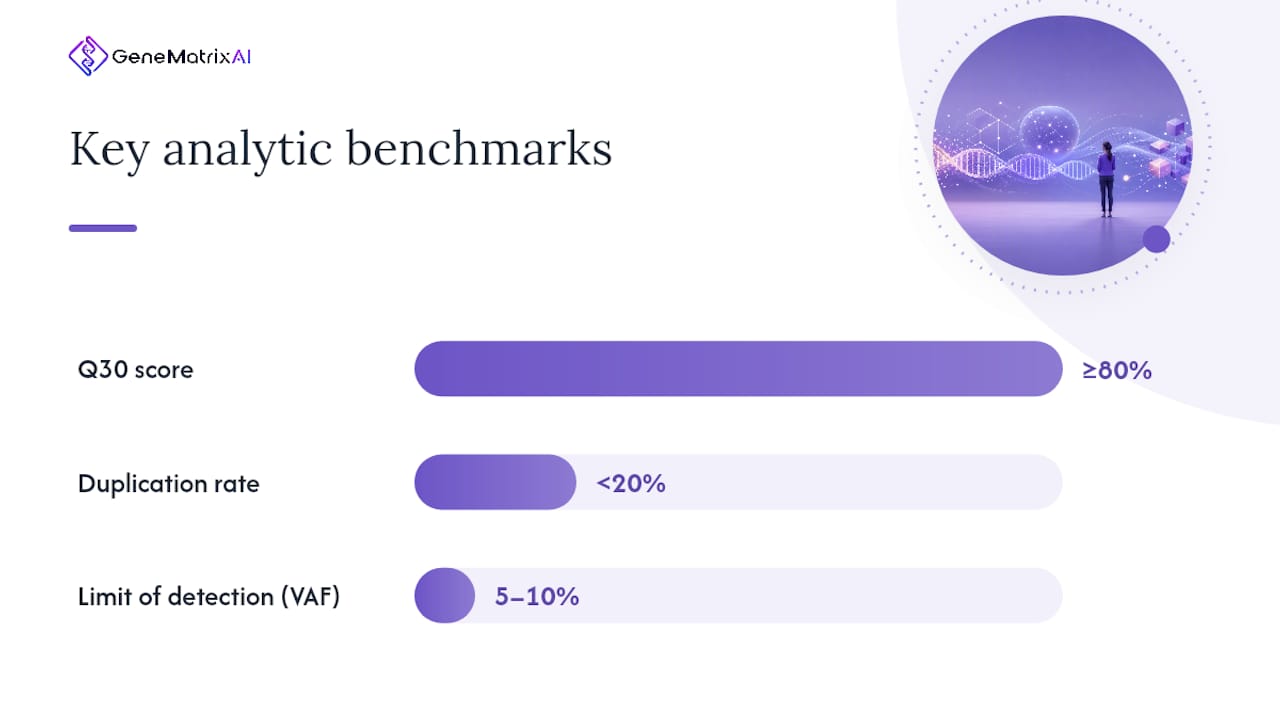
- Q30 score (percentage of bases with quality score ≥30)
- Duplication rate (high duplication inflates apparent coverage without adding real data)
- Sensitivity and specificity for each variant class, validated against characterized reference materials
Validation for different variant classes requires different approaches. Single-nucleotide variants (SNVs) are validated using well-characterized reference materials like Genome in a Bottle (GIAB) samples. Structural variant validation typically requires orthogonal methods such as FISH or MLPA to confirm findings. Labs document these in a validation summary that should be available on request.
| Metric | What It Measures | Minimum Clinical Benchmark |
|---|---|---|
| Mean coverage | Average reads per base | ≥100× (germline); ≥500× (mosaicism) |
| % bases >100× | Uniformity of coverage | Typically high percentage of target |
| Q30 score | Base call accuracy | ≥80% of bases |
| Duplication rate | Library complexity | Typically <20% |
| Limit of detection (SNV) | Smallest detectable VAF | Varies; often 5–10% for somatic panels |
What clinical NGS tests cost and how long results take
Cost and turnaround vary significantly by test type, lab, and insurance situation. Sequencing costs have dropped dramatically since the Human Genome Project, but clinical-grade testing still carries costs that reflect validation, interpretation, and reporting — not just the sequencing run itself.
Broad cost ranges for common clinical NGS tests (U.S. self-pay estimates):
- Targeted hereditary cancer panel (25–80 genes): roughly $250–$500 self-pay at many labs; often covered by insurance with medical necessity documentation.
- Comprehensive oncology somatic panel (300–500 genes): $1,500–$5,000 depending on lab and panel scope.
- Whole-exome sequencing (WES): $1,000–$4,000 clinical grade.
- Whole-genome sequencing (WGS): $3,000–$10,000+ for clinical-grade interpretation.
- Liquid biopsy (ctDNA panel): $1,000–$3,500 depending on panel and indication.
Insurance tips:
- Most insurers require prior authorization for WES and WGS. Your clinician's office typically handles this, but confirm before the sample is collected.
- Medical necessity documentation (clinical notes, family history, prior negative tests) is the single most important factor in getting coverage approved.
- For hereditary cancer panels, many major insurers cover testing when NCCN criteria are met. Ask your genetic counselor to help document eligibility.
- Self-pay pricing is often negotiable, and some labs offer financial assistance programs.
Turnaround time:
- Targeted panels: a few weeks standard; some labs offer faster urgent turnaround for oncology.
- WES: several weeks to a couple months.
- WGS: multiple weeks to several months for clinical-grade interpretation.
- Liquid biopsy: 7–14 business days at most labs.
Reflex testing (where a negative panel triggers automatic WES) can add time but avoids the need for a second sample collection.
What to do before, during, and after your NGS test
Before testing:
- Bring a three-generation family history to your pre-test appointment, including cancer diagnoses, ages at diagnosis, and any prior genetic test results in the family.
- Confirm your insurance coverage or self-pay cost in writing before the sample is collected.
- Ask whether blood or saliva is preferred for your test type — most germline panels accept either, but some labs prefer blood for higher DNA yield.
- Review and sign the informed consent form carefully, paying attention to secondary findings and data storage sections.
During sample collection:
- Blood draws for germline testing are standard venipuncture — no special preparation needed.
- Saliva kits are typically mailed to your home and returned by prepaid shipping.
- Tumor tissue samples are coordinated between your oncologist and the pathology department — you don't usually handle this directly.
At your results appointment:
- Ask for a copy of the full report, not just a verbal summary.
- If a pathogenic or likely pathogenic variant is found, ask for a referral to a specialist (oncologist, cardiologist, or relevant subspecialist) and a genetic counselor for post-test counseling.
- If you receive a VUS, ask the lab's reclassification policy in writing.
Pro Tip: Organize your medical records and family history into a single document before your results appointment. A genetic counselor can interpret your result far more precisely when they can see your full clinical picture alongside the genomic data. Apps like Apple Health or a simple shared folder work well for this.
For a step-by-step walkthrough of the full screening process, this practical genetic screening guide covers the patient journey from pre-test to follow-up in detail.
Why your genomic data is a lifelong resource, not a one-time snapshot
A clinical NGS report is not static. The databases it draws on — ClinVar, ClinGen, HGMD, OMIM — are updated continuously as new research accumulates. A variant classified as a VUS today may be reclassified as pathogenic or benign within months or years as more families with the same variant are studied and more functional data becomes available.
This is why reanalysis matters:
- New gene-disease associations: Genes not included in a panel at the time of testing may later be linked to your clinical condition. WES or WGS data can be reanalyzed against an expanded gene list without a new sample.
- Database updates: ClinVar and ClinGen regularly update variant classifications based on expert curation. A lab that reanalyzes your data against updated databases may reclassify a VUS that was unresolved at the time of your original report.
- Algorithmic improvements: Bioinformatic pipelines improve over time. Variants that were filtered out by older algorithms may be detected in reanalysis.
What to ask your lab about reanalysis:
- Do you offer periodic reanalysis, and at what cost?
- Will you proactively notify me if a VUS in my report is reclassified?
- How long do you retain my raw sequencing data, and in what format?
- Can I request my raw data (FASTQ or BAM files) for transfer to another lab?
Subscription-based reanalysis models are emerging in clinical genomics, allowing patients to receive updated interpretations as databases evolve. For unresolved cases or patients on evolving therapy protocols, periodic reanalysis can convert a previously inconclusive result into a clinically actionable one. This is particularly relevant in oncology, where new targeted therapies are approved regularly and a variant that had no matched therapy at diagnosis may have one within a year.
How Genematrix validates, analyzes, and reports clinical NGS results
Genematrix is a CLIA-certified laboratory based in Chicago. Here's how the lab's process maps to the clinical standards described in this guide:
Validation and quality standards:
- CLIA certification covers all clinical testing performed and reported by Genematrix.
- Analytic validation follows established U.S. standards, including coverage thresholds, sensitivity benchmarks, and reference material testing for each variant class.
- Reports are generated through a combination of AI-driven variant analysis and clinician review, with the GeneMatrixAI platform trained on over 500,000 genetic profiles to prioritize clinically relevant findings.
Testing modules available:
- GeneCancer: Hereditary cancer risk, including BRCA1/BRCA2 and Lynch syndrome genes.
- GenePGx: Pharmacogenomics panel covering major drug-metabolizing enzymes and drug targets.
- GeneMind: Psychiatric pharmacogenomics for medication selection in mental health.
- GeneBaby: Pediatric genetic screening.
- GeneDiet: Nutrigenomics for personalized nutrition guidance.
Turnaround and reporting:
Genematrix delivers clinician-validated, AI-assisted genomic reports with actionable insights within 72 hours of sample processing — one of the faster turnaround benchmarks in clinical genetic testing.
Data privacy: Genematrix documents data handling policies as part of the consent process. Patients can ask about data retention periods, third-party sharing policies, and options for data deletion. Review the lab's consent form carefully before submitting your sample, and ask your ordering clinician to walk you through the data handling section.
For a detailed look at the lab's technology, certifications, and validation methodology, visit Genematrix's science and certification page.
AI integration in clinical genomics is an active area of development. For broader context on how AI is being integrated across life sciences, the field is moving toward AI-assisted triage of variant lists, automated literature review, and real-time database cross-referencing — all of which reduce interpretation time without replacing clinician judgment.
The part of NGS testing most people underestimate
Precision medicine is genuinely exciting. The ability to read your genome and get a medically actionable result in days rather than months represents a real shift in how medicine can work. But the enthusiasm around NGS sometimes outpaces the reality of what a test result actually means on its own.
A pathogenic variant is not a diagnosis. It's a probability statement, a risk modifier, a piece of evidence that needs to be interpreted alongside your clinical history, your family history, and your values. A VUS is even less than that — it's a flag that says "we don't know yet," and acting on it without counseling can cause real harm, from unnecessary surgeries to insurance complications to family anxiety that turns out to be unfounded.
The genetic counseling step is not a formality. It's where the genomic data becomes a medical decision. Clinicians who skip pre-test counseling because the test "seems straightforward" are doing their patients a disservice, and patients who order DTC tests and then try to interpret them without clinical support are taking on a burden they shouldn't have to carry alone. The NCBI clinical genomics resources and CDC guidance both make this point clearly: genetic counseling before and after testing is not supplementary — it's part of the test.
My honest advice: get the test if your clinician recommends it, understand what you're consenting to, and don't try to interpret the results alone. The genomic data is yours. The interpretation takes a team.
Genematrix offers clinician-validated NGS testing with rapid turnaround
If you're ready to move from reading about NGS to actually getting tested, Genematrix offers a direct path to accredited, clinician-validated genetic testing with results in as little as 72 hours.

Genematrix's testing portfolio covers the clinical areas most likely to affect your health decisions: hereditary cancer risk (BRCA1/BRCA2, Lynch syndrome), pharmacogenomics for medication optimization, psychiatric genetics, pediatric screening, and nutrigenomics. Every report combines AI-driven variant analysis with clinician review, so you receive findings that are both fast and medically grounded, not raw data you have to interpret yourself.
For patients with a family history of cancer or those managing multiple medications, the combination of GeneCancer and GenePGx panels can surface actionable information that changes clinical management. Explore Genematrix's hereditary cancer testing services or visit the science and certifications page to review the lab's validation standards and accreditation details.
Results from Genematrix are intended to be reviewed with a qualified clinician or genetic counselor. Genomic test results are not a substitute for professional medical advice, diagnosis, or treatment.
Sources
Key authoritative references used to build this guide:
- Genetic Testing | Genomics and Your Health | CDC
- Next‑Generation Sequencing and its clinical application (PMC review)
- Genome
- Clinical genomics resources | NCBI Bookshelf