

TL;DR:
- Genetics significantly influences mental health risk through numerous small genetic variants that increase or decrease vulnerability.
- Environmental factors such as stress, trauma, and social support interact with genetic predispositions, shaping disorder outcomes.
- Genetic testing currently aids in medication selection through pharmacogenomics but cannot predict if someone will develop a psychiatric condition.
Genetics is a primary driver of mental health risk, accounting for a substantial portion of why psychiatric conditions run in families. The role of genetics in mental health is not about destiny. It is about probability. No single gene causes depression or schizophrenia. Instead, thousands of small genetic variants accumulate to raise or lower a person's vulnerability. The National Institute of Mental Health and journals like Nature Mental Health have confirmed this polygenic reality for decades. Understanding it changes how you interpret your family history, your treatment options, and your future.
How do genetics influence vulnerability to mental illness?
Psychiatric disorders are polygenic by nature, meaning no single mutation flips a switch. Thousands of common genetic variants, each with a tiny individual effect, combine to create a cumulative risk profile. That cumulative load is what researchers call polygenic liability.

Heritability estimates quantify how much of the variation in a condition across a population is explained by genetics. The numbers are striking for several major disorders. Schizophrenia carries a heritability of 64–77%, making it one of the most genetically influenced psychiatric conditions. Bipolar disorder follows closely. Major depressive disorder shows lower but still meaningful heritability. These figures tell us that genetics is a major contributor, not a minor footnote.
| Disorder | Heritability estimate | Key genetic finding |
|---|---|---|
| Schizophrenia | 64–77% | Rare variants with large effect; strong polygenic base |
| Bipolar disorder | ~70% | Shared loci with depression and ADHD |
| Major depressive disorder | ~40% | Hundreds of risk loci; highly polygenic |
| ADHD | ~75% | Overlapping genetic pathways with mood disorders |
| PTSD | ~30–40% | More environment-driven than other disorders |
Recent genomic research has accelerated the field significantly. A 2026 study identified 403 distinct genetic loci linked to bipolar disorder, major depressive disorder, and ADHD, including 88 previously unknown regions. That finding reveals shared biological pathways across what clinicians once treated as entirely separate conditions. A separate multi-omics analysis identified 62 unique genes causally linked to neuropsychiatric disorders, with 8 genes connected to multiple conditions simultaneously. These are not just correlations. They are causal relationships confirmed across more than 23,000 cases.
What role do environmental factors play alongside genetics?
Genetics loads the gun. Environment pulls the trigger. The diathesis-stress model captures this precisely: a person carries a genetic liability, and a stressful life event activates it. Without the trigger, the liability may never manifest clinically.
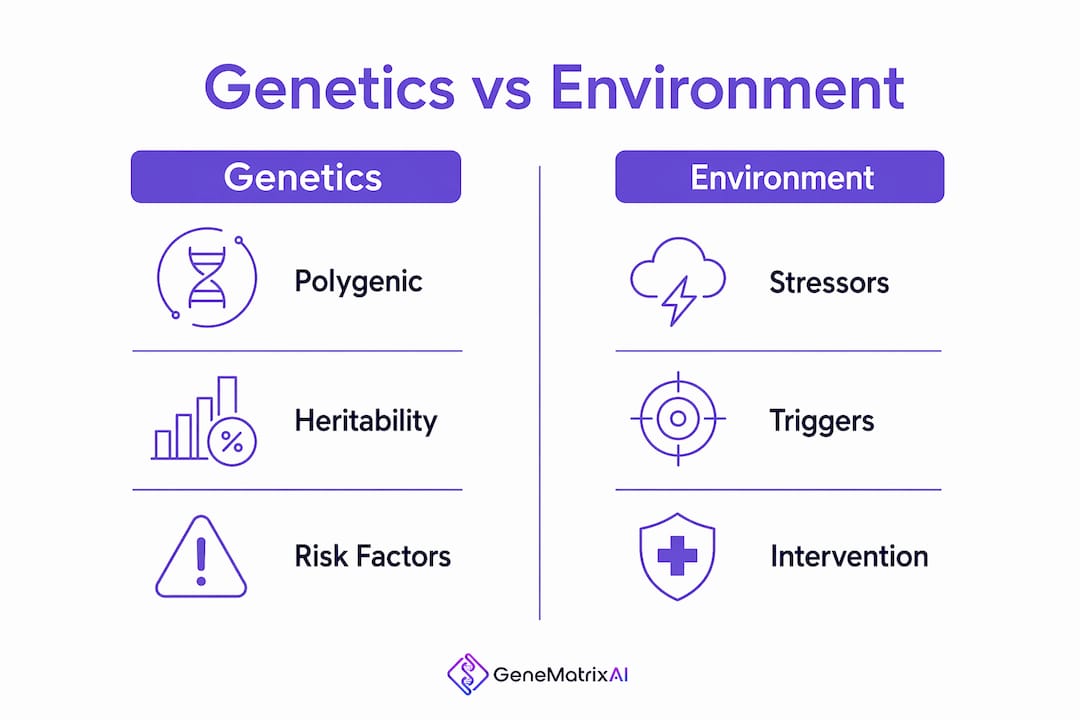
Genetic vulnerability acts as a loaded spring, waiting for environmental pressure to release it. Childhood trauma, chronic stress, poverty, social isolation, and early loss all function as triggers. PTSD is the clearest example. Its heritability sits well below schizophrenia's because the environmental component, specifically exposure to traumatic events, dominates the risk equation. Anxiety disorders show a similar pattern, where family dynamics and early attachment experiences shape outcomes as powerfully as inherited predisposition.
Major environmental factors that interact with genetic risk include:
- Childhood adversity: Abuse, neglect, and household dysfunction amplify genetic vulnerability during critical developmental windows.
- Chronic stress: Sustained cortisol elevation alters gene expression through epigenetic mechanisms, changing how risk genes behave.
- Social support: Strong relationships buffer genetic risk. Isolation removes that buffer.
- Substance use: Alcohol and cannabis use can activate dormant genetic predispositions, particularly for psychosis.
- Prenatal environment: Maternal stress, infection, and nutrition during pregnancy influence fetal brain development and later psychiatric risk.
Pro Tip: Early intervention matters most when genetic risk is present. Supportive environments, stable relationships, and access to mental health care during childhood and adolescence can significantly reduce the likelihood that inherited vulnerability ever becomes a diagnosable disorder.
Genetic influence varies greatly among disorders. Schizophrenia sits at one end of the spectrum with strong heritability. PTSD sits at the other, where lived experience dominates. Most conditions fall somewhere between, shaped by both forces simultaneously.
How is genetic information used in mental health diagnosis and treatment?
No genetic test can reliably predict whether an individual will develop a mental illness. That is not a limitation of current technology alone. It reflects the fundamental biology of polygenic conditions. Because thousands of variants each contribute a tiny effect, no single test captures the full picture.
Polygenic Risk Scores, or PRS, attempt to aggregate those thousands of variants into a single number. PRS explain part of genetic liability for depression and stress-related conditions, but their individual predictive power remains limited. A high PRS raises statistical risk across a population. It does not tell any one person whether they will develop depression. Clinicians use PRS in research settings to understand disease mechanisms, not as a standalone diagnostic tool.
Where genetics currently delivers real clinical value is in pharmacogenomics. Pharmacogenomics applies genetic data to medication selection, particularly in psychiatry. Variations in genes like CYP2D6 and CYP2C19 determine how quickly a person metabolizes antidepressants and antipsychotics. A slow metabolizer taking a standard dose may experience toxicity. A rapid metabolizer may see no effect at all. Genetic testing identifies these metabolic profiles before the first prescription is written. Genematrix's GenePGx and GeneMind modules are built precisely for this application, delivering medication guidance based on a patient's actual genetic makeup rather than trial and error.
Genetic data complements clinical evaluation. It does not replace it. A psychiatrist still weighs symptoms, history, and context. Genetics adds one more layer of precision to that judgment.
Pro Tip: Direct-to-consumer genetic tests marketed for mental health risk are not the same as clinical pharmacogenomic testing. Consumer tests rarely analyze the specific variants that matter for psychiatric medication response. Consult a physician or genetic counseling specialist before drawing conclusions from any at-home kit.
What does having a family history of mental illness mean for your risk?
Family history is the most accessible genetic signal available to most people. Children of depressed parents face a 2 to 3 times higher risk of developing depression themselves, driven largely by genetic inheritance with environmental contributions layered on top. That elevated risk is real and worth taking seriously.
The critical point is that elevated risk is not certainty. Mental illness inheritance is probabilistic. Many people with a strong family history never develop a disorder. Many people without any family history do. Resilience, environment, social support, and access to care all modify the inherited baseline. A family history is a signal to pay attention, not a sentence.
If you have close relatives with psychiatric conditions, a structured approach to risk assessment makes sense:
- Document your family history. Record which relatives have been diagnosed, at what age, and with what conditions. First-degree relatives (parents, siblings, children) carry the most genetic weight.
- Talk to your primary care physician. Share your family history and ask for a mental health baseline assessment. Early documentation creates a reference point.
- Consider genetic counseling. A certified genetic counselor can interpret your family pattern, explain what the genetic risk assessment means in practical terms, and guide decisions about further testing.
- Monitor your mental health actively. Track mood, sleep, and stress levels. Catching early symptoms before they escalate is far more effective than waiting for a crisis.
- Build protective factors deliberately. Regular exercise, consistent sleep, strong social connections, and stress management all reduce the probability that genetic vulnerability activates.
The goal is not to live in fear of your genes. The goal is to use the information to make better decisions earlier.
Key takeaways
Genetic predisposition shapes mental health risk significantly, but environmental factors, early intervention, and pharmacogenomic testing determine how that risk plays out in practice.
| Point | Details |
|---|---|
| Genetics is probabilistic, not deterministic | Inherited variants raise risk but do not guarantee any psychiatric condition will develop. |
| Heritability varies by disorder | Schizophrenia reaches 64–77% heritability; PTSD is far more environment-driven. |
| Gene-environment interaction is central | Stressors activate genetic vulnerability; supportive environments can suppress it. |
| Pharmacogenomics offers real clinical value | Genetic testing guides medication choice in psychiatry more reliably than it predicts disease onset. |
| Family history is a signal, not a verdict | Children of depressed parents face 2–3x higher risk, but resilience and environment modify that outcome. |
What I've learned from watching genetics reshape mental health care
The most important shift I have seen in mental health over the past decade is not a new drug or a new therapy. It is the slow, steady replacement of blame with biology.
For generations, families carried shame about psychiatric illness. A parent with schizophrenia was a failure. A child with depression was weak. Genetics research dismantles that narrative completely. When you understand that schizophrenia heritability rivals that of many physical diseases, the moral framing collapses. This is not weakness. This is biology.
What I find equally important is the honest acknowledgment of what genetics cannot yet do. The field has identified hundreds of risk loci. It has confirmed causal genes. But it cannot look at your genome and tell you whether you will develop bipolar disorder at 30. That gap matters. People who receive inflated claims from consumer genetic tests and then either panic or dismiss real symptoms are being failed by bad communication, not bad science.
The real promise sits at the intersection of genetics and pharmacogenomics. Knowing how a patient metabolizes psychiatric medications before prescribing them is not futuristic. It is available now. The tragedy is how rarely it gets used. Patients spend months cycling through medications that their own genes predict will not work for them. That is a solvable problem.
Genetics is one piece of the mental health puzzle. It is a significant piece. But the full picture always includes environment, relationships, access to care, and the choices made with the information available. Understanding your genetic profile does not close doors. It opens them.
— Tarek
Genematrix and the science behind mental health genetics
Genematrix is a CLIA-certified biotechnology company based in Chicago, built on AI-driven analysis trained on 500,000+ genetic profiles. Its GeneMind module addresses psychiatric genetics directly, providing medication guidance based on individual metabolic profiles rather than population averages.

For people navigating inherited mental health risk, Genematrix delivers reports within 72 hours that translate complex genomic data into clear clinical guidance. The science behind every test is publicly documented. Physicians, health systems, and individuals who want to understand the genetic factors shaping their mental health can review Genematrix's testing research and certifications to see exactly how the platform works. Precision medicine for mental health is not a future concept. It is available today.
FAQ
What is the role of genetics in mental health?
Genetics contributes significantly to the risk of developing psychiatric conditions through thousands of small genetic variants acting cumulatively. It is a major factor in conditions like schizophrenia and bipolar disorder, but it always interacts with environmental influences.
Can a genetic test diagnose mental illness?
No genetic test can diagnose a mental illness or reliably predict whether one will develop. Genetic data currently offers more clinical value in pharmacogenomics, guiding medication selection, than in predicting disease onset.
How much does family history increase mental health risk?
Children of depressed parents face a 2 to 3 times higher risk of depression compared to those without affected parents. That elevated risk reflects genetic inheritance combined with shared environmental factors.
What is a Polygenic Risk Score for mental health?
A Polygenic Risk Score aggregates thousands of small genetic variants into a single risk estimate for conditions like depression. PRS are useful in research but have limited power to predict outcomes for any individual person.
How does pharmacogenomics help with psychiatric treatment?
Pharmacogenomics uses genetic data to identify how a patient metabolizes psychiatric medications, such as antidepressants and antipsychotics. This guides prescribers toward medications more likely to be effective and less likely to cause side effects for that specific patient.