

At-home DNA tests can flag pharmacogenomic variants and limited hereditary cancer signals, but they often miss the majority of clinically relevant germline variants unless backed by full clinical sequencing and genetic counseling. Before you act on any health-relevant result, confirm it with a CLIA-certified clinical lab and a genetic counselor.
The bottom line:
- The National Cancer Institute notes that limited DTC panels may miss roughly 80% of pathogenic BRCA variants outside targeted founder mutations.
- The FDA granted its first marketing authorization for a class III de novo hereditary cancer panel on September 29, 2023. However, experts caution that DTC germline testing without clinical follow-up can cause real harm.
- Pharmacogenomic (PGx) flags from at-home tests can prompt useful prescribing conversations, but MedlinePlus is clear: PGx results should not drive treatment decisions without clinician interpretation.
- Genematrix offers CLIA-certified, clinician-validated at-home testing with genetic counselor access, making it the recommended option for consumers who want results they can actually use.
Single recommended action: Treat any positive or clinically significant at-home result as a prompt, not a diagnosis. Confirm it with clinical-grade sequencing and a genetic counselor before changing any screening schedule or treatment plan.
Key Takeaways
At-home DNA testing delivers real health insights only when the laboratory method, clinical validation, and follow-up counseling match the clinical standard.
| Point | Details |
|---|---|
| Limited panels miss most variants | Studies show limited DTC BRCA panels miss more than 90% of PLPVs in non-AJ individuals, with substantial false-positive rates. |
| PGx is the most immediately usable result | PGx-guided therapy was linked to roughly 30% fewer adverse drug reactions in a 2023 clinical study. |
| Confirm before acting | Any positive or clinically significant result requires confirmatory clinical sequencing and genetic counseling before changing screening or treatment. |
| Privacy rules differ | GINA protects against employment discrimination; HIPAA may not cover DTC companies — always read the vendor's privacy policy. |
| Genematrix recommended path | Genematrix offers CLIA-certified, clinician-validated testing with 72-hour turnaround and genetic counselor access via the health intake page. |
Table of Contents
- What can at-home DNA tests actually tell you about your health?
- Why limited DTC panels miss so many variants
- When pharmacogenomics results are worth acting on
- How to choose a genetic test you can actually trust
- What to do after your results arrive
- How Genematrix delivers clinician-validated at-home testing
- The evidence base behind these recommendations
- The case for informed testing, not fearful testing
- Genematrix: clinician-validated testing you can order from home
- Sources
What can at-home DNA tests actually tell you about your health?
At-home DNA tests analyze germline DNA, typically from a saliva sample, looking for inherited variants you carry in every cell. What they measure, and how thoroughly, varies enormously between products.
Most consumer tests use limited-variant genotyping: they check a pre-selected list of known variants (SNPs) rather than reading the full sequence of a gene. That approach works well for common, well-studied variants in specific populations. It falls short when the clinically relevant variant in your family is not on the panel's list.
Three health domains most tests cover:
- Hereditary cancer risk. Panels typically screen for a handful of BRCA1/BRCA2 founder mutations and sometimes Lynch syndrome markers. A positive is a real signal. A negative is not a clean bill of health, especially if your family history suggests risk.
- Pharmacogenomics. PGx modules identify variants in genes like CYP2D6, CYP2C19, and SLCO1B1 that affect how you metabolize specific drug classes. These results can genuinely inform prescribing conversations for antidepressants, anticoagulants, and certain oncology drugs.
- Wellness and nutrition modules. Traits like caffeine metabolism, vitamin D processing, and lactose tolerance are reported. These are exploratory, not clinical, and carry no medical urgency.
A responsible report classifies each variant by evidence level (pathogenic, likely pathogenic, variant of uncertain significance), states the recommended follow-up, and connects you to a clinician or genetic counselor. If a report skips those elements, treat the results as informational only. For a deeper look at what to do before you order, DNA health tests: what you need to know covers the key questions.
Why limited DTC panels miss so many variants
The gap between a consumer panel and a clinical test is not a marketing distinction. It reflects a real difference in laboratory method.
Genotyping vs. sequencing: Genotyping checks specific pre-defined positions in the genome. If a pathogenic variant sits outside those positions, the test simply does not see it. Full gene sequencing reads the entire coding region of a gene, plus copy-number analysis (CNV) that detects large deletions and duplications. Those deletions and duplications cause a meaningful share of hereditary cancer cases and are invisible to SNP arrays.
The numbers from published research are stark. A retrospective cohort study found that screening only the three Ashkenazi Jewish BRCA founder variants misses more than 90% of BRCA1/2 pathogenic or likely pathogenic variants (PLPVs) in non-AJ individuals. For variants reported as positive outside the AJ founder set, false-positive rates were substantial and ranged from high to very high percentages.
Statistic to remember: A limited panel that tests only three BRCA variants can have a very high false-positive rate for non-Ashkenazi Jewish individuals, per published cohort data.
For someone of mixed or non-Ashkenazi ancestry, a negative result from a limited panel is essentially non-informative if family history suggests hereditary risk. That is not a caveat buried in fine print; it is the central limitation of the technology.
When pharmacogenomics results are worth acting on
PGx is where at-home testing delivers its most immediately usable value. Variants in drug-metabolizing genes are present from birth, stay constant throughout your life, and are directly relevant the moment a relevant drug is prescribed.

A 2023 study cited in clinical pharmacist guidance reported roughly a 30% reduction in adverse drug reactions when PGx results guided therapy. That signal is meaningful for drug classes where gene-drug interactions are well-established: SSRIs and SNRIs, tricyclic antidepressants, warfarin and clopidogrel, certain statins, and some oncology supportive medications.
The limits matter just as much. PGx does not cover every drug. Gene effects are often population- and variant-specific. Organ function, drug-drug interactions, and body weight still influence response independently of genetics. A PGx result is one input into a prescribing decision, not the whole answer.
Pro Tip: *When sharing PGx results with your prescriber or pharmacist, bring the full report PDF and ask them to note the gene/allele calls (e.g., CYP2D6 *4/4, poor metabolizer) directly in your electronic health record. That notation travels with your chart and prevents duplicate work at every future prescription.
For practical guidance on putting PGx findings to work, how to optimize medication based on genetics walks through the prescriber conversation step by step.
How to choose a genetic test you can actually trust
Not every at-home test is built the same way. These signals separate a clinically useful product from one that is mainly informational.
Trust signals to look for:
- CLIA-certified laboratory performing the analysis
- Full gene sequencing plus CNV analysis for hereditary cancer panels (not just genotyping)
- Clinician-validated reports with variant classification and evidence levels
- Access to a genetic counselor, either included or clearly available
- Transparent privacy policy that specifies whether data is sold or shared with third parties
- Published analytic and clinical validity data (peer-reviewed studies or technical documentation)
Red flags:
- "Comprehensive" hereditary panels that list only a few variants
- No clear statement of lab accreditation
- No pathway for confirmatory testing after a positive result
- Marketing that emphasizes risk scores without counseling
- Vague or absent data-sharing disclosures
On privacy: the American Cancer Society notes that genetic results handled outside clinical settings may not be covered by HIPAA. GINA (the Genetic Information Nondiscrimination Act) protects against employment and group health plan discrimination, but it does not cover life insurance, disability insurance, or long-term care insurance. Read the vendor's privacy policy before you submit a sample.
Pricing for clinician-validated at-home panels typically runs from a few hundred dollars to over a thousand for multi-gene hereditary cancer panels. Turnaround for standard packages is usually 2–4 weeks for full sequencing; PGx-only panels can be faster.
What to do after your results arrive
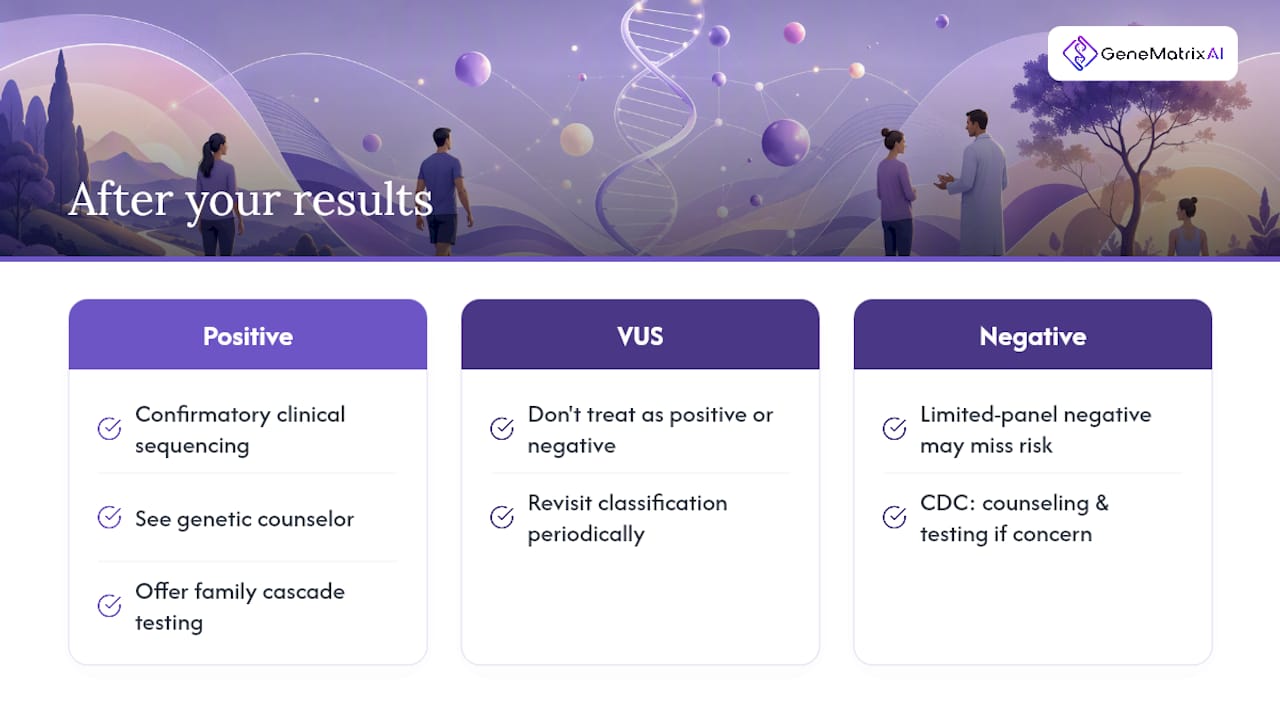
Confirm before you act. That applies whether the result is positive, negative, or a variant of uncertain significance (VUS).
For a positive or likely pathogenic result: Schedule confirmatory clinical sequencing through a certified clinical lab before changing any screening schedule or treatment. Share the result with a genetic counselor who can assess it against your personal and family history. Positive hereditary findings also have implications for blood relatives; family genetic testing guidance explains how cascade testing works and how to approach those conversations.
For a VUS: Do not treat it as a positive or a negative. A VUS means the variant's clinical significance is not yet established. Revisit it periodically, because classifications are updated as evidence accumulates.
For a negative result: A negative on a limited panel does not rule out hereditary risk when family history suggests otherwise. The CDC advises clinical counseling and confirmatory testing when hereditary cancer risk is a real concern in your family.
On insurance: some insurers cover confirmatory clinical testing after a positive DTC result, particularly for BRCA and Lynch syndrome. Check your plan's coverage before ordering confirmatory tests, and ask your genetic counselor to document medical necessity in writing. For a step-by-step interpretation checklist, how to interpret genetic test results is a practical reference.
How Genematrix delivers clinician-validated at-home testing
Genematrix is a Chicago-based, CLIA-certified biotechnology company built around the premise that at-home convenience and clinical-grade rigor are not mutually exclusive.
What the platform includes:
- GeneCancer module: Full gene sequencing for hereditary cancer panels including BRCA1/BRCA2 and Lynch syndrome genes, with CNV analysis to catch deletions and duplications that genotyping misses.
- GenePGx module: Pharmacogenomics panel mapped to current prescribing guidelines, covering major drug-metabolizing genes relevant to psychiatry, cardiology, and oncology supportive care.
- GeneDiet module: Nutrigenomics and wellness traits for personalized nutrition and lifestyle guidance.
- AI-assisted interpretation: The GeneMatrixAI platform, trained on more than 500,000 genetic profiles, generates clinician-validated reports within 72 hours for standard packages.
- Genetic counselor access: Results are not delivered in isolation. Clinician review and genetic counselor follow-up are part of the process, not an add-on.
Ordering starts at the health intake page, where you select the module that fits your concern, complete a brief health history, and receive a kit. The report arrives with variant classifications, evidence levels, and clear recommended next steps.
The evidence base behind these recommendations
The recommendations in this guide rest on peer-reviewed research and regulatory actions, not marketing claims.
The FDA's September 29, 2023 de novo authorization for a class III hereditary cancer panel was a regulatory milestone, but the same analysis cautions that authorization does not mean DTC germline testing is safe without clinical follow-up. The risks of false positives, anxiety without counseling, and missed variants in non-targeted populations remain real.
Key evidence gap: Most DTC validation studies have been conducted in predominantly European-ancestry cohorts. Variant databases are less complete for other ancestries, which means miss rates and VUS rates are likely higher for individuals of non-European descent.
Major evidence limitations to keep in mind: cohort sizes in DTC validation studies are often small, selection bias is common (people who test are not representative of the general population), and VUS prevalence is higher in underrepresented ancestry groups. Clinical outcome data showing that broad DTC testing improves health outcomes at a population level does not yet exist.
For deeper reading, the NCI genetic testing fact sheet, the PMC cohort study on DTC BRCA limitations, and the American Cancer Society's cancer risk genetics page are the most useful primary sources for verifying the claims in this article.
The case for informed testing, not fearful testing
At-home genetic testing gets criticized from two directions: oversold by companies promising transformation, and dismissed by clinicians who see only the false positives. Both reactions miss the point.
PGx testing, done well, is genuinely pre-emptive medicine. Knowing you are a CYP2D6 poor metabolizer before a psychiatrist prescribes an SSRI is useful information. It does not replace the prescribing conversation, but it makes that conversation more specific. The same logic applies to hereditary cancer screening: a positive BRCA result from a clinical-grade panel, confirmed and counseled, can change a surveillance schedule in ways that save lives.
The problem is not the technology. The problem is the gap between what a limited panel actually tests and what consumers believe it tests. A three-variant BRCA panel marketed as "hereditary cancer screening" to a non-Ashkenazi Jewish consumer is not comprehensive screening. Calling it that is the harm.
The right frame is this: use at-home testing as a first signal, not a final answer. A positive prompts clinical confirmation. A negative in the context of strong family history prompts clinical testing regardless. PGx results go into your chart and into the prescribing conversation, not into a drawer.
Genematrix: clinician-validated testing you can order from home
Most at-home tests hand you a result and leave you to figure out what it means. Genematrix is built differently. Every report from the GeneCancer and GenePGx modules is clinician-validated, generated from a CLIA-certified laboratory, and delivered with genetic counselor access so you know exactly what to do next.

Results arrive within 72 hours for standard packages. The platform covers hereditary cancer risk (BRCA1/2, Lynch syndrome), pharmacogenomics for medication optimization, and nutrigenomics through GeneDiet. Billing support for qualified patients is available, and the privacy policy is explicit about data use and sharing.
If you have a family history of cancer, are starting a new medication, or want a baseline genomic picture before a health decision, start with the Genematrix health intake to find the right module and order your kit.
Sources
- Genetic testing fact sheet | National Cancer Institute
- Retrospective Cohort Study on the Limitations of Direct-to-Consumer Genetic Screening in Hereditary Breast and Ovarian Cancer
- Pharmacogenetic tests - MedlinePlus
- Can At-Home DNA Tests Predict How You’ll Respond to your Medications? Pharmacists Explain the Risks and Benefits of Pharmacogenetic Testing - UPMC
- Genetic Testing for Cancer Risk | American Cancer Society
This article is general information, not a substitute for advice from a qualified doctor. Consult a qualified healthcare professional about your own circumstances before acting on anything here.