
TL;DR:
- Genetic mutations are permanent DNA sequence changes that influence disease risk and inheritance patterns. Most mutations result from internal errors during cell division or external factors like radiation and chemicals, while DNA damage is repairable and not always permanent. Mutations can be harmless, beneficial, or harmful, and understanding their role helps predict health outcomes and guide clinical decisions.
A genetic mutation is defined as a permanent change to the DNA sequence of a gene that alters how cells read and use genetic information. The term covers everything from a single swapped nucleotide to the gain or loss of an entire chromosome. Clinical genetics now favors the term "genetic variant" or "pathogenic variant" over "mutation" to reduce stigma, but both phrases describe the same underlying biology. Understanding what is a genetic mutation matters because these changes drive disease risk, inheritance patterns, and, in some cases, genuine survival advantages. The 1% frequency threshold separates a mutation from a polymorphism: variations found in more than 1% of the population are polymorphisms, while rarer or disease-linked changes are classified as mutations.
What is a genetic mutation, and how does it differ from DNA damage?
A genetic mutation is a stable, heritable change to the base sequence of DNA. DNA damage, by contrast, is a structural disruption such as a broken strand or a chemically altered base that the cell's repair machinery can fix before it becomes permanent. Mutation and DNA damage differ in one critical way: damage is repairable, while a mutation is locked into the sequence and copied to daughter cells. This distinction matters clinically because it explains why not every exposure to radiation or a toxic chemical produces a lasting genetic change.
The cell runs several repair systems, including base excision repair and mismatch repair, that catch most errors before they become permanent. When these systems fail or are overwhelmed, the error becomes a mutation. That is the moment a temporary molecular mistake crosses into heritable biology.
How do genetic mutations occur?
Mutations arise from two broad categories: internal replication errors and external environmental factors. DNA replication produces an estimated 1–2 mutations per cell division. That rate sounds alarming, but most of those errors are caught and corrected immediately. The ones that slip through accumulate over a lifetime and can eventually drive conditions like cancer.
External causes add to that baseline rate. The most common include:
- Ionizing radiation (X-rays, UV light) that breaks DNA strands or chemically alters bases
- Chemical mutagens such as tobacco carcinogens, benzene, and certain chemotherapy drugs
- Viral infections where viral DNA inserts into the host genome and disrupts gene function
- Spontaneous chemical reactions like deamination, where cytosine converts to uracil without any outside trigger
Mutations also split by location in the body. A germline mutation occurs in egg or sperm cells and passes to every cell in the next generation. A somatic mutation occurs in a body cell after conception and affects only the tissue where it arises. Somatic mutations cannot be inherited by children, but they can drive cancer within the person who carries them.
Pro Tip: Most people assume mutations require a dramatic cause like radiation exposure. The reality is that ordinary cell division generates the majority of mutations across a lifetime. Lifestyle factors matter, but they add to an already-present baseline, not a zero-risk starting point.
What are the different types of genetic mutations?
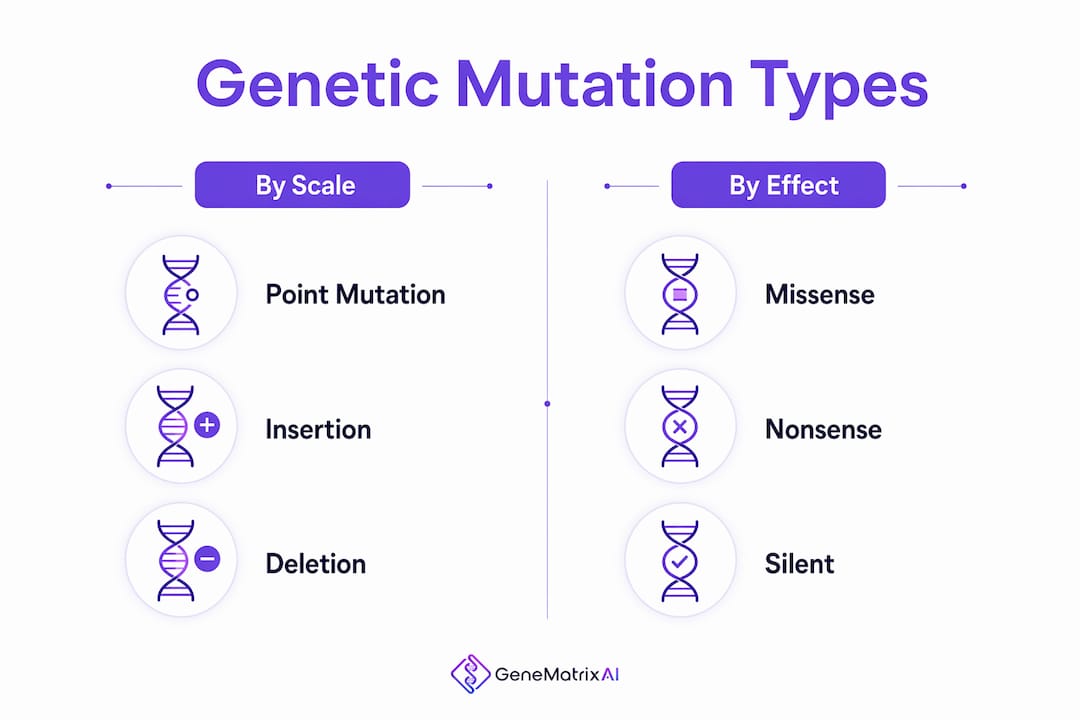
Mutations classify by the scale of the change and by how they affect the DNA sequence. At the smallest scale, point mutations alter a single nucleotide. At the largest, chromosomal mutations reorganize or duplicate entire segments of a chromosome.
| Mutation type | Molecular change | Example condition |
|---|---|---|
| Substitution (missense) | One base swapped for another | Sickle cell disease (A to T in HBB) |
| Insertion | Extra base(s) added to sequence | Huntington disease (CAG repeat expansion) |
| Deletion | Base(s) removed from sequence | Cystic fibrosis (three-base deletion in CFTR) |
| Chromosomal duplication | Segment or whole chromosome copied | Down syndrome (extra chromosome 21) |
| Chromosomal deletion | Segment lost from chromosome | Cri-du-chat syndrome (5p deletion) |
| Aneuploidy | Wrong number of chromosomes | Turner syndrome (45,X) |
Inheritance pattern adds another layer of classification. Autosomal dominant mutations require only one altered copy to produce a clinical effect. Autosomal recessive mutations require two altered copies, one from each parent. X-linked mutations sit on the X chromosome and affect males more severely because they carry only one X. Understanding genetic variants and inheritance helps clinicians predict which family members face elevated risk.
The boundary between a mutation and a normal variant also depends on frequency. Polymorphisms appear in more than 1% of the population and are generally not disease-causing. Mutations fall below that threshold or carry a documented association with disease. The same base change can be a benign polymorphism in one population and a pathogenic variant in another, which is why population-specific databases matter in clinical interpretation.
What effects do genetic mutations have on health and disease?
Mutations can create proteins that work better, fail to work, or have no effect at all. The outcome depends entirely on which protein is affected and what that protein does in the cell. A mutation in a structural protein produces a different disease profile than a mutation in a tumor suppressor gene.
Three well-documented examples show the range of effects:
- Sickle cell disease results from a single A-to-T substitution in the HBB gene. That one base change causes hemoglobin to polymerize under low oxygen, deforming red blood cells into a rigid sickle shape that blocks blood vessels and causes pain crises.
- Cystic fibrosis stems from a three-base deletion in the CFTR gene, removing a single phenylalanine from the CFTR protein. The resulting protein misfolds and fails to regulate chloride transport, causing thick mucus to accumulate in the lungs and digestive tract.
- Down syndrome arises from an extra copy of chromosome 21, producing three copies instead of two. The excess gene dosage disrupts development across multiple organ systems.
Heterozygous versus homozygous status changes the clinical picture significantly. A person with one copy of the sickle cell mutation (heterozygous) carries the sickle cell trait and rarely experiences symptoms. A person with two copies (homozygous) develops full sickle cell disease. That same heterozygous state also confers resistance to malaria, a genuine survival advantage in regions where malaria is endemic. This trade-off is one of the clearest examples of mutation complexity in human biology.
Mutations also drive cancer. When a somatic mutation disables a tumor suppressor gene or activates an oncogene, the cell loses normal growth control. Understanding gene-based cancer risk starts with recognizing which mutations accumulate in which tissues and at what rate.
Pro Tip: Popular culture frames mutations as dramatic transformations. In clinical reality, the most consequential mutations are invisible single-letter changes in a three-billion-letter code. The drama is molecular, not visible.
How are genetic mutations inherited and what do they mean for families?
Germline mutations are the ones families pass down. Every cell in the body of the next generation carries the change because it was present in the egg or sperm at the moment of fertilization. Somatic mutations, by contrast, stay confined to the tissue where they arise and die with the individual.
| Inheritance mode | Copies needed for disease | Mutation origin |
|---|---|---|
| Autosomal dominant | 1 (from either parent) | Germline, sometimes de novo |
| Autosomal recessive | 2 (one from each parent) | Germline |
| X-linked recessive | 1 in males, 2 in females | Germline |
| De novo | 1 (new mutation, not inherited) | Gamete formation or early embryo |
| Somatic | 1 or more (in body tissue only) | Post-conception cell division |
De novo mutations deserve special attention. Many genetic conditions arise from random errors during gamete formation or early embryonic development, not from a parent who carries the same variant. Down syndrome, Turner syndrome, and a significant share of autism-associated variants fall into this category. A family with no history of a condition can still have a child affected by it.
Clinical genetics has also updated its language. The field now uses "genetic variant" or "pathogenic variant" instead of "mutant" to avoid stigmatizing patients. The older terminology carried connotations that did not serve people receiving difficult diagnoses. Accurate language supports clearer communication between clinicians and families. A genetic risk assessment translates variant findings into practical guidance about screening schedules, family planning, and preventive care.
Key Takeaways
Genetic mutations are permanent DNA sequence changes that range from a single swapped base to a missing chromosome, and their health impact depends on which protein is disrupted and whether the mutation is inherited or newly arising.
| Point | Details |
|---|---|
| Mutation vs. DNA damage | Mutations are permanent base-sequence changes; DNA damage is repairable and may never become a mutation. |
| Frequency threshold | Variants found in more than 1% of the population are polymorphisms; rarer or disease-linked changes are mutations. |
| Germline vs. somatic | Germline mutations pass to children; somatic mutations affect only the individual's own tissues. |
| De novo mutations | Many serious conditions arise from new mutations in gametes or early embryos, not from family inheritance. |
| Mutation effects vary | The same mutation can cause disease in one context and confer a survival advantage in another, as seen with sickle cell trait. |
Mutations are not the enemy. Misunderstanding them is.
I have spent years reading genetic reports and explaining variant findings to people who came in convinced they were looking at a death sentence. The word "mutation" carries enormous cultural baggage. Science fiction, horror films, and decades of imprecise journalism have turned a neutral biological term into something that sounds catastrophic. The clinical reality is far more nuanced.
Most mutations do nothing. A large share of the variants in your genome are silent, sitting in non-coding regions or producing protein changes so minor that the cell never notices. The ones that matter clinically are a small subset, and even within that subset, context determines everything. A BRCA1 pathogenic variant raises lifetime breast cancer risk substantially, but it does not guarantee cancer. It is a probability, not a verdict.
What I find most underappreciated is the distinction between DNA damage and a true mutation. People hear "your DNA was damaged" and assume the worst. But cells repair damage constantly. The question is whether the repair succeeded before the cell divided. Most of the time, it did. Understanding that distinction changes how people relate to their own biology, and it makes genetic counseling far more productive.
The other thing worth saying plainly: mutations drive biodiversity and evolution, not just disease. The same biological process that causes sickle cell disease also gave populations in malaria-endemic regions a survival edge. Mutations are the raw material of adaptation. Treating them as purely negative misses the full picture of what they are.
— Tarek
Genematrix and the science behind your genetic health
Understanding mutation biology is the first step. Knowing which variants you carry is the next one.

Genematrix is a CLIA-certified biotechnology company based in Chicago that uses AI-driven analysis trained on 500,000+ genetic profiles to deliver personalized genomic reports within 72 hours. Their advanced genetic testing technology covers hereditary cancer risk (including BRCA1/BRCA2 and Lynch syndrome), pharmacogenomics, and specialized modules for psychiatric health, pediatric genetics, and nutrigenomics. For people who want to manage their genetic health from a phone, the GeneMatrixAI mobile app brings those insights to iOS and Android. Genematrix turns variant data into clinical guidance that physicians and patients can act on.
FAQ
What is the simplest definition of a genetic mutation?
A genetic mutation is a permanent change to the DNA base sequence of a gene. That change can alter, silence, or enhance the protein the gene produces.
What is the difference between a mutation and a polymorphism?
Polymorphisms appear in more than 1% of the population and are generally benign. Mutations fall below that frequency or carry a documented link to disease.
Can a genetic mutation appear with no family history?
Yes. De novo mutations arise during gamete formation or early embryonic development and are not inherited from either parent. Down syndrome and Turner syndrome are common examples.
Are all genetic mutations harmful?
No. Mutations affect protein function in ways that can be harmful, neutral, or beneficial. The sickle cell mutation causes disease in homozygous individuals but confers malaria resistance in heterozygous carriers.
What types of genetic mutations cause cancer?
Somatic mutations that disable tumor suppressor genes or activate oncogenes drive most cancers. Inherited germline mutations in genes like BRCA1, BRCA2, and Lynch syndrome genes raise the lifetime risk of specific cancers significantly.