

Your first move after getting health DNA test results is to categorize the finding, save the report, and contact a clinician or board-certified genetic counselor if anything flags as high-risk. For pharmacogenomic results, pause any medication changes until a prescriber reviews them against CPIC clinical guidelines.
Here are the immediate actions to take in the next 24–72 hours:
- Download and save your full report to a secure location (encrypted cloud storage or a password-protected folder).
- Identify the result category: hereditary cancer variant, pharmacogenomic (PGx) flag, carrier status, variant of uncertain significance (VUS), or polygenic risk score.
- Flag high-risk findings (pathogenic variants in BRCA1/2, Lynch syndrome genes, or cardiac risk genes) for urgent clinical review.
- Do not adjust any medications based on PGx results alone. Wait for a prescriber to cross-reference against validated guidelines.
- Schedule a clinical appointment within one week for any pathogenic or likely pathogenic variant.
Pro Tip: If your report flags a suspected BRCA1/2 pathogenic variant or a high-penetrance cardiac gene variant, call your clinician the same day — do not wait for a routine appointment slot. These findings can change screening schedules immediately.
Key Takeaways
Genetic test results are most useful when you match the finding type to the correct clinical pathway and confirm high-stakes variants through a CLIA-certified lab before making any medical decisions.
| Point | Details |
|---|---|
| Categorize before acting | Identify whether your result is a pathogenic variant, PGx flag, carrier result, VUS, or polygenic score — each requires a different response. |
| Confirm clinically for high-risk findings | DTC results are screening signals; pathogenic variants need CLIA-certified confirmatory testing before clinical decisions. |
| Prioritize PGx flags | Share pharmacogenomic findings with your prescriber immediately; CPIC-grounded guidelines translate genotype into safe prescribing changes. |
| Cascade testing for families | A confirmed hereditary variant means first-degree relatives should be offered testing — early detection changes outcomes. |
| Genematrix delivers clinician-ready reports | CLIA-validated, CPIC-aligned, and AI-curated reports arrive within 72 hours, formatted for direct use in clinical appointments. |
Table of Contents
- What are the actionable steps from a health DNA test, and who do you call first?
- What should you do based on your specific result type?
- DTC versus clinical genetic testing: when do you need to confirm?
- What can genetic tests actually tell you — and what can't they?
- How do you choose a genetic counselor, lab, and clinical guidelines?
- How Genematrix turns DNA results into clinician-ready steps
- Genematrix: from raw DNA results to a plan you can bring to your doctor
- Sources
What are the actionable steps from a health DNA test, and who do you call first?
The sequence matters. High-priority findings go to a clinician or genetic counselor within 24–72 hours. Medium-priority findings (elevated polygenic scores, carrier status) can wait one to two weeks. Low-priority lifestyle signals — nutrigenomics, sleep tendencies — are fine to address over the following month.
Your prioritized timeline
Immediate (24–72 hours)
- Download and archive the full report in at least two secure locations.
- Identify any pathogenic or likely pathogenic variants and call your clinician or a board-certified genetic counselor.
- Bring your PGx findings to your prescriber before your next refill or dose change.
- Note the lab name and whether it is CLIA-certified — you will need this for confirmatory testing.
Short term (1–8 weeks)
- Book a formal genetic counseling appointment. Genetic counseling helps you choose the right confirmatory test and understand what results mean for your family.
- Request confirmatory clinical sequencing for any finding that could change your medical care.
- Ask your clinician to cross-reference PGx flags against CPIC-grounded prescribing guidance.
- Notify first-degree relatives if a hereditary variant is confirmed — they may need cascade testing.
Medium term (3 months)
- Receive confirmatory test results and schedule specialist referrals (oncology, cardiology, reproductive medicine) as indicated.
- Update your screening schedule based on confirmed findings.
- Integrate lifestyle modifications for any elevated polygenic risk scores.
- Set a calendar reminder to revisit your report annually, since variant classifications can change as research advances.
What to bring to your appointment
- Printed or digital copy of the full report, including the variant name, gene, and classification tier.
- A list of all current medications (for PGx review).
- Your family health history, at least three generations if possible.
- The name of the testing lab and its CLIA certification number.
A short script that works
Cost note: Genetic counseling sessions typically run $100–$300 out-of-pocket when not covered by insurance, though many insurers cover counseling when a pathogenic variant is confirmed. Confirmatory clinical sequencing (single-gene or panel) can range from a few hundred dollars to over $1,000 without coverage. Specialist referrals vary widely. Ask your insurer about coverage under preventive care or diagnostic codes before booking.
Pro Tip: When scheduling, tell the scheduler you have a genetic finding in a specific gene. That single detail often gets you routed to the right specialist faster and may shorten your wait time significantly.
What should you do based on your specific result type?
Steps differ by result category. The triage rule: pathogenic variants act now, PGx flags go to your prescriber, carrier results inform reproductive planning, VUS findings require watchful waiting, and polygenic scores need lifestyle and family-history context before any clinical action.
Hereditary cancer variants (BRCA1/2, Lynch syndrome, and others)
- Pursue confirmatory clinical sequencing through a CLIA-certified lab before making any irreversible decisions.
- If confirmed, work with an oncologist or genetic counselor to accelerate your screening schedule. A common clinical rule of thumb: begin cancer screening 10 years before the earliest age of diagnosis in your family.
- Notify first-degree relatives so they can pursue cascade testing. A confirmed pathogenic variant in one family member makes testing far more clinically meaningful for others.
- Expected timeline: confirmatory results typically return in two to four weeks from a clinical lab.
Pharmacogenomic (PGx) findings
- Share the full PGx section of your report with every prescriber who manages your medications. Variants in genes like CYP2D6 and CYP2C19 directly affect how your body metabolizes dozens of common drugs.
- Ask your prescriber to review recommendations against CPIC guidelines rather than acting on the raw variant call alone. CPIC translates genotype into prescribing guidance that is auditable and clinically validated.
- For a deeper look at which markers matter most, the essential pharmacogenomic markers guide covers CYP2D6, CYP2C19, and SLCO1B1 in plain language.
Carrier status results
- A carrier result means you carry one copy of a variant associated with a recessive condition. You are typically unaffected, but your children could be at risk if a partner carries the same variant.
- Discuss reproductive planning options with a genetic counselor. Options range from preconception partner testing to preimplantation genetic testing during IVF.
- The family genetic planning guide walks through these decisions in detail.
Variants of uncertain significance (VUS)
- Do not act on a VUS as though it were pathogenic. The classification means there is not yet enough evidence to call it harmful or benign.
- Ask your clinician to note it in your medical record so it can be reclassified if new evidence emerges.
- Recheck the classification every 12–18 months. Databases like ClinVar update regularly, and a VUS can be upgraded or downgraded.
Polygenic risk scores
- A high polygenic score raises statistical risk across a population but does not predict your individual outcome. Contextualize it with your personal family history and lifestyle factors.
- Use it as a motivator for lifestyle changes — diet, exercise, and sleep — rather than a diagnosis. Lifestyle modifications can meaningfully reduce risk even when a genetic predisposition exists.
- Discuss with your clinician whether the score justifies earlier or more frequent screening.
Red flag callout: Seek urgent clinical evaluation for pathogenic variants in high-penetrance genes (BRCA1/2, MLH1, MSH2, TP53, LDLR) and for any flagged cardiac risk variant (KCNQ1, SCN5A, and similar). These findings can warrant immediate changes to screening or medication management.
Pro Tip: For GI-related hereditary findings, a specialist in digestive genetics can add significant clinical context. A patient-focused guide to genetic testing in GI disorders is a useful starting point before your specialist appointment.
DTC versus clinical genetic testing: when do you need to confirm?
Clinically actionable decisions should rest on clinical-grade testing and a provider's interpretation. A direct-to-consumer (DTC) result is a screening signal, not a diagnosis.
The technology gap is real. Consumer genotyping chips test a very small fraction of the genome, meaning rare variants and many clinically significant insertions or deletions are often not detected. A negative DTC result for BRCA1/2 does not rule out a hereditary cancer risk if your family history is strong.
Step-by-confirm checklist
- Trigger: Any pathogenic or likely pathogenic variant from a DTC test, or a DTC result that conflicts with your family history.
- Request: Ask your clinician to order a confirmatory diagnostic test through a CLIA-certified lab. Specify the gene and variant from your DTC report.
- What to expect in the report: Variant name in HGVS notation, classification (pathogenic/benign/VUS), the lab's CLIA number, and recommended clinical actions or referrals.
- Do not: Change medications, undergo surgery, or make major reproductive decisions based solely on a DTC result.
The CDC's guidance on taking a genetic test on your own makes this point clearly: a DTC test may not give a complete picture of cancer risk, and clinical confirmation is recommended whenever family history suggests elevated risk. For background on test types and what to know before ordering, the DNA health tests overview covers the key distinctions.
What can genetic tests actually tell you — and what can't they?
Genetics is probabilistic. A variant raises or lowers risk; it does not write your future. Many variants require clinical context, family history, and lifestyle data before they mean anything actionable.
Myth vs. fact:
- "A single variant determines my fate." Fact: Most common diseases are polygenic and environmentally influenced. Even high-penetrance variants like BRCA1 carry lifetime risk estimates, not certainties.
- "A negative result means I'm safe." Fact: A negative DTC result only means the tested variants were not detected. It does not rule out untested variants or non-genetic risk factors.
- "A VUS is dangerous." Fact: VUS means unknown, not harmful. Acting on it as though it were pathogenic can lead to unnecessary procedures.
- "My polygenic score is my destiny." Fact: Polygenic scores reflect population-level statistics. Your individual outcome depends heavily on lifestyle, environment, and other genetic factors not captured in the score.
Consider a concrete scenario: someone with a moderately elevated polygenic risk score for type 2 diabetes and no family history of the condition. The appropriate response is not panic or medication — it is a conversation with a clinician about diet, weight, and screening frequency. Contrast that with a confirmed pathogenic MLH1 variant, which warrants immediate specialist referral and an accelerated colonoscopy schedule.
The regulation of genetic tests framework at Genome.gov explains why policy and oversight shape what consumer tests can and cannot claim — worth reading before you evaluate any test's marketing.
On data privacy: Store your genetic report in an encrypted, password-protected location. Be cautious about uploading raw DNA files to third-party interpretation services unless you have reviewed their data-sharing and retention policies. Under GINA (Genetic Information Nondiscrimination Act), health insurers and employers cannot use genetic information to discriminate — but life, disability, and long-term care insurers are not covered by GINA.
How do you choose a genetic counselor, lab, and clinical guidelines?
Prioritize board-certified genetic counselors, CLIA/CAP-certified labs, and clinicians who reference established clinical guidelines. For pharmacogenomics, that means CPIC-grounded recommendations rather than raw variant reports.
Provider vetting checklist
- Genetic counselor credentials: Look for board certification from the American Board of Genetic Counseling (ABGC) or the American Board of Medical Genetics and Genomics (ABMGG).
- Lab certification: Confirm the lab is CLIA-certified and ideally CAP-accredited. Ask for the CLIA number — any legitimate clinical lab will provide it.
- Clinical guidelines in use: Ask whether your clinician references CPIC for pharmacogenomics, NCCN guidelines for hereditary cancer, and ACC/AHA guidelines for cardiac genetics.
- Red flags: Avoid providers who recommend irreversible interventions based solely on a DTC result, or who cannot name the guideline framework they use.
What to ask in a first consult
- Are you board-certified in genetic counseling or medical genetics?
- Which lab will process my confirmatory test, and is it CLIA-certified?
- Which clinical guidelines do you use to interpret pharmacogenomic findings?
- What is the expected turnaround time for results?
- Will you communicate results directly to my other treating physicians?
Genetic counseling before and after testing helps select the right test and interpret results in the context of family history, age, and other factors — the CDC frames this as a standard of care, not an optional add-on.
When multidisciplinary care is warranted
Some findings require more than one specialist. A confirmed BRCA2 variant may involve a breast surgeon, oncologist, and gynecologist. A cardiac channelopathy variant warrants a cardiologist with electrophysiology experience. A Lynch syndrome diagnosis typically involves a gastroenterologist and a gynecologic oncologist. Ask your genetic counselor to coordinate referrals rather than navigating this alone.

Pro Tip: When evaluating pharmacogenomics reports, ask specifically whether the interpretation engine references CPIC guidelines. A report that cites raw literature without a validated clinical framework is harder for your prescriber to act on safely.
How Genematrix turns DNA results into clinician-ready steps
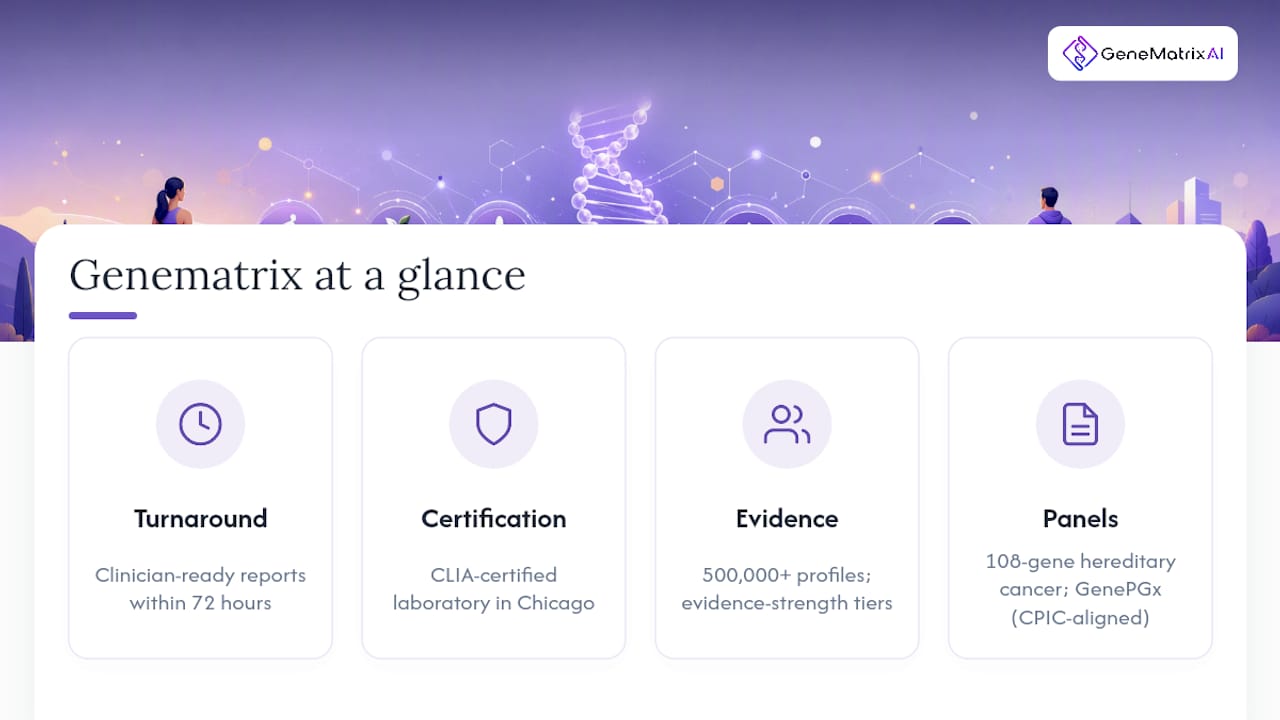
Genematrix uses CLIA-validated lab processes, CPIC-aligned pharmacogenomic interpretation, and AI-assisted evidence curation to deliver clinician-ready reports — typically within 72 hours of sample receipt.
The workflow
- Sample collection: At-home collection kit; sample shipped to the CLIA-certified Genematrix lab.
- Variant curation: Sequencing output is mapped against ClinVar, PharmGKB, and GWAS catalogs.
- Evidence tiering: Variants are classified by evidence strength and clinical actionability.
- CPIC/clinical guideline cross-check: Pharmacogenomic findings are cross-referenced against CPIC guidelines before any prescribing recommendation is surfaced.
- Clinician-ready report: The final report includes variant classification, recommended clinical actions, and referral guidance — formatted for direct use in a clinical appointment.
Service scope
- GeneCancer: Hereditary cancer panels covering BRCA1/2, Lynch syndrome genes, and additional high-penetrance variants.
- GenePGx: Pharmacogenomics panel covering CYP2D6, CYP2C19, SLCO1B1, and other high-impact drug-gene interactions.
- GeneMind: Psychiatric pharmacogenomics for medication selection in mental health care.
- GeneBaby: Pediatric genetic screening.
- GeneDiet: Nutrigenomics for dietary and lifestyle personalization.
Pro Tip: When you receive your Genematrix report, bring the evidence-tier summary directly to your clinician. The tiering tells them which findings are supported by strong clinical evidence versus preliminary signals — that distinction shapes the conversation and the follow-up plan.
The AI synthesis layer in the GeneMatrixAI platform adds value by matching curated variant catalogs to your individual context and producing a prioritized, evidence-rated report. The underlying variant curation is auditable, which matters when a prescriber needs to trace a recommendation back to its source guideline.
Disclaimer: Genematrix reports are intended to support clinical decision-making, not replace it. Always review findings with a licensed clinician or board-certified genetic counselor before making medical decisions.
The case for patience — and precision
Most people who receive a health DNA test result make one of two mistakes: they either dismiss the finding entirely or they treat a probabilistic risk score as a diagnosis. Neither response serves them well.
The evidence points toward a middle path. Confirm what is clinically significant. Use lifestyle levers aggressively for elevated polygenic risk, because the data on modifiable risk factors is genuinely strong. Bring your prescriber into the pharmacogenomics conversation early — PGx findings are often the most immediately usable piece of a genetic report, and they can prevent real harm from a medication that your metabolism handles poorly.
What gets underestimated is the value of doing nothing hasty. A VUS is not a ticking clock. A moderately elevated polygenic score is not a mandate for aggressive intervention. The clinical system has tools to help you act proportionately — genetic counselors, CPIC-aligned prescribers, and CLIA-certified confirmatory labs — and using them in the right sequence is what separates a useful genetic result from an anxiety-generating one.
The readers who get the most from genetic testing are the ones who treat it as the beginning of a clinical conversation, not the end of one.
Genematrix: from raw DNA results to a plan you can bring to your doctor
Most people who get a health DNA test walk away with a PDF and no clear next step. Genematrix closes that gap. As a CLIA-certified, Chicago-based genomics company, Genematrix delivers clinician-ready reports within 72 hours — covering hereditary cancer risk, pharmacogenomics, mental health, pediatric screening, and nutrigenomics — all cross-referenced against CPIC and clinical guidelines so your prescriber can act on the findings, not just read them.

The difference between a result and a plan is clinical validation. Genematrix's AI platform, trained on 500,000+ genetic profiles, tiers every finding by evidence strength and flags the ones that need immediate clinical attention. You get a report your doctor can use at the appointment, not a printout that raises more questions than it answers.
If you have a family history of hereditary cancer, the 108-gene hereditary cancer panel is the place to start. For medication optimization, the GenePGx panel gives your prescriber the CPIC-aligned data they need to adjust your regimen safely. Visit Genematrix's science and certification page to review the lab credentials and workflow, then order the panel that fits your situation.
This article is general information, not a substitute for advice from a qualified doctor. Consult a qualified healthcare professional about your own circumstances before acting on anything here.
Sources
Before acting on any genetic finding, cross-reference with these official resources. Bring specific citations to your clinical appointments.