
Your metabolizer phenotype — poor, intermediate, normal, or ultrarapid — often determines whether a standard drug dose will cause toxicity, work as expected, or fail entirely. That single genetic fact should drive three immediate clinical decisions: whether to reduce the dose, select an alternative drug, or intensify monitoring. The field that formalizes this is pharmacogenomics (PGx), and the authoritative sources that translate genotype into dosing action are:
- CPIC (Clinical Pharmacogenetics Implementation Consortium): gene-specific guidelines with graded dosing recommendations
- FDA Table of Pharmacogenetic Associations: label-based gene–drug pairs with prescribing implications
- PharmGKB: curated drug–gene annotations with evidence levels
- ClinPGx: aggregated CPIC/PharmGKB guidance formatted for point-of-care use
Three things to do right now if you have a patient's PGx result in hand:
- Check the relevant CPIC guideline or FDA table for the specific gene–drug pair before writing the prescription
- Flag the phenotype in the EHR so future prescribers see it automatically
- Plan therapeutic drug monitoring (TDM) for any narrow-therapeutic-index drug where the phenotype suggests altered exposure
Key Takeaways
Genetic metabolism type is one of the most actionable variables in medication dosing — but only when the result is paired with the right guideline, the right workflow, and an honest accounting of its limits.
| Point | Details |
|---|---|
| Phenotype drives the dosing decision | PM, IM, NM, and UM status determines whether to reduce dose, use standard dose, or select an alternative drug. |
| CPIC and FDA are the primary sources | Check the CPIC guideline and FDA Table of Pharmacogenetic Associations for every gene–drug pair before acting. |
| Confounders can override genotype | Drug–drug interactions, hepatic impairment, age, and phenoconversion can shift actual exposure away from genotype predictions. |
| TDM closes the loop | For narrow-therapeutic-index drugs or mismatched clinical response, therapeutic drug monitoring confirms what genotype only predicts. |
| Genematrix GenePGx | CLIA-certified panel results delivered within 72 hours, with CPIC-linked recommendations and genetic counseling support. |
Table of Contents
- How does your genetic metabolism type affect medication dosing?
- Which genes matter most for drug metabolism and dosing?
- How do you translate a genotype result into a dosing decision?
- How should you order and use a PGx test in clinical practice?
- When does genotype alone not tell the whole story?
- Quick-reference guide: phenotype to clinical action for common gene–drug pairs
- A stepwise checklist for putting PGx-informed dosing into practice
- Combining pharmacogenomics with TDM and model-informed precision dosing
- Why PGx dosing needs a realistic, multidisciplinary mindset
- Genematrix GenePGx: CLIA-certified PGx testing built for clinical workflows
- Sources
How does your genetic metabolism type affect medication dosing?
Pharmacogenomics uses the concept of metabolizer phenotypes to predict how quickly a patient's body processes a given drug. The four categories map directly to enzyme activity, and each carries a distinct pharmacokinetic consequence.
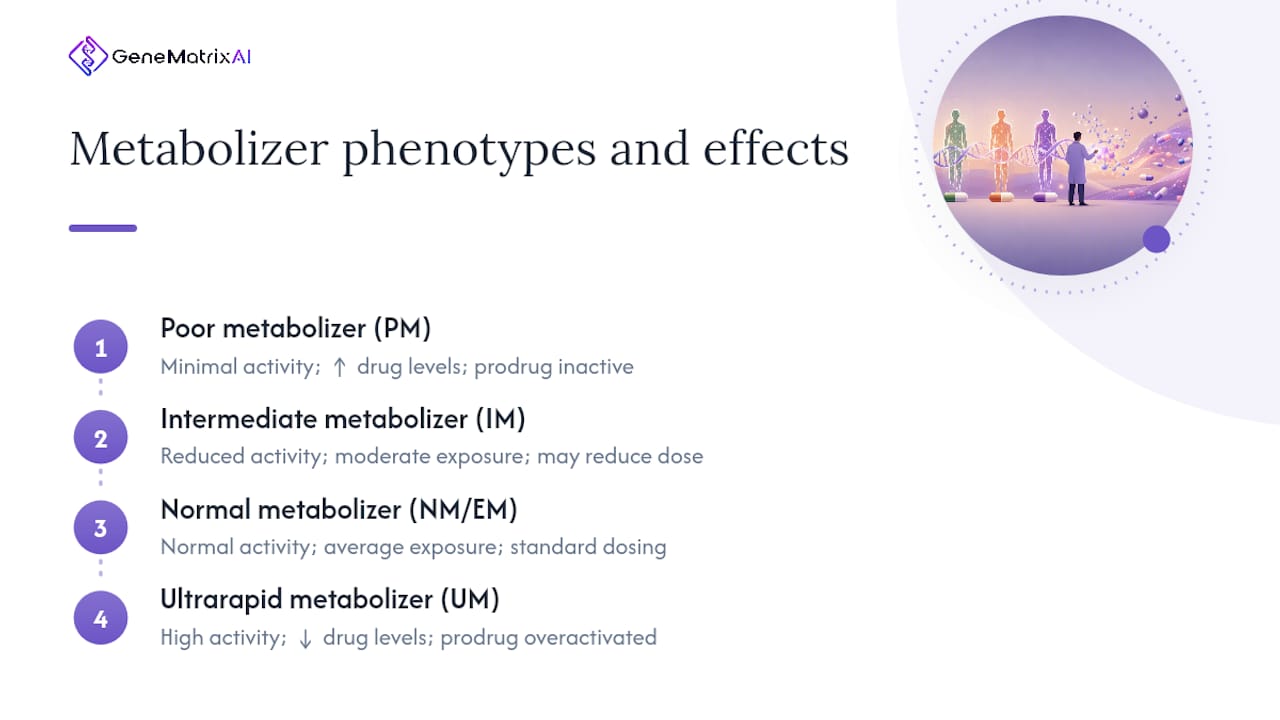
Poor metabolizer (PM): Both gene copies carry loss-of-function variants, leaving the enzyme with little or no activity. Drugs that depend on that enzyme for clearance accumulate to higher-than-expected concentrations. The clinical risk is toxicity at standard doses. For prodrugs that require the enzyme to become active (codeine → morphine via CYP2D6), a PM gets almost no therapeutic effect and the drug is essentially inactive.
Intermediate metabolizer (IM): One functional copy and one reduced-function or loss-of-function copy. Enzyme activity is reduced but present. Drug exposure sits between PM and normal, and the clinical implication depends on the drug's therapeutic index. Many IMs tolerate standard doses with monitoring; others need a modest reduction.
Normal (extensive) metabolizer (NM/EM): Two functional copies, standard enzyme activity, and the population average drug exposure. Standard dosing guidelines are written for this group.
Ultrarapid metabolizer (UM): Extra gene copies or highly active alleles drive above-normal enzyme activity. Drugs are cleared faster, plasma concentrations stay lower, and therapeutic failure becomes the risk. The exception is prodrugs: a CYP2D6 UM converting codeine to morphine can generate dangerously high morphine concentrations.
How genotype maps to phenotype
A patient's diplotype is the combination of two alleles, one from each parent, expressed as star-allele notation (e.g., *1/*4 for CYP2D6). Each allele carries an activity score — typically 0 for no function, 0.5 for reduced function, and 1 for full function. The two scores are summed into an activity score (AS), and that score maps to a phenotype category. A CYP2D6 AS of 0 is a PM; 0.5–1.0 is IM; 1.5–2.0 is NM; above 2.0 is UM.
Two clinical examples make this concrete. A CYP2C19 PM prescribed citalopram at a standard 20 mg dose will accumulate drug to concentrations well above the therapeutic range, raising QTc prolongation risk. Conversely, a CYP2D6 UM prescribed tramadol may convert it to its active O-desmethyl metabolite so rapidly that standard doses produce inadequate analgesia — or, in extreme cases, excessive opioid effect. Clinical reviews confirm that common genetic variation in CYP enzymes meaningfully alters drug exposure and risk, but genotype alone does not always fully predict clinical dose requirements.
Which genes matter most for drug metabolism and dosing?
Understanding the gene-by-gene picture is what makes pharmacogenomics medication guidelines practical rather than theoretical. Here are the genes with the strongest clinical evidence for dosing impact:
-
CYP2D6: Metabolizes roughly 25% of commonly prescribed drugs. Key loss-of-function alleles include *3, *4, *5 (gene deletion), and *6; duplication alleles (*1xN, *2xN) create UMs. Drug classes affected: SSRIs (paroxetine, fluvoxamine), tricyclic antidepressants, opioids (codeine, tramadol), antipsychotics (haloperidol, risperidone), and beta-blockers (metoprolol). Clinical implication: PMs on paroxetine face elevated plasma levels and anticholinergic toxicity; UMs on codeine risk rapid morphine accumulation.
-
CYP2C19: Activates clopidogrel and metabolizes most SSRIs and PPIs. Loss-of-function alleles *2 and *3 are most common; *17 is a gain-of-function allele creating UMs. Drug classes: antiplatelet agents, SSRIs (citalopram, escitalopram, sertraline), PPIs (omeprazole), and some antifungals. Clinical implication: IMs and PMs on clopidogrel have reduced active metabolite formation and higher ischemic event risk — a situation where dose escalation is often insufficient and an alternative P2Y12 inhibitor is preferred.
-
CYP2C9: Primary metabolizer of warfarin (S-enantiomer) and many NSAIDs. Reduced-function alleles *2 and *3 lower clearance. Drug classes: anticoagulants, NSAIDs, sulfonylureas, phenytoin. Clinical implication: *2/*3 carriers on warfarin need lower starting doses and more frequent INR checks to avoid bleeding.
-
TPMT and NUDT15: Both enzymes are involved in thiopurine metabolism (azathioprine, 6-mercaptopurine, thioguanine). TPMT loss-of-function alleles (*2, *3A, *3C) and NUDT15 *3 are the most clinically significant. Drug class: thiopurines used in oncology, inflammatory bowel disease, and organ transplant. Clinical implication: PMs for either gene face severe, potentially life-threatening myelosuppression at standard doses. CPIC recommends substantial dose reductions or alternative agents.
-
CYP3A4/CYP3A5: Together responsible for metabolizing roughly 50% of drugs on the market, including tacrolimus, cyclosporine, many statins, and some opioids. CYP3A5 *3 is a loss-of-function allele; *3/*3 carriers (the majority of European-ancestry patients) are non-expressers. Clinical implication: CYP3A5 expressers (*1 carriers) need higher tacrolimus starting doses to reach target trough concentrations.
-
VKORC1 and CYP2C9 (warfarin dosing): Warfarin sensitivity is driven by both CYP2C9 (clearance) and VKORC1 (pharmacodynamic target). The FDA label and CPIC both recommend genotype-guided starting doses, though the clinical benefit of prospective genotyping for warfarin remains debated in some settings.
-
Transporters (SLCO1B1): SLCO1B1 *5 reduces hepatic uptake of simvastatin, raising plasma concentrations and myopathy risk. CPIC recommends switching to a statin with lower SLCO1B1 dependence (e.g., rosuvastatin, pravastatin) in *5 carriers on high-dose simvastatin.
CYP2D6 *17 and *29 reduced-function alleles are more common in individuals of African ancestry. NUDT15 *3 is most prevalent in East Asian and Hispanic populations. These population differences matter when interpreting a "normal" result — a panel that does not test the alleles most common in a patient's ancestry may miss a clinically significant variant. Transporter and enzyme variants relevant across specialties continue to be cataloged as curated resources expand.
How do you translate a genotype result into a dosing decision?
The protocol is short: check the CPIC guideline for the gene–drug pair → check the FDA pharmacogenetic table → consider local formulary and contraindications → decide between dose change, alternative drug, and intensified monitoring.
Understanding evidence strength labels matters before acting. CPIC grades recommendations as Strong, Moderate, or Optional. A Strong recommendation (e.g., avoid clopidogrel in CYP2C19 PMs) is backed by multiple outcome studies and should change prescribing in most cases. A Moderate recommendation (e.g., reduce starting dose of a tricyclic in a CYP2D6 PM) warrants action but allows clinical judgment. Optional recommendations flag a gene–drug interaction where evidence exists but the clinical magnitude is uncertain. The FDA Table of Pharmacogenetic Associations uses label language rather than evidence grades — look for phrases like "contraindicated," "dosage adjustment recommended," or "may affect response" to gauge the strength of the label-based action.
One critical nuance: for some gene–drug pairs, dose escalation cannot rescue the pharmacologic effect. CPIC's 2022 update on clopidogrel recommends avoiding clopidogrel in many CYP2C19 IMs and PMs and using prasugrel or ticagrelor at standard doses when no contraindication exists, because higher clopidogrel doses do not reliably restore adequate platelet inhibition in loss-of-function allele carriers.
The table below covers high-priority gene–drug pairs with phenotype-specific actions. Every row maps to a CPIC guideline or FDA label action.
| Gene(s) | Drug / Drug Class | Phenotype | Consequence | Recommended Action | Primary Source |
|---|---|---|---|---|---|
| CYP2C19 | Clopidogrel | IM or PM | Reduced active metabolite; higher ischemic risk | Avoid clopidogrel; use prasugrel or ticagrelor (if no contraindication) | CPIC 2022 |
| CYP2C19 | Citalopram / Escitalopram | PM | Elevated drug exposure; QTc risk | Reduce dose or select alternative SSRI | CPIC |
| CYP2C19 | Sertraline | UM | Reduced exposure; possible therapeutic failure | Consider dose increase or alternative | CPIC |
| CYP2D6 | Paroxetine / Fluvoxamine | PM | Markedly elevated plasma levels; toxicity risk | Select alternative SSRI not metabolized by CYP2D6 | CPIC |
| CYP2D6 | Codeine | UM | Rapid morphine formation; toxicity risk | Avoid codeine; use non-CYP2D6 opioid | CPIC / FDA |
| CYP2D6 | Tramadol | PM | Reduced active metabolite; inadequate analgesia | Avoid tramadol; select alternative analgesic | CPIC |
| TPMT / NUDT15 | Thiopurines (AZA, 6-MP) | PM | Severe myelosuppression risk | Substantial dose reduction or alternative agent | CPIC |
| CYP2C9 + VKORC1 | Warfarin | Reduced-function variants | Altered S-warfarin clearance and sensitivity | Genotype-guided starting dose; frequent INR monitoring | CPIC / FDA |
CPIC guidelines for SSRIs include dose reductions or alternative drug recommendations for CYP2D6 and CYP2C19 poor metabolizers and guidance for ultrarapid metabolizers where evidence supports it. For antidepressant dosing informed by CYP2D6/CYP2C19, the practical implication is that a PM on paroxetine is not a candidate for dose titration upward — the right move is switching to a drug with a different metabolic pathway.
How should you order and use a PGx test in clinical practice?
Ordering a pharmacogenomics test is straightforward; interpreting the report and acting on it requires a short workflow.
Checklist for ordering:
- Choose a CLIA-certified and ideally CAP-accredited laboratory. CLIA certification is the federal minimum for clinical testing; CAP accreditation adds a layer of proficiency testing and quality oversight that matters for complex genotyping.
- Decide between targeted testing (single gene, e.g., CYP2C19 before starting clopidogrel) and panel testing (10–20+ genes at once). Panels are more cost-effective for patients on multiple medications or those starting a new medication regimen.
- Expect turnaround of 3–7 business days for most commercial panels; some labs offer expedited results in 24–72 hours for urgent clinical decisions.
- Confirm the report will include: raw genotype calls (alleles detected), diplotype assignment, predicted phenotype, activity score where applicable, and evidence-based clinical recommendations with source citations.
- Verify the panel covers the alleles most relevant to the patient's ancestry (see ethnicity note in the pharmacogenes section above).
Reading the report:
A well-structured PGx report moves from genotype → diplotype → phenotype → recommended action. The genotype tells you which alleles were detected; the diplotype combines them into a pair (e.g., CYP2D6 *1/*4); the phenotype assigns the functional category (IM, in this case); and the recommended action section should cite CPIC or FDA as the basis. Check whether the phenotype assignment used an activity score method or a simple allele-lookup method — activity scores are more granular and better supported for CYP2D6 in particular. Look for an evidence level label on each recommendation. A recommendation without a cited source or evidence grade is a flag to verify independently via CPIC or PharmGKB.
Preemptive vs. reactive testing:
Preemptive panel testing — ordering a broad PGx panel before any specific drug is prescribed — is gaining traction in high-risk populations: patients starting chemotherapy, patients with polypharmacy, and patients with a history of adverse drug reactions. The advantage is that results are already in the chart when a relevant drug is prescribed later. Reactive testing, ordered after an adverse event or treatment failure, is still common but misses the prevention opportunity. Drug-gene interaction testing panels versus targeted tests each have a place depending on the clinical context.
Store results in a discrete EHR field (not just a scanned PDF) so clinical decision support (CDS) alerts can fire when a relevant drug is ordered. Expert reviews on EHR integration and precision dosing emphasize that data accessibility and CDS integration are the primary barriers to scaling PGx in routine care.
Pro Tip: For complex cases — multiple interacting drugs, rare alleles, or a phenotype that does not match the clinical response — involve a pharmacogenomics-trained clinical pharmacist or genetic counselor before finalizing the dosing plan. Set a persistent EHR flag (not just a note) so every future prescriber sees the phenotype automatically.
When does genotype alone not tell the whole story?
Genotype predicts enzyme activity under ideal conditions. Several factors can shift actual drug exposure well away from what the genotype predicts, and missing them is where PGx-informed dosing goes wrong.
Drug–drug interactions and phenoconversion: A genotypic NM can become a functional PM when a potent CYP2D6 inhibitor (fluoxetine, paroxetine, bupropion) is added to the regimen. This is called phenoconversion — the genotype has not changed, but the enzyme is now effectively blocked. A patient who is a CYP2D6 NM by genotype but is also taking fluoxetine will metabolize codeine as slowly as a PM. Clinicians who rely on genotype alone without checking the co-medication list will miss this entirely.

Hepatic and renal impairment: CYP enzyme expression decreases with hepatic dysfunction. A CYP2C9 NM with Child-Pugh B cirrhosis may have warfarin clearance closer to a PM. Renal impairment affects drugs with active metabolites that are renally cleared (e.g., the active morphine-6-glucuronide from codeine metabolism).
Age-related changes: Pediatric patients have immature CYP enzyme expression that does not reach adult levels until roughly age 1–2 for CYP3A4 and later for CYP2D6. Geriatric patients show declining CYP3A4 activity and reduced renal clearance, which compounds genotype-based predictions. A CYP2C9 NM at age 75 may behave pharmacokinetically more like an IM.
Incomplete allele coverage: No commercial panel tests every known variant. Rare alleles not on the panel are reported as wild-type by default, which can misclassify a PM as an NM. This is particularly relevant for CYP2D6, which has over 100 named alleles.
Formulation differences: Extended-release formulations change absorption kinetics in ways that can partially offset genotype-based clearance differences. A PM on an extended-release formulation may not accumulate drug as dramatically as predicted from immediate-release pharmacokinetics.
When multiple confounders are present and the drug has a narrow therapeutic index, TDM is not optional — it is the only way to confirm that the predicted exposure matches what is actually happening in the patient. Use cautious titration, start at the lower end of the dose range, and measure drug concentrations before escalating.
Quick-reference guide: phenotype to clinical action for common gene–drug pairs
The table below is designed for point-of-care use. Every action maps to a CPIC guideline or FDA label. Local formulary restrictions and patient-specific factors (organ function, co-medications, age) may modify the action, and TDM is recommended for narrow-therapeutic-index drugs regardless of phenotype.
Footnote: This table summarizes general guidance from CPIC and FDA labeling. Individual patient factors — hepatic and renal function, co-medications, age, and clinical context — may change the recommended action. TDM is recommended for drugs with a narrow therapeutic index regardless of phenotype. Consult the current CPIC guideline or FDA table for the most up-to-date recommendation for each gene–drug pair.
How DNA testing can change medication outcomes in practice depends on having this kind of structured reference available at the point of prescribing, not buried in a PDF attachment.
A stepwise checklist for putting PGx-informed dosing into practice
Converting a PGx result into a prescribing decision takes fewer steps than most clinicians expect. Here is a numbered workflow you can follow during a patient visit or medication review:
-
Confirm the clinical indication. Verify that the drug you are considering is one where PGx guidance exists. If you are unsure, check ClinPGx or CPIC's drug list before ordering.
-
Check for existing PGx results. Search the EHR for a prior PGx report. If one exists, confirm it was performed by a CLIA-certified lab and that the relevant gene was tested. If no result exists and the drug has a strong CPIC or FDA recommendation, order testing before prescribing when the clinical timeline allows.
-
Consult CPIC and the FDA table. Look up the specific gene–drug pair. Note the recommendation strength (Strong, Moderate, Optional) and the specific action (dose change, alternative drug, or monitoring).
-
Choose dose vs. alternative vs. monitoring. For Strong recommendations, follow the guideline action. For Moderate recommendations, weigh the clinical context. For Optional, document your reasoning either way.
-
Document the plan in the EHR. Write a brief note that includes: the PGx result (gene, diplotype, phenotype), the clinical action taken, and the monitoring plan. Example template:
-
Set an EHR flag for future prescribers. A discrete structured field (not a free-text note) allows CDS alerts to fire when a relevant drug is ordered in the future. This is the single highest-leverage implementation step for long-term value.
-
Schedule follow-up or TDM. For narrow-therapeutic-index drugs or when confounders are present, schedule a drug concentration check at steady state. For most oral drugs, steady state is reached in 4–5 half-lives.
Who to involve: A clinical pharmacist with PGx training is the most practical resource for complex cases. For patients with rare alleles, multiple interacting drugs, or a result that does not match clinical response, a genetic counselor adds interpretive depth. Optimizing medication based on genetics works best as a team effort, not a solo prescriber decision.
Combining pharmacogenomics with TDM and model-informed precision dosing
Genotype predicts where a patient is likely to land on the exposure curve. TDM confirms where they actually are. The combination is more powerful than either alone, and leading precision medicine researchers recommend integrating genetic testing with therapeutic drug monitoring so clinicians can confirm genotype-predicted exposure in the patient's plasma.
When to add TDM on top of genotype:
- Narrow therapeutic index drugs (tacrolimus, warfarin, lithium, aminoglycosides, certain antiepileptics)
- A mismatch between predicted phenotype and observed clinical response (e.g., a CYP2D6 NM who shows signs of drug accumulation)
- High-risk situations: hepatic impairment, polypharmacy with known inhibitors, pediatric or geriatric patients
- Any time phenoconversion is suspected
Model-informed precision dosing (MIPD) takes this further by using physiologically based pharmacokinetic (PBPK) models to simulate individual drug exposure from genotype, weight, organ function, and co-medications, then refining the prediction with measured concentrations. Open-source tools like Tucuxi-CDSS are being developed to automate MIPD workflows and deliver TDM-guided dosing recommendations at the point of care.
A brief clinical scenario illustrates the value: a CYP2D6 UM is prescribed tramadol for moderate pain. Genotype predicts rapid conversion to the active O-desmethyltramadol metabolite. At day 3, the patient reports minimal pain relief. Rather than increasing the tramadol dose, the clinician measures plasma tramadol and metabolite concentrations. If the metabolite is low despite rapid conversion (suggesting rapid further clearance), the result confirms therapeutic failure from the UM phenotype and supports switching to a non-CYP2D6 analgesic. If the metabolite is unexpectedly high, it prompts a review of co-medications for CYP2D6 inhibitors that are causing phenoconversion.
Pharmacogenomics combined with proteomics and metabolomics promises even finer dose personalization beyond genotype alone, though this remains an evolving research area rather than routine clinical practice.
Pro Tip: *For tacrolimus in transplant patients, CYP3A5 genotyping combined with early TDM at day 3–5 post-transplant is one of the most evidence-supported applications of PGx + TDM in clinical practice. CYP3A5 expressers (1 carriers) consistently require higher starting doses to reach target trough concentrations.
Why PGx dosing needs a realistic, multidisciplinary mindset
Pharmacogenomics is genuinely useful. But the gap between what it promises in a press release and what it delivers in a busy clinic is real, and closing that gap requires honesty about both.
The strongest evidence sits in a handful of gene–drug pairs: CYP2C19 and clopidogrel, TPMT/NUDT15 and thiopurines, CYP2D6 and codeine. For these, the clinical benefit of genotype-guided prescribing is well-documented and the recommendation is Strong. For many other pairs, the evidence is Moderate or Optional, which means the genotype informs but does not dictate the decision. Clinicians who treat every PGx result as a hard mandate will over-correct; those who dismiss the whole field because some pairs have weak evidence will miss the cases where it genuinely prevents harm.
The other honest point: PGx results are only as useful as the workflow that surrounds them. A report filed as a PDF attachment that no CDS system reads is nearly worthless for future prescribing. The investment in structured EHR data entry and CDS alert configuration is not glamorous, but it is what converts a one-time test into a permanent clinical asset.
My view is that the right model is a pharmacist-led, physician-supported multidisciplinary team that treats PGx as one input among several — not a replacement for clinical judgment, TDM, or patient preference. Local implementation pilots, starting with the highest-evidence gene–drug pairs, are a more durable path than institution-wide automation built on incomplete evidence. The goal is not to have a PGx result for every patient. The goal is to act on the right result, for the right drug, at the right moment.
Genematrix GenePGx: CLIA-certified PGx testing built for clinical workflows
Getting a PGx result that actually changes prescribing requires more than a genotype call — it requires a report structured for clinical action, delivered fast enough to matter.
Genematrix's GenePGx module is built for exactly that. As a CLIA-certified laboratory, Genematrix delivers pharmacogenomics panel results within 72 hours, with reports that map genotype to phenotype, link recommendations to CPIC and FDA guidance, and flag clinically significant drug–gene interactions. The GeneMatrixAI platform, trained on over 500,000 genetic profiles, adds an AI-driven interpretation layer that surfaces the most relevant dosing implications for each patient's specific medication list.

For clinicians managing patients on SSRIs, antiplatelet agents, thiopurines, or anticoagulants, GenePGx provides the structured, evidence-linked output that fits a real prescribing workflow. Genetic counseling support is available for complex cases. To review Genematrix's lab certifications and scientific approach, visit our science page, or start a test order to see how GenePGx integrates into your practice.
Sources
These are the primary resources to bookmark or integrate into your EHR workflow for gene–drug dosing guidance:
- Clinical Pharmacogenetics Implementation Consortium (CPIC) Guideline for CYP2D6 and CYP2C19 Genotypes and Dosing of Selective Serotonin Reuptake Inhibitors
- Table of Pharmacogenetic Associations
This article is general information, not a substitute for advice from a qualified doctor. Consult a qualified healthcare professional about your own circumstances before acting on anything here.