

TL;DR:
- Pharmacogenomics testing predicts individual medication responses by analyzing key genes like CYP2D6 and CYP2C19, reducing trial-and-error cycles for antidepressant treatment. Preparing properly and consulting with a healthcare provider ensures accurate results and informed treatment decisions, while understanding the nuanced clinical guidance helps optimize therapy. Evidence shows PGx-guided prescribing improves remission rates and lowers side effects, making personalized mental health care more effective and efficient.
Starting an antidepressant can feel like guessing in the dark. You try a medication, wait four to six weeks, and discover it either doesn't work or causes side effects you can't tolerate. Then you start over. For roughly half of patients, the first antidepressant prescribed doesn't produce remission, and the trial-and-error cycle can stretch on for months or even years. Pharmacogenomics (PGx) testing offers a way out of that cycle by reading your DNA to predict how your body will process specific medications, giving you and your provider a smarter starting point before the first pill is swallowed.
Table of Contents
- What is pharmacogenomics testing for antidepressants?
- Preparing to take a pharmacogenomics test: What you need
- How to undergo pharmacogenomics testing for antidepressants: Step-by-step
- Interpreting your results and avoiding common mistakes
- What outcomes can you expect? Evidence and real-world impact
- Why the reality of pharmacogenomics testing is more nuanced than the hype
- Take the next step toward personalized antidepressant treatment
- Frequently asked questions
Key Takeaways
| Point | Details |
|---|---|
| Test targets key genes | CYP2D6 and CYP2C19 are the most impactful genes for many antidepressants. |
| Prepares you for treatment | Collecting important info and following best practices maximizes your PGx test value. |
| Stepwise process | A five-step procedure gets you from provider order to actionable results. |
| Evidence for benefit | PGx-guided care improves remission rates over time, especially for those with actionable gene-drug matches. |
| Interpret with context | Results guide choices best when combined with medical oversight, not in isolation. |
What is pharmacogenomics testing for antidepressants?
Before jumping into the testing process, it's important to understand what PGx testing actually examines and why it matters for antidepressant selection.
Pharmacogenomics testing analyzes specific gene variants in your DNA to predict how your body metabolizes, responds to, or tolerates particular medications. For antidepressants, the most clinically relevant genes are CYP2D6 and CYP2C19, two liver enzymes responsible for breaking down the majority of commonly prescribed psychiatric medications. Knowing your variant in each gene tells your prescriber whether you're likely to build up dangerously high drug levels or flush a medication out so quickly it never has a chance to work.
The key PGx markers tested in a standard panel do far more than confirm a diagnosis. They place you into a metabolizer category that directly informs dosing and drug selection. CYP2D6 and CYP2C19 guide dose adjustments and drug choices for antidepressants across clinical guidelines worldwide, and the FDA includes pharmacogenomic biomarker information for several antidepressants directly in their drug labeling. That means this is not fringe science; it's embedded in mainstream regulatory guidance.
Antidepressant classes most relevant to PGx testing:
- Selective serotonin reuptake inhibitors (SSRIs): fluoxetine, sertraline, citalopram, escitalopram, paroxetine
- Serotonin-norepinephrine reuptake inhibitors (SNRIs): venlafaxine, duloxetine
- Tricyclic antidepressants (TCAs): amitriptyline, nortriptyline, clomipramine
- Atypical antidepressants: mirtazapine, bupropion
To get familiar with psychiatric medication basics before your appointment, it helps to know which class your provider is considering.
| Gene | Antidepressants affected | Clinical action based on results |
|---|---|---|
| CYP2D6 | TCAs, paroxetine, fluoxetine, venlafaxine | Adjust dose or switch drug if poor or ultrarapid metabolizer |
| CYP2C19 | Citalopram, escitalopram, sertraline | Reduce dose for poor metabolizers; consider alternative for ultrarapid |
| SLC6A4 (5-HTTLPR) | SSRIs broadly | Informs response likelihood, not a dose change driver |
| HLA-A / HLA-B | Carbamazepine (mood stabilizers) | Screen before prescribing to avoid severe adverse reactions |
The table above illustrates why a single gene panel test can offer a meaningful head start compared to guessing from scratch. Rather than waiting weeks to see whether a drug works, your provider can read your genetic roadmap and make a much more informed first choice.
Preparing to take a pharmacogenomics test: What you need
Armed with an understanding of what PGx testing is and which antidepressants are affected, it's time to get ready for the testing process.

Preparation is often skipped, but it makes a real difference in how smoothly the process goes. The most critical step is gathering your complete medication list, including supplements and over-the-counter drugs. Why? Because certain medications can actually phenocopy your genotype (mimic a metabolizer status you don't truly have), potentially confusing interpretation if your provider doesn't know what you're taking. Guidelines recommend genotyping in specific contexts, particularly for tricyclic antidepressants, where getting the metabolizer status right is literally a safety issue due to the narrow therapeutic window of those drugs.
You'll also want to follow the genetic screening steps your provider recommends to make sure nothing falls through the cracks before you submit your sample.
| Prerequisite | Details |
|---|---|
| Healthcare provider order | Most labs require a provider's requisition to release results |
| Full medication and supplement list | Needed for accurate phenoconversion assessment |
| Sample collection kit | Typically a saliva tube or cheek swab; shipped directly to your home or clinic |
| Signed consent documentation | Standard for genetic testing; required by most CLIA-certified labs |
| Insurance or payment information | Coverage varies; some plans cover PGx for psychiatric indications |
| Health history summary | Prior medication trials, allergies, and relevant diagnoses |
Questions to ask your provider before testing:
- Which specific gene-drug pairs will this panel test for?
- Will the results integrate with my current electronic health record?
- What happens if my result falls into a rare or ambiguous category?
- How will results be communicated: through a patient portal, a follow-up appointment, or both?
- Is the lab CLIA-certified, and does it follow CPIC or DPWG clinical guidelines?
Pro Tip: Avoid eating, drinking anything other than water, or chewing gum for at least 30 minutes before you collect your saliva or cheek swab sample. Food residue can degrade sample quality and lead to inconclusive results, which means another swab and more waiting.
How to undergo pharmacogenomics testing for antidepressants: Step-by-step
Once you have the essentials in place, you're ready to follow the steps to complete a PGx test.
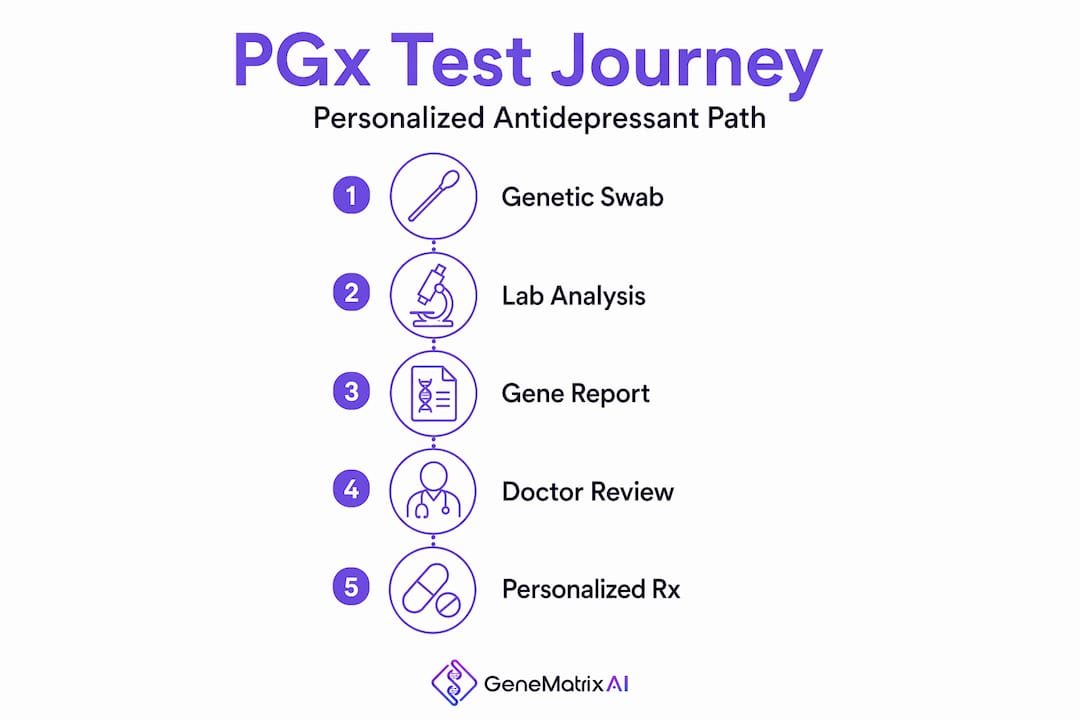
The process is simpler than most people expect, but each step matters. Skipping or rushing a step is the most common reason for sample rejection or delayed results. Here's how it works from start to finish:
-
Get a provider order. Your prescribing psychiatrist, primary care physician, or nurse practitioner submits a test requisition to a certified lab. This step confirms medical necessity, which matters for insurance coverage. Understand the full drug-gene testing process so you can ask informed questions during this visit.
-
Receive your collection kit. Most labs mail a kit directly to your home within a few business days of the order being placed. The kit includes a saliva collection tube or cheek swab, a biohazard return bag, and prepaid shipping materials.
-
Collect your sample. Follow the kit instructions precisely. For saliva kits, fill the tube to the marked line. For cheek swabs, rub firmly against the inside of your cheek for the full recommended duration (usually 30 to 60 seconds per swab). Don't touch the swab tip.
-
Register your kit online. Almost all labs require you to register your unique kit ID on their website before shipping. This step links your sample to your provider's order and your patient profile. Missing this step is a surprisingly common error.
-
Ship the sample. Place the sealed sample into the return bag, then into the prepaid shipping envelope. Drop it off at the designated carrier location. Most labs request that samples ship on a weekday to avoid sitting in a facility over the weekend.
-
Await results and schedule a follow-up. Results typically arrive within one to three weeks. As pharmacogenomic biomarkers in drug labeling are already incorporated into FDA guidance, your provider should have a framework ready to interpret the results in the context of your prescription.
Important safety note: Pharmacogenomics test results are informational, not prescriptive. A report that says you're a poor metabolizer of a particular drug does not mean you should stop taking it without speaking to your provider first. Never alter your dose or discontinue a medication based on a test report alone. Always involve your prescribing clinician in any medication decision.
Pro Tip: Double-check the specific instructions for your kit model. Different manufacturers use different tube types, and the fill line or swab technique can vary. A common mistake is underfilling a saliva tube, which leads to a rejected sample and a two-week delay.
Interpreting your results and avoiding common mistakes
After you complete the test, the next milestone is making sense of your results and ensuring you act on them with care.
Pharmacogenomics reports use terminology that can feel unfamiliar the first time you read one. Here are the key terms you'll likely encounter:
- Poor metabolizer (PM): Your body breaks down the drug very slowly. Drug levels can accumulate, increasing side effect risk.
- Intermediate metabolizer (IM): Slower than average but not as extreme as a poor metabolizer. May need a lower dose.
- Normal (extensive) metabolizer (NM/EM): Standard drug processing; typical doses usually apply.
- Ultrarapid metabolizer (UM): Your body clears the drug so quickly that standard doses may be ineffective.
- Actionable gene-drug pair: A gene variant and medication combination for which clinical guidelines provide specific, evidence-based recommendations.
- Phenoconversion: When a drug you're already taking mimics a different metabolizer status than your true genotype.
CYP2D6 and CYP2C19 genotypes impact antidepressant exposure in measurable, clinically significant ways. DPWG guidelines incorporate nuance about drug, gene, and metabolizer status in a way that goes well beyond a simple "avoid this drug" recommendation. That nuance matters when you're interpreting PGx reports with your provider.
| Metabolizer status | CYP2D6 example (TCA: nortriptyline) | Clinical recommendation |
|---|---|---|
| Poor metabolizer | Drug levels too high | Reduce dose or switch to a non-CYP2D6-dependent drug |
| Intermediate metabolizer | Somewhat elevated exposure | Monitor closely; consider dose reduction |
| Normal metabolizer | Expected drug exposure | Standard dosing appropriate |
| Ultrarapid metabolizer | Drug cleared too quickly | Increase dose cautiously or select alternative |
The same genotype can mean something different depending on which antidepressant is being prescribed. For instance, being a CYP2C19 poor metabolizer may mean a dose reduction for escitalopram but a different clinical response for sertraline because the two drugs are metabolized differently even within the SSRI class. This is why reviewing results with a provider who understands the crucial markers for safety is non-negotiable, and why explaining medication choices to people around you may require the full clinical picture, not just the genetic one.
Pro Tip: Never change or stop your medication based solely on your PGx report. Even with a clear actionable result, your provider needs to weigh your full clinical picture before adjusting your prescription.
What outcomes can you expect? Evidence and real-world impact
Understanding your results is important, but knowing what changes to expect in your treatment experience is just as crucial.
The evidence base for PGx-guided antidepressant prescribing has matured significantly. A major randomized trial found that genotype-guided SSRI prescribing produced remission in 48.3% of patients at 6 months compared to 39.4% in usual care groups. That's nearly a 9-percentage-point difference in the share of people who actually got better. Notably, the benefit was stronger at six months than at three months, suggesting that PGx guidance helps most over a longer treatment arc.
A large real-world analysis, the PRIME Care study, similarly found higher remission and response rates with PGx-guided treatment compared to standard care.
Documented patient benefits of PGx-guided antidepressant treatment:
- Fewer failed medication trials before finding an effective drug
- Lower exposure to preventable side effects from incompatible medications
- Better communication between patient and provider about medication rationale
- Reduced time spent at subtherapeutic doses due to metabolizer-unaware prescribing
- Greater confidence in the treatment plan when there's genetic evidence supporting the choice
That said, PGx testing is not a guaranteed shortcut to wellness. Not every antidepressant class has equally strong pharmacogenomic evidence. Bupropion, for example, has a more limited PGx evidence base than SSRIs or TCAs. And even within well-studied drug-gene pairs, environmental factors, comorbid conditions, and life circumstances all shape treatment outcomes in ways that no gene panel can fully capture. Learning more about DNA testing and outcomes can help you set realistic expectations going in.
For patients struggling with improving access to care or living in areas with limited psychiatric resources, PGx testing can be especially valuable because it reduces the number of provider visits needed to find a workable medication.
Why the reality of pharmacogenomics testing is more nuanced than the hype
Here's something the marketing brochures don't always say clearly: having a PGx report in hand does not automatically mean your treatment will improve. The test is a tool. A powerful one. But it is only as useful as the clinical conversation that surrounds it.
Some commercial test panels list 50 or more genes, which can feel reassuring. Broader must mean better, right? Not necessarily. For antidepressants specifically, the evidence for actionable recommendations clusters tightly around CYP2D6 and CYP2C19. A panel that includes dozens of rarely tested variants may generate confusion rather than clarity, especially if your provider isn't trained to interpret the noisier signals. Clinical actions should be anchored to established gene-drug recommendations and patient context beyond genotype alone.
Context also means the other medications you're taking. If you're on a drug that inhibits CYP2D6 (like some heart medications or antifungals), your functional metabolizer status can shift completely regardless of what your DNA says. A provider who doesn't ask about your full medication list before interpreting PGx results is missing half the picture.
"True personalized care isn't a report. It's an ongoing conversation between a patient who understands their results and a provider who knows how to translate those results into a real, workable treatment plan."
We've seen firsthand at Gene Matrix that patients who get the most benefit from genetic testing are those who bring their results to a follow-up appointment, ask specific questions, and treat the report as the beginning of a conversation, not the end of one. The benefits of genetic counseling in that context are real and measurable.
Pro Tip: Use your PGx results as a conversation starter with your provider, not a prescription in disguise. Bring your printed or digital report to your follow-up, highlight the actionable gene-drug pairs, and ask specifically how the results will change your treatment plan.
Take the next step toward personalized antidepressant treatment
You've spent years working through trial-and-error prescribing when a smarter path has been available. Pharmacogenomics testing, done right and interpreted with clinical skill, can meaningfully reduce the time it takes to find a medication that works for you.

At Gene Matrix, our GeneMind psychiatric testing module is designed specifically for patients navigating medication decisions in mental health care. Powered by AI trained on 500,000+ genetic profiles, our precision medicine innovation delivers actionable results within 72 hours through our CLIA-certified lab. Whether you're starting your first antidepressant or trying to optimize a regimen that hasn't quite worked, our health intake process makes it easy to begin. You bring the questions. We bring the genomic clarity.
Frequently asked questions
Is pharmacogenomics testing for antidepressants covered by insurance?
Coverage varies widely; check with your insurer and have your provider document medical necessity to improve the chance of reimbursement. Some Medicare Advantage and commercial plans cover PGx for psychiatric indications.
How accurate are pharmacogenomics tests for guiding antidepressant choices?
Tests reliably identify gene variants like CYP2D6 and CYP2C19, but treatment outcomes depend on clinical context as well as genetics. Only select gene-drug pairs are actionable for antidepressant choice, so a broader panel doesn't automatically mean better guidance.
Can I get a pharmacogenomics test for antidepressants without a prescription?
Most high-quality pharmacogenomics tests require a healthcare provider's order for legal and clinical reasons. Guidelines recommend provider-ordered genotyping, especially for tricyclics, where metabolizer status has direct safety implications.
Do all antidepressants have actionable guidance from PGx testing?
Not every antidepressant is affected equally by PGx results. CYP2D6 and CYP2C19-based guidance exists most directly for SSRIs and tricyclics, while evidence for newer or atypical agents is still developing.
How long does it take to get pharmacogenomics results and act on them?
Most tests return results in one to three weeks, after which changes can be discussed with your provider. Some platforms, including Gene Matrix, offer results within 72 hours depending on the test type and lab workflow.