

If you're planning a pregnancy, get sickle cell carrier testing before you conceive. That's the direct recommendation from both ACOG and ACMG, and the reason is practical: preconception results give you the widest range of reproductive options, from IVF with preimplantation genetic diagnosis to prenatal diagnostics to alternative family-building paths. Once you're already pregnant, some of those doors close or narrow.
Who should test: Both biological parents. Either partner can carry the sickle cell gene without any symptoms, and no family history of sickle cell disease is required to be a carrier. Autosomal recessive conditions like this one can appear with no prior affected relatives, which is exactly why preconception screening matters.
Sample types accepted: Blood draw (most common), saliva, or cheek swab for DNA-based panels.
If both partners test positive as carriers, the inheritance math for each pregnancy is fixed:
Per pregnancy: 25% chance of sickle cell disease, 50% chance of carrier status, 25% chance of neither — per NHLBI/NIH.
Immediate next steps if both are carriers:
- Request a formal referral to a genetic counselor.
- Ask your OB/GYN about prenatal diagnostic options (CVS or amniocentesis).
- Discuss IVF with preimplantation genetic diagnosis (PGD) with a reproductive specialist.
- Inform biological siblings and first-degree relatives — they may also be carriers.
Key Takeaways
Preconception sickle cell carrier testing is the single most effective step couples can take to understand their reproductive risk and preserve the broadest range of options before pregnancy begins.
| Point | Details |
|---|---|
| Test before conception | Preconception timing gives you access to IVF/PGD, donor gametes, and other options unavailable mid-pregnancy. |
| Both partners need testing | Carrier status in one partner only matters clinically when the other partner is also tested. |
| Dual carriers: fixed probabilities | Each pregnancy carries a 25% chance of sickle cell disease, 50% carrier, 25% unaffected. |
| Confirmatory testing matters | Ambiguous screening results require hemoglobin electrophoresis or DNA sequencing at a CLIA-certified lab. |
| Notify biological relatives | Carrier status is relevant to siblings and parents; cascade testing can identify at-risk family members. |
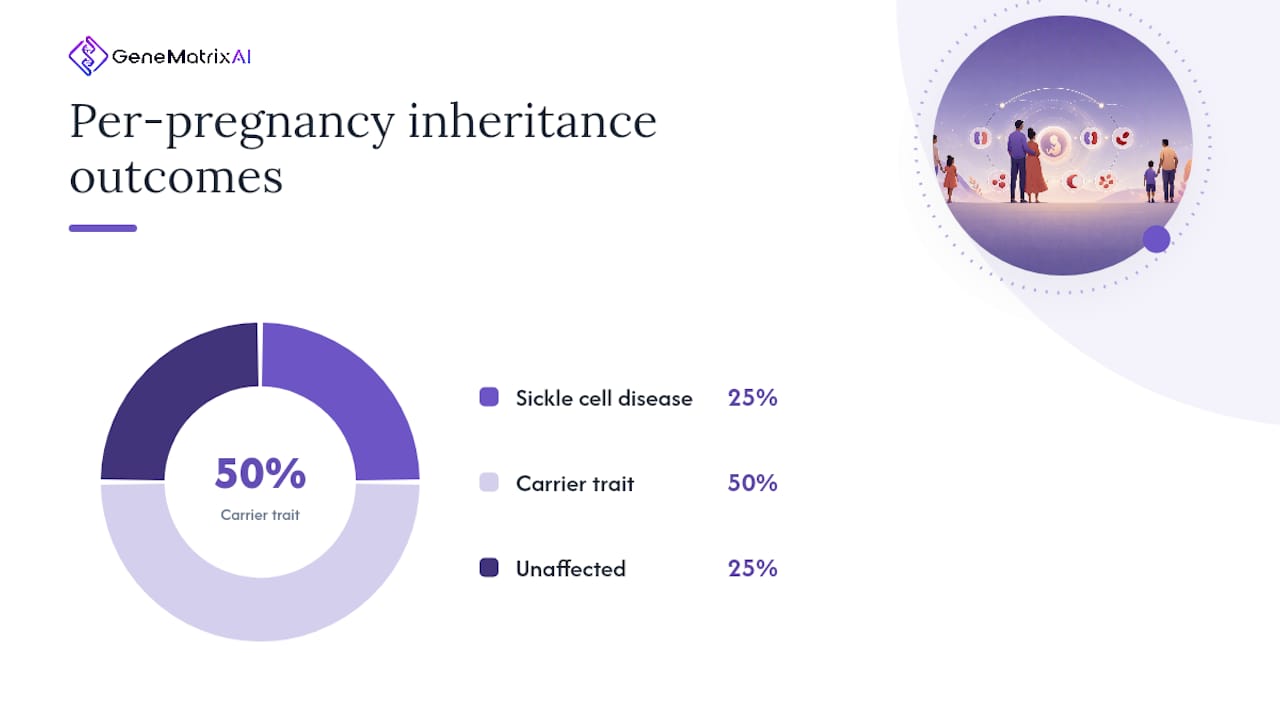
Table of Contents
- What sickle cell carrier testing checks for and why it matters
- When to get tested: preconception vs. prenatal timing
- How to interpret results and what to do next
- How tests work, their accuracy limits, and when confirmatory testing is needed
- Where and how to get tested in the U.S.
- What the preconception-first approach actually means in practice
- Genematrix: CLIA-certified genetic testing with results in 72 hours
- Sources
What sickle cell carrier testing checks for and why it matters
Carrier screening and diagnostic testing are not the same thing. A carrier screen tells you whether you carry one copy of the abnormal hemoglobin S gene. A diagnostic test tells you whether you have sickle cell disease, meaning two copies. The distinction matters enormously for family planning because carriers are almost always healthy and symptom-free.
Sickle cell trait, the clinical term for carrier status, means a person is heterozygous for hemoglobin S: one normal beta-globin gene, one mutated version. Red blood cells still function normally under most conditions. The risk isn't to the carrier's own health in typical circumstances — it's to their children if the other biological parent also carries the gene.
Why carrier status affects your children: Each copy of the sickle cell gene is inherited independently. Two carrier parents each pass one copy to every child, and which copy each parent passes is random. That's where the 25/50/25 probability split comes from.
ACOG's committee opinion recommends hemoglobin electrophoresis or HPLC (high-performance liquid chromatography) as the standard confirmatory tests for hemoglobinopathies. DNA-based genetic testing is used when electrophoresis results are ambiguous or when a specific known family variant needs confirmation. The Merck Manual's preconception guidance also recommends including family history, pedigree, and ancestry considerations when deciding which tests to order.
Pro Tip: Tell the lab upfront if you've had a blood transfusion in the past three months or if you have iron deficiency anemia. Both conditions can alter hemoglobin patterns and produce misleading results on standard screening tests.
| Test type | What it detects | When it's used |
|---|---|---|
| Hemoglobin electrophoresis | Separates hemoglobin variants by charge | Confirmatory standard; first-line in many labs |
| HPLC | Quantifies hemoglobin fractions | High-throughput labs; also confirmatory |
| DNA sequencing | Identifies specific gene mutations | Ambiguous results; known family variants |
| Newborn screening (heel stick) | Detects HbS in newborns | Newborn care only — not a substitute for preconception screening |
When to get tested: preconception vs. prenatal timing
Preconception testing is the preferred timing, and the reason isn't just clinical preference. Testing before pregnancy means that if both partners are carriers, you can consider IVF with PGD, use donor gametes, or explore adoption before a pregnancy begins. Those options require lead time — sometimes months of planning and medical preparation.

If you're already pregnant when you first learn about carrier risk, testing is still worth doing. Partner testing can happen simultaneously with maternal screening to speed up the timeline. If both partners are confirmed carriers during pregnancy, CVS (chorionic villus sampling) is available from roughly weeks 10–13, and amniocentesis from around weeks 15–20. Both can determine whether the fetus has sickle cell disease, sickle cell trait, or neither.
The practical ask: bring up carrier screening at your first preconception appointment or your first prenatal visit if you haven't tested yet. Most OB/GYNs and primary care providers can order the test directly. Turnaround from a CLIA-certified lab typically runs 1–2 weeks for standard hemoglobin testing, slightly longer for expanded DNA panels.
One point worth clarifying: newborn screening programs in all 50 states test for sickle cell disease at birth, but that's not a substitute for preconception carrier screening. Newborn screening identifies affected infants so treatment can begin early. It tells you nothing about your own carrier status before or during pregnancy.
How to interpret results and what to do next
A carrier result means you have one copy of the hemoglobin S gene. You don't have sickle cell disease. Your health is not at immediate risk from the carrier status itself. What it does mean is that your reproductive partner should be tested.
When only one partner is a carrier, the children cannot inherit sickle cell disease from that pairing (assuming the other parent has no hemoglobin S gene). They may be carriers themselves, but they won't be affected. That's a meaningful distinction.
Genetic counseling is the recommended next step, not optional. A certified genetic counselor walks through the inheritance pattern, explains what sickle cell disease means clinically, and lays out every reproductive option without pressure.
Reproductive options at that point include:
- IVF with preimplantation genetic diagnosis (PGD): Embryos are tested before transfer; only unaffected or carrier embryos are implanted.
- Prenatal diagnosis: CVS or amniocentesis during pregnancy to determine fetal status.
- Donor gametes: Using donor eggs or sperm from a non-carrier to eliminate the risk.
- Adoption or foster care: A path some couples choose after weighing all options.
- Continuing naturally: Some couples, fully informed, choose to conceive naturally and prepare for any outcome.
Immediate next steps after a dual-carrier result:
- Schedule genetic counseling — your OB/GYN can refer you, or search the National Society of Genetic Counselors directory.
- Discuss IVF/PGD timing with a reproductive endocrinologist if that's a path you want to explore.
- Ask about CVS or amniocentesis if you're already pregnant.
- Notify biological siblings and parents — they have a meaningful probability of also being carriers and deserve the chance to test.
How tests work, their accuracy limits, and when confirmatory testing is needed
Blood is the most reliable sample for hemoglobin-based testing. A standard blood draw allows both electrophoresis and HPLC, which identify and quantify hemoglobin variants. Saliva and cheek swabs work for DNA-based carrier panels, which detect the specific beta-globin gene mutations rather than the hemoglobin protein itself.
MedlinePlus notes that screening tests detect abnormal hemoglobin suggesting sickle cell trait or disease, but confirmatory electrophoresis is required to distinguish between them. Known causes of false-negative results include recent blood transfusions (donor red cells dilute the patient's own hemoglobin pattern) and iron deficiency anemia (which alters hemoglobin fractions). Newborns also have high levels of fetal hemoglobin (HbF), which can obscure HbS on some screening platforms.
Point-of-care tests — rapid, low-cost devices used in field settings — are emerging as accessible screening tools. Validation research shows variable sensitivity and specificity across these platforms, and most are not yet validated for recently transfused patients or newborns. They're useful for initial population screening but should not replace CLIA-certified lab confirmation for clinical decision-making.
| Condition | Effect on standard screening | Recommended action |
|---|---|---|
| Recent blood transfusion | False-negative HbS result | Delay testing 3+ months or use DNA testing |
| Iron deficiency anemia | Altered hemoglobin fractions | Treat anemia first or use DNA-based test |
| High fetal hemoglobin (newborns) | May mask HbS signal | Use newborn-specific protocols |
| Ambiguous electrophoresis result | Inconclusive hemoglobin pattern | Follow with DNA sequencing |
Pro Tip: If your initial screen comes back ambiguous or borderline, ask specifically for hemoglobin electrophoresis or HPLC confirmation at a CLIA-certified lab before making any reproductive decisions based on that result.
Where and how to get tested in the U.S.
Any of the following can order sickle cell carrier testing: your OB/GYN, primary care physician, family medicine doctor, or a genetics clinic. Commercial reference labs also accept clinician orders. The key trust signal to look for is CLIA certification — it means the lab meets federal standards for analytic accuracy and quality control. ACMG guidance supports expanded carrier screening panels (Tier 3) rather than ancestry-only testing, so ask whether the lab offers a panel that goes beyond a single-condition test.
Checklist for choosing a lab or provider:
- CLIA-certified laboratory with documented analytic validation
- Offers both hemoglobin-based and DNA-based testing options
- Pre-test and post-test genetic counseling available (or referral pathway in place)
- Clear result turnaround time (typically 1–2 weeks for standard tests)
- Insurance billing support or transparent self-pay pricing
At-home collection kits using saliva or cheek swabs are available through several direct-to-consumer platforms. They're convenient, but for clinical decision-making around pregnancy, clinician-collected blood samples processed at a CLIA-certified lab remain the standard. A step-by-step guide to genetic screening can help you understand what to expect from sample collection through result delivery.
After ordering, expect results within 1–2 weeks. If a carrier is detected, the provider should offer or refer for post-test genetic counseling before the next clinical step. Insurance coverage for preconception carrier screening has expanded under preventive care provisions — check with your insurer or review preventive care coverage guidance to understand what your plan covers before you order.
Genetic counseling is not just for people who test positive. Pre-test counseling helps you understand what the results will and won't tell you, so you're not making decisions in a vacuum when results arrive.
What the preconception-first approach actually means in practice
The conventional framing of sickle cell carrier testing as something you do "if you have African ancestry" is outdated and, frankly, leaves too many people unscreened. Sickle cell trait appears across populations from sub-Saharan Africa, the Mediterranean, the Middle East, South Asia, and parts of Latin America. Ancestry-based screening misses carriers who don't fit the expected demographic profile, and it puts the burden of self-identification on people who may not know their full family history.
The stronger position, backed by ACMG's expanded screening recommendations, is that anyone planning a pregnancy should have access to carrier screening regardless of ancestry. A negative family history doesn't rule out carrier status. The test is simple, the sample is a blood draw or cheek swab, and the information it returns is genuinely useful before you need it.
What gets underestimated is the cascade effect. When one person learns they're a carrier, that result is relevant to their siblings, parents, and extended biological family. Encouraging carriers to share results with relatives isn't just good practice — it's how population-level screening actually reduces disease burden over time. Genetic counseling is the right venue for that conversation, both for the individual and for the family.
Genematrix: CLIA-certified genetic testing with results in 72 hours

Genematrix is a Chicago-based, CLIA-certified genetic testing company. Its GeneMatrixAI platform uses AI analysis trained on 500,000+ genetic profiles to deliver clinician-validated reports within 72 hours. For families planning a pregnancy, the GeneBaby module covers pediatric and preconception genetic screening with clear, structured reporting designed for both patients and clinicians.
Testing through Genematrix includes access to genetic counseling support and covers a broad range of hereditary conditions beyond sickle cell. If you're ready to move from information to action, start your health intake to explore your options.
Sources
The recommendations in this guide draw from the following primary clinical sources:
- Carrier Screening for Genetic Conditions | ACOG
- Sickle cell disease — causes (NHLBI/NIH)
- American College of Medical Genetics and Genomics recommendations on carrier screening (abstract/index)
- Carrier Screening for Genetic Conditions — ACOG Committee Opinion
- Sickle cell tests — MedlinePlus
This article reflects current clinical guidance as of 2026. For personalized advice based on your specific family history and health profile, consult a board-certified genetic counselor or your OB/GYN.