

Germline testing analyzes inherited DNA variants present in every cell of your body, from a blood or saliva sample, to identify hereditary cancer risk. It is a different test for a different question than tumor genomic profiling, which sequences a tumor sample to guide active cancer treatment. About 5% to 10% of all cancers are linked to inherited pathogenic variants, which is why guideline bodies like NCCN and USPSTF recommend testing for people with a suggestive personal or family history. Genematrix offers this as a clinician-validated at-home option including comprehensive pharmacogenomic (PGx) testing to enhance personalized care.
If a positive result is even a possibility for you, here's what to do next:
- Confirm your history. Note any first- or second-degree relatives with breast, ovarian, pancreatic, or colorectal cancer, and your own diagnosis history.
- Get counseled, then tested. Talk to a genetics-qualified clinician or start with a clinician-validated at-home panel that includes counseling access.
- Plan for a positive result before you get one. Know that a pathogenic finding usually triggers cascade testing for relatives and a conversation about risk-reducing options.
Key Takeaways
Germline testing answers a hereditary risk question with inherited DNA, while tumor genomic profiling answers a treatment question with tumor-specific mutations, and choosing the right one depends entirely on whether you're assessing future risk or treating an existing cancer.
| Point | Details |
|---|---|
| Germline tests inherited risk | It reads DNA present in every cell to flag hereditary cancer risk before diagnosis. |
| Tumor profiling guides treatment | It sequences tumor tissue for somatic mutations to select therapy after diagnosis. |
| Testing is targeted, not universal | NCCN and USPSTF recommend germline testing based on personal or family history, not population screening. |
| VUS results shouldn't drive surgery | Variants of uncertain significance need reclassification over time, not immediate action. |
| Genematrix offers the germline path | Its CLIA-certified 108-gene panel delivers clinician-validated reports in about 72 hours. |
Table of Contents
- What Does Germline Testing Show, and Why Does It Matter?
- Who Should Consider Germline Testing?
- How Does the Germline Testing Process Actually Work?
- What Do Your Results Actually Mean for Your Care?
- What Should You Weigh Before Choosing a Test?
- How Do You Order a Clinician-Validated At-Home Germline Test?
- Why Do Guidelines and Lab Credentials Matter Here?
- What Does Tumor Genomic Profiling Actually Detect?
- Germline Testing and Tumor Profiling: Different Tools, Different Jobs
- What Limits Tumor Profiling's Usefulness?
- What Ethical Questions Come Up With Each Test?
- How Does Each Test Shape Treatment Decisions?
- Get a Clinician-Validated Hereditary Cancer Panel From Genematrix
- Sources
What Does Germline Testing Show, and Why Does It Matter?
Germline testing looks at DNA you inherited from your parents, the same sequence found in every cell in your body, whether it's a skin cell, a blood cell, or an egg or sperm cell. That's the entire point of the test: it doesn't matter which cells you sample, because the variant is baked into your genome from conception. This is a fundamentally different question from asking what mutations exist only inside a tumor.
A standard hereditary cancer panel screens genes like BRCA1 and BRCA2 (breast and ovarian cancer risk), the mismatch-repair genes tied to Lynch syndrome (colorectal and endometrial cancer risk), and a broader set of moderate- and high-penetrance cancer-susceptibility genes such as PALB2, ATM, and CHEK2.
Roughly 5% to 10% of all cancers trace back to an inherited pathogenic variant. That's a small slice of total cancer cases, but it's a slice where a single blood draw can change decades of medical decisions, for the patient and for their relatives.
Results generally fall into three buckets:
- Pathogenic or likely pathogenic: a variant with strong evidence linking it to elevated cancer risk, which typically changes screening or prevention plans.
- Variant of uncertain significance (VUS): a change in the gene that hasn't been proven harmful or harmless yet.
- Negative: no pathogenic variant found on the panel tested, which lowers but doesn't eliminate risk if family history remains strong.
Who Should Consider Germline Testing?
Guideline groups don't recommend testing everyone. NCCN's patient guidelines and USPSTF's BRCA-related risk assessment recommendation both point to targeted testing based on personal and family history rather than testing the general population, because benefit concentrates heavily in people with a suggestive background.
You're a stronger candidate for testing if any of these apply:
- You've been diagnosed with epithelial ovarian cancer, pancreatic cancer, or certain early-onset or triple-negative breast cancers, since these diagnoses meet testing criteria on their own.
- Your family tree includes multiple relatives with breast, ovarian, pancreatic, or colorectal cancer, especially at younger ages.
- You have Ashkenazi Jewish ancestry, which carries a higher baseline rate of specific BRCA1/2 founder variants.
- A relative already tested positive for a specific pathogenic variant, which makes your own testing a matter of confirming or ruling out that exact change.
That last scenario is called cascade testing, and it's arguably the highest-value use of germline testing in public health terms. When a family's pathogenic variant is already known, testing relatives is fast, targeted, and dramatically more efficient than testing at the population level. If you're mapping your own risk profile before deciding whether to test, our guide on recognizing hereditary cancer patterns early walks through what a suggestive history actually looks like.
How Does the Germline Testing Process Actually Work?
The mechanics are simpler than most people expect. A clinician-validated at-home test usually starts with a saliva swab or a small blood draw, no phlebotomy visit required for most panels, and moves through a defined pipeline before a report reaches you.
- Order the panel and complete pre-test counseling, ideally with a genetics-qualified professional who reviews your personal and family history before you spit in a tube.
- Provide your sample (saliva or blood, depending on the kit) and ship it to a CLIA-certified laboratory.
- The lab runs next-generation sequencing (NGS) across the panel's genes, paired with deletion/duplication analysis to catch structural changes that NGS alone can miss.
- A certified reviewer classifies each variant and finalizes a clinician-validated report.
- You receive post-test counseling to walk through what pathogenic, VUS, or negative results actually mean for your care.
NGS multigene panels have made broad testing more affordable than the single-gene sequencing that was standard a decade ago, which is a big part of why panels covering dozens or over a hundred genes are now routine rather than exceptional. Turnaround for most clinician-validated at-home panels runs in the range of a few days to two weeks, depending on panel size and lab volume.
Pro Tip: A VUS result isn't permanent. Labs periodically reclassify variants as more population data comes in, so ask your provider whether your report includes a plan for re-review, not just a one-time snapshot.
What Do Your Results Actually Mean for Your Care?
A pathogenic or likely pathogenic result should trigger a real conversation, not a panic response. Depending on the gene and your personal history, guideline-based management can include intensified imaging surveillance, prophylactic surgery such as risk-reducing mastectomy or salpingo-oophorectomy, or chemoprevention. For a BRCA1 carrier with a strong family history of ovarian cancer, that might mean earlier and more frequent screening starting years before it would otherwise begin, plus a conversation about surgical risk reduction once childbearing is complete. It should also start a family conversation, since a first-degree relative has about an even chance of carrying the same variant.
A VUS result is where people get tripped up. It is not a yes, and it is not a no. Current guidance is explicit that a VUS should generally not drive a decision to pursue prophylactic surgery or change screening intensity on its own, because the variant simply hasn't accumulated enough evidence yet to classify either way.
A negative result matters too, but context decides how much. If your family history remains strong despite a negative panel, your clinician may still recommend enhanced surveillance, because a negative result rules out the genes tested, not every possible hereditary factor.
- Pathogenic: intensified screening, possible surgery, cascade testing for relatives.
- VUS: monitor for reclassification, don't change management yet.
- Negative with strong family history: consider surveillance based on history, not just the lab result.
What Should You Weigh Before Choosing a Test?
Cost and coverage vary by plan and by indication. Many guideline-qualifying tests are billable through insurance, but coverage depends heavily on whether your specific history meets the payer's criteria, so it's worth confirming eligibility before you order.
Privacy matters as much as price. Ask how a lab stores your data, whether it's shared with third parties, and whether your report stays tied to your name or gets de-identified for research use.
Lab quality is where clinician-validated matters most. Look for these signals before you commit to any provider:
- CLIA certification, the baseline federal standard for clinical laboratory testing in the United States.
- Clinician-validated reporting, meaning a qualified professional reviews the AI or algorithmic output before it reaches you.
- Variant classification using ACMG criteria, the standard interpretive framework labs use to call a variant pathogenic, VUS, or benign.
- Genetic counseling access, before testing and after your results arrive.
- Turnaround time, since a report that takes months undercuts its own clinical usefulness.
Our breakdown of genetic screening's real tradeoffs covers the false-positive and VUS-rate issues that come with broader panels in more depth.
How Do You Order a Clinician-Validated At-Home Germline Test?
The path is straightforward whether you're a patient self-referring or a clinician ordering for a patient.
- Gather personal and family cancer history, including ages at diagnosis and specific cancer types.
- Consult a clinician or genetic counselor, or start directly with a clinician-validated at-home panel that includes counseling access.
- Choose a CLIA-certified provider with a panel size that matches your risk profile.
- Provide a saliva or blood sample per the kit instructions.
- Receive your clinician-validated report along with post-test counseling.
- Plan follow-up: if a variant is pathogenic, discuss cascade testing for relatives and risk-adapted care.
Before you commit to a provider, confirm:
- Lab certification (CLIA) and how variants are classified.
- Realistic turnaround time for your specific panel.
- Whether counseling is included or an added cost.
- Panel breadth, and whether it covers the genes relevant to your family history.
A positive result usually opens a referral pathway to a genetics specialist or high-risk clinic, plus a plan for testing relatives who carry roughly even odds of the same variant. Our step-by-step walkthrough of a hereditary cancer screening test covers what happens between sample collection and report delivery in more detail.
Why Do Guidelines and Lab Credentials Matter Here?
Guideline bodies exist because testing indiscriminately wastes counseling capacity and generates VUS results nobody can act on. NCCN, ASCO, and USPSTF converge on targeted testing tied to personal and family history, which keeps results actionable rather than noisy.
- CLIA certification and ACMG-based variant classification are the baseline for trusting any report.
- Genetic counseling before and after testing turns a lab result into a usable care decision.
Genematrix runs its panels through CLIA-certified labs, applies clinician validation before a report ships, and uses its GeneMatrixAI platform, trained on over 500,000 genetic profiles, to return results in around 72 hours.
What Does Tumor Genomic Profiling Actually Detect?
Tumor genomic profiling is a different test answering a different question, and it's worth understanding the distinction clearly rather than assuming the two are interchangeable. Where germline testing reads the DNA you were born with, tumor profiling sequences a biopsy or resection sample from the tumor itself, looking for somatic mutations, genetic changes that arose only in the cancer cells, not in the rest of your body.

These somatic mutations aren't inherited and aren't present in your normal skin, blood, or saliva. They accumulate over a person's lifetime, sometimes from environmental exposure, sometimes from replication errors, and they're often unique to that specific tumor. A lung tumor might carry an EGFR mutation driving its growth, while a neighboring healthy lung cell carries no such change at all.
Because tumor profiling is built to characterize an existing cancer rather than assess future risk, it's ordered after a diagnosis, typically to guide active treatment decisions like which targeted therapy or immunotherapy might work against that specific tumor's mutational profile. It has no role in assessing whether a currently healthy person carries elevated hereditary cancer risk, which is exactly the question germline testing answers. This article focuses on germline testing as the tool for that risk question, since it's the test relevant to prevention planning and family risk assessment rather than active tumor treatment selection.
Germline Testing and Tumor Profiling: Different Tools, Different Jobs
The cleanest way to separate these two tests is by the question each one answers. Germline testing asks: "What did I inherit, and what does that mean for my future risk and my family's risk?" Tumor profiling asks: "What's driving this specific tumor, and what treatment might target it?"
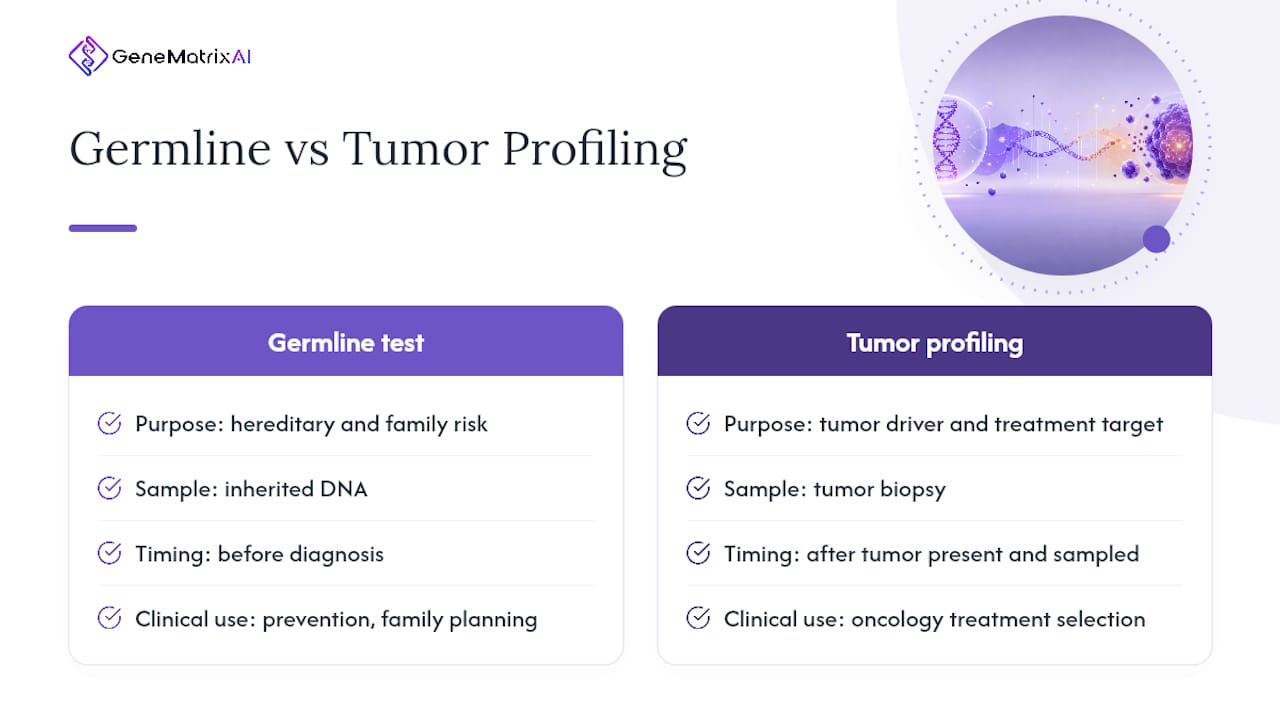
That distinction drives everything downstream. Germline results matter before a diagnosis exists, during prevention planning, and they matter to relatives who share your DNA. Tumor profiling results only exist after a tumor is present and sampled, and they're specific to that tumor, not transferable to a sibling or a child.
The clinical teams involved differ too. Germline testing typically involves genetic counselors and primary care or high-risk clinic referrals. Tumor profiling usually sits inside oncology treatment planning, often ordered by a medical oncologist deciding between chemotherapy regimens or targeted agents.
Cost structures and timing diverge as well. Germline testing is a one-time assessment, repeated only if panel technology advances significantly. Tumor profiling may be repeated over the course of treatment, since a tumor's mutational profile can shift under treatment pressure, a phenomenon oncologists call clonal evolution.
For the audience considering hereditary risk assessment or family planning, that means germline testing is almost always the relevant starting point. It's the test that tells you something actionable before cancer develops, not after. If your interest is in understanding your own or your family's inherited risk rather than managing an existing tumor, germline-focused testing is the appropriate tool, not tumor profiling.
What Limits Tumor Profiling's Usefulness?
Tumor profiling carries real technical constraints worth naming plainly, since they explain why it isn't a substitute for hereditary risk testing. The most significant is tumor heterogeneity: different regions of the same tumor can carry different mutations, meaning a single biopsy sample might not represent the tumor's full genetic makeup. A mutation found in one part of a tumor may be entirely absent in another, which can lead to an incomplete picture if only one region gets sampled.
Variant interpretation adds another layer of difficulty. Somatic mutations found in a tumor sample require classification just like germline variants do, sorting a real driver mutation from background noise that has no bearing on treatment. Tumors accumulate mutations constantly as they grow, and most of those changes are passengers along for the ride, not the mutations actually driving the cancer's behavior. Distinguishing a clinically actionable mutation from irrelevant genetic noise takes considerable expertise and still leaves room for disagreement between labs.
Sample quality is a practical constraint too. A biopsy that's too small, too degraded, or taken from necrotic tissue can produce unreliable sequencing data, sometimes forcing a repeat procedure. And because tumors evolve under treatment pressure, a profile taken at diagnosis may no longer reflect the tumor's genetic makeup months later, after chemotherapy or targeted therapy has selected for resistant subclones.
None of these limitations apply to germline testing in the same way, since your inherited DNA doesn't shift from one biopsy site to another or evolve under treatment. That stability is part of why germline results, once classified, tend to hold up over time in a way a single tumor sample doesn't.
What Ethical Questions Come Up With Each Test?
Germline testing raises questions tumor profiling simply doesn't, because germline results implicate people who never consented to testing at all. A pathogenic finding in you is, statistically, a finding about your children and siblings too, at roughly even odds for each first-degree relative. That creates real tension: do you have an obligation to share results with relatives who may not want to know, or who may face insurance or psychological consequences from finding out?
Genetic discrimination concerns also run deeper with germline results, since they describe permanent, inherited traits rather than an acquired tumor characteristic. Federal protections exist, but coverage gaps remain around life, disability, and long-term care insurance, which is a real consideration before testing, not an afterthought.
Tumor profiling carries a narrower ethical footprint by comparison. Its findings apply to one patient's existing cancer, not to relatives, and rarely trigger the same cascade of family disclosure decisions. The more common ethical tension there involves incidental findings, occasionally a tumor sequencing panel turns up a mutation pattern suggestive of an underlying germline condition, which then raises the question of whether and how to refer that patient for germline evaluation.
Consent processes reflect these differences. Pre-test genetic counseling for germline testing routinely covers family disclosure, insurance implications, and psychological preparation for a positive result, precisely because the stakes extend beyond the person being tested.
How Does Each Test Shape Treatment Decisions?
Germline results shape preventive and risk-management decisions: whether to intensify screening, consider prophylactic surgery, or test relatives before anyone else in the family gets sick. A pathogenic BRCA1 finding changes a person's entire prevention timeline, often years before any cancer diagnosis occurs.
Germline status can occasionally influence active treatment too, certain targeted therapies are approved specifically for patients with pathogenic variants in genes like BRCA1/2, but that application sits at the intersection of hereditary risk and treatment selection, rather than being germline testing's primary purpose.
Tumor profiling exists specifically to select treatment for an existing cancer. Its results point an oncologist toward a specific targeted therapy or immunotherapy matched to that tumor's mutational drivers, decisions made after diagnosis, focused on the tumor in front of them right now.
For the reader planning ahead of a diagnosis, or mapping inherited risk for themselves and their family, germline testing is the tool that fits that goal. It answers the question of what to watch for and when to act, well before treatment selection becomes relevant at all.
A Clinician's and a Patient's View
Clinicians order clinician-validated at-home panels to save counseling time on straightforward cases. One patient's negative BRCA result, paired with strong family history, still led her doctor to keep annual MRI screening in place.
Get a Clinician-Validated Hereditary Cancer Panel From Genematrix
Genematrix built its hereditary cancer screening specifically for the workflow this article just walked through: at-home sample collection, a 108-gene panel run through a CLIA-certified lab, and a clinician-validated report instead of a raw data dump you have to interpret yourself.

The panel screens BRCA1/2, the Lynch syndrome genes, and over a hundred other cancer-susceptibility genes in one sample, with genetic counseling available before and after you get results. Behind the report sits the GeneMatrixAI platform, trained on more than 500,000 genetic profiles, which helps return results in roughly 72 hours instead of the multi-week wait common with traditional lab pathways. Genematrix's leadership pairs clinical genetics expertise with the technology side, a combination reflected in how the lab's science and certifications are documented for anyone who wants to check credentials before ordering. If a family history conversation has been sitting on your to-do list, order the hereditary cancer screening panel and get a clinician-reviewed answer within days, not months.
Sources
- Genetic Testing Fact Sheet - National Cancer Institute (NCI)
- NCCN Guidelines for Patients: Genetic Testing for Hereditary Breast, Ovarian, Pancreatic, and Prostate Cancers
- Emerging Opportunity of Cascade Genetic Testing for Population-Wide Cancer Prevention and Control (ASCO/JCO)
This article is general information, not a substitute for advice from a qualified doctor. Consult a qualified healthcare professional about your own circumstances before acting on anything here.