

TL;DR:
- CLIA certification requires laboratories testing human specimens for clinical purposes to meet federal quality standards set by CMS.
- Genomic tests are almost always high-complexity, demanding strict oversight due to multi-step workflows and bioinformatics interpretation.
- Verifying a lab's CLIA status ensures testing quality, with Genematrix exemplifying a compliant facility delivering validated, timely reports.
CLIA certification is the U.S. federal quality program that requires every facility testing human specimens for clinical purposes to meet standards administered by the Centers for Medicare & Medicaid Services (CMS), in partnership with the CDC and FDA. If a genomic test result is going to influence a diagnosis or treatment decision, the lab that produced it must hold a valid CLIA certificate. That is not a technicality. It is the legal and scientific floor beneath every credible lab result in the country.
The Clinical Laboratory Improvement Amendments of 1988 established this framework specifically to ensure accuracy, reliability, and timeliness regardless of where or by whom testing is performed. For genomic testing, where a single result can guide cancer screening, medication choices, or family planning, that floor matters enormously. Genematrix (Gene Matrix LLC) is a Chicago-based, CLIA-certified biotechnology company whose operations are built around exactly these standards.
Table of Contents
- What is CLIA certification, and which agencies run the program?
- Which facilities need a CLIA certificate?
- Why are genomic tests almost always high-complexity?
- What certificate types exist, and what do they require?
- What does CLIA certification mean for you as a patient or clinician?
- How to verify a lab's CLIA certification
- How labs apply for CLIA certification: steps, timeline, and costs
- How a CLIA-certified genomic lab operates: Genematrix as an example
- Key Takeaways
- Genematrix offers CLIA-certified genomic testing with clinical-grade reporting
- Official sources and further reading
What is CLIA certification, and which agencies run the program?
Three federal agencies share responsibility for CLIA, each with a distinct role.
- CMS is the program administrator. It issues CLIA certificates, sets the fee schedule, coordinates State Agency surveys, and maintains the official application (Form CMS-116). If a lab's certificate is suspended or revoked, CMS is the authority behind that action.
- CDC provides technical support, laboratory guidance, and public health resources that help labs implement CLIA requirements in practice.
- FDA categorizes test systems by complexity (waived, moderate, or high), which directly determines the level of CLIA oversight a lab must meet.
Understanding this split matters when you are evaluating a lab. CMS enforces. CDC supports. FDA classifies. All three shape what a CLIA-certified lab must do before it hands you a result.
Which facilities need a CLIA certificate?
The rule is broader than most people expect. Under CLIA, performing even one test on a human specimen for health assessment makes a facility a laboratory that must apply for certification. The physical setup is irrelevant. A physician's office running a single glucose test qualifies. A mobile clinic collecting blood qualifies. A hospital's satellite draw station that processes specimens on-site qualifies.
There are narrow exceptions:
- Laboratories performing testing only for forensic purposes
- Research labs that test human specimens but do not report patient-specific results for clinical decisions
- SAMHSA-certified labs performing employment drug testing (though all other testing they perform still requires CLIA)
- Laboratories in New York or Washington state, which operate under HHS-approved state programs (contact the relevant State Agency to confirm)
Collection-only sites that ship all specimens to a certified reference lab generally do not need their own certificate. But the moment any analysis happens on-site, the certification requirement kicks in.
Pro Tip: Check both CLIA requirements and your state's laboratory licensing rules. State licensing requirements can add personnel, facility, or reporting obligations that go beyond federal CLIA standards.

Why are genomic tests almost always high-complexity?
FDA's three complexity categories carry very different regulatory weight.
- Waived tests are simple, low-risk assays (think basic dipstick urinalysis). Minimal personnel and QA requirements apply.
- Moderate-complexity tests require more rigorous quality controls, defined personnel qualifications, and participation in proficiency testing (PT) programs.
- High-complexity tests carry the strictest requirements: doctoral-level or equivalent lab directors, comprehensive quality systems, mandatory PT, and regular on-site surveys.
Genomic assays almost always land in the high-complexity category. Multi-step wet-lab workflows, bioinformatics pipelines, variant interpretation, and clinical reporting all introduce points where errors can compound. FDA's classification framework reflects that reality. The more steps between a specimen and a result, the more oversight the system demands.
For a clinical genomics provider, this means that ordering from a CLIA-certified lab with a Certificate of Compliance or Accreditation is the practical guarantee that the result was produced under validated, inspected conditions.
What certificate types exist, and what do they require?
There are five CLIA certificate types, and every certificate is valid for a fixed term.
| Certificate | Abbreviation | When it applies |
|---|---|---|
| Certificate of Waiver | CoW | Lab performs only waived tests |
| Certificate for Provider-Performed Microscopy | PPM | Clinician performs microscopy during patient visit |
| Certificate of Registration | CoR | Temporary; allows non-waived testing while awaiting initial survey |
| Certificate of Compliance | CoC | Non-waived testing; issued after CMS/State Agency survey confirms compliance |
| Certificate of Accreditation | CoA | Non-waived testing; based on accreditation by a CMS-approved organization |
Labs performing non-waived tests must undergo on-site surveys and participate in approved PT programs. Failure to comply can result in sanctions up to certificate suspension or revocation. Labs pursuing a CoA can work through one of seven CMS-approved Accreditation Organizations, including the College of American Pathologists (CAP) and The Joint Commission.
Core quality requirements for non-waived labs include documented proficiency testing, qualified personnel at every level (from lab director to testing personnel), written quality control and quality assurance programs, and complete recordkeeping. These are not bureaucratic checkboxes. They are the mechanisms that catch errors before a result reaches a clinician. U.S. lab standards built around this framework consistently reduce diagnostic error rates across test categories.
What does CLIA certification mean for you as a patient or clinician?
CLIA certification tells you three things about a lab: its personnel met federal qualification standards, its methods were validated and are monitored through PT, and it is subject to inspection. That is the analytic foundation a clinical result needs to be trusted.
One distinction worth knowing: CLIA and FDA approval are not the same thing. CLIA governs lab processes. FDA regulates test systems and medical devices. A test can be FDA-cleared and still be run in a non-CLIA-certified lab (which would be illegal for clinical use), or a lab can develop its own test (a laboratory-developed test, or LDT) that is not FDA-cleared but is still subject to CLIA oversight. For clinical genomics, both dimensions matter.
Questions to ask before ordering a genomic test:
- What is the lab's CLIA identification number?
- What certificate type does the lab hold (CoC or CoA for high-complexity)?
- Which PT program does the lab participate in, and what are its recent performance records?
- What are the lab director's qualifications?
- What is the turnaround time, and how are results delivered?
- Is genetic counseling available with the report?
Red flags to watch for:
- No CLIA number provided, or the number does not appear in the CMS database
- No documented PT participation for the specific test type
- Ambiguous or unvalidated reporting language (e.g., "suggestive of" without defined variant classification criteria)
- No named lab director or unclear personnel qualifications
How to verify a lab's CLIA certification
The CMS CLIA certificate lookup is the authoritative tool. Here is how to use it:
- Go to the CMS CLIA certificate search (accessible from the CMS CLIA program page).
- Search by lab name, city, state, or CLIA identification number.
- Confirm the certificate type (CoC or CoA for high-complexity genomic testing).
- Check the certificate expiration date — all certificates run on two-year cycles.
- Contact the relevant State Agency to confirm any additional state licensing requirements.
For clinicians ordering genomic panels, go further: request the lab's method validation documentation, analytic sensitivity and specificity data, and variant interpretation criteria. Ask whether the lab offers access to genetic counseling. A DNA lab for healthcare providers operating at clinical grade should be able to provide all of this without hesitation.
How labs apply for CLIA certification: steps, timeline, and costs
The application process follows a defined path, though timelines vary.
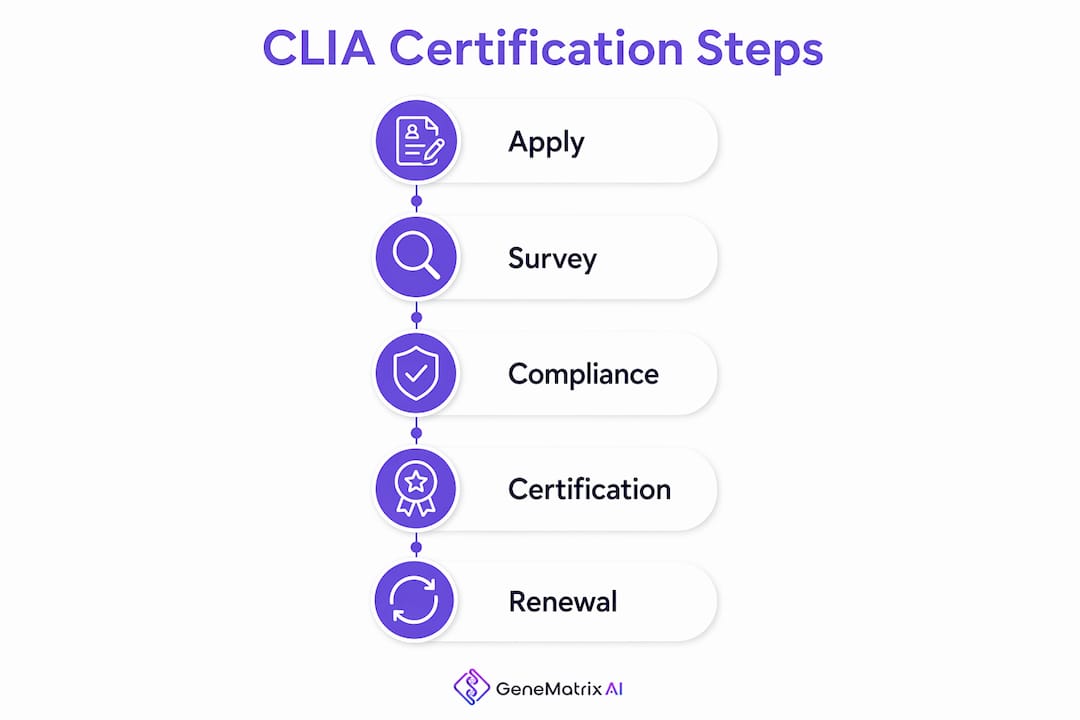
- Complete Form CMS-116. This is the official CLIA application. Download it from CMS, fill it out digitally, and save a copy. Use a general business email address that multiple staff members can access. A P.O. box is not acceptable as the physical facility address.
- Submit to your State Agency. Send the completed application and supporting documents to the State Agency in the state where the lab is physically located.
- Receive your fee coupon and pay online. CMS issues a unique ten-character CLIA identification number with the fee coupon. Pay through pay.gov (bank account, debit, or credit card — paper checks are no longer accepted).
- Receive your certificate and begin testing. Certificates arrive by email. Labs applying for a CoC or CoA first receive a temporary Certificate of Registration (CoR), which permits non-waived testing while the initial survey is scheduled.
- Maintain certification. Fees are due every two years. Labs should use a quick-start guide to confirm they have selected the correct certificate type based on the highest complexity test they perform.
Common delays: incomplete credential verification for lab directors (especially foreign degrees requiring equivalency evaluation) and errors on the CMS-116 that cause the application to be returned. Budget extra time if the lab director's credentials require evaluation. Cost considerations include the two-year CLIA certification fee (which varies by testing volume and complexity), accreditation fees if using a CMS-approved AO, and ongoing PT program enrollment costs.
How a CLIA-certified genomic lab operates: Genematrix as an example
Genematrix (Gene Matrix LLC) is a Chicago-based, CLIA-certified biotechnology company offering hereditary cancer screening, pharmacogenomics, and precision medicine services. Its operations illustrate how CLIA requirements translate into day-to-day lab practice.
- Documented method validation for every assay, including BRCA1/BRCA2 panels and Lynch syndrome testing
- PT participation for all high-complexity test categories
- Qualified lab director meeting federal education and experience standards
- CLIA certificate displayed and verifiable through the CMS database
- Clinician-facing reports with variant interpretation, clinical context, and genetic counseling pathways
- 72-hour turnaround from specimen receipt to report delivery
When a patient orders a BRCA panel through Genematrix, the specimen moves through validated extraction and sequencing workflows under documented QA controls. The result is interpreted by qualified personnel using defined variant classification criteria, then returned with a clinician-facing report and access to genetic counseling. That sequence is what CLIA compliance looks like in practice, not as a certificate on a wall, but as a process that runs every time a test is ordered. The AI-driven analysis platform behind Genematrix's reporting is trained on over 500,000 genetic profiles, adding a layer of pattern recognition that supports, rather than replaces, the validated clinical workflow.
Key Takeaways
CLIA certification is the federal quality standard that makes a genomic test result clinically usable — without it, no U.S. lab can legally report patient-specific results for diagnosis or treatment.
| Point | Details |
|---|---|
| CLIA definition | U.S. federal program requiring labs testing human specimens to meet CMS-administered quality standards. |
| Three-agency governance | CMS administers, CDC supports, FDA classifies test complexity — all three shape what a certified lab must do. |
| Genomic tests are high-complexity | Multi-step workflows and bioinformatics interpretation place genomic assays in the strictest CLIA oversight tier. |
| Verification steps | Use the CMS CLIA certificate lookup to confirm certificate type, expiration, and state licensing status. |
| Genematrix | A CLIA-certified genomic lab delivering validated hereditary cancer, pharmacogenomics, and precision medicine reports within 72 hours. |
Why CLIA compliance is the baseline, not the benchmark
Most conversations about genomic testing quality focus on technology: sequencing depth, variant databases, AI interpretation. Those matter. But none of them substitute for the foundational question of whether the lab producing the result is operating under a validated, inspected, federally certified quality system.
CLIA compliance is not a differentiator in the marketing sense. It is the legal and scientific minimum for clinical use. What separates a genuinely strong genomic lab from one that merely holds a certificate is how seriously it treats the underlying requirements: the rigor of method validation, the consistency of PT performance, the qualifications of the personnel interpreting variants, and the clarity of the report a clinician actually receives. A lab that treats CLIA as a checkbox will pass inspections and still produce results that mislead. A lab that treats it as an operational standard builds every workflow around it.
For patients and clinicians evaluating genomic testing options, the CLIA certificate is the starting point, not the ending point. Verify it. Then ask the harder questions about what happens between specimen receipt and report delivery.
Genematrix offers CLIA-certified genomic testing with clinical-grade reporting
If you have read this far, you already know what to look for in a genomic testing provider. Genematrix delivers exactly that: CLIA-certified hereditary cancer screening, pharmacogenomics, and precision medicine testing, with clinician-validated reports returned within 72 hours. Every test runs under documented QA controls, with a qualified lab director and genetic counseling pathways built into the process.

Clinicians can access the provider portal to request a portal invite, review available panels, and set up ordering workflows. Patients ready to order can go directly to the hereditary cancer testing intake page to start the process. For a full overview of Genematrix's laboratory certifications and scientific methods, visit our science page. The lab is verified in the CMS CLIA database — check it before you order, and you will find exactly what you should expect.
Official sources and further reading
The resources below are primary documentation for CLIA rules, forms, and verification tools.
- CMS CLIA Program Overview — program authority, certificate lookup, and fee schedule
- Form CMS-116 — official CLIA application form
- CMS CLIA Certification Guide (PDF) — certificate types, application steps, and fee overview
- CDC CLIA Program Overview — technical background and public health context
- FDA CLIA Role and Test Categorization — how FDA classifies test complexity
- CMS MLN CLIA and Medicare Lab Services (PDF) — inspection, PT, and compliance requirements
- Utah CLIA Quick Start Guide (PDF) — practical worksheet for completing CMS-116 correctly
- Lab quality control practices — general QA principles aligned with CLIA expectations
For state-specific licensing requirements, contact your State Agency directly. Laboratories located in New York or Washington state should confirm whether the state program satisfies federal CLIA obligations before submitting a CMS-116. International laboratories sending specimens to U.S. facilities should contact CMS for guidance on applicable certification requirements.
This article provides general information about the CLIA program and is not legal or regulatory advice. Confirm current requirements with CMS, your State Agency, or a qualified regulatory professional for your specific situation.