

Knowing your cancer risk is one of the most concrete steps you can take toward protecting your health. The American Cancer Society and the National Cancer Institute both frame this knowledge as the foundation for shifting healthcare from reactive treatment to proactive prevention. Here is what that means in practice:
- Inherited genetic mutations account for 5%–10% of all cancers, meaning most risk is shaped by factors you can actually influence.
- Understanding your personal risk profile unlocks access to tailored screening schedules, earlier interventions, and preventive options unavailable to the general population.
- Family history, lifestyle choices, and environmental exposures all feed into a risk picture that is specific to you, not a statistical average.
- Authoritative bodies like the ACS and NCI consistently validate that early detection through personalized screening significantly reduces cancer mortality.
The benefits of knowing your cancer risk go beyond your own health. When you understand your genetic profile, you give your family the chance to act too.
Table of Contents
- What factors actually shape your cancer risk?
- How your family history reveals inherited cancer risk
- How knowing your risk guides prevention and early detection
- Genematrix brings hereditary cancer screening within reach
- Key Takeaways
What factors actually shape your cancer risk?
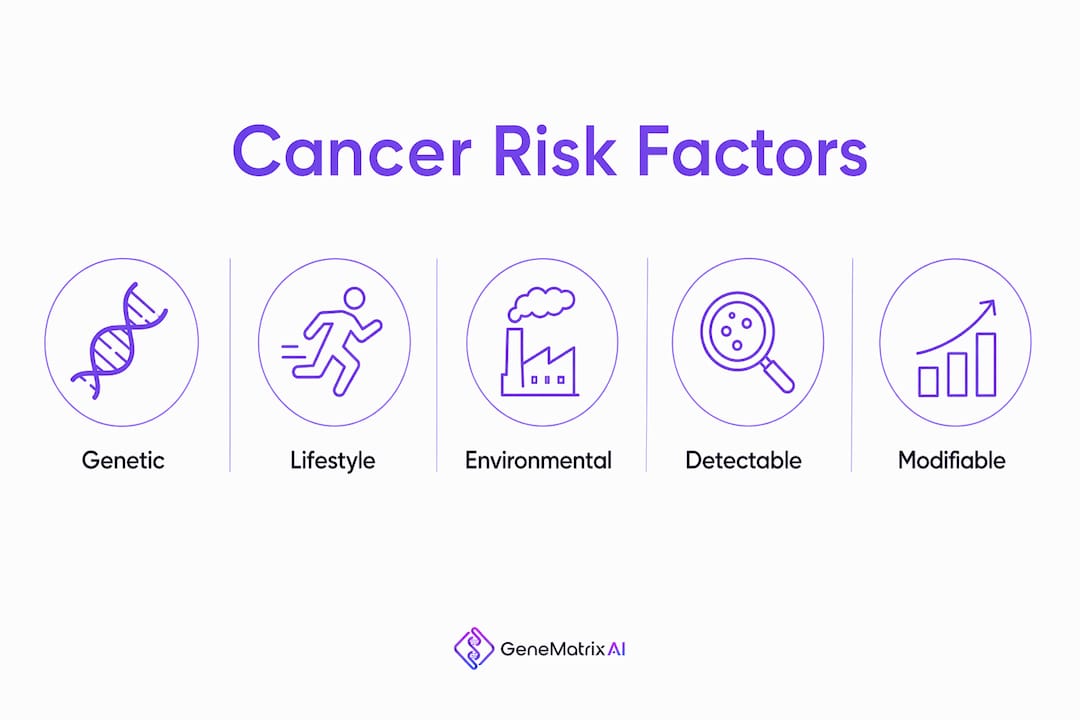
Cancer risk is not a single number. It is the product of several overlapping forces, some fixed and some changeable.
Genetic factors sit at the top of the list for high-risk individuals. Mutations in genes like BRCA1, BRCA2, and the Lynch syndrome genes (MLH1, MSH2, MSH6, PMS2) dramatically raise the likelihood of specific cancers. These are inherited changes, passed down through families, and they are detectable through hereditary cancer testing.
Lifestyle factors carry significant weight for the broader population. According to NCI's risk factor overview, tobacco use, physical inactivity, poor diet, excess alcohol, and obesity are among the most studied and most modifiable contributors to cancer risk. Eliminating tobacco alone addresses one of the single largest preventable causes of cancer death in the United States.
Environmental exposures add another layer. Prolonged contact with carcinogens such as asbestos, radon, UV radiation, and certain industrial chemicals raises risk for lung, skin, and other cancers. These exposures often interact with genetic predispositions, compounding the effect.
- Age is a non-modifiable risk factor; cancer incidence rises steadily with advancing age.
- Hormonal factors, prior radiation therapy, and certain chronic infections (HPV, hepatitis B and C) also increase risk for specific cancer types.
- Most risk factors are initially identified through large epidemiological studies comparing people who develop cancer with those who do not.
The key takeaway: most cancer risk factors are either modifiable or detectable. That is precisely why understanding cancer risk matters so much.
How your family history reveals inherited cancer risk
Your family's cancer history is one of the strongest predictors of your own risk. A first-degree relative (parent, sibling, or child) diagnosed with ovarian cancer, for example, carries an odds ratio of 3.1 for the same diagnosis in you. That is not a small signal.

Clinicians use what is called the "3-generation rule," documenting cancer type, age at diagnosis, and lineage across three generations to distinguish true hereditary syndromes from coincidental clustering. According to the NCI Genetic Testing Fact Sheet, shared environments and behaviors like smoking can create family cancer patterns that look hereditary but are not. Accurate documentation separates the two.
Two hereditary syndromes stand out for their prevalence and clinical impact:
- Hereditary Breast and Ovarian Cancer (HBOC) syndrome raises risk for breast, ovarian, advanced prostate, and pancreatic cancers, primarily through BRCA1 and BRCA2 mutations.
- Lynch syndrome elevates risk for colorectal, uterine, and ovarian cancers through mutations in mismatch repair genes.
One important caveat: a negative genetic test is not always reassuring. The American Cancer Society notes that when a family history strongly suggests a hereditary syndrome but no mutation is detected, clinical management should still account for that history. The absence of a known mutation does not erase inherited risk. Genetic counselors help navigate exactly this kind of uncertainty, and inherited cancer syndromes are best understood as family conditions, not individual diagnoses.
How knowing your risk guides prevention and early detection
This is where understanding cancer risk translates into concrete action. High-risk individuals gain access to surveillance protocols that the general population simply does not qualify for.
For Lynch syndrome, a positive genetic test triggers earlier and more frequent colonoscopies, catching colorectal cancers sooner when they are most treatable. The same logic applies across cancer types: risk knowledge determines the when and how often of screening, not just the whether.
Early-stage breast, cervical, and colorectal cancers carry a 5-year survival rate of 84%–93%, compared to far lower rates when caught at advanced stages.
Prevention options extend well beyond screening schedules. Depending on your risk profile, a clinician might recommend:
- Lifestyle modifications: weight management, reduced alcohol intake, increased physical activity, and dietary changes supported by preventive care strategies.
- Chemoprevention: medications like tamoxifen or raloxifene for high-risk breast cancer candidates.
- Risk-reducing surgery: prophylactic mastectomy or salpingo-oophorectomy for BRCA1/BRCA2 carriers in appropriate clinical contexts.
Genetic counseling is the bridge between a test result and a management plan. According to the PDQ Cancer Genetics Editorial Board, counseling is an interactive process that addresses not just the clinical data but also the emotional and familial implications of probabilistic results. Results are not destiny. They are a starting point for informed decisions.
Sharing your risk information with family members matters too. When an inherited mutation is identified, relatives can pursue targeted cascade testing. That single conversation can set off a chain of early detections across an entire family.

Genematrix brings hereditary cancer screening within reach
Most people who would benefit from hereditary cancer screening never get it, not because they do not want it, but because the path to testing feels unclear. Genematrix changes that.

Genematrix is a Chicago-based, CLIA-certified biotechnology company that delivers AI-powered hereditary cancer screening through its GeneMatrixAI platform, trained on 500,000+ genetic profiles. Results arrive within 72 hours, covering BRCA1/BRCA2, Lynch syndrome genes, and a broad panel of hereditary cancer markers. The platform goes beyond a single test: GeneCancer, GenePGx, GeneMind, and GeneDiet modules give you a complete picture of how your genetics affect cancer risk, medication response, and overall wellness.
For anyone who has read this far and is thinking about their own family history, the next step is straightforward. Download the GeneMatrixAI app to start your hereditary cancer risk assessment today.
Key Takeaways
Knowing your cancer risk enables personalized screening, earlier detection, and preventive action that can significantly reduce cancer mortality for you and your family.
| Point | Details |
|---|---|
| Inherited risk is a minority | Only 5%–10% of cancers are hereditary, but those cases carry the highest individual risk and the clearest path to intervention. |
| Family history is a clinical tool | The 3-generation rule helps clinicians distinguish true hereditary syndromes from coincidental cancer clustering in families. |
| Early detection saves lives | Early-stage breast, cervical, and colorectal cancers have a 5-year survival rate of 84%–93%, making timely screening critical. |
| Negative tests need context | A negative genetic result can be uninformative when family history strongly suggests a hereditary syndrome; clinical management must continue. |
| Genematrix for hereditary screening | Genematrix delivers AI-powered hereditary cancer screening with results in 72 hours, covering BRCA1/BRCA2, Lynch syndrome, and more. |